


Cocoa and Chocolate Market Overview
As per Data Bridge Market Research analysis The Cocoa and Chocolate Market was valued at USD 92.85 billion in 2025 and is projected to reach USD 144.67 billion by 2033, growing at a CAGR of 5.70% from 2026 to 2033. The market is experiencing steady growth driven by rising global demand for premium confectionery products, increasing consumer preference for dark and organic chocolate, and expanding applications across food & beverage, bakery, and functional nutrition sectors.
The growing urbanization and rising disposable income, particularly in emerging economies, are significantly boosting chocolate consumption worldwide. In addition, increasing awareness of cocoa’s health benefits, including antioxidant properties and mood-enhancing effects, is encouraging product innovation in sugar-free, vegan, and high-cocoa-content formulations. The expansion of retail channels, e-commerce platforms, and premium artisanal chocolate brands is further supporting market growth across both developed and developing regions.
Key Market Trends & Insights
- North America dominated the Cocoa and Chocolate Market with the largest revenue share of 36.45% in 2025, supported by high per capita chocolate consumption, strong presence of leading confectionery brands, and well-established retail distribution networks.
- The Milk Chocolate segment led the market with a 45.28% share in 2025, driven by its widespread consumer acceptance, creamy taste profile, and strong presence across mass-market confectionery products.
- Asia-Pacific is expected to be the fastest-growing region at a CAGR of 6.9% from 2026 to 2033, fueled by rising disposable incomes, westernization of diets, and rapidly expanding retail and e-commerce chocolate sales in countries such as China and India.
- Dark is the fastest-growing chocolate type, projected to register a CAGR of 7.3%, reflecting the surge in health consciousness and demand for high-cocoa, low-sugar products.
- The Cocoa Powder & Cake segment dominated the cocoa type category with a 38.62% revenue share in 2025, led by its extensive use in chocolate manufacturing, bakery products, beverages, and processed foods.
- Confectionery accounted for 52.16% of the market, preferred by the strong global demand for chocolate bars, pralines, truffles, and seasonal gift products.
- The Cosmetics segment is the fastest-growing application category, with a CAGR of 7.0%, driven by the increasing use of cocoa butter in skincare, haircare, and personal care products.
Market Size & Forecast
- Global Market Value (2025): USD 92.85 Billion
- Expected Market Value (2033): USD 144.67 Billion
- Forecast CAGR (2026–2033): 5.70%
- Leading Region in 2025: North America
- Fastest Growing Region: Asia Pacific
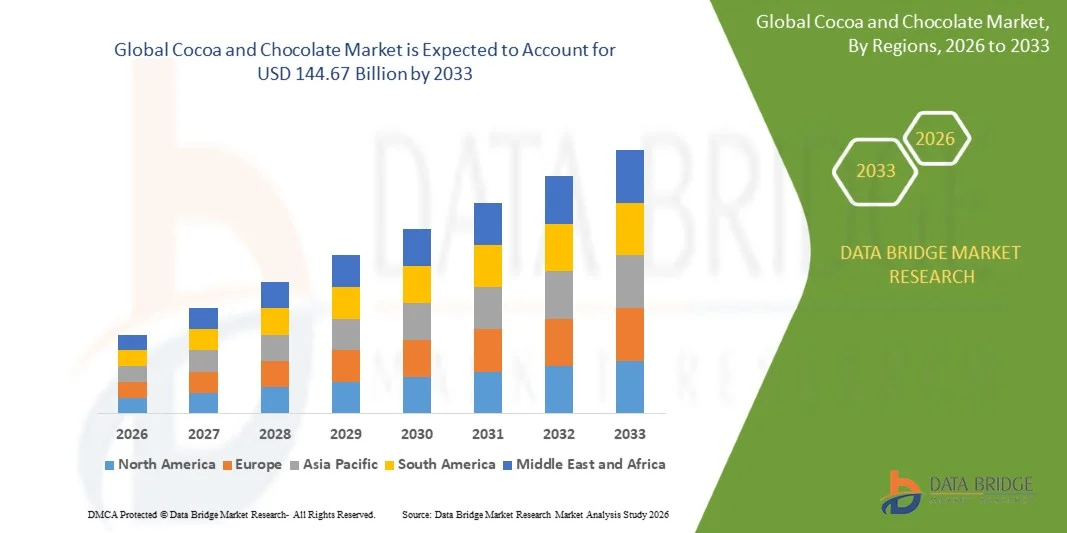
Report Scope and Cocoa and Chocolate Market Segmentation
|
Attributes |
Cocoa and Chocolate Key Market Insights |
|
Segments Covered |
|
|
Countries Covered |
North America · U.S. · Canada · Mexico Europe · Germany · France · U.K. · Netherlands · Switzerland · Belgium · Russia · Italy · Spain · Turkey · Rest of Europe Asia-Pacific · China · Japan · India · South Korea · Singapore · Malaysia · Australia · Thailand · Indonesia · Philippines · Rest of Asia-Pacific Middle East and Africa · Saudi Arabia · U.A.E. · South Africa · Egypt · Israel · Rest of Middle East and Africa South America · Brazil · Argentina · Rest of South America |
|
Key Market Players |
· Mondelez International, Inc. (U.S.) · Nestlé (Switzerland) · The Hershey Company (U.S.) · Mars, Incorporated (U.S.) · Ferrero International S.A. (Luxembourg) · Barry Callebaut AG (Switzerland) · Lindt & Sprüngli AG (Switzerland) · Meiji Holdings Co., Ltd. (Japan) · Ezaki Glico Co., Ltd. (Japan) · Fuji Oil Holdings Inc. (Japan) · Cargill, Incorporated (U.S.) · Olam International Limited (Singapore) · JDE Peet’s N.V. (Netherlands) · Orkla ASA (Norway) · Strauss Group Ltd. (Israel) · Grupo Nutresa S.A. (Colombia) · Blommer Chocolate Company (U.S.) · Guittard Chocolate Company (U.S.) · TCHO Ventures, Inc. (U.S.) · Valrhona SAS (France) |
|
Market Opportunities |
· Rising demand for functional and fortified chocolate products · Expansion in emerging markets across Asia-Pacific, Latin America, and the Middle East · Growing focus on sustainable and traceable cocoa sourcing |
|
Value Added Data Infosets |
In addition to the insights on market scenarios such as market value, growth rate, segmentation, geographical coverage, and major players, the market reports curated by the Data Bridge Market Research also include in-depth expert analysis, pricing analysis, brand share analysis, consumer survey, demography analysis, supply chain analysis, value chain analysis, raw material/consumables overview, vendor selection criteria, PESTLE Analysis, Porter Analysis, and regulatory framework. |
Cocoa and Chocolate Market Trends
Trend: Rising Demand for Premium, Organic & Functional Chocolate Products
Consumers are increasingly shifting toward premium, organic, and functional chocolate varieties driven by health consciousness, ethical consumption, and indulgence trends in urban populations. Dark chocolate, sugar-free variants, and cocoa-rich formulations enriched with protein, fiber, probiotics, and antioxidants are gaining strong traction across global markets. This shift is also supported by growing awareness of lifestyle-related diseases such as obesity and diabetes, pushing manufacturers to reformulate products with reduced sugar and cleaner ingredient labels. Brands are investing heavily in sustainable packaging, fair-trade cocoa, and origin-based storytelling to strengthen emotional and ethical appeal.
For instance, companies such as Barry Callebaut and Lindt & Sprüngli are expanding premium, high-cocoa, and organic product lines to capture evolving demand for healthier indulgence and sustainable chocolate consumption.
Cocoa and Chocolate Market Dynamics
Key Market Driver: Rising Global Demand for Indulgence and Packaged Confectionery Consumption
The Cocoa and Chocolate Market is strongly driven by increasing consumer inclination toward indulgent snacking and convenient packaged confectionery products. Rapid urbanization, busy lifestyles, and rising disposable incomes have made chocolate a daily consumption item rather than an occasional treat in many regions. Seasonal demand spikes during festivals, holidays, and gifting occasions further reinforce stable year-round consumption patterns. In addition, aggressive marketing strategies, attractive packaging, and continuous product innovation in flavors and textures are expanding consumer reach across age groups. Global players such as Nestlé and Mondelez International are continuously introducing new product variants, limited-edition chocolates, and region-specific flavors to strengthen brand penetration and sustain long-term demand growth.
Key Restraint/Challenge: Volatility in Cocoa Supply and High Raw Material Costs
A major constraint in the cocoa and chocolate industry is the high volatility in cocoa bean supply, largely influenced by climate change, unpredictable rainfall patterns, crop diseases, and geopolitical instability in key producing regions such as West Africa. This supply inconsistency directly leads to price fluctuations in cocoa beans, which represent a significant portion of total production costs for manufacturers. As a result, chocolate producers face pressure on margins, pricing stability, and long-term procurement planning. In addition, rising compliance requirements related to sustainable farming practices, deforestation-free sourcing, and fair labor standards further increase operational complexity and cost burden.
For instance, supply disruptions and yield variations in major cocoa-producing countries such as Côte d’Ivoire and Ghana have historically caused sharp global price volatility, impacting both manufacturers and downstream confectionery pricing strategies.
Key Market Opportunity: Expansion of Sustainable, Traceable & Alternative Cocoa Sourcing
The growing global emphasis on sustainability and supply chain transparency is creating significant opportunities in the cocoa and chocolate market. Consumers, regulators, and retailers are increasingly demanding ethically sourced cocoa, pushing companies to invest in traceability systems, farmer welfare initiatives, and certified sourcing programs. Technologies such as blockchain are being adopted to provide end-to-end visibility from cocoa farms to finished chocolate products, strengthening consumer trust and brand reputation. At the same time, climate change concerns are encouraging innovation in climate-resilient cocoa farming techniques and alternative cocoa production methods. Leading companies such as Mars Incorporated and Ferrero are actively expanding sustainable cocoa programs, investing in farmer training, and strengthening long-term sourcing partnerships to ensure supply security while meeting sustainability commitments.
Cocoa and Chocolate Market Scope
The cocoa and chocolate market is segmented on the basis of chocolate type, cocoa type, application, and distribution channel.
- By Chocolate Type
On the basis of chocolate type, the Cocoa and Chocolate Market is segmented into dark, white, filled, and milk chocolate. The Milk Chocolate segment dominated the market with the largest share of 45.28% in 2025, driven by its widespread consumer acceptance, creamy taste profile, and strong presence across mass-market confectionery products. Milk chocolate is heavily preferred in impulse purchases, seasonal gifting, and everyday snacking due to its balanced sweetness and smooth texture. It is also extensively used in bakery fillings, desserts, and packaged snack bars, making it a core product for global manufacturers. Strong brand penetration by major players and continuous product innovation in formats such as bars, bites, and spreads further reinforce its dominance. High availability across supermarkets, convenience stores, and online platforms strengthens its global reach. Despite rising health awareness, its indulgent taste profile continues to secure its leadership position.
The Dark Chocolate segment is projected to register the fastest growth at a CAGR of 7.3% from 2026 to 2033, driven by increasing health consciousness and demand for high-cocoa, low-sugar products. Consumers are shifting toward dark chocolate due to its perceived antioxidant benefits, heart health advantages, and premium positioning. It is gaining popularity among urban, health-focused demographics and millennials seeking functional indulgence. Manufacturers are introducing high-cocoa content variants (70%–90%) along with organic and single-origin offerings. The segment is also benefiting from rising vegan and clean-label trends. Expanding availability in premium retail and e-commerce channels is further accelerating adoption globally.
- By Cocoa Type
On the basis of cocoa type, the market is segmented into cocoa beans, cocoa butter, cocoa powder & cake, cocoa liquor & paste, cocoa nibs, and others. The Cocoa Powder & Cake segment dominated the market with a share of 38.62% in 2025, due to its extensive use in chocolate manufacturing, bakery products, beverages, and processed foods. Cocoa powder is widely preferred because of its long shelf life, ease of storage, and cost-effective integration into large-scale food production. It is a key ingredient in confectionery coatings, flavored drinks, and dessert formulations. Strong demand from industrial food processing companies continues to reinforce its leading position. In addition, its versatility across multiple applications makes it essential in both premium and mass-market products. Continuous growth in packaged food consumption globally further strengthens its dominance.
The Cocoa Nibs segment is expected to witness the fastest growth at a CAGR of 7.6% from 2026 to 2033, driven by increasing demand for minimally processed, natural, and functional cocoa ingredients. Cocoa nibs are gaining popularity in health foods, protein bars, smoothies, and artisanal chocolate products. Their high antioxidant content and clean-label appeal align strongly with modern wellness trends. Consumers are increasingly seeking whole-food ingredients with minimal processing. Premium and organic food brands are incorporating cocoa nibs into innovative product formulations. Rising demand for superfoods and functional nutrition is further accelerating this segment’s growth.
- By Application
On the basis of application, the market is segmented into confectionery, cosmetics, pharmaceuticals, and food & beverage. The Confectionery segment dominated the market with the largest share of 52.16% in 2025, driven by strong global demand for chocolate bars, pralines, truffles, and seasonal gift products. Chocolate remains one of the most consumed confectionery items worldwide, supported by strong retail penetration and impulse buying behavior. Continuous innovation in flavors, fillings, and premium assortments enhances product appeal. Major global brands rely heavily on confectionery as their core revenue driver. Seasonal demand during festivals and holidays further boosts sales volume. Expanding urban populations and rising disposable incomes continue to support this segment’s leadership.
The Cosmetics segment is expected to register the fastest growth at a CAGR of 7.0% from 2026 to 2033, driven by increasing use of cocoa butter in skincare, haircare, and personal care products. Cocoa-derived ingredients are valued for their moisturizing, anti-aging, and antioxidant properties. Rising consumer preference for natural and organic cosmetics is further driving demand. Premium beauty brands are increasingly incorporating cocoa-based formulations in lotions, lip balms, and creams. Growing awareness of clean beauty and chemical-free products is accelerating adoption. Expanding spa and wellness industries also contribute to market growth.
- By Distribution Channel
On the basis of distribution channel, the market is segmented into sales channels, distributors, traders, and dealers. The Sales Channel segment dominated the market with a share of 48.90% in 2025, supported by strong product visibility, wide assortment availability, and high impulse purchase behavior across supermarkets, hypermarkets, and retail stores. Consumers prefer physical retail outlets for chocolate purchases due to instant availability and promotional offers. Seasonal displays and attractive packaging significantly influence buying decisions in this channel. Strong presence of global brands in retail chains further strengthens dominance. Retail expansion in emerging economies is also boosting sales channel growth. This channel remains the primary revenue contributor for mass-market chocolate products.
The Distributors segment is expected to witness the fastest growth at a CAGR of 6.8% from 2026 to 2033, driven by increasing demand for efficient supply chain networks in emerging and fragmented markets. Distributors play a critical role in reaching small retailers, rural markets, and developing regions. Growing expansion of chocolate brands into tier-2 and tier-3 cities is increasing reliance on distribution networks. They help manufacturers reduce logistics complexity and improve market penetration. Rising demand for packaged foods in developing economies is further strengthening distributor-led growth. Digital supply chain integration is also improving distribution efficiency and scalability.
Cocoa and Chocolate Market Regional Analysis
North America dominated the Cocoa and Chocolate Market with the largest revenue share of 36.45% in 2025, supported by high per capita chocolate consumption, strong presence of leading confectionery brands, and well-established retail distribution networks. The region benefits from strong demand for premium, dark, and functional chocolate products driven by rising health consciousness and preference for indulgent yet high-quality snacking options. Continuous product innovation, aggressive marketing strategies, and frequent product launches by major manufacturers further strengthen market growth. Seasonal consumption patterns during holidays such as Halloween, Christmas, and Valentine’s Day significantly boost sales volumes across the region. The expanding trend of organic, low-sugar, and ethically sourced cocoa products is also contributing to sustained demand.
U.S. Cocoa and Chocolate Market Insight
The U.S. cocoa and chocolate market is witnessing strong growth due to high per capita chocolate consumption, strong demand for premium confectionery products, and increasing preference for dark, organic, and low-sugar chocolates. The country’s well-established retail ecosystem, strong presence of global confectionery giants, and advanced food processing capabilities are driving market expansion across multiple product categories. Rising health consciousness and demand for functional chocolates enriched with protein, antioxidants, and clean-label ingredients are further supporting growth. Seasonal demand during holidays such as Halloween, Christmas, and Valentine’s Day significantly boosts sales volumes. In addition, continuous product innovation and aggressive marketing strategies by leading manufacturers are strengthening market penetration.
Europe Cocoa and Chocolate Market Insight
The Europe cocoa and chocolate market remains a major contributor to global revenue, driven by strong chocolate consumption culture, established confectionery manufacturing base, and high demand for premium and ethically sourced cocoa products. The region benefits from advanced food processing technologies, strong retail infrastructure, and increasing consumer preference for organic, fair-trade, and sustainable chocolate offerings. Continuous innovation in dark chocolate, sugar-free variants, and artisanal products is further supporting market expansion. Seasonal gifting traditions and high household chocolate consumption continue to drive stable demand across the region. In addition, strict regulatory frameworks on sustainability and quality standards reinforce Europe’s leadership position in the Cocoa and Chocolate Market.
U.K. Cocoa and Chocolate Market Insight
The U.K. cocoa and chocolate market is experiencing steady growth, supported by strong consumer preference for premium chocolate products, rising demand for ethically sourced cocoa, and expanding retail and e-commerce distribution channels. Increasing health awareness is driving demand for dark chocolate and reduced-sugar alternatives across urban populations. The presence of well-established confectionery brands and continuous product innovation in flavors, formats, and packaging are contributing to market expansion. Seasonal consumption during festivals and gifting occasions further supports sales growth. In addition, growing adoption of sustainable sourcing practices and clean-label formulations is strengthening the country’s premium chocolate segment.
Germany Cocoa and Chocolate Market Insight
The Germany cocoa and chocolate market is expanding steadily due to high chocolate consumption levels, strong domestic confectionery manufacturing base, and increasing demand for premium and organic chocolate products. Consumers in Germany show strong preference for high-quality, sustainably sourced cocoa, driving growth in fair-trade and certified product categories. The country also benefits from advanced food processing technologies and strong export capabilities in chocolate manufacturing. Rising health consciousness is boosting demand for dark chocolate and functional chocolate variants. Continuous innovation by leading manufacturers in product formulation and packaging is further strengthening market competitiveness.
Asia-Pacific Cocoa and Chocolate Market Insight
The Asia-Pacific cocoa and chocolate market is expected to witness rapid growth, driven by rising disposable incomes, increasing urbanization, and growing westernization of dietary habits across countries such as China, India, and Southeast Asian nations. Expanding retail penetration and e-commerce platforms are significantly improving product accessibility and boosting consumption. Rising awareness of premium and branded chocolate products is further supporting market expansion. In addition, increasing demand for affordable indulgence and seasonal gifting is strengthening chocolate adoption in emerging economies. Growing presence of global confectionery brands and local manufacturers is accelerating regional market development.
Japan Cocoa and Chocolate Market Insight
The Japan cocoa and chocolate market is witnessing consistent growth due to strong demand for premium, high-quality confectionery products and increasing preference for unique flavors and limited-edition chocolates. The country’s mature retail environment and strong gifting culture significantly contribute to steady consumption patterns. Rising health awareness is driving demand for dark chocolate and functional variants with low sugar content. Continuous innovation in packaging, portion sizes, and flavor profiles is further supporting market growth. In addition, integration of premium cocoa sourcing and artisanal chocolate concepts is strengthening the country’s niche but high-value chocolate segment.
China Cocoa and Chocolate Market Insight
The China cocoa and chocolate market is growing rapidly, driven by increasing urbanization, rising disposable incomes, and expanding middle-class population adopting Western-style confectionery consumption habits. Strong growth in e-commerce platforms and modern retail formats is significantly improving chocolate accessibility across urban and semi-urban regions. Demand for premium, imported, and branded chocolate products is rising steadily, especially among younger consumers. Seasonal gifting culture and expanding retail promotions are further boosting sales. In addition, increasing investments by global chocolate manufacturers in local production and distribution networks are strengthening China’s position as one of the fastest-growing cocoa and chocolate markets globally.
Cocoa and Chocolate Market Share
The cocoa and chocolate industry is primarily led by well-established companies, including:
- Mondelez International, Inc. (U.S.)
- Nestlé (Switzerland)
- The Hershey Company (U.S.)
- Mars, Incorporated (U.S.)
- Ferrero International S.A. (Luxembourg)
- Barry Callebaut AG (Switzerland)
- Lindt & Sprüngli AG (Switzerland)
- Meiji Holdings Co., Ltd. (Japan)
- Ezaki Glico Co., Ltd. (Japan)
- Fuji Oil Holdings Inc. (Japan)
- Cargill, Incorporated (U.S.)
- Olam International Limited (Singapore)
- JDE Peet’s N.V. (Netherlands)
- Orkla ASA (Norway)
- Strauss Group Ltd. (Israel)
- Grupo Nutresa S.A. (Colombia)
- Blommer Chocolate Company (U.S.)
- Guittard Chocolate Company (U.S.)
- TCHO Ventures, Inc. (U.S.)
- Valrhona SAS (France)
Latest Developments in Cocoa and Chocolate Market
- In October 2024, Barry Callebaut announced continued progress under its “Forever Chocolate” strategy, increasing its share of sustainably sourced cocoa globally. The company expanded farmer training programs, improved certification coverage, and strengthened traceability systems across key sourcing regions. It is also investing in climate-smart agriculture and long-term supply chain resilience to address industry challenges. This development reinforces growing global demand for transparent and sustainable chocolate production systems
- In January 2024, Mondelez International advanced its Cocoa Life program by expanding sustainable cocoa sourcing across major production regions. The initiative aims to improve farmer productivity, strengthen rural communities, and promote environmentally responsible farming practices. Mondelez is working toward sourcing all cocoa for key brands such as Cadbury and Oreo through this program, ensuring traceability and sustainability in its supply chain. This expansion demonstrates the increasing integration of sustainability into mainstream chocolate production strategies
- In January 2023, Ferrero Group strengthened its Cocoa Charter commitments to further improve sustainability and traceability across its global cocoa supply chain. The company increased its focus on eliminating deforestation risks, improving farmer income, and ensuring greater transparency in cocoa sourcing. Ferrero also expanded collaboration with NGOs and supply chain partners to support responsible cocoa production in key growing regions. This development reflects increasing ESG expectations and regulatory pressure in the global chocolate industry
- In August 2022, Mars Incorporated expanded its “Cocoa for Generations” sustainability program to strengthen responsible cocoa sourcing across West Africa. The initiative focuses on improving farmer livelihoods, promoting regenerative agriculture practices, and enhancing supply chain traceability. It also aims to address environmental challenges such as deforestation and climate change while supporting rural community development. This expansion highlights the growing industry focus on ethical sourcing and long-term cocoa supply sustainability
- In January 2021, Nestlé launched KitKat V, a vegan version of its iconic chocolate brand in the U.K. and selected European markets. The product was designed to meet the rising demand for plant-based confectionery while maintaining the original KitKat taste and texture. It replaces dairy ingredients with rice-based alternatives and uses sustainably sourced cocoa under the Nestlé Cocoa Plan. This launch marked a key milestone in Nestlé’s shift toward sustainable and plant-based chocolate innovation, reflecting the broader global trend toward vegan and environmentally responsible products

- Interactive Data Analysis Dashboard
- Company Analysis Dashboard for high growth potential opportunities
- Research Analyst Access for customization & queries
- Competitor Analysis with Interactive dashboard
- Latest News, Updates & Trend analysis
- Harness the Power of Benchmark Analysis for Comprehensive Competitor Tracking
Global Cocoa And Chocolate Market, Supply Chain Analysis and Ecosystem Framework
To support market growth and help clients navigate the impact of geopolitical shifts, DBMR has integrated in-depth supply chain analysis into its Global Cocoa And Chocolate Market research reports. This addition empowers clients to respond effectively to global changes affecting their industries. The supply chain analysis section includes detailed insights such as Global Cocoa And Chocolate Market consumption and production by country, price trend analysis, the impact of tariffs and geopolitical developments, and import and export trends by country and HSN code. It also highlights major suppliers with data on production capacity and company profiles, as well as key importers and exporters. In addition to research, DBMR offers specialized supply chain consulting services backed by over a decade of experience, providing solutions like supplier discovery, supplier risk assessment, price trend analysis, impact evaluation of inflation and trade route changes, and comprehensive market trend analysis.
Data collection and base year analysis are done using data collection modules with large sample sizes. The stage includes obtaining market information or related data through various sources and strategies. It includes examining and planning all the data acquired from the past in advance. It likewise envelops the examination of information inconsistencies seen across different information sources. The market data is analysed and estimated using market statistical and coherent models. Also, market share analysis and key trend analysis are the major success factors in the market report. To know more, please request an analyst call or drop down your inquiry.
The key research methodology used by DBMR research team is data triangulation which involves data mining, analysis of the impact of data variables on the market and primary (industry expert) validation. Data models include Vendor Positioning Grid, Market Time Line Analysis, Market Overview and Guide, Company Positioning Grid, Patent Analysis, Pricing Analysis, Company Market Share Analysis, Standards of Measurement, Global versus Regional and Vendor Share Analysis. To know more about the research methodology, drop in an inquiry to speak to our industry experts.
Data Bridge Market Research is a leader in advanced formative research. We take pride in servicing our existing and new customers with data and analysis that match and suits their goal. The report can be customized to include price trend analysis of target brands understanding the market for additional countries (ask for the list of countries), clinical trial results data, literature review, refurbished market and product base analysis. Market analysis of target competitors can be analyzed from technology-based analysis to market portfolio strategies. We can add as many competitors that you require data about in the format and data style you are looking for. Our team of analysts can also provide you data in crude raw excel files pivot tables (Fact book) or can assist you in creating presentations from the data sets available in the report.













