


Coconut Sugar Market Size
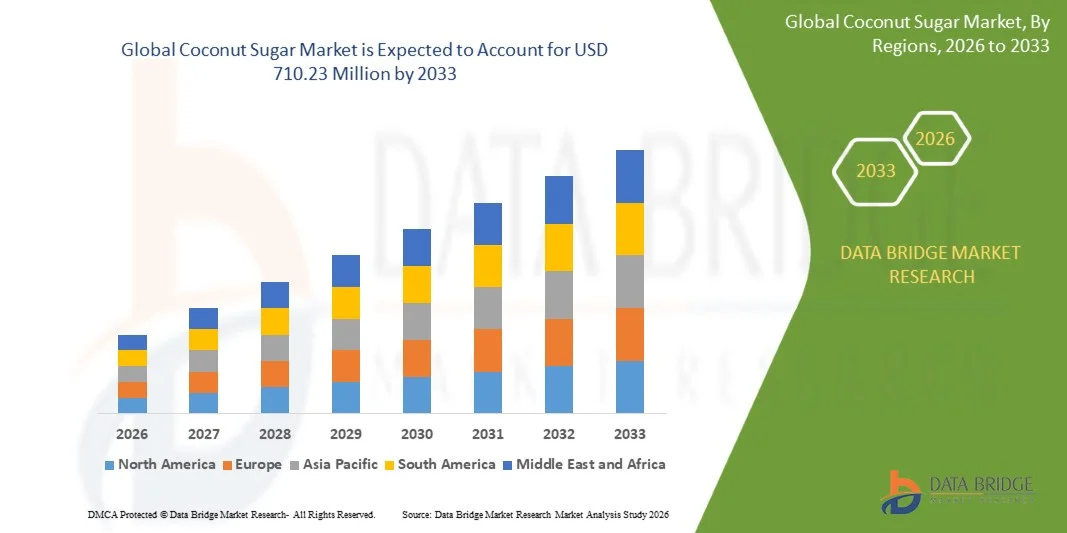
- The global coconut sugar market size was valued at USD 421.17 million in 2025 and is expected to reach USD 710.23 million by 2033, at a CAGR of 6.75% during the forecast period
- The coconut sugar market growth is largely fueled by the rising global shift toward natural, organic, and low-glycemic sweeteners, driven by increasing health consciousness and growing awareness of the negative effects of refined sugar consumption in daily diets
- Furthermore, expanding demand from the food & beverage industry for clean-label ingredients and plant-based sweetening alternatives is positioning coconut sugar as a preferred substitute in bakery, confectionery, beverages, and functional food formulations, thereby significantly boosting industry growth
Coconut Sugar Market Analysis
- Coconut sugar, derived from coconut palm sap and minimally processed to retain nutrients, is increasingly important in modern food systems due to its perceived health benefits, lower glycemic index, and compatibility with organic and vegan food trends across global markets
- The escalating demand for coconut sugar is primarily fueled by rising consumer preference for natural sweeteners, rapid expansion of the organic food sector, and increasing incorporation of plant-based ingredients in processed food and beverage products
- Asia-Pacific dominated the coconut sugar market with a share of 52.39% in 2025, due to strong demand from food & beverage, bakery, confectionery, and health-focused sweetener applications
- North America is expected to be the fastest growing region in the coconut sugar market during the forecast period due to increasing demand for natural sweeteners in health-focused diets and processed food applications
- Sucrose segment dominated the market with a market share of 62.9% in 2025, due to its natural abundance in coconut sap and its similarity to conventional table sugar in taste and functionality. Manufacturers widely utilize sucrose-rich coconut sugar as a direct substitute for refined sugar in food formulations due to its caramel-like flavor and lower glycemic index perception
Report Scope and Coconut Sugar Market Segmentation
|
Attributes |
Coconut Sugar Key Market Insights |
|
Segments Covered |
|
|
Countries Covered |
North America · U.S. · Canada · Mexico Europe · Germany · France · U.K. · Netherlands · Switzerland · Belgium · Russia · Italy · Spain · Turkey · Rest of Europe Asia-Pacific · China · Japan · India · South Korea · Singapore · Malaysia · Australia · Thailand · Indonesia · Philippines · Rest of Asia-Pacific Middle East and Africa · Saudi Arabia · U.A.E. · South Africa · Egypt · Israel · Rest of Middle East and Africa South America · Brazil · Argentina · Rest of South America |
|
Key Market Players |
· Bigtreefarms (Indonesia) · THE COCONUT COMPANY (U.K.) · Earth Circle Organics (U.S.) · Franklin Baker (U.S.) · Coco Sugar Indonesia (Indonesia) · Treelife Ventures Services Private Limited (India) · Saudi Food Ingredients Factory (Saudi Arabia) · Celebes Coconut Corporation (Indonesia) · Urmatt Ltd (Thailand) · MADHAVA LTD (U.S.) · AGRIM PTE LTD (Singapore) · Samara & Co (U.A.E.) · KOPERASI NIRASATRIA (Indonesia) · PT. Singabera Indonesia (Indonesia) · FARM MADE FOODS (Thailand) · Ecobuddy Exports (India) · TARDO's Best (Philippines) · SINGABERA (Thailand) · Integral Mulia Cipta (Indonesia) · PT. Mega Inovasi Organik (Indonesia) · Connecticut Coconut Company (U.S.) |
|
Market Opportunities |
· Expansion in Organic and Functional Food Product Development · Increasing Penetration in Emerging Food and Beverage Markets |
|
Value Added Data Infosets |
In addition to the insights on market scenarios such as market value, growth rate, segmentation, geographical coverage, and major players, the market reports curated by the Data Bridge Market Research also include in-depth expert analysis, pricing analysis, brand share analysis, consumer survey, demography analysis, supply chain analysis, value chain analysis, raw material/consumables overview, vendor selection criteria, PESTLE Analysis, Porter Analysis, and regulatory framework. |
Coconut Sugar Market Trends
“Rising Adoption of Clean-Label and Natural Sweeteners”
- A significant trend in the coconut sugar market is the increasing shift toward clean-label and minimally processed natural sweeteners, driven by growing consumer awareness of health risks associated with refined sugar and artificial sweeteners. This trend is strengthening the position of coconut sugar as a preferred alternative in organic and health-focused food formulations across global markets
- For instance, The Coconut Company and Earth Circle Organics supply organic coconut sugar products that are widely used in bakery, beverage, and nutritional food applications. Such offerings support food manufacturers in meeting clean-label requirements and responding to evolving consumer preferences for natural ingredients
- The incorporation of coconut sugar in plant-based and vegan food products is expanding as manufacturers focus on healthier reformulations with lower glycemic impact. This is encouraging its use across snacks, cereals, and functional food categories where natural sweetening is increasingly prioritized
- Foodservice and retail sectors are also witnessing higher demand for coconut sugar-based products as consumers seek healthier sweetening options in daily consumption. This is accelerating product innovation in packaged foods and ready-to-eat meals that emphasize natural ingredient positioning
- The rise of organic certification standards and transparency in ingredient sourcing is further strengthening this trend across developed and emerging markets. Companies are increasingly highlighting traceability and sustainability credentials to enhance consumer trust and brand positioning
- The growing alignment between health-driven dietary shifts and natural ingredient adoption is reinforcing long-term demand for coconut sugar. This trend is expected to continue shaping product development strategies across the global food and beverage industry
Coconut Sugar Market Dynamics
Driver
“Growing Demand from Health-Conscious Consumers and Food Industry Shift”
- The coconut sugar market is primarily driven by increasing health consciousness among consumers and the ongoing shift in the food industry toward natural and low-glycemic sweeteners. Rising concerns over obesity, diabetes, and lifestyle-related disorders are encouraging consumers to replace refined sugar with healthier alternatives such as coconut sugar
- For instance, MADHAVA LTD and Franklin Baker offer coconut sugar-based sweetener solutions that are widely used in health-oriented packaged foods and beverages. These companies support the growing demand for natural sugar substitutes across retail and industrial food applications
- The expanding clean-label movement in the food and beverage sector is pushing manufacturers to adopt coconut sugar in bakery, confectionery, and beverage formulations. This shift is being driven by consumer demand for transparency and minimally processed ingredients
- Increasing penetration of organic and natural food products in supermarkets and online retail platforms is further accelerating market adoption. Consumers are actively seeking plant-based and sustainable sweetening options that align with healthier lifestyles
- The combined influence of dietary awareness and industry reformulation strategies continues to strengthen demand for coconut sugar globally. This driver is expected to remain central to market expansion across both developed and emerging economies
Restraint/Challenge
“Fluctuating Coconut Raw Material Supply and Price Volatility”
- The coconut sugar market faces challenges due to fluctuations in coconut sap availability and raw material supply, which are heavily dependent on climatic conditions, seasonal variations, and agricultural productivity. These factors create instability in production volumes and pricing structures across the supply chain
- For instance, Celebes Coconut Corporation and Coco Sugar Indonesia experience variations in output levels due to weather-related impacts on coconut palm cultivation in Southeast Asia. Such disruptions directly affect production consistency and export commitments
- Dependence on smallholder farming systems in key producing regions contributes to supply chain fragmentation and inconsistent raw material quality. This limits the ability of manufacturers to maintain stable large-scale production
- Rising transportation and agricultural input costs further add to pricing volatility in coconut sugar production. These cost pressures make it difficult for producers to maintain competitive pricing in international markets
- The overall dependence on agricultural cycles and environmental conditions continues to pose a structural challenge for the coconut sugar market. This restraint affects long-term supply stability and profit margins across the value chain
Coconut Sugar Market Scope
The market is segmented on the basis of type, nutrient content, application, product, form, and distribution channel.
- By Type
On the basis of type, the coconut sugar market is segmented into sucrose, glucose, and fructose. The sucrose segment dominated the market with the largest revenue share of 62.9% in 2025, driven by its natural abundance in coconut sap and its similarity to conventional table sugar in taste and functionality. Manufacturers widely utilize sucrose-rich coconut sugar as a direct substitute for refined sugar in food formulations due to its caramel-like flavor and lower glycemic index perception. Its compatibility with a wide range of food and beverage products further strengthens its market dominance. In addition, consumer preference for minimally processed sweeteners supports the continued demand for sucrose-based coconut sugar across global markets.
The fructose segment is anticipated to witness the fastest growth rate from 2026 to 2033, fueled by rising demand for low-glycemic and diabetic-friendly sweetening alternatives. Fructose-based coconut sugar offers enhanced sweetness intensity, allowing lower usage levels in formulations, which appeals to health-conscious consumers and manufacturers aiming to reduce calorie content. Increasing awareness regarding blood sugar management and functional food consumption is further accelerating the adoption of fructose variants. The segment is also gaining traction in specialized dietary products and nutraceutical applications.
- By Nutrient Content
On the basis of nutrient content, the coconut sugar market is segmented into minerals, vitamin C, and phytonutrients. The minerals segment dominated the market with the largest revenue share in 2025, driven by the presence of essential nutrients such as potassium, magnesium, and iron in coconut sugar. These minerals enhance the product’s appeal as a healthier alternative to refined sugar, especially among health-conscious consumers seeking added nutritional value. Food manufacturers are increasingly highlighting mineral content in product labeling to attract wellness-focused buyers. The natural retention of minerals during minimal processing further supports segment growth.
The phytonutrients segment is expected to witness the fastest growth rate from 2026 to 2033, driven by increasing demand for functional foods with antioxidant properties. Phytonutrients present in coconut sugar contribute to overall health benefits, including improved metabolism and reduced oxidative stress, which aligns with evolving consumer preferences. Growing awareness regarding plant-based nutrition and preventive healthcare is accelerating the demand for phytonutrient-rich sweeteners. This segment is gaining prominence in premium and organic product lines.
- By Application
On the basis of application, the coconut sugar market is segmented into bakery, confectionary, tea, juice, food seasoned, and others. The bakery segment dominated the market with the largest revenue share in 2025, driven by the extensive use of coconut sugar as a natural sweetener in baked goods such as cakes, cookies, and bread. Its rich flavor profile and ability to enhance texture make it a preferred ingredient among bakers aiming to develop clean-label and artisanal products. Rising consumer demand for healthier bakery options is further supporting segment expansion. The compatibility of coconut sugar with gluten-free and vegan recipes also contributes to its widespread adoption.
The beverage segment, particularly juice, is anticipated to witness the fastest growth rate from 2026 to 2033, fueled by increasing consumption of natural and organic beverages. Coconut sugar is increasingly used as a sweetening agent in juices and ready-to-drink beverages due to its perceived health benefits and natural origin. Growing demand for low-calorie and functional drinks is accelerating its inclusion in beverage formulations. Manufacturers are focusing on innovative product offerings to cater to evolving consumer preferences in this segment.
- By Product
On the basis of product, the coconut sugar market is segmented into organic coconut sugar and inorganic coconut sugar. The organic coconut sugar segment dominated the market with the largest revenue share in 2025, driven by increasing consumer preference for certified organic and chemical-free food products. Organic variants are perceived as healthier and environmentally sustainable, which aligns with the growing clean-label movement. Regulatory certifications and eco-friendly production practices further enhance consumer trust and product demand. The premium pricing of organic coconut sugar also contributes significantly to revenue generation.
The inorganic coconut sugar segment is expected to witness the fastest growth rate from 2026 to 2033, driven by its affordability and wider availability across emerging markets. Cost-sensitive consumers and large-scale food manufacturers often prefer inorganic variants for bulk usage in processed food applications. Improvements in production efficiency and supply chain distribution are further supporting segment growth. This segment is also expanding due to increasing penetration in mass-market retail channels.
- By Form
On the basis of form, the coconut sugar market is segmented into granular, liquid powder, solid, and others. The granular segment dominated the market with the largest revenue share in 2025, driven by its ease of handling, storage, and direct substitution for conventional sugar. Granular coconut sugar is widely preferred in both household and industrial applications due to its versatility and long shelf life. Its consistent texture and dissolvability make it suitable for a variety of culinary uses. The widespread availability of granular forms further strengthens its market position.
The liquid segment is anticipated to witness the fastest growth rate from 2026 to 2033, fueled by rising demand in beverage and processed food industries. Liquid coconut sugar offers better solubility and ease of blending in formulations, making it ideal for ready-to-drink products and syrups. Increasing adoption in innovative food applications and convenience products is driving segment expansion. Manufacturers are also focusing on developing advanced liquid formulations to cater to evolving industry needs.
- By Distribution Channel
On the basis of distribution channel, the coconut sugar market is segmented into specialty stores, hypermarket and supermarkets, food processing industries, and others. The hypermarket and supermarkets segment dominated the market with the largest revenue share in 2025, driven by their extensive product availability and strong consumer footfall. These retail channels provide consumers with easy access to a variety of coconut sugar brands and product types under one roof. Promotional activities and competitive pricing strategies further enhance product visibility and sales. The growing expansion of organized retail networks supports segment dominance.
The food processing industries segment is expected to witness the fastest growth rate from 2026 to 2033, fueled by increasing utilization of coconut sugar as a natural sweetener in large-scale food production. Rising demand for clean-label and functional food products is encouraging manufacturers to incorporate coconut sugar into their formulations. Bulk purchasing and long-term supply agreements further drive segment growth. This segment is expanding rapidly as food companies focus on reformulating products to meet changing consumer preferences.
Coconut Sugar Market Regional Analysis
- Asia-Pacific dominated the coconut sugar market with the largest revenue share of 52.39% in 2025, driven by strong demand from food & beverage, bakery, confectionery, and health-focused sweetener applications
- The region benefits from abundant coconut production, established agricultural supply chains, and expanding adoption of natural and low-glycemic sugar alternatives across processed food industries
- Rising health consciousness, rapid growth in clean-label product consumption, and increasing export-oriented production of coconut-based sweeteners are accelerating market expansion
China Coconut Sugar Market Insight
China held the largest share in the Asia-Pacific coconut sugar market in 2025, supported by strong demand from processed food, beverage, and health-conscious consumer segments. The country’s expanding packaged food industry is increasing the use of natural sweeteners as alternatives to refined sugar. Strong import networks and well-developed food processing infrastructure are enabling large-scale adoption across urban markets. In addition, rising consumer preference for low-calorie and plant-based ingredients is reinforcing market growth in China.
India Coconut Sugar Market Insight
India is witnessing the fastest growth in the Asia-Pacific region, driven by increasing demand for natural sweeteners across bakery, confectionery, and traditional food applications. Growing health awareness and rising cases of lifestyle-related disorders are encouraging a shift toward coconut sugar consumption. Expanding food processing capacity and rising penetration of organic food products are supporting adoption across urban and semi-urban regions. In addition, increasing availability through retail and e-commerce channels is accelerating long-term market expansion.
Europe Coconut Sugar Market Insight
The Europe coconut sugar market is expanding steadily, supported by strong demand for organic, clean-label, and plant-based sweetener alternatives. Consumers are increasingly shifting away from refined sugar toward natural substitutes in bakery, beverages, and functional food products. Regulatory emphasis on healthier food formulations and sugar reduction initiatives is further supporting market growth. In addition, growing innovation in organic food processing and specialty ingredient development is widening application scope across the region.
Germany Coconut Sugar Market Insight
Germany accounted for the largest share in the Europe coconut sugar market in 2025, driven by strong demand from health-focused consumers and well-established organic food industries. The country has a mature retail ecosystem supporting widespread availability of natural sweeteners across supermarkets and specialty stores. High adoption in bakery and functional food applications is reinforcing demand for coconut sugar. In addition, strong sustainability preferences and advanced food formulation capabilities are strengthening Germany’s position in the regional market.
U.K. Coconut Sugar Market Insight
The U.K. market is supported by rising demand for plant-based and low-glycemic sweeteners across packaged foods and beverages. Increasing consumer preference for clean-label ingredients is driving coconut sugar adoption in home cooking and foodservice sectors. The country’s strong organic product retail segment is further supporting market penetration. In addition, growing innovation in healthier snack and dessert formulations is contributing to steady market expansion.
North America Coconut Sugar Market Insight
North America is projected to grow at the fastest CAGR from 2026 to 2033, driven by increasing demand for natural sweeteners in health-focused diets and processed food applications. Strong consumer shift toward clean-label and organic products is boosting coconut sugar adoption across bakery, beverages, and nutrition products. Continuous product innovation in sugar alternatives is expanding usage across food manufacturing industries. In addition, rising investment in specialty food ingredients and wellness-oriented product development is accelerating regional growth.
U.S. Coconut Sugar Market Insight
The U.S. accounted for the largest share in the North America coconut sugar market in 2025, supported by strong demand from health-conscious consumers and the expanding natural food sector. The country benefits from a highly developed packaged food industry that is rapidly incorporating plant-based sweeteners. Coconut sugar is widely used in bakery products, beverages, and dietary formulations. In addition, strong retail distribution networks and continuous product innovation in sugar alternatives are reinforcing the U.S. leadership position in the regional market.
Coconut Sugar Market Share
The coconut sugar industry is primarily led by well-established companies, including:
- Bigtreefarms (Indonesia)
- THE COCONUT COMPANY (U.K.)
- Earth Circle Organics (U.S.)
- Franklin Baker (U.S.)
- Coco Sugar Indonesia (Indonesia)
- Treelife Ventures Services Private Limited (India)
- Saudi Food Ingredients Factory (Saudi Arabia)
- Celebes Coconut Corporation (Indonesia)
- Urmatt Ltd (Thailand)
- MADHAVA LTD (U.S.)
- AGRIM PTE LTD (Singapore)
- Samara & Co (U.A.E.)
- KOPERASI NIRASATRIA (Indonesia)
- PT. Singabera Indonesia (Indonesia)
- FARM MADE FOODS (Thailand)
- Ecobuddy Exports (India)
- TARDO's Best (Philippines)
- SINGABERA (Thailand)
- Integral Mulia Cipta (Indonesia)
- PT. Mega Inovasi Organik (Indonesia)
- Connecticut Coconut Company (U.S.)
Latest Developments in Global Coconut Sugar Market
- In October 2025, Century Pacific Food, Inc. expanded its coconut processing operations in Mindanao through a large-scale acquisition of an integrated facility, strengthening its downstream coconut value-added production capabilities including coconut sugar. This development is expected to significantly enhance processing efficiency and increase output of coconut-based sweeteners by improving supply chain integration and export readiness. The expansion also supports higher industrial capacity utilization, reinforcing the region’s role as a key coconut processing hub and boosting overall market supply
- In June 2025, the Philippine government approved an updated Coconut Farmers and Industry Development Plan aimed at strengthening the entire coconut value chain, including production, processing, and value-added product development such as coconut sugar. This initiative is expected to improve farm productivity and increase raw material availability for processing industries, thereby supporting steady growth in coconut sugar manufacturing. It also encourages greater farmer participation in downstream activities, enhancing long-term industry sustainability and supply stability
- In April 2025, PhilCo Food Processing, Inc., a subsidiary of Thai World Group, received PEZA registration for a large-scale coconut processing facility in Misamis Oriental. This facility is expected to strengthen industrial coconut processing capacity and improve production efficiency for coconut-derived products, including coconut sugar. With significant daily coconut handling capability, the project is likely to enhance export-oriented production and support rising global demand for natural sweeteners
- In May 2024, the Northern Samar provincial government collaborated with the Board of Investments to establish a medium-scale integrated coconut processing center. This facility, supported by multi-million-dollar investment, aims to enhance regional coconut sugar production capabilities through improved processing infrastructure. It is expected to strengthen local value addition, reduce post-harvest losses, and support small and medium coconut-based enterprises in scaling production
- In March 2024, private sector stakeholders in Southeast Asia expanded investments in coconut-based ingredient processing facilities, focusing on high-demand products such as coconut sugar and coconut-based sweeteners. This expansion is driven by rising global demand for natural and low-glycemic sweeteners, encouraging capacity expansion and technology upgrades. The development is expected to improve production efficiency, enhance product quality consistency, and strengthen export competitiveness of coconut sugar in international markets

- Interactive Data Analysis Dashboard
- Company Analysis Dashboard for high growth potential opportunities
- Research Analyst Access for customization & queries
- Competitor Analysis with Interactive dashboard
- Latest News, Updates & Trend analysis
- Harness the Power of Benchmark Analysis for Comprehensive Competitor Tracking
Global Coconut Sugar Market, Supply Chain Analysis and Ecosystem Framework
To support market growth and help clients navigate the impact of geopolitical shifts, DBMR has integrated in-depth supply chain analysis into its Global Coconut Sugar Market research reports. This addition empowers clients to respond effectively to global changes affecting their industries. The supply chain analysis section includes detailed insights such as Global Coconut Sugar Market consumption and production by country, price trend analysis, the impact of tariffs and geopolitical developments, and import and export trends by country and HSN code. It also highlights major suppliers with data on production capacity and company profiles, as well as key importers and exporters. In addition to research, DBMR offers specialized supply chain consulting services backed by over a decade of experience, providing solutions like supplier discovery, supplier risk assessment, price trend analysis, impact evaluation of inflation and trade route changes, and comprehensive market trend analysis.
Data collection and base year analysis are done using data collection modules with large sample sizes. The stage includes obtaining market information or related data through various sources and strategies. It includes examining and planning all the data acquired from the past in advance. It likewise envelops the examination of information inconsistencies seen across different information sources. The market data is analysed and estimated using market statistical and coherent models. Also, market share analysis and key trend analysis are the major success factors in the market report. To know more, please request an analyst call or drop down your inquiry.
The key research methodology used by DBMR research team is data triangulation which involves data mining, analysis of the impact of data variables on the market and primary (industry expert) validation. Data models include Vendor Positioning Grid, Market Time Line Analysis, Market Overview and Guide, Company Positioning Grid, Patent Analysis, Pricing Analysis, Company Market Share Analysis, Standards of Measurement, Global versus Regional and Vendor Share Analysis. To know more about the research methodology, drop in an inquiry to speak to our industry experts.
Data Bridge Market Research is a leader in advanced formative research. We take pride in servicing our existing and new customers with data and analysis that match and suits their goal. The report can be customized to include price trend analysis of target brands understanding the market for additional countries (ask for the list of countries), clinical trial results data, literature review, refurbished market and product base analysis. Market analysis of target competitors can be analyzed from technology-based analysis to market portfolio strategies. We can add as many competitors that you require data about in the format and data style you are looking for. Our team of analysts can also provide you data in crude raw excel files pivot tables (Fact book) or can assist you in creating presentations from the data sets available in the report.













