What is the Commercial Refrigerator and Freezer Market Size and Growth Rate?
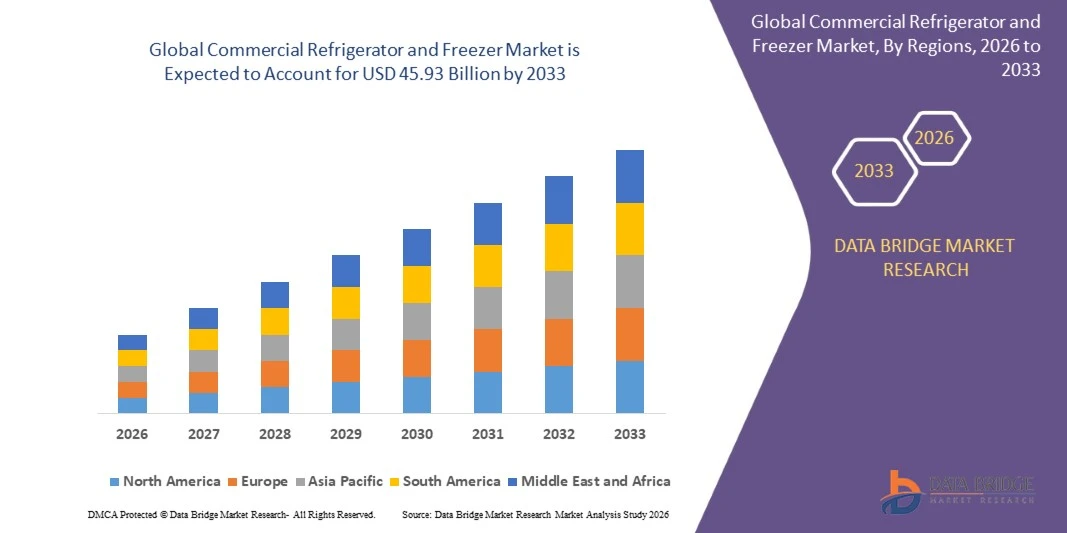
- As per Data Bridge Market Research analysis, the commercial refrigerator and freezer market was valued at USD 26.73 billion in 2025 and is projected to reach USD 45.93 billion by 2033, growing at a CAGR of 7.0% from 2026 to 2033, across food retail and foodservice.
- The market is experiencing consistent growth driven by rising demand for fresh and frozen food, increasing expansion of retail and foodservice outlets, and expanding applications across supermarkets, restaurants, convenience stores, healthcare facilities, and institutional catering worldwide.
- The increasing shift toward energy-efficient equipment, natural refrigerants, and cold chain integrity, combined with growing expansion of organized retail, quick-service restaurants, and online food delivery, is supporting market adoption. Commercial refrigerators and freezers are being applied across supermarket display cases, restaurant reach-in units, walk-in cold rooms, beverage coolers, and commercial refrigeration equipment, offering operators reliable temperature control, product safety, and lower energy use within modern cold chain networks.
Market Size & Forecast
- Global Market Value (2025): USD 26.73 Billion
- Expected Market Value (2033): USD 45.93 Billion
- Forecast CAGR (2026–2033): 7.0%
- Leading Region in 2025: North America
- Fastest Growing Region: Asia-Pacific
What are the Major Takeaways of the Commercial Refrigerator and Freezer Market?
- North America dominated the commercial refrigerator and freezer market with the largest revenue share of 33.60% in 2025, supported by extensive supermarket and restaurant networks, strong equipment replacement cycles, and early adoption of energy-efficient and low-GWP technologies across the region and neighboring markets.
- Asia-Pacific is expected to be the fastest-growing region at a CAGR of 8.60% from 2026 to 2033, fueled by rapid retail modernization, expanding foodservice chains, and growing investment in cold chain infrastructure across urban and emerging markets.
- The reach-in segment led the market with a 41.2% share in 2025, driven by extensive use in restaurants, convenience stores, and foodservice kitchens across regions.
- Walk-in units are the fastest-growing equipment type, projected to register a CAGR of 8.3%, reflecting the surge in demand for bulk cold storage in retail and foodservice distribution.
- The display and merchandising segment dominated the application category with a 46.1% revenue share in 2025, led by extensive use in supermarkets and convenience stores.
- Supermarkets and hypermarkets accounted for 36.9% of the market share in 2025, preferred by increasing fresh and frozen food assortments and store expansion.
- The healthcare and pharmaceutical segment is the fastest-growing end-user category, with a CAGR of 8.8%, driven by increasing vaccine storage and specialty drug distribution.
Report Scope and Commercial Refrigerator and Freezer Market Segmentation
|
Attributes |
Commercial Refrigerator and Freezer Key Market Insights |
|
Segments Covered |
|
|
Countries Covered |
North America
Europe
Asia-Pacific
Middle East and Africa
South America
|
|
Key Market Players |
|
|
Market Opportunities |
|
|
Value Added Data Infosets |
In addition to the insights on market scenarios such as market value, growth rate, segmentation, geographical coverage, and major players, the market reports curated by the Data Bridge Market Research also include in-depth expert analysis, pricing analysis, brand share analysis, consumer survey, demography analysis, supply chain analysis, value chain analysis, raw material/consumables overview, vendor selection criteria, PESTLE Analysis, Porter Analysis, and regulatory framework. |
What is the Key Trend in the Commercial Refrigerator and Freezer Market?
- Manufacturers are increasingly shifting toward natural refrigerants such as CO2 and propane, combining high-efficiency compressors, plug-in and integrated cabinet designs, and digital monitoring to meet regulatory requirements and reduce operating costs for retailers and foodservice operators across regions.
- For instance, in February 2026, EuroShop 2026 in Düsseldorf highlighted CO2 and R290 refrigeration systems, with exhibitors presenting transcritical CO2 equipment, R290 and CO2 commercial units, and CO2 condensing units up to 29 kW for medium temperature and 15 kW for low temperature applications, alongside cabinet formats focused on merchandising and total store integration.
- Retailers are integrating refrigeration with building energy management, using sensors, controls, and remote monitoring to improve efficiency, food safety, and maintenance planning.
- Plug-in cabinets and islands focused on merchandising are gaining relevance as retailers seek flexible layouts, lower refrigerant charge, and easier installation across store formats, supported by plug-in islands and cabinets from specialists such as CCR and HAUSER.
- For instance, in February 2026, Copeland introduced a CO2 scroll compressor with dynamic vapor injection designed for distributed CO2 refrigeration systems, reflecting growing component innovation for natural refrigerant commercial equipment, as suppliers focus on efficiency, reliability, and part-load performance for supermarkets and other retail formats.
- As regulation, energy costs, and food safety expectations continue to tighten, commercial refrigerators and freezers are expected to evolve into connected, low-GWP, and highly efficient cold chain assets across regions worldwide.
What are the Key Drivers of the Commercial Refrigerator and Freezer Market?
- Rising consumption of fresh, chilled, and frozen foods, along with expansion of supermarkets, restaurants, and convenience stores, is increasing demand for reliable commercial refrigeration equipment worldwide.
- For instance, in March 2024, according to Umweltbundesamt, Regulation (EU) 2024/573 came into force, and from 1 January 2025 commercial refrigerators and freezers containing fluorinated gases with a GWP of 150 or more can no longer be placed on the EU market, driving equipment replacement and adoption of natural refrigerants.
- Growth of organized retail, quick-service restaurants, and online food delivery is increasing installations of display cases, reach-in units, and walk-in cold rooms across urban and emerging markets and developing economies.
- For instance, in February 2024, Carrier announced an agreement to sell Carrier Commercial Refrigeration, with more than 4,000 employees, to Haier Smart Home, which planned to expand into food retail refrigeration and cold storage, building on a 22-year refrigeration partnership between the two companies.
- With rising energy costs and sustainability targets, operators are replacing older units with efficient models that reduce electricity use, refrigerant leakage, and maintenance costs across store networks.
What Factors Are Challenging the Growth of the Commercial Refrigerator and Freezer Market?
- Commercial refrigeration equipment requires high capital investment, careful installation, and regular maintenance, while refrigerant transitions, safety requirements, and component costs can raise prices for operators and small businesses.
- For instance, in October 2025, the U.S. EPA proposed an interim GWP limit of 1,400 from January 2026 for new remote condensing units, illustrating regulatory uncertainty as the HFC transition timeline continues to evolve.
- Flammable refrigerants such as propane require charge limits, safety design, and technician training, while CO2 systems require higher pressure components, which can increase complexity and cost for smaller operators and installers.
- Shifting regulations across regions create compliance burdens for manufacturers, who must redesign products, update labeling, and manage inventory across different refrigerant requirements, which can delay launches and raise engineering and certification costs.
- For instance, in January 2025, according to a regulatory summary of Commission Implementing Regulation (EU) 2025/33, certain self-contained refrigeration equipment with GWP of 150 or more was authorised on the EU market only until 30 June 2026 if properly labelled, illustrating transition complexity for manufacturers, distributors, and operators that must manage stock, labelling, and replacement planning.
- The combination of refrigerant regulation, higher equipment costs, safety requirements, and capital constraints can limit expansion among small retailers and restaurants, particularly where older equipment still meets basic cooling needs or where service providers lack natural refrigerant expertise.
How is the Commercial Refrigerator and Freezer Market Segmented?
The commercial refrigerator and freezer market is segmented on the basis of product, equipment type, application, and end user across regions.
- By Product
On the basis of product, the commercial refrigerator and freezer market is segmented into refrigerators and freezers. The refrigerators segment dominated the market with 58.4% share in 2025, supported by extensive use in supermarkets, restaurants, and convenience stores for chilled foods and beverages. Commercial refrigerators provide stable temperature control for dairy, produce, beverages, and prepared foods. They are widely used across retail, hospitality, and institutional kitchens. Improvements in compressors, insulation, and LED lighting are further strengthening demand. Integration with controls and remote monitoring also enables better efficiency and food safety across store networks, while energy-efficient glass doors and night covers help reduce losses.
The freezers segment is projected to register the fastest growth at a CAGR of 7.6% from 2026 to 2033, driven by increasing demand for frozen foods, ice cream, and ready meals. Commercial freezers offer deep temperature storage for meat, seafood, frozen desserts, and pharmaceuticals. Their applications include supermarkets, restaurants, catering, and healthcare facilities. Increasing frozen food assortments are creating additional demand across retailers and distributors. Improvements in defrost control and door design are enhancing efficiency. Energy-saving glass doors are also expanding commercial use. Integration with remote monitoring and compressor controls supports reliable temperature performance, and CO2 and propane freezers are being introduced to meet refrigerant regulations.
- By Equipment Type
On the basis of equipment type, the commercial refrigerator and freezer market is segmented into reach-in, walk-in, and display & merchandisers. The reach-in segment dominated the market with 41.2% share in 2025, supported by extensive use in restaurants, convenience stores, bars, and foodservice kitchens. Reach-in units offer a balanced combination of capacity, footprint, and accessibility for high-volume operations. Their availability across multiple sizes and suppliers expands the potential customer base. Operators use them for daily storage close to preparation areas. The segment also benefits from established replacement cycles and widespread service networks.
The walk-in segment is projected to register the fastest growth at a CAGR of 8.3% from 2026 to 2033, supported by increasing demand for bulk storage, expanding supermarkets, and growth in commissary kitchens and food distribution. Walk-in cold rooms enable large-volume storage with flexible layouts and temperature zones. Operators are increasingly investing in modular panels and efficient refrigeration systems. Suppliers are developing systems with natural refrigerants and advanced controls. Improved insulation and monitoring further strengthen the segment’s attractiveness. Installation costs and space requirements remain important considerations for expansion. Modular panels also allow faster installation and easier expansion for growing food businesses.
- By Application
On the basis of application, the commercial refrigerator and freezer market is segmented into display & merchandising, storage & preservation, beverage cooling, and others. The display and merchandising segment dominated the application category with 46.1% share in 2025, supported by extensive use in supermarkets and convenience stores. Display cases present chilled and frozen products while maintaining stable temperatures. Retail competition is increasing the use of attractive, efficient cabinets. Growth in fresh food assortments further strengthens demand. Retailers are also seeking equipment that combines visibility, energy savings, and easy maintenance across store formats and customer traffic patterns. Plug-in cabinets and islands are increasingly selected for flexible store layouts.
The beverage cooling segment is projected to register the fastest growth at a CAGR of 8.2% from 2026 to 2033, driven by increasing consumption of packaged drinks, expansion of convenience retail, and brand-led cooler placement. Bottle coolers and glass-door units support visibility and cold serving temperatures. Beverage companies and retailers in Asia-Pacific, Latin America, and Europe are investing in efficient coolers. Rising impulse purchases are creating additional opportunities. Natural refrigerant and LED-equipped models make coolers particularly attractive to sustainability-focused brands. Supportive branding programs can further improve placement across regions. Glass-door coolers with LED lighting and efficient compressors are increasingly specified by beverage brands.
- By End User
On the basis of end user, the commercial refrigerator and freezer market is segmented into supermarkets & hypermarkets, restaurants & hotels, convenience stores, healthcare & pharmaceutical, catering & institutions, and others. The supermarkets and hypermarkets segment dominated the end-user category with 36.9% share in 2025, supported by increasing fresh and frozen food assortments. Large retailers rely on refrigeration for display, storage, and food safety compliance. The segment includes plug-in cabinets, remote condensing systems, and integrated CO2 solutions. Increasing store openings and remodels are creating further opportunities. Large store networks also make energy cost, service support, and refrigerant strategy important considerations in purchase decisions.
The healthcare and pharmaceutical segment is projected to register the fastest growth at CAGR of 8.8% from 2026 to 2033, driven by increasing vaccine storage, specialty drug distribution, and laboratory needs. Hospitals, pharmacies, and distributors require precise temperature control, alarms, and monitoring for sensitive products. Suppliers are expanding portfolios of medical-grade refrigerators and freezers. Closer collaboration between equipment makers and healthcare providers is accelerating development of validated solutions. Strict compliance requirements are further supporting adoption. Reliability, validation, and service remain important considerations for deployment, particularly for vaccine storage, laboratory refrigeration, and pharmacy distribution.
Which Region Holds the Largest Share of the Commercial Refrigerator and Freezer Market?
- North America dominated the commercial refrigerator and freezer market with the largest revenue share of 33.60% in 2025, supported by extensive supermarket and restaurant networks, strong equipment replacement cycles, and early adoption of energy-efficient and low-GWP technologies across the region and neighboring markets.
- The region also benefits from large supermarket and restaurant chains, strong foodservice demand, and the presence of established equipment manufacturers, along with growing emphasis on energy efficiency and low-GWP refrigerants. Increasing replacement cycles, remodeling activity, and cold chain investment continue to strengthen North America’s position in the global market.
U.S. Commercial Refrigerator and Freezer Market Insight
The U.S. commercial refrigerator and freezer market is witnessing consistent growth due to rising investments in store remodeling, restaurant expansion, and refrigerant transition. Retailers, restaurant operators, and equipment suppliers are increasingly focusing on efficiency and compliance. Moreover, a large food retail base and continued regulatory developments on HFC limits, supported by strong distributor and service networks, are further contributing to market growth in the U.S.
Canada Commercial Refrigerator and Freezer Market Insight
Canada’s commercial refrigerator and freezer market is witnessing steady growth, driven by expanding foodservice operations, supermarket modernization, and increasing cold-chain requirements. Demand for energy-efficient refrigerators, walk-in freezers, and advanced display units is rising. Sustainability regulations are encouraging the adoption of low-global-warming-potential refrigerants and eco-friendly technologies. Equipment replacement, operational cost reduction, and food safety compliance present significant opportunities for manufacturers. Technological innovation and efficient cooling solutions will shape future market competitiveness.
Asia-Pacific Commercial Refrigerator and Freezer Market Insight
The Asia-Pacific commercial refrigerator and freezer market is expected to witness rapid growth, driven by expanding organized retail, rising foodservice chains, and increasing investment in cold chain infrastructure across countries such as China, India, Japan, and Australia. Growing urban populations, rising incomes, and demand for fresh and frozen foods are supporting regional market expansion. In addition, the region’s strong manufacturing base and rapid growth of convenience stores and e-commerce grocery are accelerating demand for commercial refrigeration across retail and foodservice.
China Commercial Refrigerator and Freezer Market Insight
The China commercial refrigerator and freezer market is growing steadily, driven by rapid retail modernization, expanding chain restaurants, and strong investment in cold chain logistics. Growing use of display cases, walk-in cold rooms, and beverage coolers is boosting market demand. In addition, the country’s large manufacturing base, domestic brands, and rising focus on energy efficiency are positioning China as an important market across Asia-Pacific, supported by growth in online grocery delivery.
India Commercial Refrigerator and Freezer Market Insight
The India commercial refrigerator and freezer market is expanding steadily due to the country’s growing organized retail, quick-service restaurants, and dairy and beverage distribution. Retailers, restaurants, and distributors are increasingly utilizing reach-in and display equipment. Continuous advancements in local manufacturing, cold chain investment, and energy-efficient models, along with rising consumption of packaged foods, are further driving market growth in the country, particularly across expanding urban retail and quick-service restaurant chains.
Which are the Top Companies in Commercial Refrigerator and Freezer Market?
The commercial refrigerator and freezer industry is primarily led by well-established companies, including:
- Haier Smart Home Co., Ltd. (China)
- Carrier Global Corporation (U.S.)
- Daikin Industries, Ltd. (Japan)
- Electrolux Professional AB (Sweden)
- True Manufacturing Co., Inc. (U.S.)
- Hussmann Corporation (U.S.)
- Hillphoenix (U.S.)
- Epta S.p.A. (Italy)
- Hoshizaki Corporation (Japan)
- AHT Cooling Systems GmbH (Austria)
- The Middleby Corporation (U.S.)
- Illinois Tool Works Inc. (U.S.)
- Panasonic Holdings Corporation (Japan)
- Arneg S.p.A. (Italy)
- Frigoglass S.A.I.C. (Greece)
- Liebherr-International AG (Switzerland)
- Gram Commercial A/S (Denmark)
- Blue Star Limited (India)
- Danfoss A/S (Denmark)
- Standex International Corporation (U.S.)
What are Latest Developments in Commercial Refrigerator and Freezer Market?
- In February 2026, Epta announced the closing of its acquisition of Austria’s Hauser, a specialist in plug-in cabinets and islands for food retail, strengthening Epta’s commercial refrigeration portfolio, European presence, and ability to offer flexible merchandising solutions for supermarkets and convenience formats, while supporting growing demand for low-GWP cabinets and efficient display equipment.
- In February 2026, Copeland introduced a CO2 scroll compressor with dynamic vapor injection, designed for distributed CO2 refrigeration systems, supporting retailers and equipment makers as they adopt natural refrigerants and seek improved efficiency, reliability, and part-load performance in commercial refrigeration applications, particularly for supermarkets, convenience stores, and other food retail formats.
- In February 2026, EuroShop in Düsseldorf featured transcritical CO2 systems from Arneg, R290 and CO2 equipment from FREOR, CO2 condensing units from Panasonic up to 29 kW medium temperature and 15 kW low temperature, plug-in islands from CCR and HAUSER, and monitoring solutions from CAREL and Danfoss, with exhibitors focusing on CO2 and R290 options, merchandising cabinets, and total store integration.
- In 2026, Beijer Ref announced an acquisition in Lithuania of Refra, a Vilnius-based maker of custom cooling and heating systems using CO2 and propane with annual turnover of about SEK 500 million, subject to approval by the Lithuanian competition authority, expanding its natural refrigerant offering and adding expertise in CO2 refrigeration and propane chillers for commercial and industrial customers.
- In October 2025, the U.S. EPA published a proposed rule providing targeted relief from the 2023 HFC Technology Transitions Rule, including an interim GWP limit of 1,400 for new remote condensing units from January 2026 and supermarket systems from January 2027, before limits revert to 150 or 300 from January 2032, reflecting continuing regulatory adjustments for retail food refrigeration in the United States.
- Interactive Data Analysis Dashboard
- Company Analysis Dashboard for high growth potential opportunities
- Research Analyst Access for customization & queries
- Competitor Analysis with Interactive dashboard
- Latest News, Updates & Trend analysis
- Harness the Power of Benchmark Analysis for Comprehensive Competitor Tracking
Data collection and base year analysis are done using data collection modules with large sample sizes. The stage includes obtaining market information or related data through various sources and strategies. It includes examining and planning all the data acquired from the past in advance. It likewise envelops the examination of information inconsistencies seen across different information sources. The market data is analysed and estimated using market statistical and coherent models. Also, market share analysis and key trend analysis are the major success factors in the market report. To know more, please request an analyst call or drop down your inquiry.
The key research methodology used by DBMR research team is data triangulation which involves data mining, analysis of the impact of data variables on the market and primary (industry expert) validation. Data models include Vendor Positioning Grid, Market Time Line Analysis, Market Overview and Guide, Company Positioning Grid, Patent Analysis, Pricing Analysis, Company Market Share Analysis, Standards of Measurement, Global versus Regional and Vendor Share Analysis. To know more about the research methodology, drop in an inquiry to speak to our industry experts.
Data Bridge Market Research is a leader in advanced formative research. We take pride in servicing our existing and new customers with data and analysis that match and suits their goal. The report can be customized to include price trend analysis of target brands understanding the market for additional countries (ask for the list of countries), clinical trial results data, literature review, refurbished market and product base analysis. Market analysis of target competitors can be analyzed from technology-based analysis to market portfolio strategies. We can add as many competitors that you require data about in the format and data style you are looking for. Our team of analysts can also provide you data in crude raw excel files pivot tables (Fact book) or can assist you in creating presentations from the data sets available in the report.