


What is the Counter-Unmanned Aircraft Systems (Counter-UAS) Market Size and Growth Rate?
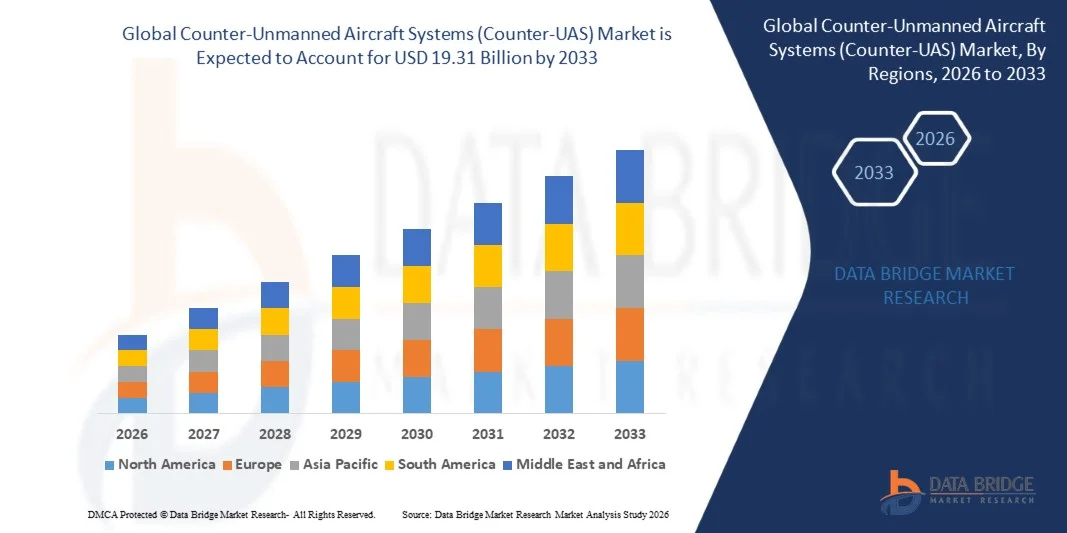
- As per Data Bridge Market Research analysis, the counter-unmanned aircraft systems (Counter-UAS) market was valued at USD 3.20 billion in 2025 and is projected to reach USD 19.31 billion by 2033, growing at a CAGR of 25.20% from 2026 to 2033.
- The market is experiencing consistent growth driven by rising security concerns related to unauthorized drone activities, increasing adoption of counter-drone solutions across defense and homeland security applications, and rapid advancements in radar, radio frequency (RF), electro-optical/infrared (EO/IR), artificial intelligence, and integrated detection technologies.
- The increasing deployment of unmanned aerial systems for military operations, illicit activities, and security threats, combined with the growing need to protect critical infrastructure, airports, military bases, borders, and public spaces, is compelling governments and defense organizations to adopt advanced Counter-UAS technologies. Detection and tracking systems, RF jamming solutions, electronic warfare systems, and integrated counter-drone platforms are increasingly being deployed to provide automated, scalable, and effective protection against evolving drone threats.
Market Size & Forecast
- Global Market Value (2025): USD 3.20 Billion
- Expected Market Value (2033): USD 19.31 Billion
- Forecast CAGR (2026–2033): 25.20%
- Leading Region in 2025: North America
- Fastest Growing Region: Asia Pacific
What are the Major Takeaways of the Counter-Unmanned Aircraft Systems (Counter-UAS) Market?
- North America dominated the counter-unmanned aircraft systems (Counter-UAS) market with the largest revenue share of 49% in 2025, supported by extensive defense spending, heightened awareness of drone threats to critical infrastructure, and a mature counter-drone technology ecosystem.
- Asia-Pacific is expected to be the fastest-growing region at a CAGR of 24.72% from 2026 to 2033, fueled by increasing military expenditures, rising drone incursions, and expanding investments in counter-drone technologies across Australia, Japan, India, and other regional markets.
- The standalone systems segment led the market with a 42% share in 2025, driven by increasing deployment across military bases, airports, critical infrastructure facilities, and border security applications
- Portable are the fastest-growing system configuration type, projected to register a CAGR of 30%, reflecting the surge in demand for mobile and rapidly deployable drone defense solutions.
- The hardware segment dominated the component category with a 58.3% revenue share in 2025, led by increasing demand for radar systems, RF sensors, jammers, electro-optical cameras, and kinetic counter-drone equipment.
- Electronic systems accounted for 43.4% of the market share in 2025, preferred by widespread adoption of RF jamming, spoofing, and electronic warfare technologies for neutralizing unauthorized drones.
- The naval segment is the fastest-growing deployment category, with a CAGR of 24.0%, driven by increasing concerns regarding drone threats targeting naval vessels, maritime infrastructure, and coastal security operations.
Report Scope and Counter-Unmanned Aircraft Systems (Counter-UAS) Market Segmentation
|
Attributes |
Counter-Unmanned Aircraft Systems (Counter-UAS) Key Market Insights |
|
Segments Covered |
|
|
Countries Covered |
North America
Europe
Asia-Pacific
Middle East and Africa
South America
|
|
Key Market Players |
|
|
Market Opportunities |
|
|
Value Added Data Infosets |
|
What is the Key Trend in the Counter-Unmanned Aircraft Systems (Counter-UAS) Market?
- Defense forces and security organizations are increasingly adopting layered Counter-UAS architectures that combine radar, radio-frequency sensors, electro-optical/infrared systems, command-and-control software, and electronic or kinetic effectors to detect and neutralize increasingly sophisticated drone threats.
- For instance, in February 2025, Lockheed Martin demonstrated a scalable Counter-UAS solution combining AI-enabled detection and tracking software, low-cost sensors, command-and-control, and multiple effectors to provide layered protection against small unmanned aircraft systems.
- AI-enabled sensor fusion and automated target classification are increasingly being integrated into Counter-UAS platforms to improve detection accuracy, accelerate threat identification, and reduce operator workload during complex drone incursions.
- Critical infrastructure operators, military installations, airports, and public-security organizations are increasingly deploying multi-sensor Counter-UAS systems to provide continuous monitoring and rapid response against unauthorized drones.
- For instance, in March 2025, DroneShield expanded its DroneSentry Counter-UAS portfolio with configurable multi-sensor detection and tracking capabilities, including AI-enabled SensorFusionAI, for government, critical-infrastructure, and military applications.
- As drone threats continue to evolve toward larger numbers, greater autonomy, and more complex flight profiles, demand for integrated, AI-enabled, and scalable Counter-UAS architectures is expected to accelerate, reinforcing layered defense as a core component of modern airspace security.
What are the Key Drivers of the Counter-Unmanned Aircraft Systems (Counter-UAS) Market?
- The rapid proliferation of commercial and military drones and their increasing use for surveillance, reconnaissance, and attack missions has significantly increased demand for Counter-UAS systems capable of detecting, tracking, identifying, and neutralizing unauthorized aerial threats.
- For instance, in January 2026, the U.S. Army’s Joint Interagency Task Force 401 announced its first Replicator 2 acquisition, purchasing two DroneHunter F700 systems specifically to counter the growing threat from small UAS and protect military installations and critical infrastructure.
- Military organizations, homeland-security agencies, and critical-infrastructure operators are integrating Counter-UAS technologies into their security architectures to protect personnel, military installations, airports, ports, energy facilities, and other high-value assets from increasingly accessible drone threats.
- For instance, in September 2024, NATO conducted its C-UAS Technical Interoperability Exercise in the Netherlands, involving 450 participants from 19 Allied and three Partner Nations and testing more than 60 sensors, effectors, jammers, and other technologies to detect, identify, and neutralize drones.
- With governments and defense organizations increasingly prioritizing protection against low-cost and rapidly evolving unmanned aerial threats, Counter-UAS systems will remain essential for strengthening airspace security, protecting critical assets, and supporting next-generation defense operations.
What Factors are Challenging the Growth of the Counter-Unmanned Aircraft Systems (Counter-UAS) Market?
- Advanced Counter-UAS systems require significant investment because they combine specialized sensors, command-and-control platforms, electronic warfare equipment, kinetic interceptors, and other sophisticated detection and mitigation technologies.
- For instance, in April 2024, the Pentagon's acquisition chief stated that counter-drone engagements costing more than USD 100,000 per shot were becoming too expensive, emphasizing the need to reduce the cost of defeating unmanned aerial systems.
- The high cost of certain interception technologies creates affordability challenges when inexpensive drones are deployed in large numbers, particularly for military organizations seeking scalable and sustainable defensive capabilities.
- Counter-UAS procurement also faces challenges related to rapidly evolving drone technologies, interoperability requirements, testing, certification, and integration with existing command-and-control networks, increasing deployment complexity for defense and security organizations.
- For instance, in January 2024, Unmanned Airspace highlighted procurement challenges identified from Ukraine, including the need for Counter-UAS systems to be acquired rapidly, deployed at massive scale, remain affordable, and integrate effectively into operational environments.
- The combination of high interception costs, complex system integration, and rapidly changing drone threats continues to challenge widespread Counter-UAS deployment, particularly where organizations require affordable, scalable, and interoperable solutions capable of addressing large numbers of diverse aerial threats.
How is the Counter-Unmanned Aircraft Systems (Counter-UAS) Market Segmented?
The counter-unmanned aircraft systems (Counter-UAS) market is segmented on the basis of system configuration, component, technology, deployment, power source, range of operation, end user, and distribution channel.
- By System Configuration
On the basis of system configuration, the counter-unmanned aircraft systems (Counter-UAS) market is segmented into portable, vehicle-mounted, and standalone systems. The standalone systems segment dominated the market with 42% share in 2025, owing to increasing deployment across military bases, airports, critical infrastructure facilities, and border security applications. These systems provide continuous monitoring and protection through integrated radar, RF, EO/IR, and command-and-control technologies. Standalone platforms are preferred for fixed-location defense requirements where persistent drone detection and mitigation are essential. Their ability to combine multiple detection and neutralization technologies within a single infrastructure framework improves operational efficiency.
The portable Counter-UAS systems segment is projected to register the fastest growth at a CAGR of 30% from 2026 to 2033, driven by increasing demand for mobile and rapidly deployable drone defense solutions. These lightweight systems enable military personnel, law enforcement agencies, and security teams to counter unauthorized drones in dynamic operational environments. Portable solutions offer flexibility for battlefield operations, temporary security events, and emergency response applications. Advances in miniaturized sensors, electronic warfare technologies, and battery efficiency are improving system performance. Rising demand for expeditionary defense capabilities and protection against small unmanned aircraft threats is accelerating adoption.
- By Component
On the basis of component, the counter-unmanned aircraft systems (Counter-UAS) market is segmented into hardware, software, and services. The hardware segment dominated the market with 58.3% share in 2025, supported by increasing demand for radar systems, RF sensors, jammers, electro-optical cameras, and kinetic counter-drone equipment. Hardware components form the core infrastructure required for detecting, tracking, identifying, and neutralizing unauthorized unmanned aircraft. Defense organizations are investing heavily in advanced sensor networks and electronic warfare equipment to enhance airspace protection. Continuous improvements in radar accuracy, detection range, and mitigation effectiveness are strengthening hardware adoption. The growing deployment of integrated Counter-UAS platforms across military and homeland security applications is further supporting market expansion.
The software segment is expected to witness the fastest growth at a CAGR of 15.2% from 2026 to 2033, driven by increasing integration of artificial intelligence, machine learning, and advanced analytics into Counter-UAS platforms. Software solutions improve automated threat identification, target classification, and real-time decision-making capabilities. AI-based algorithms enable faster detection of small and low-altitude drones operating in complex environments. Increasing demand for centralized command-and-control platforms is encouraging adoption of advanced software solutions. Software upgrades also allow existing hardware systems to improve performance without complete replacement.
- By Technology
On the basis of technology, the counter-unmanned aircraft systems (Counter-UAS) market is segmented into laser systems, kinetic defeat technologies, and electronic systems. The electronic systems segment dominated the market with 43.4% share in 2025, driven by widespread adoption of RF jamming, spoofing, and electronic warfare technologies for neutralizing unauthorized drones. Electronic Counter-UAS solutions provide effective mitigation without requiring physical destruction of the target aircraft. These systems are increasingly deployed by defense forces, airports, and security agencies due to their operational flexibility. Growing concerns regarding drone-based surveillance, smuggling, and battlefield threats are increasing demand for electronic countermeasures.
The laser systems segment is projected to register the fastest growth at a CAGR of 25% from 2026 to 2033, supported by increasing demand for precise, cost-effective, and non-kinetic drone neutralization solutions. Laser-based Counter-UAS systems provide accurate engagement capabilities with reduced operational costs compared with conventional interception methods. Continuous advancements in directed-energy technologies are improving range, accuracy, and response time. Defense organizations are increasingly evaluating laser systems for protection against drone swarms and repeated aerial threats. These systems offer advantages such as low ammunition dependency and rapid engagement capability.
- By Deployment
On the basis of deployment, the counter-unmanned aircraft systems (Counter-UAS) market is segmented into air, land, and naval systems. The land deployment segment dominated the market with 42% share in 2025, driven by increasing demand for ground-based counter-drone solutions across military installations, border security zones, airports, and critical infrastructure facilities. Land-based Counter-UAS systems provide flexible protection through fixed and mobile platforms equipped with radar, RF detection, electronic warfare, and kinetic interception capabilities. Defense organizations widely deploy these systems to safeguard troops, command centers, and strategic assets from unauthorized unmanned aircraft threats. Rising adoption of ground-based surveillance networks and integrated air defense systems is further supporting segment growth.
The naval deployment segment is projected to register the fastest growth at a CAGR of 24.0% from 2026 to 2033, driven by increasing concerns regarding drone threats targeting naval vessels, maritime infrastructure, and coastal security operations. Naval forces are investing in advanced Counter-UAS systems to protect aircraft carriers, warships, ports, and offshore assets from aerial surveillance and attack drones. Integration of radar, electronic warfare, and autonomous detection systems is enhancing maritime threat response capabilities. Growing adoption of unmanned systems in naval warfare is increasing the need for specialized counter-drone solutions. Rising geopolitical tensions and maritime security challenges are encouraging governments to strengthen naval defense capabilities.
- By Power Source
On the basis of power source, the counter-unmanned aircraft systems (Counter-UAS) market is segmented into battery-powered, plug-in/electric, hybrid, and fuel-based systems. The plug-in/electric power source segment dominated the market with 40% share in 2025, supported by widespread adoption of fixed Counter-UAS installations requiring continuous and reliable power supply. These systems are commonly deployed at airports, military bases, government facilities, and critical infrastructure sites where uninterrupted operation is essential. Electric-powered solutions provide stable performance for radar systems, sensors, command platforms, and electronic mitigation technologies. Their lower operational complexity and reduced maintenance requirements make them suitable for long-duration security applications.
The hybrid power source segment is expected to witness the fastest growth at a CAGR of 27% from 2026 to 2033, driven by increasing demand for flexible Counter-UAS solutions capable of operating across diverse environments. Hybrid systems combine multiple energy sources to provide extended operational endurance and improved mobility. These systems are particularly suitable for military missions, remote surveillance operations, and temporary security deployments. Advances in energy storage technologies and efficient power management systems are improving hybrid platform performance. Defense organizations are increasingly adopting mobile Counter-UAS solutions requiring longer operational periods without frequent recharging or refueling.
- By Range of Operation
On the basis of range of operation, the counter-unmanned aircraft systems (Counter-UAS) market is segmented into under 10 km, 10–15 km, 15–20 km, and above 20 km. The 10–15 km range segment dominated the market with 35% share in 2025, owing to its balance between operational effectiveness, deployment flexibility, and cost efficiency. Systems within this range are widely used for protecting military facilities, airports, and industrial sites against small and medium-range drone threats. These solutions provide sufficient detection and mitigation distance for many tactical and security applications. Increasing adoption of medium-range radar and RF-based Counter-UAS technologies is supporting segment growth. Defense and homeland security agencies prefer these systems because they provide effective protection without excessive infrastructure requirements.
The above 20 km range segment is projected to be the fastest-growing segment at a CAGR of 28% from 2026 to 2033, driven by increasing demand for extended-area protection against advanced unmanned aerial threats. Long-range Counter-UAS systems enable early detection and response, improving protection of large military bases, borders, and critical infrastructure networks. Advances in radar technology, satellite communication, and integrated command systems are enhancing long-distance threat monitoring capabilities. Growing deployment of drones with improved endurance and operational range is increasing demand for extended-range countermeasures. Military organizations are prioritizing layered defense systems capable of identifying threats before they approach protected zones.
- By End User
On the basis of end user, the counter-unmanned aircraft systems (Counter-UAS) market is segmented into defense & military, homeland security, commercial & industrial, and others. The defense & military segment dominated the market with 52.3% share in 2025, supported by increasing use of unmanned aerial systems in modern warfare, intelligence operations, and battlefield missions. Military organizations are investing heavily in Counter-UAS technologies to protect personnel, equipment, and strategic assets from hostile drones. The growing adoption of drone-based attacks and surveillance activities has increased demand for advanced detection and mitigation solutions. Defense agencies are deploying integrated systems combining radar, electronic warfare, and kinetic technologies.
The commercial & industrial segment is expected to register the fastest growth at a CAGR of 24% from 2026 to 2033, driven by increasing concerns regarding unauthorized drone activity around airports, energy facilities, manufacturing sites, and public venues. Commercial operators are adopting Counter-UAS solutions to improve security, prevent operational disruptions, and protect sensitive assets. Growing drone usage in logistics, surveillance, and industrial inspection is increasing the need for controlled airspace management. Advances in affordable detection technologies are making Counter-UAS solutions more accessible for non-defense users. Regulatory developments supporting drone monitoring and security applications are further encouraging adoption.
- By Distribution Channel
On the basis of distribution channel, the counter-unmanned aircraft systems (Counter-UAS) market is segmented into online and offline channels. The offline distribution channel dominated the market with 75% share in 2025, driven by the complex procurement requirements and customized integration needs associated with Counter-UAS systems. Defense agencies, government organizations, and large enterprises typically purchase these systems through direct contracts with manufacturers and authorized solution providers. Offline channels enable technical consultation, system customization, installation support, and after-sales services. Large-scale procurement programs often require extensive evaluation, testing, and integration before deployment. Increasing demand for mission-specific Counter-UAS solutions continues to support offline purchasing models.
The online distribution channel is projected to register the fastest growth at a CAGR of 20% from 2026 to 2033, supported by increasing availability of commercial-grade counter-drone solutions and digital procurement platforms. Online channels allow organizations to compare technologies, access product specifications, and streamline purchasing processes. Growing adoption among commercial users, security providers, and smaller organizations is encouraging digital sales expansion. Manufacturers are increasingly developing online platforms to improve product accessibility and customer engagement. Rising demand for portable and affordable Counter-UAS solutions is further supporting online adoption.
Which Region Holds the Largest Share of the Counter-Unmanned Aircraft Systems (Counter-UAS) Market?
- North America dominated the counter-unmanned aircraft systems (Counter-UAS) market with the largest revenue share of 49% in 2025, supported by extensive defense spending, heightened awareness of drone threats to critical infrastructure, and a mature counter-drone technology ecosystem.
- The region also benefits from increasing protection requirements for military installations, airports, borders, energy assets, ports, and other critical infrastructure, alongside the presence of established defense technology providers and growing deployment of layered detection, tracking, command-and-control, and mitigation systems. Increasing investments in advanced airspace security and counter-drone capabilities continue to strengthen North America's leadership position in the global market.
U.S. Counter-Unmanned Aircraft Systems (Counter-UAS) Market Insight
The U.S. counter-unmanned aircraft systems (Counter-UAS) market is witnessing strong growth due to rising investments in homeland security, military base protection, border surveillance, and advanced counter-drone technologies. The country’s mature defense ecosystem, along with increasing adoption of AI-enabled detection, electronic warfare, and layered counter-UAS systems, is driving demand across defense and security applications. In addition, growing concerns regarding unauthorized drone activity and the protection of critical infrastructure are accelerating deployment of integrated detection, tracking, and mitigation solutions.
Asia-Pacific Counter-Unmanned Aircraft Systems (Counter-UAS) Market Insight
The Asia-Pacific counter-unmanned aircraft systems (Counter-UAS) market is expected to witness rapid growth, driven by increasing geopolitical tensions, defense modernization programs, and rising requirements for border and airspace security across countries such as China, India, Japan, and South Korea. Growing investments in electronic warfare, radar-based detection, and integrated counter-drone capabilities are supporting regional market expansion. In addition, increasing focus on indigenous defense technologies and protection of military bases, ports, airports, and critical infrastructure is accelerating Counter-UAS adoption across military and homeland security sectors.
Japan Counter-Unmanned Aircraft Systems (Counter-UAS) Market Insight
The Japan counter-unmanned aircraft systems (Counter-UAS) market is witnessing consistent growth due to rising investments in base protection, advanced defense technologies, and counter-drone capabilities. The Japan Ministry of Defense is increasing efforts to introduce higher-performance counter-drone equipment capable of detecting, identifying, and jamming drones intruding into Self-Defense Forces bases. Moreover, growing emphasis on protecting military installations, naval facilities, and other important infrastructure is supporting the adoption of advanced Counter-UAS solutions across Japan.
China Counter-Unmanned Aircraft Systems (Counter-UAS) Market Insight
The China counter-unmanned aircraft systems (Counter-UAS) market is growing rapidly, driven by increasing defense modernization, rising adoption of unmanned aerial systems, and growing requirements for airspace and border security. Increasing deployment of radar, electronic warfare, and integrated counter-drone technologies across defense applications is supporting market demand. In addition, rising investments in indigenous defense capabilities, military infrastructure protection, and advanced drone detection and mitigation technologies are strengthening China’s position as a major market for Counter-UAS solutions in the Asia-Pacific region.
U.K. Counter-Unmanned Aircraft Systems (Counter-UAS) Market Insight
The U.K. counter-unmanned aircraft systems (Counter-UAS) market is experiencing steady growth, supported by rising adoption of counter-drone technologies across defense, homeland security, and critical infrastructure protection applications. Increasing investments in integrated detection, electronic warfare, and layered airspace security solutions are contributing to market expansion. Furthermore, growing requirements to protect military installations, airports, borders, and other high-value assets from unauthorized drone activity are supporting the deployment of advanced Counter-UAS systems across the U.K.
Germany Counter-Unmanned Aircraft Systems (Counter-UAS) Market Insight
The Germany counter-unmanned aircraft systems (Counter-UAS) market is expanding steadily due to increasing defense modernization, growing emphasis on airspace security, and rising adoption of advanced counter-drone technologies. Defense organizations and security agencies are increasingly utilizing Counter-UAS solutions for protection of military installations, critical infrastructure, and other sensitive sites. Continuous advancements in radar, electronic warfare, AI-enabled detection, and integrated mitigation technologies, along with increasing focus on strengthening European and NATO-aligned defense capabilities, are further supporting market growth in Germany.
Which are the Top Companies in Counter-Unmanned Aircraft Systems (Counter-UAS) Market?
The counter-unmanned aircraft systems (Counter-UAS) industry is primarily led by well-established companies, including:
- RTX (U.S.)
- Lockheed Martin Corporation (U.S.)
- Northrop Grumman (U.S.)
- L3Harris Technologies, Inc. (U.S.)
- AeroVironment, Inc. (U.S.)
- Anduril Industries, Inc. (U.S.)
- Epirus Inc. (U.S.)
- SRC, Inc. (U.S.)
- DroneShield Ltd (Australia)
- Saab AB (Sweden)
- Rheinmetall AG (Germany)
- Rohde & Schwarz (Germany)
- SAFRAN (France)
- KONGSBERG (Norway)
- Elbit Systems Ltd. (Israel)
- Israel Aerospace Industries (Israel)
- Rafael Advanced Defense Systems Ltd. (Israel)
- Thales (France)
- Leonardo S.p.A. (Italy)
- Hensoldt AG (Germany)
What are Latest Developments in Counter-Unmanned Aircraft Systems (Counter-UAS) Market?
- In May 2025, AeroVironment launched Titan 4, the next-generation of its RF-based Counter-Unmanned Aerial Systems technology. The portable and adaptable system was designed to detect and defeat Group 1 and Group 2 drone threats and integrates AI/ML-backed passive threat detection through the Titan-SV system. The launch expanded AeroVironment’s Titan C-UAS portfolio with a smaller, lighter, and more powerful solution for protecting personnel and infrastructure against evolving drone threats.
- In February 2025, Adani Defence & Aerospace, in collaboration with the Defence Research and Development Organisation (DRDO), unveiled a vehicle-mounted Counter-Drone System at Aero India 2025. Developed under DRDO’s Transfer of Technology framework, the system was introduced to strengthen protection against evolving asymmetric drone threats and support the development of indigenous Counter-UAS capabilities.
- In October 2024, Rohde & Schwarz launched ARDRONIS Detect, a compact counter-drone solution designed to detect and identify different types of drones through their radio signals. The product forms the basis of the company’s ARDRONIS Counter-UAS system and was introduced as a cost-effective addition to its drone-detection portfolio for sensitive installations and security applications.
- In June 2024, Safran Electronics & Defense launched Skyjacker, a counter-drone system designed to neutralize drone threats through GNSS spoofing. The system combines spoofing transmitters with command-and-control capabilities and can be integrated with radar, optronic sensors, and other effectors, providing a flexible solution for countering individual drones and drone swarms in land and naval environments.
- In June 2024, Roke launched Roke Agile Counter-UAS, a portable and scalable Counter-UAS solution combining its RapidEO sensor with an open-architecture fusion and autonomy engine. The system was designed to detect and respond to evolving unmanned-air-system threats and supports integration with multiple sensors, enabling military, civilian, national-security, and public-sector users to adapt the system to different operational requirements.

- Interactive Data Analysis Dashboard
- Company Analysis Dashboard for high growth potential opportunities
- Research Analyst Access for customization & queries
- Competitor Analysis with Interactive dashboard
- Latest News, Updates & Trend analysis
- Harness the Power of Benchmark Analysis for Comprehensive Competitor Tracking
Data collection and base year analysis are done using data collection modules with large sample sizes. The stage includes obtaining market information or related data through various sources and strategies. It includes examining and planning all the data acquired from the past in advance. It likewise envelops the examination of information inconsistencies seen across different information sources. The market data is analysed and estimated using market statistical and coherent models. Also, market share analysis and key trend analysis are the major success factors in the market report. To know more, please request an analyst call or drop down your inquiry.
The key research methodology used by DBMR research team is data triangulation which involves data mining, analysis of the impact of data variables on the market and primary (industry expert) validation. Data models include Vendor Positioning Grid, Market Time Line Analysis, Market Overview and Guide, Company Positioning Grid, Patent Analysis, Pricing Analysis, Company Market Share Analysis, Standards of Measurement, Global versus Regional and Vendor Share Analysis. To know more about the research methodology, drop in an inquiry to speak to our industry experts.
Data Bridge Market Research is a leader in advanced formative research. We take pride in servicing our existing and new customers with data and analysis that match and suits their goal. The report can be customized to include price trend analysis of target brands understanding the market for additional countries (ask for the list of countries), clinical trial results data, literature review, refurbished market and product base analysis. Market analysis of target competitors can be analyzed from technology-based analysis to market portfolio strategies. We can add as many competitors that you require data about in the format and data style you are looking for. Our team of analysts can also provide you data in crude raw excel files pivot tables (Fact book) or can assist you in creating presentations from the data sets available in the report.












