What is the Crop Residue Valorization Market Size and Growth Rate?
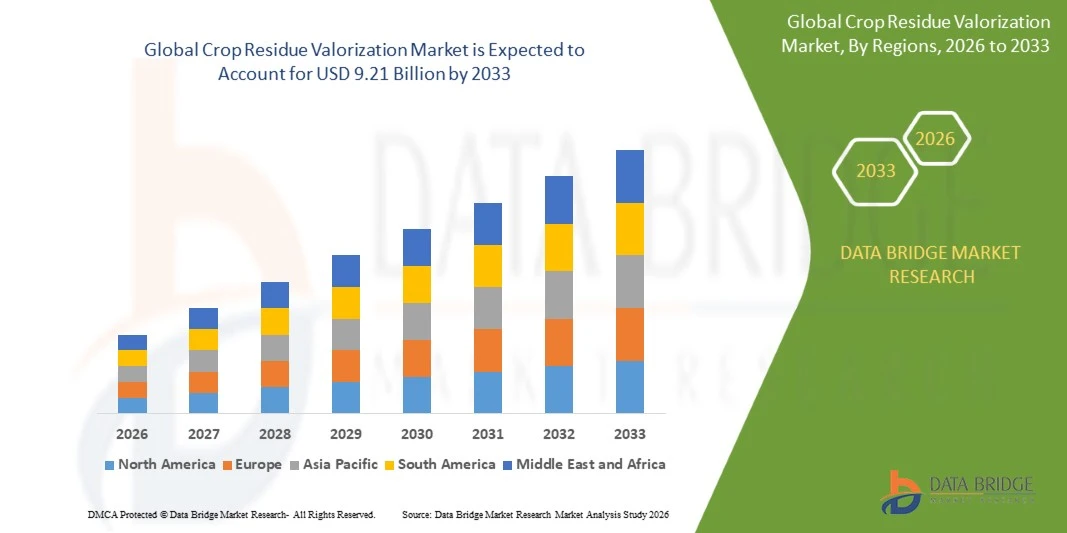
- As per Data Bridge Market Research analysis, the crop residue valorization market was valued at USD 5.10 billion in 2025 and is projected to reach USD 9.21 billion by 2033, growing at a CAGR of 9.58% from 2026 to 2033.
- The market is experiencing consistent growth driven by tightening restrictions on open residue burning, rising demand for low-carbon fuels and materials, and expanding investment in biomass pellets, second-generation biofuels, biochar, and bio-based product value chains.
- The increasing shift toward circular agriculture, renewable energy mandates, and farm-level income diversification, combined with growing integration of residue supply chains with power plants, refineries, and industrial boilers, is supporting market adoption. Crop residue valorization is being applied across biochar, biomass pellets, and bioethanol production, as well as bio-based materials, offering farmers and industries a productive alternative to residue disposal.
Market Size & Forecast
- Global Market Value (2025): USD 5.10 Billion
- Expected Market Value (2033): USD 9.21 Billion
- Forecast CAGR (2026–2033): 9.58%
- Leading Region in 2025: Asia Pacific
- Fastest Growing Region: Europe
What are the Major Takeaways of the Crop Residue Valorization Market?
- Asia-Pacific dominated the crop residue valorization market with the largest revenue share of 48.37% in 2025, supported by vast residue availability from rice, wheat, and sugarcane production, strict anti-burning enforcement, and fast-growing biomass energy capacity in India and China.
- Europe is expected to be the fastest-growing region at a CAGR of 11.24% from 2026 to 2033, fueled by advanced biofuel targets, biogas expansion, and strong policy support for low-carbon bio-based materials.
- The cereal residues segment led the market with a 63.72% share in 2025, driven by large volumes of rice straw, wheat straw, and corn stover generated during each harvest season.
- Non-cereal residues are the fastest-growing residue type, projected to register a CAGR of 11.40%, reflecting rising use of cotton stalks, sugarcane trash, oilseed stalks, and orchard prunings in energy and materials.
- The mechanical densification segment dominated the technology category with a 41.73% revenue share in 2025, led by extensive deployment of baling, briquetting, and pelletizing for co-firing and industrial heating.
- Bioenergy & biofuels accounted for 54.62% of the market share in 2025, preferred by growing blending mandates, co-firing requirements, and commissioning of second-generation ethanol and compressed biogas plants.
- The biochar & soil amendments segment is the fastest-growing product category, with a CAGR of 12.80%, driven by increasing interest in durable carbon removal and soil health improvement.
Report Scope and Crop Residue Valorization Market Segmentation
|
Attributes |
Crop Residue Valorization Key Market Insights |
|
Segments Covered |
|
|
Countries Covered |
North America
Europe
Asia-Pacific
Middle East and Africa
South America
|
|
Key Market Players |
|
|
Market Opportunities |
|
|
Value Added Data Infosets |
In addition to the insights on market scenarios such as market value, growth rate, segmentation, geographical coverage, and major players, the market reports curated by the Data Bridge Market Research also include import export analysis, production capacity overview, production consumption analysis, price trend analysis, climate change scenario, supply chain analysis, value chain analysis, raw material/consumables overview, vendor selection criteria, PESTLE Analysis, Porter Analysis, and regulatory framework. |
What is the Key Trend in the Crop Residue Valorization Market?
- Crop residue valorization is increasingly evolving from simple disposal and low-value fuel use into an integrated biorefinery and carbon-management approach, combining collection logistics, densification, conversion technologies, and digital tracking to create higher-value fuels, materials, and soil products from farm waste.
- For instance, in June 2025, according to the Commission for Air Quality Management (CAQM), India directed Punjab and Haryana to mandate paddy straw-based pellets and briquettes in brick kilns beyond the NCR, starting at 20% co-firing from 1 November 2025 and rising to 50%, demonstrating policy-led demand creation for densified residue fuels.
- Advanced conversion routes such as lignocellulosic ethanol, compressed biogas, and pyrolysis are expanding the range of products that can be created from straw, stover, husks, and stalks, reducing dependence on a single end market.
- Carbon-market integration is adding a new revenue layer, as projects that convert residues into durable products such as biochar can pursue measured and verified carbon removal credits alongside product sales.
- For instance, in June 2026, according to Indian Chemical News, SED secured INR 150 crore in assistance under the PM JI-VAN Yojana for a 91 KLPD second-generation ethanol biorefinery at Dhanaura, Uttar Pradesh, combining thermochemical gasification with biological gas fermentation to convert agricultural residues into ethanol and future green chemical feedstocks.
- As conversion technologies mature, supply chains become better organized, and policy support for low-carbon fuels strengthens, crop residue valorization is expected to expand beyond conventional fuel use into advanced biofuels, bio-based materials, carbon removal, and integrated rural bioeconomy models.
What are the Key Drivers of the Crop Residue Valorization Market?
- The sheer volume of crop residues generated each season, combined with growing restrictions on open burning and rising demand for renewable feedstocks, is encouraging governments, industries, and farmers to convert residues into fuels, materials, and soil products.
- For instance, in June 2022, according to Energies (MDPI), global agricultural residues were estimated at between 3.7 billion and 5 billion tons per year, of which approximately 2.8 billion tons were corn, rice, and wheat residues, highlighting the scale of feedstock available for valorization.
- Power utilities, refiners, brick kilns, and industrial boilers are increasingly adopting biomass-based fuels to meet blending, co-firing, and emission-reduction requirements, creating assured demand for processed crop residues and supporting investment in supply chains.
- For instance, in September 2025, according to the Commission for Air Quality Management (CAQM), the state governments of Punjab and Haryana were directed to treat zero stubble burning during the 2025 paddy harvest season as non-negotiable and to bridge gaps in in-situ management and ex-situ utilization through strengthened supply chains.
- Farm-level income diversification, carbon credit opportunities, and the development of local collection, storage, and processing infrastructure are making residue sales more attractive than disposal, strengthening participation across the value chain.
What Factors Are Challenging the Growth of the Crop Residue Valorization Market?
- Crop residues are bulky, seasonal, and geographically dispersed, so collection, baling, storage, and transportation require extensive machinery, labor, and storage infrastructure, increasing delivered costs compared with conventional fuels and feedstocks.
- For instance, in November 2025, according to The Tribune, the Commission for Air Quality Management noted that four thermal power plants in Punjab had co-fired only 3.12 lakh metric tonnes of crop residue pellets until September against a 2025-26 target of 11.83 lakh metric tonnes, highlighting supply and utilization gaps.
- Short windows between harvest and the next sowing, high moisture content, and fire risk in stored residues complicate supply planning and can reduce the heating value and quality of biomass delivered to end users.
- High capital costs and technology risks associated with second-generation biofuel and biochar plants, together with uncertainty over feedstock prices and long-term offtake, can delay investment decisions and project commissioning.
- For instance, in January 2021, according to the Council on Energy, Environment and Water (CEEW), aggregating paddy residue from the field to a straw bank within 15 km costs about INR 1,330 per tonne of bale, with cutting and baling accounting for roughly half of procurement costs and storage representing 20-30% of the delivered cost of biomass.
- The combination of high logistics costs, seasonal supply, and capital-intensive conversion facilities can constrain adoption among small processors and cost-sensitive farmers, particularly where open burning or in-field incorporation remains the lowest-cost residue management option.
How is the Crop Residue Valorization Market Segmented?
The crop residue valorization market is segmented on the basis of residue type, technology, product, and end user.
- By Residue Type
On the basis of residue type, the crop residue valorization market is segmented into cereal residues and non-cereal residues. The cereal residues segment dominated the market with 63.72% share in 2025, supported by large volumes of rice straw, wheat straw, and corn stover generated during each harvest season. These residues are produced in concentrated production belts, which improves the feasibility of aggregation and processing. They are widely used for pellets, briquettes, ethanol, biogas, and packaging inputs. Policy attention on paddy and wheat residue burning is further strengthening demand. Seasonal availability and moisture content remain important considerations for storage and conversion planning across cereal-growing regions.
The non-cereal residues segment is projected to register the fastest growth at a CAGR of 11.40% from 2026 to 2033, driven by increasing use of cotton stalks, sugarcane trash, oilseed stalks, coconut and palm residues, and orchard prunings in energy and materials. These residues are often underutilized and burned or left to decompose, creating an opportunity for new collection models. Biochar, pellets, and compressed biogas projects are expanding their feedstock mix to improve supply security. Aggregation by industrial processors and agribusiness companies is improving access. Variable composition and dispersed availability require tailored handling and pretreatment solutions.
- By Technology
On the basis of technology, the crop residue valorization market is segmented into mechanical densification, biochemical conversion, and thermochemical conversion. The mechanical densification segment dominated the technology category with 41.73% share in 2025, supported by extensive deployment of baling, briquetting, and pelletizing for power plant co-firing, brick kilns, and industrial heating. These processes require comparatively lower capital investment and can be established close to farming clusters. Densified residues are easier to store, transport, and meter into boilers. Government mandates for biomass use are creating predictable demand. Quality standards, moisture control, and delivered cost remain important factors for large-scale adoption.
The biochemical conversion segment is projected to register the fastest growth at a CAGR of 12.30% from 2026 to 2033, driven by commissioning of second-generation ethanol refineries, compressed biogas plants, and enzymatic conversion facilities that use straw and other lignocellulosic residues. Ethanol blending programs and renewable fuel policies are creating long-term offtake for advanced biofuels. Improvements in pretreatment, enzymes, and fermentation are enhancing yields and process stability. Integration with zero liquid discharge systems and by-product recovery is improving environmental performance. High capital intensity and dependable feedstock supply remain central considerations for project developers.
- By Product
On the basis of product, the crop residue valorization market is segmented into bioenergy & biofuels, biochar & soil amendments, bio-based materials & packaging, and others. The bioenergy & biofuels segment dominated the product category with 54.62% share in 2025, supported by co-firing requirements, ethanol blending programs, and expanding compressed biogas capacity. Energy applications can absorb very large volumes of residue and benefit from established offtake channels in utilities and fuel marketing companies. Government incentives and renewable energy targets are reinforcing investment. Competition for feedstock, price stability, and logistics remain important factors influencing project economics and operating continuity.
The biochar & soil amendments segment is projected to register the fastest growth at a CAGR of 12.80% from 2026 to 2033, driven by increasing interest in durable carbon removal, soil health improvement, and carbon credit generation from pyrolysis of agricultural residues. Industrial-scale reactors are being commissioned to process agricultural and fruit processing residues into stable biochar. Farmers benefit from improved soil structure and water retention, while producers gain revenue from carbon credits and soil product sales. Third-party measurement, reporting, and verification are becoming important for market credibility. Feedstock collection costs and product distribution remain key scaling considerations.
- By End User
On the basis of end user, the crop residue valorization market is segmented into power generation, biofuel refining, agriculture & farming, pulp, paper & packaging, industrial heating & brick kilns, and others. The power generation segment dominated the end-user category with 31.18% share in 2025, supported by biomass co-firing policies in thermal power plants and dedicated biomass power projects that consume large volumes of pellets and briquettes. Power utilities offer stable, repeat demand and can enter long-term supply arrangements with aggregators. Regulatory direction on co-firing percentages is helping create predictable volumes. Fuel quality specifications, delivery reliability, and price competitiveness against coal remain important considerations.
The biofuel refining segment is projected to register the fastest growth at a CAGR of 12.10% from 2026 to 2033, driven by oil marketing companies and industrial developers commissioning second-generation ethanol and compressed biogas facilities that use straw and other residues. These refineries create assured demand for residue and an additional income stream for farmers. National blending targets and renewable fuel policies are strengthening the investment case. Public financial support for advanced biofuel projects is accelerating commercialization. Securing year-round feedstock supply, managing storage losses, and achieving stable plant operation remain key success factors.
Which Region Holds the Largest Share of the Crop Residue Valorization Market?
- Asia-Pacific dominated the crop residue valorization market with the largest revenue share of 48.37% in 2025, supported by vast residue availability from rice, wheat, and sugarcane production, strict anti-burning enforcement, and fast-growing biomass energy capacity in India and China.
- The region also benefits from large agricultural output, rising energy demand, government mandates for biomass co-firing, and expanding investment in second-generation ethanol, compressed biogas, and biochar facilities. Increasing focus on air quality, farmer income diversification, and rural industrialization continues to strengthen Asia-Pacific's position in the global market.
India Crop Residue Valorization Market Insight
The India crop residue valorization market is witnessing strong growth due to the large volume of paddy, wheat, and sugarcane residues and heightened regulatory attention on stubble burning. Pellet co-firing mandates for power plants and brick kilns, new second-generation ethanol refineries, and expanding biochar and compressed biogas projects are creating diversified demand. In addition, public financial support for advanced biofuels and growing participation by oil marketing companies are strengthening the country's position as a major growth market in Asia-Pacific.
Europe Crop Residue Valorization Market Insight
The Europe crop residue valorization market is expected to witness rapid growth, driven by advanced biofuel targets, expansion of biogas, and strong support for low-carbon bio-based materials. Cereal straw and other residues are increasingly evaluated for energy, packaging, and soil carbon applications. In addition, stringent sustainability criteria, carbon removal certification frameworks, and well-developed bioeconomy research ecosystems are encouraging investment in efficient residue collection and conversion technologies across the region.
Germany Crop Residue Valorization Market Insight
The Germany crop residue valorization market is expanding steadily due to the country's strong engineering base, established biogas sector, and active research on straw-based fuels and materials. Farmers, energy producers, and technology providers are exploring the use of cereal straw and other residues for biogas, biofuels, and pyrolysis. Furthermore, a strong focus on emissions reduction, soil humus protection, and sustainable feedstock sourcing is shaping carefully balanced residue utilization strategies in the country.
France Crop Residue Valorization Market Insight
The France crop residue valorization market is experiencing steady growth, supported by extensive cereal and oilseed production and increasing interest in using straw and other residues for bioenergy and bio-based materials. Agricultural cooperatives and energy companies are developing collection arrangements and anaerobic digestion projects. Moreover, supportive renewable energy policies, growing demand for sustainable packaging and construction materials, and attention to maintaining soil organic matter are encouraging wider adoption of residue valorization solutions.
China Crop Residue Valorization Market Insight
The China crop residue valorization market is growing rapidly, driven by large volumes of corn, rice, and wheat straw and long-standing policies promoting comprehensive straw utilization. Biomass power generation, biogas, pellet fuel, and straw-based materials are being deployed across rural regions. In addition, strong domestic equipment manufacturing, air quality objectives, and rural revitalization programs are positioning China as a key market for residue valorization across Asia-Pacific.
Brazil Crop Residue Valorization Market Insight
The Brazil crop residue valorization market is witnessing consistent growth due to abundant sugarcane, soybean, and corn residues and a well-established biofuel industry. Sugarcane straw and bagasse are increasingly considered for second-generation ethanol, biogas, and cogeneration. Furthermore, supportive biofuel policies, large agricultural estates, and growing interest in carbon credits from residue-based projects are encouraging investment in collection systems and conversion facilities across the country.
Which are the Top Companies in Crop Residue Valorization Market?
The crop residue valorization industry is primarily led by well-established companies, including:
- Praj Industries Ltd. (India)
- Indian Oil Corporation Ltd. (India)
- Bharat Petroleum Corporation Ltd. (India)
- Hindustan Petroleum Corporation Ltd. (India)
- Clariant AG (Switzerland)
- NTPC Limited (India)
- Novonesis (Denmark)
- Verbio SE (Germany)
- POET, LLC (U.S.)
- Raízen S.A. (Brazil)
- GranBio Investimentos S.A. (Brazil)
- Versalis S.p.A. (Italy)
- Jain Irrigation Systems Ltd. (India)
- Applied Carbon (U.S.)
- Planboo (U.K.)
- Straw Innovations Ltd. (U.K.)
- Siam Modern Green Energy (Thailand)
- Columbia Pulp LLC (U.S.)
- Ag Energy Solutions, Inc. (U.S.)
- Lantmännen (Sweden)
What are Latest Developments in Crop Residue Valorization Market?
- In June 2026, Siam Modern Green Energy (SMGE) celebrated the grand opening of its new manufacturing plant in Surat Thani, Thailand, designed to convert local agricultural waste into high-quality biochar. The facility integrates third-party verified measurement, reporting, and verification methodologies to issue carbon removal certificates for voluntary markets and creates new revenue streams for farmers supplying residual biomass.
- In June 2026, Applied Carbon and Poas were profiled for converting hard-to-recycle, high-volume agricultural residues into biochar using customized pyrolysis technologies. Applied Carbon processes corn stover, wheat straw, and sugarcane waste in the United States, while Poas focuses on wet agricultural residues such as coffee and pineapple waste from tropical regions, aiming to cut residue logistics costs for producers.
- In June 2026, Jain Irrigation Systems Ltd. commissioned a roughly 20,000 tonne-per-annum industrial-scale biochar facility with partners in Jalgaon, Maharashtra. With capacity to process more than 50 tonnes of agricultural and fruit processing residue per day, the plant is described as one of the world's largest single-unit biochar reactors and is the first of several planned reactors.
- In March 2026, Bharat Petroleum Corporation Limited announced the commissioning of its second-generation bioethanol refinery at Bargarh, Odisha. The 100 KL/day facility produces fuel-grade bioethanol from rice straw, is designed as a zero liquid discharge plant, and supports India's E20 ethanol blending program and National Biofuels Policy while creating demand for agricultural residue.
- In February 2026, Better Cotton and Planboo announced a project in the Indian states of Gujarat and Maharashtra under which at least 75 farmers would convert cotton harvest waste into biochar using three kilns, processing 375 tonnes of farm waste to produce 60-70 tonnes of biochar, with farmer training scheduled for February 2026 as an alternative to burning residues.

- Interactive Data Analysis Dashboard
- Company Analysis Dashboard for high growth potential opportunities
- Research Analyst Access for customization & queries
- Competitor Analysis with Interactive dashboard
- Latest News, Updates & Trend analysis
- Harness the Power of Benchmark Analysis for Comprehensive Competitor Tracking
Data collection and base year analysis are done using data collection modules with large sample sizes. The stage includes obtaining market information or related data through various sources and strategies. It includes examining and planning all the data acquired from the past in advance. It likewise envelops the examination of information inconsistencies seen across different information sources. The market data is analysed and estimated using market statistical and coherent models. Also, market share analysis and key trend analysis are the major success factors in the market report. To know more, please request an analyst call or drop down your inquiry.
The key research methodology used by DBMR research team is data triangulation which involves data mining, analysis of the impact of data variables on the market and primary (industry expert) validation. Data models include Vendor Positioning Grid, Market Time Line Analysis, Market Overview and Guide, Company Positioning Grid, Patent Analysis, Pricing Analysis, Company Market Share Analysis, Standards of Measurement, Global versus Regional and Vendor Share Analysis. To know more about the research methodology, drop in an inquiry to speak to our industry experts.
Data Bridge Market Research is a leader in advanced formative research. We take pride in servicing our existing and new customers with data and analysis that match and suits their goal. The report can be customized to include price trend analysis of target brands understanding the market for additional countries (ask for the list of countries), clinical trial results data, literature review, refurbished market and product base analysis. Market analysis of target competitors can be analyzed from technology-based analysis to market portfolio strategies. We can add as many competitors that you require data about in the format and data style you are looking for. Our team of analysts can also provide you data in crude raw excel files pivot tables (Fact book) or can assist you in creating presentations from the data sets available in the report.