What is the Cucurbit Vegetable Seeds Market Size and Growth Rate?
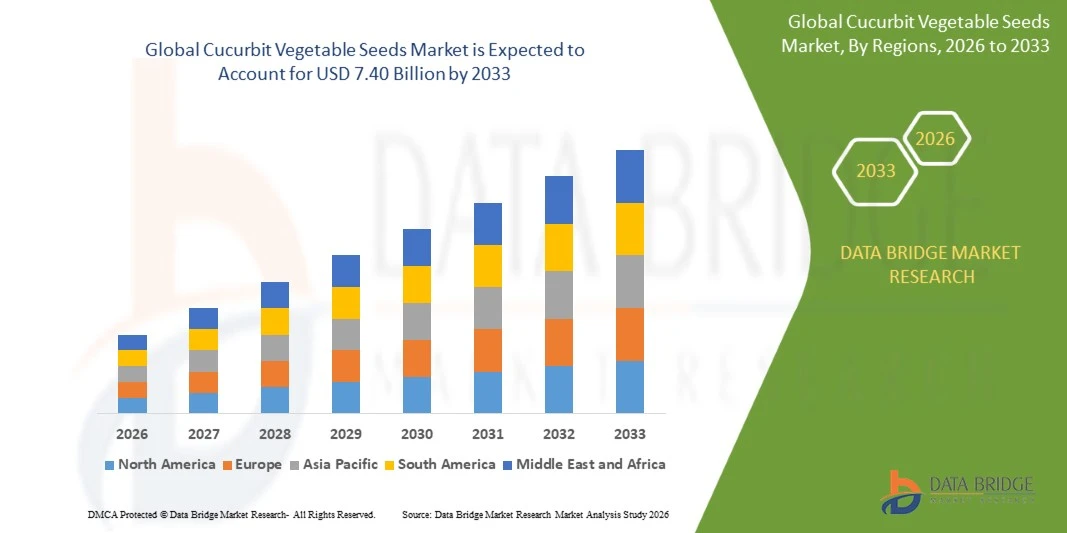
- As per Data Bridge Market Research analysis, the cucurbit vegetable seeds market was valued at USD 4.31 billion in 2025 and is projected to reach USD 7.40 billion by 2033, growing at a CAGR of 7.00% from 2026 to 2033.
- The market is experiencing consistent growth driven by rising demand for high-quality vegetables, increasing adoption of hybrid seeds, and expanding cultivation of cucurbit crops such as cucumbers, melons, pumpkins, and squash. Growing awareness of improved seed varieties and advancements in agricultural breeding technologies are further supporting market expansion.
- The increasing global demand for fresh vegetables, combined with the need to improve crop productivity and resilience against pests, diseases, and changing climatic conditions, is encouraging farmers to adopt advanced cucurbit seed varieties. Hybrid and disease-resistant seeds are gaining traction across commercial farming operations, offering improved yields, better crop quality, and enhanced adaptability to diverse growing conditions.
Market Size & Forecast
- Global Market Value (2025): USD 4.31 Billion
- Expected Market Value (2033): USD 7.40 Billion
- Forecast CAGR (2026–2033): 7.00%
- Leading Region in 2025: North America
- Fastest Growing Region: Asia Pacific
What are the Major Takeaways of the Cucurbit Vegetable Seeds Market?
- North America dominated the cucurbit vegetable seeds market with the largest revenue share of 37.9% in 2025, supported by commercial farming and strong demand for cucumber and gherkin seeds.
- Asia-Pacific is expected to be the fastest-growing region at a CAGR of 6.7% from 2026 to 2033, fueled by expanding vegetable cultivation, rising demand for hybrid seeds, and agricultural modernization.
- The cucumber segment led the market with a 35.7% share in 2025, driven by widespread cultivation, strong consumer demand, and extensive use in fresh consumption, salads, and food processing
- Melon are the fastest-growing type, projected to register a CAGR of 6.0%, reflecting the surge in demand for watermelon and muskmelon varieties across domestic and international markets
- The farmland segment dominated the application category with a 73.4% revenue share in 2025, led by extensive cultivation of cucumbers, pumpkins, melons, loofah, and gourds across open agricultural fields.
- Inorganic accounted for 62% of the market share in 2025, preferred by widespread use of conventionally produced commercial seed varieties and their established distribution networks
- The G.M. segment is the fastest-growing trait category, with a CAGR of 7.1%, driven by potential applications of genetic technologies in improving disease resistance, pest tolerance, and crop productivity.
Report Scope and Cucurbit Vegetable Seeds Market Segmentation
|
Attributes |
Cucurbit Vegetable Seeds Key Market Insights |
|
Segments Covered |
|
|
Countries Covered |
North America
Europe
Asia-Pacific
Middle East and Africa
South America
|
|
Key Market Players |
|
|
Market Opportunities |
|
|
Value Added Data Infosets |
In addition to the insights on market scenarios such as market value, growth rate, segmentation, geographical coverage, and major players, the market reports curated by the Data Bridge Market Research also include in-depth expert analysis, pricing analysis, brand share analysis, consumer survey, demography analysis, supply chain analysis, value chain analysis, raw material/consumables overview, vendor selection criteria, PESTLE Analysis, Porter Analysis, and regulatory framework. |
What is the Key Trend in the Cucurbit Vegetable Seeds Market?
- Seed companies are increasingly developing high-performance cucurbit vegetable seeds with improved disease resistance, higher yields, and better adaptability to changing climatic conditions. These innovations help growers improve productivity and maintain consistent crop quality.
- For instance, in June 2024, Syngenta Vegetable Seeds highlighted its Bobal Piel de Sapo melon variety with resistance to Tomato Leaf Curl New Delhi Virus (ToLCNDV), supporting improved crop protection and helping growers reduce disease-related production losses
- Advanced breeding techniques and marker-assisted selection enable seed developers to identify desirable traits more efficiently and accelerate the development of improved cucumber, melon, pumpkin, and squash varieties.
- Commercial growers are increasingly adopting hybrid cucurbit seeds to improve uniformity, disease tolerance, fruit quality, and marketable yields across diverse growing environments.
- For instance, in August 2025, Syngenta Vegetable Seeds showcased new watermelon and melon innovations at its Future of Veg event in California, highlighting improved varietal performance and solutions designed to address grower challenges and evolving market demand
- As growers face increasing pressure from climate variability, crop diseases, and demand for consistent vegetable quality, innovation in hybrid breeding and disease-resistant cucurbit varieties is expected to remain a key trend shaping the market.
What are the Key Drivers of the Cucurbit Vegetable Seeds Market?
- The rising demand for high-quality vegetables and improved crop productivity is increasing the adoption of hybrid cucurbit seeds that offer higher yields, uniform fruit quality, and resistance to major crop diseases.
- For instance, in July 2023, Syngenta Vegetable Seeds highlighted its research into Tomato Leaf Curl New Delhi Virus (ToLCNDV)-resistant cucurbit varieties, including squash and cucumber, to help growers protect crop yields and fruit quality against disease-related losses.
- Commercial growers are increasingly investing in improved seed genetics to enhance crop performance, reduce production losses, and meet the quality requirements of retailers, food processors, and fresh produce markets.
- For instance, in June 2024, Syngenta Vegetable Seeds introduced its Bobal Piel de Sapo melon variety with resistance to ToLCNDV, combining disease protection with resistance to powdery mildew and graciano aphids to support crop productivity and quality.
- As demand for reliable yields, disease-resistant varieties, and consistent produce quality continues to increase, investment in cucurbit seed breeding and hybrid development is expected to support market growth.
What Factors are Challenging the Growth of the Cucurbit Vegetable Seeds Market?
- High prices of hybrid cucurbit seeds, limited access to certified planting materials, and counterfeit seed products create financial and operational challenges for growers, particularly smallholder farmers in developing agricultural markets.
- For instance, in November 2022, a study published in Australasian Plant Pathology identified the growing risk of introducing seed-borne viral pathogens through international cucurbit seed trade, noting that it is not practically feasible to screen imported seeds for every known pathogen, increasing biosecurity and disease-management challenges.
- These constraints can discourage farmers from adopting improved cucumber, watermelon, melon, pumpkin, and squash varieties, limiting access to higher yields and disease-resistant crop genetics.
- ·Seed quality issues, including low germination rates, genetic impurity, and inconsistent availability, can further reduce farmers' confidence in commercial seed suppliers and increase cultivation risks.
- For instance, in May 2022, a study published Plant Methods demonstrating that Cucumber green mottle mosaic virus could be detected in infected zucchini seeds at very low concentrations, highlighting the challenges of seed-health testing and the importance of sensitive diagnostic methods for preventing the distribution of infected seed lots.
- High seed costs and inconsistent access to reliable planting materials continue to challenge market penetration, particularly in price-sensitive regions, despite the growing demand for productive and disease-resistant cucurbit seed varieties.
How is the Cucurbit Vegetable Seeds Market Segmented?
The cucurbit vegetable seeds market is segmented on the basis of type, application, form, and trait.
- By Type
On the basis of type, the cucurbit vegetable seeds market is segmented into cucumber, pumpkin, loofah, melon, gourd, and other varieties. The cucumber seeds segment dominated the market with an estimated 35.7% share in 2025, owing to widespread cultivation, strong consumer demand, and extensive use in fresh consumption, salads, and food processing. Cucumbers are cultivated across open fields and protected agricultural environments, supporting consistent demand for quality seeds. Hybrid cucumber seeds are increasingly preferred for their uniform fruit size, improved productivity, and disease resistance. Growing demand from supermarkets, food service providers, and fresh produce distributors further supports the segment. The availability of varieties suited to different climates and growing cycles also strengthens adoption among commercial farmers.
The melon seeds segment is expected to witness strong growth at CAGR of 6.0% from 2026 to 2033, driven by increasing demand for watermelon and muskmelon varieties across domestic and international markets. Rising consumption of fresh fruit and growing interest in seedless watermelon varieties are encouraging seed companies to develop improved hybrids. Farmers are increasingly seeking seeds that offer higher yields, improved fruit quality, and resistance to prevalent diseases. Advances in breeding technologies are helping develop varieties suited to different climatic conditions and cultivation systems. Growing commercial production and demand from organized retail and fresh produce supply chains are also supporting expansion.
- By Application
On the basis of application, the cucurbit vegetable seeds market is segmented into farmland, greenhouse, and others. The farmland segment is expected to dominate the market with an estimated 73.4% share in 2025, supported by extensive cultivation of cucumbers, pumpkins, melons, loofah, and gourds across open agricultural fields. Open-field farming remains widely adopted because it requires comparatively lower infrastructure investment than greenhouse cultivation. Farmers rely on commercially available cucurbit seeds to improve germination, crop establishment, and marketable yields. The availability of varieties suited to different soil types and climatic conditions further supports widespread adoption. Large-scale cultivation and established agricultural distribution networks strengthen demand for seeds in farmland applications.
The greenhouse segment is expected to witness the fastest growth at an approx. CAGR of 7.8% from 2026 to 2033, driven by increasing adoption of protected cultivation and the need for year-round crop production. Greenhouse environments allow growers to manage temperature, humidity, irrigation, and other growing conditions more effectively. These systems support the cultivation of high-value cucumbers and other cucurbit crops with improved consistency and quality. Demand for greenhouse-suitable hybrid seeds is increasing because growers seek varieties with strong disease resistance and reliable productivity. Advances in controlled-environment agriculture and precision irrigation are further supporting adoption.
- By Form
On the basis of form, the cucurbit vegetable seeds market is segmented into organic and inorganic seeds. The inorganic seeds segment is expected to dominate the market with 62% share in 2025, reflecting the widespread use of conventionally produced commercial seed varieties and their established distribution networks. Conventional seed production benefits from extensive breeding programs focused on yield, uniformity, and resistance to important crop diseases. Farmers widely use these seeds across commercial farms because they are available in multiple varieties suited to different growing conditions. Hybrid seeds developed through conventional breeding are particularly important for improving crop performance and fruit quality. Established relationships between seed suppliers, agricultural distributors, and growers further support adoption.
The organic seeds segment is expected to witness strong growth at CAGR of 13.8% from 2026 to 2033, driven by expanding organic farming practices and rising consumer interest in organically produced vegetables and fruits. Organic farmers require seeds that comply with applicable organic production standards and certification requirements. Demand is increasing for seed varieties that perform well under organic cultivation systems with limited reliance on synthetic agricultural inputs. Seed developers are increasingly focusing on varieties with natural disease tolerance and adaptability to diverse growing conditions. Expansion of organic food retail and direct-to-consumer produce channels is also supporting interest in organic seed production. Growing awareness of sustainable agriculture and soil health is expected to encourage further adoption of organic cucurbit seeds.
- By Trait
On the basis of trait, the cucurbit vegetable seeds market is segmented into genetically modified (G.M.) and conventional seeds. The conventional seeds segment dominated the market with an estimated 61.7% share in 2025, supported by widespread commercial availability, established breeding practices, and broad acceptance across major cucurbit-producing countries. Conventional breeding enables seed developers to improve yield potential, fruit quality, maturity, and resistance to specific diseases without genetic engineering. These varieties are used extensively in cucumber, pumpkin, melon, loofah, and gourd cultivation. Their suitability for different farming systems and established distribution channels supports adoption among smallholder and commercial farmers. Regulatory familiarity and compatibility with existing agricultural practices further strengthen the segment.
The genetically modified seeds segment is projected to register the fastest growth at CAGR of 7.1% from 2026 to 2033, driven by potential applications of genetic technologies in improving disease resistance, pest tolerance, and crop productivity. Research into advanced genetic technologies may support the development of traits designed to improve crop performance under environmental stress. However, conventional hybrid breeding and marker-assisted selection remain important approaches for improving cucurbit seed performance. Regulatory requirements governing genetically modified crops differ across countries and can affect commercialization timelines. Grower demand for improved traits may encourage continued research into new breeding technologies. Wider adoption will depend on regulatory authorization, demonstrated agronomic benefits, commercial availability, and market acceptance.
Which Region Holds the Largest Share of the Cucurbit Vegetable Seeds Market?
- North America dominated the cucurbit vegetable seeds market with the largest revenue share of 37.9% in 2025, supported by commercial farming and strong demand for cucumber and gherkin seeds.
- The region also benefits from widespread adoption of hybrid seeds, commercial-scale vegetable farming, and investments in greenhouse cultivation and precision agriculture. The United States represents a major contributor to regional demand, while Canada and Mexico support growth through commercial horticulture and expanding vegetable production. Increasing demand for disease-resistant varieties, seedless watermelons, and high-yield cucurbit crops continues to strengthen North America's position in the global market.
U.S. Cucurbit Vegetable Seeds Market Insight
The U.S. cucurbit vegetable seeds market is witnessing steady growth due to strong demand for high-quality watermelon, cucumber, pumpkin, and melon varieties. The country's established commercial farming sector, advanced seed breeding capabilities, and widespread adoption of hybrid seeds are supporting market expansion. Increasing demand for disease-resistant varieties, seedless watermelons, and improved crop yields is encouraging seed companies to strengthen breeding and product development. Furthermore, growing demand for fresh produce and efficient agricultural practices is supporting the adoption of improved cucurbit seeds.
Asia-Pacific Cucurbit Vegetable Seeds Market Insight
The Asia-Pacific cucurbit vegetable seeds market is expected to witness rapid growth, driven by extensive vegetable cultivation, rising food consumption, and increasing adoption of hybrid seed varieties across China, India, and Japan. Growing demand for cucumbers, melons, pumpkins, and gourds is encouraging farmers to adopt seeds offering improved productivity and disease resistance. In addition, government initiatives supporting agricultural modernization, domestic seed development, and protected cultivation are strengthening regional market expansion. Rising investments in seed research and improved farming practices are further supporting demand for advanced cucurbit vegetable seeds.
Japan Cucurbit Vegetable Seeds Market Insight
The Japan cucurbit vegetable seeds market is witnessing consistent growth due to increasing demand for premium vegetables, advanced breeding technologies, and improved crop productivity. Seed developers and agricultural research institutions are focusing on cucumber and melon varieties with enhanced disease resistance, heat tolerance, and reduced labor requirements. Furthermore, increasing use of genomic information and AI-assisted breeding is supporting the development of improved cultivars. Collaboration between research organizations and private seed companies is also strengthening innovation, helping Japanese growers improve production efficiency and maintain consistent crop quality.
China Cucurbit Vegetable Seeds Market Insight
The China cucurbit vegetable seeds market is expanding steadily, driven by extensive vegetable production, increasing demand for improved seed varieties, and growing investments in domestic seed innovation. Farmers are increasingly adopting hybrid cucumber, watermelon, and melon seeds to improve yield potential, fruit quality, and disease resistance. Government initiatives supporting seed-industry modernization and agricultural research are encouraging the development of locally adapted varieties. In addition, advances in greenhouse farming, cultivation technologies, and seed quality management are supporting wider adoption of improved cucurbit seeds across commercial agricultural operations.
U.K. Cucurbit Vegetable Seeds Market Insight
The U.K. cucurbit vegetable seeds market is supported by demand for high-quality cucumbers, pumpkins, squash, and melon varieties across commercial horticulture and protected cultivation. Growers increasingly require seeds that deliver consistent quality, reliable yields, and resistance to common crop diseases. Demand for greenhouse-suitable cucumber varieties is also supporting the adoption of specialized hybrid seeds. Furthermore, changing weather conditions and the need to improve domestic horticultural productivity are encouraging growers to select varieties suited to local growing environments. Continued investment in efficient cultivation practices is expected to support demand for improved cucurbit seeds.
Germany Cucurbit Vegetable Seeds Market Insight
The Germany cucurbit vegetable seeds market is developing steadily due to the country's established horticultural sector, growing demand for quality vegetables, and adoption of advanced cultivation methods. Commercial growers are increasingly seeking cucumber, pumpkin, and other cucurbit varieties that provide uniform produce, reliable yields, and improved disease resistance. Greenhouse cultivation and controlled-environment farming are supporting demand for specialized seed varieties. In addition, established seed certification systems and continued breeding innovation are helping maintain seed quality and improve crop performance. Growing emphasis on resource-efficient agriculture is further supporting interest in high-performance cucurbit seeds.
Which are the Top Companies in Cucurbit Vegetable Seeds Market?
The cucurbit vegetable seeds industry is primarily led by well-established companies, including:
- Rijk Zwaan (Netherlands)
- Enza Zaden (Netherlands)
- TAKII & CO.,LTD (Japan)
- KNOWN-YOU SEED CO., LTD (Taiwan)
- East-West Seed (Thailand)
- Mahyco (India)
- Fitó Seeds (Spain)
- Gautier Semences (France)
- Johnny's Selected Seeds (U.S.)
- Rupp Seeds, Inc. (U.S.)
- Global Seeds India Private Limited (India)
- ORIGENE SEEDS (Israel)
- VNR Seeds (India)
- Willhite Seed (U.S.)
- Indo American Hybrid Seeds (India)
- Rasi Seeds (India)
- Kalashseeds Pvt. Ltd. (India)
- Seedway, LLC (U.S.)
- Seed Savers Exchange (U.S.)
- Kaveri Seeds (India)
What are Latest Developments in Cucurbit Vegetable Seeds Market?
- In January 2025, Syngenta Vegetable Seeds and Apricus Seeds announced an exclusive global licensing partnership, providing Syngenta with access to Apricus Seeds’ germplasm and breeding pipeline for watermelon, melon, and squash. The partnership strengthens Syngenta’s cucurbit seed portfolio and supports the development of improved seed genetics for growers across global markets.
- In June 2024, Syngenta Vegetable Seeds introduced its Bobal Piel de Sapo melon variety with resistance to Tomato Leaf Curl New Delhi Virus (ToLCNDV), initially targeting growers in the Mediterranean region. The variety also offers resistance to powdery mildew and graciano aphids, helping growers protect crop quality and yield potential against important pests and diseases. This development highlights the industry's focus on disease-resistant cucurbit seed varieties.
- In November 2023, Syngenta Vegetable Seeds launched its Tomato Leaf Curl New Delhi Virus (ToLCNDV) Information Center to provide growers with information on disease-resistant varieties, agronomic practices, and crop protection strategies for cucumber, melon, and squash. The platform supports access to technical resources and resistance options, helping growers manage virus-related crop losses and encouraging the adoption of improved cucurbit seed varieties.
- In December 2022, Syngenta Vegetable Seeds announced that its IDEAL Melons featuring the Harvest Indicator Trait had been recognized as one of Seed World's five most innovative products. The technology uses changes in melon rind color to indicate the appropriate harvest time, helping growers reduce premature harvesting and improve fruit quality. The innovation also supports more efficient harvesting, handling, and distribution of cantaloupe melons
- In June 2021, Bayer introduced its Yellow Gold 48 yellow watermelon variety in India under the Seminis brand, following local field trials. Developed through breeding research, the variety offers yellow flesh, a sweet flavor, enhanced yield potential, improved pest and disease tolerance, and a thicker rind that supports shelf life and transportation. Bayer also highlighted its Crimson B32 red watermelon variety, reflecting continued innovation in commercial watermelon seed offerings
- Interactive Data Analysis Dashboard
- Company Analysis Dashboard for high growth potential opportunities
- Research Analyst Access for customization & queries
- Competitor Analysis with Interactive dashboard
- Latest News, Updates & Trend analysis
- Harness the Power of Benchmark Analysis for Comprehensive Competitor Tracking
Global Cucurbit Vegetables Seeds Market, Supply Chain Analysis and Ecosystem Framework
To support market growth and help clients navigate the impact of geopolitical shifts, DBMR has integrated in-depth supply chain analysis into its Global Cucurbit Vegetables Seeds Market research reports. This addition empowers clients to respond effectively to global changes affecting their industries. The supply chain analysis section includes detailed insights such as Global Cucurbit Vegetables Seeds Market consumption and production by country, price trend analysis, the impact of tariffs and geopolitical developments, and import and export trends by country and HSN code. It also highlights major suppliers with data on production capacity and company profiles, as well as key importers and exporters. In addition to research, DBMR offers specialized supply chain consulting services backed by over a decade of experience, providing solutions like supplier discovery, supplier risk assessment, price trend analysis, impact evaluation of inflation and trade route changes, and comprehensive market trend analysis.
Data collection and base year analysis are done using data collection modules with large sample sizes. The stage includes obtaining market information or related data through various sources and strategies. It includes examining and planning all the data acquired from the past in advance. It likewise envelops the examination of information inconsistencies seen across different information sources. The market data is analysed and estimated using market statistical and coherent models. Also, market share analysis and key trend analysis are the major success factors in the market report. To know more, please request an analyst call or drop down your inquiry.
The key research methodology used by DBMR research team is data triangulation which involves data mining, analysis of the impact of data variables on the market and primary (industry expert) validation. Data models include Vendor Positioning Grid, Market Time Line Analysis, Market Overview and Guide, Company Positioning Grid, Patent Analysis, Pricing Analysis, Company Market Share Analysis, Standards of Measurement, Global versus Regional and Vendor Share Analysis. To know more about the research methodology, drop in an inquiry to speak to our industry experts.
Data Bridge Market Research is a leader in advanced formative research. We take pride in servicing our existing and new customers with data and analysis that match and suits their goal. The report can be customized to include price trend analysis of target brands understanding the market for additional countries (ask for the list of countries), clinical trial results data, literature review, refurbished market and product base analysis. Market analysis of target competitors can be analyzed from technology-based analysis to market portfolio strategies. We can add as many competitors that you require data about in the format and data style you are looking for. Our team of analysts can also provide you data in crude raw excel files pivot tables (Fact book) or can assist you in creating presentations from the data sets available in the report.