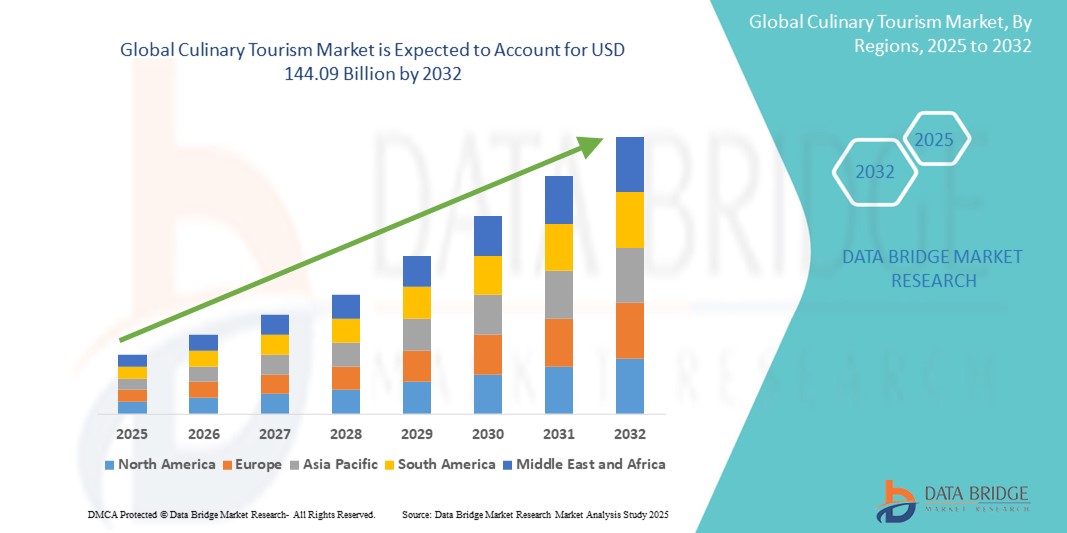
Global Culinary Tourism Market Size
- The global culinary tourism market was valued at USD 54.09 billion in 2024 and is expected to reach USD 144.09 billion by 2032
- During the forecast period of 2025 to 2032 the market is likely to grow to grow at a CAGR of 11.5%, primarily driven by the growing interest in authentic and immersive food experiences
- this growth is driven by factors such as the rise of experiential travel, increasing consumer spending on travel & tourism, and social media influence
Global Culinary Tourism Market Analysis
- Culinary tourism has become an essential segment within the global travel market, where travelers explore different destinations with a primary focus on experiencing the local food and beverage culture. This includes activities such as food tours, cooking classes, wine tasting, street food exploration, and visiting food festivals. Culinary tourism provides an immersive way to engage with the culture, heritage, and traditions of various regions through their unique culinary offerings
- The demand for culinary tourism is largely driven by several key factors, including the increasing global interest in food diversity, media influence (such as food-focused TV shows, documentaries, and social media platforms), and the growing desire for authentic travel experiences. Food has become a central theme in travel, and travelers are seeking destinations that offer not only food experiences but also insight into the traditions, history, and agricultural practices behind the cuisine. In addition, the rise in wellness and sustainable travel has led to greater interest in local, organic, and sustainable food experiences
- Europe is one of the dominant regions in the global culinary tourism market, with countries such as Italy, France, Spain, and Greece at the forefront due to their rich culinary heritage and world-renowned food experiences. In addition, regions such as Southeast Asia (Thailand, Vietnam, Japan) and Latin America (Mexico, Peru, Argentina) have also gained significant attention from food tourists, thanks to their unique, vibrant, and diverse cuisines. The demand in these regions is largely driven by their deep-rooted food culture and the growing presence of culinary events and food festivals
- North America also stands as a significant player in the culinary tourism market, driven by the U.S. and Canada. The growth in culinary tourism in this region is bolstered by a burgeoning food scene, especially in cities such as New York, Los Angeles, San Francisco, and Montreal, which are known for their diverse and innovative culinary landscapes. Food tourism in North America not only caters to local consumers but also attracts international tourists seeking high-quality food experiences, from fine dining to street food
- Globally, culinary tourism ranks as one of the top motivations for travelers, with food experiences often driving travel decisions. In fact, it is considered one of the most crucial aspects of overall travel satisfaction, with food and beverage-related activities contributing significantly to local economies. From street vendors in Bangkok to Michelin-starred restaurants in Paris, culinary tourism supports not only chefs and restaurants but also local farmers, food artisans, and producers. The market for culinary tourism continues to expand as travelers seek deeper, more meaningful experiences, often aligning food with cultural identity, social responsibility, and sustainability
- In conclusion, the global culinary tourism market has seen substantial growth, fueled by increasing consumer interest in food culture, local cuisine, and authentic experiences. It has become an integral part of the travel experience, driving significant economic benefits and cultural exchange across the globe
Report Scope and Global Culinary Tourism Market Segmentation
|
Attributes |
Global Culinary Tourism Market Insights |
|
Segments Covered |
|
|
Countries Covered |
North America
Europe
Asia-Pacific
Middle East and Africa
South America
|
|
Key Market Players |
|
|
Market Opportunities |
|
|
Value Added Data Infosets |
In addition to the insights on market scenarios such as market value, growth rate, segmentation, geographical coverage, and major players, the market reports curated by the Data Bridge Market Research also include in-depth expert analysis, pricing analysis, brand share analysis, consumer survey, demography analysis, supply chain analysis, value chain analysis, raw material/consumables overview, vendor selection criteria, PESTLE Analysis, Porter Analysis, and regulatory framework. |
Global Culinary Tourism Market Trends
“Increasing Focus on Authentic Culinary Experiences and Digital Integration”
- One prominent trend in the global culinary tourism market is the increasing focus on authentic culinary experiences paired with digital integration
- These evolving trends enhance the overall travel and dining experience by allowing travelers to explore and engage with local food cultures in innovative ways. Through digital platforms and apps, tourists can now seamlessly book culinary tours, access food recommendations, and connect with local chefs and food producers, all from the comfort of their devices
- For instance, digital integration allows travelers to virtually join cooking classes, watch live food demonstrations, and even take part in virtual food festivals, making culinary tourism more accessible to a global audience. It also offers a more personalized experience by using AI to recommend food experiences based on travelers preferences and past activities
- Authentic culinary experiences are now more valued than ever, with food tourists seeking out locally-sourced ingredients, traditional cooking methods, and sustainable food practices. For instance farm-to-table dining experiences, where travelers engage directly with local producers and learn about sustainable food practices, are becoming increasingly popular. Digital tools help highlight these experiences, allowing tourists to explore beyond traditional restaurants and engage in more intimate, culturally enriching food journeys
- This trend is revolutionizing how food tourism is experienced, enriching the connection between travelers and the local culture. It not only enhances consumer satisfaction but also promotes sustainability and supports local food systems. The growing reliance on digital tools is making it easier for both the tourism industry and food producers to cater to a tech-savvy audience, driving demand for more diverse and innovative food experiences in the market
Global Culinary Tourism Market Dynamics
Driver
“Increasing Consumer Demand for Authentic and Sustainable Culinary Experiences”
- The growing demand for authentic, local culinary experiences is significantly driving the global culinary tourism market. As travellers seek more immersive and meaningful experiences, food and beverage experiences have become a major part of the journey
- Tourists are increasingly interested in exploring destinations known for their unique culinary traditions, farm-to-table dining, and sustainable food practices, pushing the demand for culinary tourism in various regions
- Sustainable food tourism is a key trend, where travellers prefer food experiences that emphasize locally sourced ingredients, ethical farming practices, and eco-friendly dining options. This shift is also influenced by consumers’ growing awareness of sustainability and environmental impacts
- The rise in the popularity of culinary-focused travel is closely tied to the increasing awareness of food as a cultural and social experience. For instance, food festivals, local cooking classes, and market tours provide travellers with a deeper understanding of regional traditions and agricultural practices
- As consumer demand for unique food-related travel experiences grows, the culinary tourism market is witnessing an influx of new destinations offering specialized tours, dining experiences, and culinary adventures to cater to these interests
For instance,
- In 2023, according to a report by the World Tourism Organization, the increasing number of culinary tourists seeking authentic food experiences is a key factor propelling the growth of culinary tourism globally, especially in regions such as Southeast Asia, Europe, and South America
- In 2024, a study from the Global Food Tourism Network highlighted that nearly 50% of tourists surveyed prioritize culinary experiences when planning their trips, reflecting the growing importance of food tourism in global travel
- The growing demand for authentic, sustainable, and immersive culinary experiences is driving the expansion of the global culinary tourism market, with travellers increasingly seeking unique food-related adventures
Opportunity
“Integration of Technology to Enhance Culinary Tourism Experiences”
- The integration of digital technology into culinary tourism is offering new opportunities for growth. Digital platforms, apps, and social media play a major role in connecting food tourists with local experiences, from booking food tours to discovering hidden culinary gems
- Technology is transforming culinary tourism by providing virtual food experiences, such as online cooking classes, food and wine pairings, and interactive food festivals that attract a wider audience
- Augmented Reality (AR) and Virtual Reality (VR) technologies are creating innovative ways for travelers to engage with food cultures remotely, such as through virtual food tours or immersive cooking demonstrations
- AI-powered recommendations and personalized itineraries are enhancing the food tourism experience, helping tourists discover new culinary destinations based on their personal preferences and previous activities
For instance,
- In December 2024, a report by the Culinary Tourism Association stated that VR food experiences, such as virtual tastings and interactive cooking lessons, are gaining popularity among food tourists who want to experience global cuisine from home
- In January 2025, according to the Food Tourism Technology Summit, AI is helping culinary tour operators create personalized travel experiences based on a traveler’s food preferences, dietary restrictions, and culinary interests, allowing for more tailored and engaging itineraries
- The integration of digital technologies such as VR, AR, and AI is revolutionizing culinary tourism by offering virtual experiences, personalized itineraries, and enhanced connections to local food cultures
Restraint/Challenge
“High Costs of Culinary Tourism Experiences Limiting Accessibility”
- The high cost of specialized culinary tourism experiences presents a significant challenge for the market, particularly affecting the affordability and accessibility of these experiences for many potential travelers, especially in developing regions
- Culinary tourism packages, which include food tours, cooking classes, exclusive dining experiences, and food festivals, can often be expensive, with prices ranging from hundreds to thousands of dollars depending on the destination and type of experience
- This substantial financial barrier can deter budget-conscious travelers or those from lower-income regions from participating in high-end culinary tourism experiences, limiting the overall reach of the market
For instance,
- In November 2024, according to a report by the Global Food Tourism Network, one of the challenges highlighted in expanding culinary tourism globally is the cost associated with premium food experiences, which can make it difficult for smaller, less affluent markets to access. This economic limitation affects the ability of tourists to engage in unique, high-quality culinary experiences, thus restricting the growth of the market
- Consequently, such challenges may result in disparities in the global participation in culinary tourism, particularly between affluent and emerging markets, ultimately hindering the overall growth and inclusivity of the industry
Global Culinary Tourism Market Scope
The market is segmented on the basis of activity type, age group, mode of booking, and application.
|
Segmentation |
Sub-Segmentation |
|
By Activity Type |
|
|
By Age Group |
|
|
By Mode of Booking |
|
|
By Application
|
|
Global Culinary Tourism Market Regional Analysis
“North America is the Dominant Region in the Culinary Tourism Market”
- North America holds a dominant position in the global culinary tourism market, driven by its diverse food culture, strong tourism infrastructure, and high demand for unique, high-quality food experiences
- The U.S. plays a significant role in the market due to its vast range of food experiences, from Michelin-starred restaurants to diverse regional culinary traditions, along with a growing interest in food tourism
- The availability of well-established food-focused travel agencies, robust culinary tourism platforms, and a high number of food festivals further boost the market
- In addition, North America benefits from a large, affluent population with an increasing interest in culinary travel, which is further supported by the rising popularity of food documentaries, cooking shows, and social media influencers driving food tourism trends
“Asia-Pacific is Projected to Register the Highest Growth Rate”
- The Asia-Pacific region is projected to witness the highest growth rate in the global culinary tourism market, driven by rapid growth in tourism infrastructure, an increase in food-focused travel demand, and the rising popularity of Asian cuisines globally
- Countries such as China, India, Japan, and Thailand are emerging as key markets, with their rich culinary traditions and increasing recognition as food tourism destinations
- Japan remains a crucial market due to its globally renowned culinary offerings, such as sushi, ramen, and kaiseki, attracting both local and international food tourists. The country is also investing in food tourism promotions, hosting numerous food festivals and culinary events to engage tourists
- China and India, with their growing middle class and expanding culinary tourism infrastructure, are seeing increasing demand for food experiences, from street food tours to luxury dining experiences. Both countries are heavily investing in food tourism campaigns, food festivals, and gastronomic tours to attract global food enthusiasts. The expanding influence of international chefs and food brands is further fuelling market growth in the region
Global Culinary Tourism Market Share
The market competitive landscape provides details by competitor. Details included are company overview, company financials, revenue generated, market potential, investment in research and development, new market initiatives, global presence, production sites and facilities, production capacities, company strengths and weaknesses, product launch, product width and breadth, application dominance. The above data points provided are only related to the companies' focus related to market.
The Major Market Leaders Operating in the Market Are:
- A&K Travel Group (U.S.)
- Greaves Travel (U.S.)
- India Food Tour (India)
- Classic Journeys, llc (U.S.)
- The FTC4Lobe Group (U.S.)
- The Travel Corporation (U.S.)
- Gourmet on Tour (U.K.)
- INTERNATIONAL CULINARY TOURS (U.S.)
- Topco Associates, LLC. (U.S.)
- Butterfield & Robinson Inc. (Canada)
- TourRadar (Austria)
- Traveling Spoon (U.S.)
- Artisans of Leisure, Inc. (U.S.)
- Culinary Backstreets LLC (U.S.)
- World Food Travel Association (U.S.)
- Global Food Tourism Association (U.S.)
- Intrepid Travel (Australia)
- G Adventures (Canada)
- Essor Ltd. (U.K.)
Latest Developments in Global Culinary Tourism Market
- In January 2025, the global culinary tourism industry saw the introduction of a new culinary travel platform, "TasteWorld," offering curated food tours across diverse global destinations. The platform aims to connect food enthusiasts with local chefs and artisans, providing exclusive access to cooking classes, food festivals, and private dining experiences focused on authentic regional cuisines
- In December 2024, the Michelin Guide launched a new category for "Sustainable Culinary Destinations," highlighting restaurants and culinary tours that emphasize eco-friendly practices, such as farm-to-table dining and waste reduction. This initiative is part of a broader push to promote sustainable tourism and attract eco-conscious travelers
- In November 2024, renowned culinary tour operator "Epicurean Adventures" expanded its portfolio by introducing immersive farm-to-table culinary tours across Southeast Asia. The tours include hands-on cooking experiences, market visits, and cultural exchanges that explore the rich food traditions of the region
- In October 2024, the World Food Travel Association (WFTA) hosted the first-ever Global Culinary Tourism Conference, bringing together chefs, restaurateurs, and tourism professionals to discuss the growing trend of culinary tourism. The event emphasized the increasing role of food festivals and culinary events in boosting local economies and attracting international tourists

- Interactive Data Analysis Dashboard
- Company Analysis Dashboard for high growth potential opportunities
- Research Analyst Access for customization & queries
- Competitor Analysis with Interactive dashboard
- Latest News, Updates & Trend analysis
- Harness the Power of Benchmark Analysis for Comprehensive Competitor Tracking
Data collection and base year analysis are done using data collection modules with large sample sizes. The stage includes obtaining market information or related data through various sources and strategies. It includes examining and planning all the data acquired from the past in advance. It likewise envelops the examination of information inconsistencies seen across different information sources. The market data is analysed and estimated using market statistical and coherent models. Also, market share analysis and key trend analysis are the major success factors in the market report. To know more, please request an analyst call or drop down your inquiry.
The key research methodology used by DBMR research team is data triangulation which involves data mining, analysis of the impact of data variables on the market and primary (industry expert) validation. Data models include Vendor Positioning Grid, Market Time Line Analysis, Market Overview and Guide, Company Positioning Grid, Patent Analysis, Pricing Analysis, Company Market Share Analysis, Standards of Measurement, Global versus Regional and Vendor Share Analysis. To know more about the research methodology, drop in an inquiry to speak to our industry experts.
Data Bridge Market Research is a leader in advanced formative research. We take pride in servicing our existing and new customers with data and analysis that match and suits their goal. The report can be customized to include price trend analysis of target brands understanding the market for additional countries (ask for the list of countries), clinical trial results data, literature review, refurbished market and product base analysis. Market analysis of target competitors can be analyzed from technology-based analysis to market portfolio strategies. We can add as many competitors that you require data about in the format and data style you are looking for. Our team of analysts can also provide you data in crude raw excel files pivot tables (Fact book) or can assist you in creating presentations from the data sets available in the report.