


What is the Cybersecurity Solutions for Connected Medical Devices Market Size and Growth Rate?
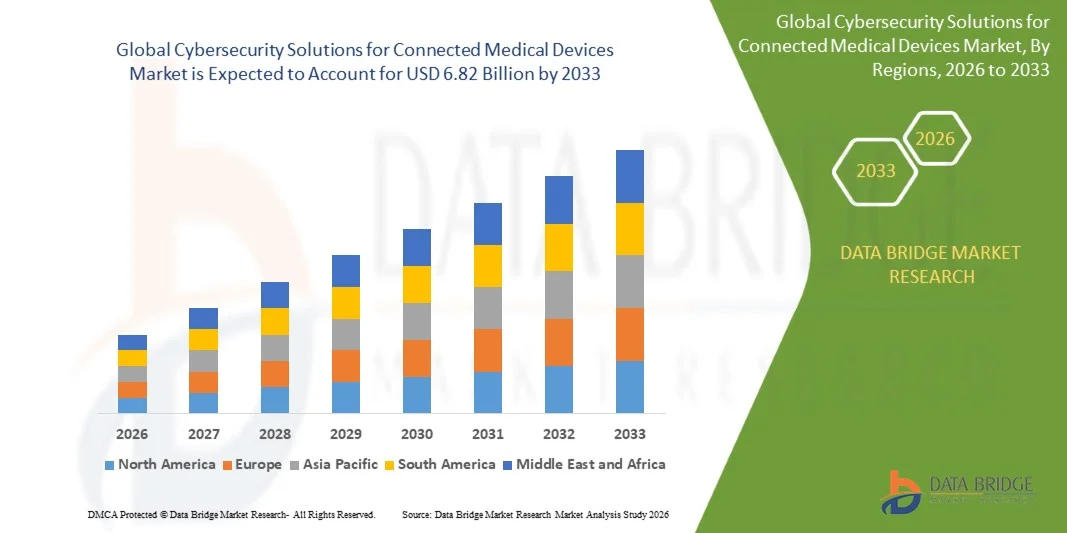
- As per Data Bridge Market Research analysis, the cybersecurity solutions for connected medical devices market was valued at USD 2.48 billion in 2025 and is projected to reach USD 6.82 billion by 2033, growing at a CAGR of 13.50% from 2026 to 2033.
- The market is experiencing consistent growth driven by increasing adoption of connected medical devices, expanding digital health and telemedicine platforms, and growing integration of medical equipment with hospital networks and cloud-based systems.
- The increasing frequency of data breaches, ransomware attacks, and unauthorized access to connected medical devices, combined with stricter cybersecurity and data-protection requirements, is compelling healthcare providers and medical device manufacturers to adopt advanced cybersecurity solutions. Network security, endpoint protection, identity and access management, and vulnerability management are increasingly being deployed to protect patient data, ensure device integrity, and maintain the continuity of critical healthcare operations.
Market Size & Forecast
- Global Market Value (2025): USD 2.48 Billion
- Expected Market Value (2033): USD 6.82 Billion
- Forecast CAGR (2026–2033): 13.50%
- Leading Region in 2025: North America
- Fastest Growing Region: Asia Pacific
What are the Major Takeaways of the Cybersecurity Solutions for Connected Medical Devices Market?
- North America dominated the cybersecurity solutions for connected medical devices market with the largest revenue share of 40.5% in 2025, supported by advanced healthcare infrastructure, high adoption of connected medical technologies, and stringent cybersecurity regulations.
- Asia-Pacific is expected to be the fastest-growing region at a CAGR of 9.5% from 2026 to 2033, fueled by increasing adoption of connected healthcare systems, expanding healthcare IT infrastructure, and rising government initiatives for medical cybersecurity.
- The solutions segment led the market with a 68.0% share in 2025, driven by strong demand for asset discovery, network segmentation, endpoint protection, identity management, and threat-monitoring technologies.
- Services are the fastest-growing component type, projected to register a CAGR of 14.0%, reflecting the surge in demand for continuous cybersecurity monitoring, vulnerability assessment, incident response, compliance support, and specialized expertise.
- The network security segment dominated the security type category with a 31.0% revenue share in 2025, led by the large number of connected medical devices communicating through hospital and healthcare networks.
- Hospital medical devices accounted for 60% of the market share in 2025, preferred by widespread deployment of infusion pumps, patient monitors, imaging systems, ventilators, workstations, and other connected equipment within hospitals
- The wearable medical devices segment is the fastest-growing device type category, with a CAGR of 14.9%, driven by expanding use of connected glucose monitors, cardiac monitoring devices, wearable sensors, and remote patient-monitoring technologies.
Report Scope and Cybersecurity Solutions for Connected Medical Devices Market Segmentation
|
Attributes |
Cybersecurity Solutions for Connected Medical Devices Key Market Insights |
|
Segments Covered |
|
|
Countries Covered |
North America
Europe
Asia-Pacific
Middle East and Africa
South America
|
|
Key Market Players |
|
|
Market Opportunities |
|
|
Value Added Data Infosets |
In addition to the insights on market scenarios such as market value, growth rate, segmentation, geographical coverage, and major players, the market reports curated by the Data Bridge Market Research also include in-depth expert analysis, patient epidemiology, pipeline analysis, pricing analysis, and regulatory framework. |
What is the Key Trend in the Cybersecurity Solutions for Connected Medical Devices Market?
- Connected medical device manufacturers are increasingly adopting lifecycle-based cybersecurity, integrating threat modeling, vulnerability management, secure design, software updates, and continuous monitoring throughout device development and deployment.
- For instance, in February 2026, the U.S. Food and Drug Administration (FDA) issued final cybersecurity guidance recommending cybersecurity considerations in device design, labeling, and premarket documentation, strengthening lifecycle-based protection for connected medical devices.
- Software Bills of Materials (SBOMs) are becoming an increasingly important cybersecurity tool, enabling manufacturers and healthcare providers to identify software components, monitor vulnerabilities, and improve transparency across connected medical-device ecosystems.
- Healthcare providers are increasingly prioritizing network segmentation, device authentication, vulnerability monitoring, and access controls as medical devices become more interconnected with hospital networks, cloud platforms, and remote-care systems
- For instance, in January 2025, the FDA issued a safety communication concerning Contec CMS8000 and Epsimed MN-120 patient monitors, identifying three cybersecurity vulnerabilities that could enable unauthorized control, exploit a software backdoor, and exfiltrate patient information after internet connection. The incident highlights the growing need for continuous monitoring and cybersecurity protection for connected medical devices.
- As connected medical devices become more deeply integrated into clinical workflows, cybersecurity-by-design, SBOM management, and continuous postmarket monitoring are expected to become increasingly central to medical-device security strategies, strengthening demand for specialized cybersecurity solutions.
What are the Key Drivers of the Cybersecurity Solutions for Connected Medical Devices Market?
- The rapid expansion of internet-connected, wireless, and interoperable medical devices has increased the number of endpoints requiring protection against unauthorized access, data exfiltration, device manipulation, and disruption of clinical operations.
- For instance, in January 2025, the FDA issued a safety communication regarding Contec CMS8000 and Epsimed MN-120 patient monitors, identifying three cybersecurity vulnerabilities that could allow unauthorized remote control, exploitation of a software backdoor, and exfiltration of patient information after the monitors were connected to the internet
- Regulatory requirements are also strengthening demand for cybersecurity solutions, as manufacturers must increasingly demonstrate that connected medical devices incorporate appropriate cybersecurity controls before entering the market.
- For instance, in October 2025, the U.S. FDA issued a Class I correction for Abiomed’s Automated Impella Controller after cybersecurity vulnerabilities were identified in its operating system. The vulnerabilities could potentially result in loss of device control or unexpected pump stoppage, and Abiomed instructed customers to restrict access and disable network capabilities while security updates were developed
- With healthcare organizations operating increasingly interconnected device environments, continuous vulnerability management, secure authentication, network protection, and incident-response capabilities are becoming essential for maintaining device safety and protecting patient information.
Which Factors are Challenging the Growth of the Cybersecurity Solutions for Connected Medical Devices Market?
- Connected medical-device cybersecurity is challenging because healthcare environments contain large, heterogeneous device ecosystems, including legacy equipment that may have limited security capabilities, making comprehensive vulnerability management and security upgrades difficult.
- For instance, in January 2025, the FDA noted that medical devices can become particularly vulnerable when older equipment was not originally designed with cybersecurity in mind, highlighting the difficulty of protecting legacy connected devices throughout their operational lifecycles.
- Device cybersecurity remediation can also require specialized technical expertise and operational changes, while disconnecting vulnerable devices may affect remote monitoring and clinical workflows, creating implementation challenges for healthcare providers.
- For instance, in July 2025, the FDA reported that a Contec software patch removed networking functionality from affected patient monitors, meaning the devices could subsequently be used only for local monitoring and requiring specialized expertise for patch installation.
- The complexity of heterogeneous medical-device environments, legacy-device limitations, specialized remediation requirements, and potential disruption to connected clinical functions continue to challenge cybersecurity implementation, particularly where healthcare organizations must balance security improvements with uninterrupted patient care.
How is the Cybersecurity Solutions for Connected Medical Devices Market Segmented?
The cybersecurity solutions for connected medical devices market is segmented on the basis of component, security type, device type, and end user.
- By Component
On the basis of component, the cybersecurity solutions for connected medical devices market is segmented into solutions, services, consulting services, managed security services, and support and maintenance services. The solutions segment dominated the market with 68.0% share in 2025, supported by strong demand for asset discovery, network segmentation, endpoint protection, identity management, and threat-monitoring technologies. Healthcare organizations increasingly deploy cybersecurity solutions to establish visibility and protection across large connected-device environments. These technologies can be integrated with existing hospital IT and security infrastructure, making them suitable for protecting diverse medical-device fleets. Automated monitoring and threat-detection capabilities are further strengthening demand for technology-based security solutions.
The services segment is projected to register the fastest growth at CAGR of 14.0% during forecast period, driven by increasing demand for continuous cybersecurity monitoring, vulnerability assessment, incident response, compliance support, and specialized expertise. Healthcare organizations often operate complex medical-device environments that require ongoing security management rather than one-time deployment. Managed security services allow hospitals and clinics to obtain continuous monitoring and threat-response capabilities without building extensive internal cybersecurity teams. Consulting services are also gaining importance as manufacturers and providers address evolving regulatory requirements and device-security risks. Support and maintenance services help organizations maintain security controls throughout the operational lifecycle of connected devices.
- By Security Type
On the basis of security type, the cybersecurity solutions for connected medical devices market is segmented into network security, endpoint security, application security, cloud security, data security, identity and access management, and vulnerability management. The network security segment dominated the market with 31.0% share in 2025, supported by the large number of connected medical devices communicating through hospital and healthcare networks. Network security solutions protect communication channels connecting patient monitors, imaging systems, infusion pumps, electronic health records, and clinical workstations. Firewalls, secure gateways, network access controls, and intrusion prevention systems help prevent unauthorized access and lateral movement of cyber threats. Healthcare providers also use network segmentation to isolate vulnerable medical devices from critical IT infrastructure.
The cloud security segment is projected to register the fastest growth at CAGR of 16.1% during forecast period, driven by increasing adoption of cloud-based healthcare platforms, remote patient monitoring, telemedicine, and cloud-enabled medical imaging. Connected medical devices increasingly exchange patient and operational data with cloud applications, expanding the need for secure data transmission, access control, encryption, and cloud workload protection. Cloud security solutions provide centralized visibility across geographically distributed healthcare environments and connected devices. Healthcare providers are also adopting cloud infrastructure to improve scalability and reduce dependence on extensive on-premise security infrastructure. Integration with identity management and secure application interfaces is further strengthening cloud protection capabilities.
- By Device Type
On the basis of device type, the cybersecurity solutions for connected medical devices market is segmented into patient monitoring devices, imaging devices, diagnostic devices, therapeutic devices, wearable medical devices, infusion pumps, ventilators, and other connected medical devices. The hospital medical devices segment dominated the market with 60.0% share in 2025, supported by widespread deployment of infusion pumps, patient monitors, imaging systems, ventilators, workstations, and other connected equipment within hospitals. These devices operate across critical-care and clinical environments where secure connectivity and uninterrupted operation are essential. Hospitals also maintain large and heterogeneous device fleets that create extensive cybersecurity requirements. Increasing integration of medical equipment with hospital networks and digital health platforms is expanding the potential attack surface.
The wearable medical devices segment is projected to register the fastest growth at CAGR of 14.9% during forecast period, driven by expanding use of connected glucose monitors, cardiac monitoring devices, wearable sensors, and remote patient-monitoring technologies. Unlike many hospital-based devices, wearables operate across homes, mobile networks, wireless connections, and cloud platforms, increasing exposure to cybersecurity risks. These devices transmit continuous health and biometric information that requires strong encryption, authentication, and access controls. The expansion of home-based healthcare and remote chronic-disease management is further increasing the number of connected wearable endpoints. Advances in wireless connectivity and cloud integration are enabling more continuous data exchange between patients and healthcare providers.
- By End User
On the basis of end user, the cybersecurity solutions for connected medical devices market is segmented into hospitals and clinics, ambulatory surgical centers, diagnostic and imaging centers, home healthcare, pharmaceutical and biotechnology companies, medical device manufacturers, and other healthcare facilities. The hospitals and health systems segment dominated the market with 42.2% share in 2025, supported by the extensive deployment of interconnected medical devices across critical-care, diagnostic, surgical, and patient-monitoring departments. Hospitals operate large and heterogeneous device environments that require centralized cybersecurity visibility and continuous monitoring. Connected imaging systems, infusion pumps, ventilators, patient monitors, and clinical workstations create multiple potential entry points for cyber threats. Hospitals also face significant regulatory and operational requirements to protect patient information and maintain uninterrupted clinical services.
The diagnostic and imaging centers segment is projected to register the fastest growth at CAGR of 16.0% during forecast period, driven by increasing connectivity of imaging equipment, diagnostic systems, clinical networks, and digital data platforms. Diagnostic centers increasingly rely on connected imaging and information systems to transfer, store, and analyze sensitive patient information. This connectivity creates cybersecurity requirements around device access, data transmission, network protection, and vendor connectivity. Imaging equipment can also represent a critical operational asset where cybersecurity incidents may disrupt diagnostic workflows. Increasing digitalization of diagnostic services is consequently expanding the attack surface beyond traditional hospital environments.
Which Region Holds the Largest Share of the Cybersecurity Solutions for Connected Medical Devices Market?
- North America dominated the cybersecurity solutions for connected medical devices market with the largest revenue share of 40.5% in 2025, supported by advanced healthcare infrastructure, high adoption of connected medical technologies, and stringent cybersecurity regulations.
- The region also benefits from the presence of leading cybersecurity providers, growing deployment of IoT-enabled medical technologies, and increasing emphasis on protecting connected hospital equipment and patient data. Strong regulatory oversight, including FDA cybersecurity requirements, along with rising cyber threats and investments in continuous monitoring and vulnerability management, continues to strengthen North America’s position in the global market.
U.S. Cybersecurity Solutions for Connected Medical Devices Market Insight
The U.S. cybersecurity solutions for connected medical devices market is witnessing strong growth due to rising investments in medical device cybersecurity, regulatory requirements, and increasing adoption of connected healthcare technologies. The country’s advanced healthcare infrastructure, along with increasing use of networked patient monitoring, diagnostic, therapeutic, and wearable devices, is driving demand for comprehensive cybersecurity solutions. In addition, growing emphasis on protecting patient data, preventing unauthorized device access, and managing vulnerabilities across connected medical device ecosystems is accelerating cybersecurity adoption among healthcare providers and medical device manufacturers.
Asia-Pacific Cybersecurity Solutions for Connected Medical Devices Market Insight
The Asia-Pacific cybersecurity solutions for connected medical devices market is expected to witness rapid growth, driven by increasing digitalization of healthcare systems, expanding adoption of connected medical devices, and rising investments in healthcare cybersecurity across countries such as China, Japan, and India. Growing awareness regarding medical device vulnerabilities, increasing connectivity between healthcare equipment and hospital networks, and rising demand for secure remote healthcare technologies are supporting regional market expansion. In addition, strengthening cybersecurity frameworks and increasing focus on protecting connected healthcare infrastructure are accelerating adoption of cybersecurity solutions across hospitals, medical device manufacturers, and other healthcare organizations.
Japan Cybersecurity Solutions for Connected Medical Devices Market Insight
The Japan cybersecurity solutions for connected medical devices market is witnessing consistent growth due to rising investments in healthcare digitalization, medical device security, and connected healthcare technologies. Healthcare providers and medical device manufacturers are increasingly focusing on protecting network-connected medical equipment, managing cybersecurity vulnerabilities, and maintaining secure device operations throughout the product lifecycle. Moreover, strengthening cybersecurity requirements for connected medical devices and increasing attention toward network security, vulnerability management, and secure interoperability are further contributing to market growth in Japan.
China Cybersecurity Solutions for Connected Medical Devices Market Insight
The China cybersecurity solutions for connected medical devices market is growing rapidly, driven by increasing digital transformation across healthcare facilities, expanding deployment of connected medical equipment, and rising focus on healthcare cybersecurity. Growing adoption of networked patient monitoring, diagnostic, imaging, and therapeutic technologies is significantly boosting demand for solutions that protect connected devices and sensitive healthcare information. In addition, increasing awareness regarding cyber threats, strengthening medical device security practices, and rapid development of digital healthcare infrastructure are positioning China as an important growth market for cybersecurity solutions for connected medical devices.
U.K. Cybersecurity Solutions for Connected Medical Devices Market Insight
The U.K. cybersecurity solutions for connected medical devices market is experiencing steady growth, supported by rising adoption of connected healthcare technologies, increasing cybersecurity requirements, and growing demand for secure digital healthcare infrastructure. Increasing investments in cybersecurity capabilities and greater attention to protecting connected devices, healthcare networks, and sensitive patient information are contributing to market growth. Furthermore, the U.K.'s broader focus on connected-device security and engagement with cybersecurity providers, manufacturers, and healthcare stakeholders is supporting the development and adoption of stronger security measures.
Germany Cybersecurity Solutions for Connected Medical Devices Market Insight
The Germany cybersecurity solutions for connected medical devices market is expanding steadily due to the country’s advanced healthcare infrastructure, increasing adoption of connected medical technologies, and growing emphasis on cybersecurity throughout the medical device lifecycle. Healthcare organizations and medical device manufacturers are increasingly focusing on vulnerability management, secure connectivity, and protection of networked medical equipment against cyber threats. Continuous development of cybersecurity requirements for connected medical devices, along with increasing demand for secure interoperability and resilient healthcare systems, is further supporting market growth in Germany.
Which are the Top Companies in Cybersecurity Solutions for Connected Medical Devices Market?
The cybersecurity solutions for connected medical devices industry is primarily led by well-established companies, including:
- Armis (U.S.)
- Claroty Ltd. (U.S.)
- Medcrypt (U.S.)
- Palo Alto Networks, Inc. (U.S.)
- Fortinet, Inc. (U.S.)
- CrowdStrike, Inc. (U.S.)
- Forescout Technologies, Inc. (U.S.)
- Trellix (U.S.)
- Darktrace (U.K.)
- Check Point Software Technologies Ltd. (Israel)
- Cisco Systems, Inc. (U.S.)
- Microsoft Corporation (U.S.)
- IBM Corporation (U.S.)
- Nozomi Networks (U.S.)
- SentinelOne, Inc. (U.S.)
- GE HealthCare (U.S.)
- Siemens Healthineers AG (Germany)
- Koninklijke Philips N.V. (Netherlands)
- Johnson Controls International plc (Ireland)
- Zscaler, Inc. (U.S.)
What are Latest Developments in Cybersecurity Solutions for Connected Medical Devices Market?
- In June 2025, the U.S. Food and Drug Administration (FDA) issued its final guidance, Cybersecurity in Medical Devices: Quality System Considerations and Content of Premarket Submissions, updating recommendations for cybersecurity device design, labeling, and premarket documentation. The guidance also addresses requirements under Section 524B of the FD&C Act for devices with cybersecurity risks, strengthening expectations for manufacturers to incorporate cybersecurity throughout the medical device development process.
- In February 2024, Medtronic made a software update available for its ILLUMISITE platform to address security vulnerabilities that could allow unauthorized users to execute code on the system. The update was designed to improve system security while allowing the platform to remain network connected, highlighting the increasing focus on vulnerability remediation for connected medical equipment used in clinical environments.
- In September 2023, the U.S. Food and Drug Administration (FDA) issued its final guidance on Cybersecurity in Medical Devices: Quality System Considerations and Content of Premarket Submissions. The guidance provided recommendations for manufacturers on addressing cybersecurity considerations and documenting cybersecurity information in premarket submissions, supporting greater integration of security measures into connected medical device development
- In September 2022, Medtronic disclosed security vulnerabilities affecting its ILLUMISITE™ platform, an electromagnetic navigation bronchoscopy system used during pulmonary procedures. The company recommended security measures including network isolation or protected sub-networks while remediation was being implemented, demonstrating the importance of vulnerability disclosure and network protection for connected medical devices.
- In June 2021, the U.S. Food and Drug Administration (FDA) released a discussion paper on Strengthening Cybersecurity Practices Associated with Servicing of Medical Devices: Challenges and Opportunities. The initiative examined cybersecurity issues associated with servicing medical devices and sought industry input on approaches for maintaining device security during servicing activities, reinforcing the importance of cybersecurity across the medical device lifecycle

- Interactive Data Analysis Dashboard
- Company Analysis Dashboard for high growth potential opportunities
- Research Analyst Access for customization & queries
- Competitor Analysis with Interactive dashboard
- Latest News, Updates & Trend analysis
- Harness the Power of Benchmark Analysis for Comprehensive Competitor Tracking
Data collection and base year analysis are done using data collection modules with large sample sizes. The stage includes obtaining market information or related data through various sources and strategies. It includes examining and planning all the data acquired from the past in advance. It likewise envelops the examination of information inconsistencies seen across different information sources. The market data is analysed and estimated using market statistical and coherent models. Also, market share analysis and key trend analysis are the major success factors in the market report. To know more, please request an analyst call or drop down your inquiry.
The key research methodology used by DBMR research team is data triangulation which involves data mining, analysis of the impact of data variables on the market and primary (industry expert) validation. Data models include Vendor Positioning Grid, Market Time Line Analysis, Market Overview and Guide, Company Positioning Grid, Patent Analysis, Pricing Analysis, Company Market Share Analysis, Standards of Measurement, Global versus Regional and Vendor Share Analysis. To know more about the research methodology, drop in an inquiry to speak to our industry experts.
Data Bridge Market Research is a leader in advanced formative research. We take pride in servicing our existing and new customers with data and analysis that match and suits their goal. The report can be customized to include price trend analysis of target brands understanding the market for additional countries (ask for the list of countries), clinical trial results data, literature review, refurbished market and product base analysis. Market analysis of target competitors can be analyzed from technology-based analysis to market portfolio strategies. We can add as many competitors that you require data about in the format and data style you are looking for. Our team of analysts can also provide you data in crude raw excel files pivot tables (Fact book) or can assist you in creating presentations from the data sets available in the report.













