


What is the Data Centre Transformation Market Size and Growth Rate?
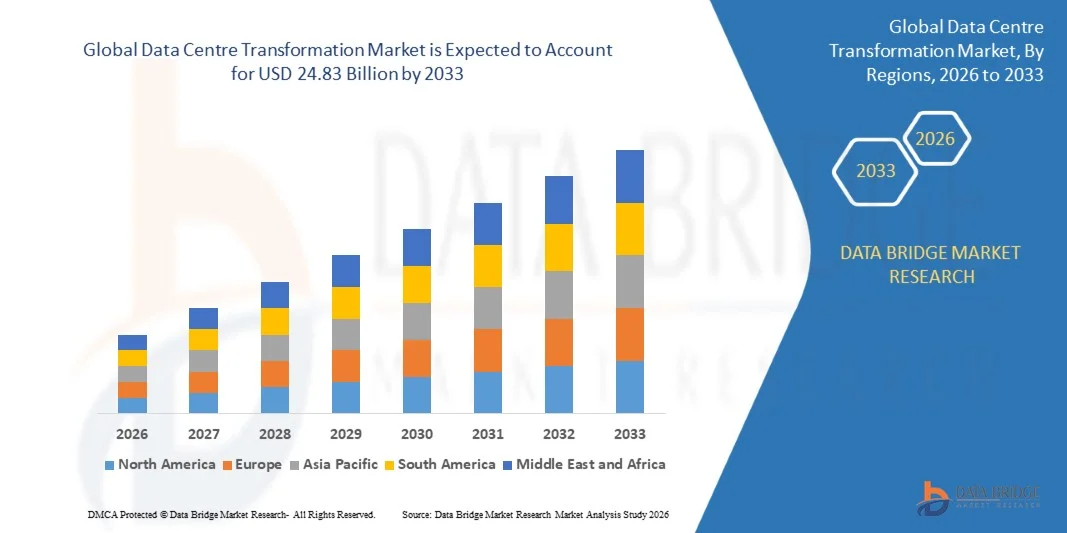
- As per Data Bridge Market Research Analysis the global data centre transformation market size was valued at USD 11.79 billion in 2025 and is expected to reach USD 24.83 billion by 2033, at a CAGR of 9.75 % during the forecast period
- The market growth is largely fuelled by the increasing adoption of advanced digital infrastructure, cloud computing, and automation technologies across enterprises and service providers worldwide
- Furthermore, the rising demand for scalable, secure, and efficient data centre operations, coupled with the need for energy optimization and reduced operational costs, is reinforcing the uptake of data centre transformation services.
Market Size & Forecast
- Global Market Value (2025): USD 11.79 Billion
- Expected Market Value (2033): USD 24.83 Billion
- Forecast CAGR (2026–2033): 9.75 %
What are the Major Takeaways of Data Centre Transformation Market?
- Data Centre Transformation services provide comprehensive solutions such as consolidation, optimization, automation, and infrastructure management, which are increasingly essential for enterprises, cloud service providers, and colocation operators. These solutions enhance operational efficiency, minimize downtime, and enable seamless scalability
- The growing reliance on cloud-based applications, high-performance computing, and hybrid IT infrastructure is driving demand for transformation services. In addition, organizations are prioritizing cost-effective, sustainable, and automated data centre solutions to improve agility, resilience, and business continuity, making data centre transformation a critical enabler of modern digital operations
- North America dominated the data centre transformation market with the largest revenue share in 2025, driven by rapid digital transformation initiatives and strong adoption of cloud computing technologies across enterprises
- Asia-Pacific region is expected to witness the highest growth rate in the global data centre transformation market, driven by rising demand for cloud services, rapid expansion of digital economies, and increasing investments in large-scale data centre infrastructure across countries such as China, India, Japan, and Singapore
- The optimization services segment held the largest market revenue share in 2025 driven by the increasing need for enterprises to enhance data centre efficiency, reduce operational costs, and improve infrastructure performance. Optimization services help organizations streamline workloads, improve resource utilization, and enhance system reliability, making them a key component of digital infrastructure modernization strategies
Report Scope and Data Centre Transformation Market Segmentation
|
Attributes |
Data Centre Transformation Key Market Insights |
|
Segments Covered |
|
|
Countries Covered |
North America
Europe
Asia-Pacific
Middle East and Africa
South America
|
|
Key Market Players |
|
|
Market Opportunities |
|
|
Value Added Data Infosets |
In addition to the market insights such as market value, growth rate, market segments, geographical coverage, market players, and market scenario, the market report curated by the Data Bridge Market Research team includes in-depth expert analysis, import/export analysis, pricing analysis, production consumption analysis, and pestle analysis. |
What is the Key Trend in the Data Centre Transformation Market?
“Growing Adoption of Cloud Computing and Hybrid IT Infrastructure”
• The increasing shift toward cloud computing and hybrid IT infrastructure is significantly shaping the data centre transformation market, as organizations seek scalable, flexible, and efficient digital infrastructure to support modern workloads. Data centre transformation solutions are gaining traction due to their ability to optimize resource utilization, improve operational efficiency, and support seamless integration between on-premises and cloud environments. This trend is encouraging enterprises to modernize legacy infrastructure and implement advanced data management solutions that align with evolving digital strategies
• Rising demand for high-performance computing, real-time data processing, and digital services has accelerated the need for modernized data centre environments. Businesses across industries such as finance, healthcare, retail, and telecommunications are investing in infrastructure upgrades to support growing data volumes and ensure uninterrupted service delivery. This transition is also driving the adoption of software-defined infrastructure, virtualization technologies, and automated management platforms to enhance operational agility and efficiency
• Digital transformation initiatives are influencing enterprise IT strategies, with organizations emphasizing automation, scalability, and energy-efficient infrastructure. Data centre transformation enables companies to reduce operational complexity while improving system performance and resilience. Technology providers are increasingly introducing advanced platforms and integrated solutions that support seamless workload migration, enhanced security capabilities, and improved infrastructure management across hybrid and multi-cloud environments
• For instance, in 2024, Microsoft and Amazon Web Services expanded their cloud infrastructure and introduced advanced data centre transformation services to support enterprise modernization initiatives. These developments were introduced to help organizations migrate legacy systems to cloud environments, improve data processing capabilities, and strengthen digital infrastructure resilience across global markets
• While demand for data centre transformation solutions is increasing, sustained market expansion depends on continuous technological innovation, efficient infrastructure management, and the ability to integrate advanced technologies with existing IT environments. Service providers are also focusing on improving scalability, operational efficiency, and cybersecurity capabilities to support long-term enterprise digital transformation strategies
Data Centre Transformation Market Dynamics
Driver
“Increasing Enterprise Digital Transformation Initiatives”
• Rapid digital transformation across industries is a major driver for the data centre transformation market. Organizations are modernizing their IT infrastructure to support emerging technologies such as artificial intelligence, big data analytics, and Internet of Things (IoT) applications. This shift is encouraging enterprises to upgrade traditional data centre environments and adopt flexible infrastructure solutions capable of supporting complex digital workloads
• Expanding use of cloud-based applications and data-driven services is influencing market growth as companies require reliable, scalable, and secure infrastructure to manage increasing data volumes. Data centre transformation enables enterprises to improve system performance, enhance resource management, and ensure business continuity while supporting evolving digital services and customer experiences
• Technology providers are actively supporting enterprise modernization through advanced transformation solutions, consulting services, and integrated infrastructure platforms. These efforts are supported by the growing need for operational agility and improved IT efficiency, encouraging partnerships between technology vendors and enterprises to streamline infrastructure modernization and improve data centre performance
• For instance, in 2023, IBM and Dell Technologies reported increased deployment of data centre transformation solutions across enterprise and cloud service provider environments. These initiatives were introduced to support hybrid cloud adoption, optimize infrastructure management, and enhance system scalability for modern enterprise workloads
• Although digital transformation initiatives are driving market growth, long-term expansion depends on continuous infrastructure upgrades, improved interoperability between platforms, and the availability of skilled IT professionals capable of managing complex digital ecosystems
Restraint/Challenge
“High Implementation Costs and Integration Complexity”
• The high cost associated with data centre transformation projects remains a significant challenge, particularly for small and medium-sized enterprises. Upgrading legacy infrastructure, deploying advanced hardware and software solutions, and migrating workloads to modern platforms require substantial financial investment. These costs can limit adoption among organizations with constrained IT budgets
• Integration challenges also affect market growth, as enterprises often operate complex legacy systems that require careful planning during modernization initiatives. Ensuring compatibility between existing infrastructure and new digital platforms can be technically demanding, requiring specialized expertise and extended implementation timelines
• Security and data privacy concerns further influence adoption, as organizations must ensure that transformed data centre environments comply with regulatory requirements and maintain robust cybersecurity frameworks. The growing sophistication of cyber threats requires continuous monitoring, advanced security tools, and well-structured governance frameworks to safeguard sensitive enterprise data
• For instance, in 2024, organizations across countries such as Germany and Singapore reported challenges in implementing large-scale data centre transformation initiatives due to high infrastructure investment requirements and integration complexities with existing IT systems. These challenges increased project timelines and operational costs for enterprises undergoing digital infrastructure modernization
• Addressing these challenges will require cost-efficient transformation strategies, improved interoperability between legacy and modern systems, and stronger collaboration between technology providers and enterprises. Investment in workforce training, advanced security frameworks, and scalable infrastructure solutions will also be essential to support the long-term growth of the global data centre transformation market
How is the Data Centre Transformation Market Segmented?
The market is segmented on the basis of services, end user, and vertical.
• By Services
On the basis of services, the data centre transformation market is segmented into Consolidation Services, Optimization Services, Automation Services, and Infrastructure Management Services. The optimization services segment held the largest market revenue share in 2025 driven by the increasing need for enterprises to enhance data centre efficiency, reduce operational costs, and improve infrastructure performance. Optimization services help organizations streamline workloads, improve resource utilization, and enhance system reliability, making them a key component of digital infrastructure modernization strategies.
The automation services segment is expected to witness the fastest growth rate from 2026 to 2033, driven by the growing adoption of intelligent automation tools and software-defined infrastructure. Automation services enable organizations to reduce manual intervention, improve operational efficiency, and support faster deployment of IT resources, making them increasingly important for managing complex hybrid and multi-cloud environments.
• By End User
On the basis of end user, the data centre transformation market is segmented into Cloud Service Providers, Colocation Providers, and Enterprises. The cloud service providers segment held the largest market revenue share in 2025 driven by the rapid expansion of cloud infrastructure and the growing demand for scalable data storage and processing solutions. Cloud providers continuously invest in modernizing data centre infrastructure to improve performance, reliability, and energy efficiency, supporting the growing demand for cloud-based services.
The enterprises segment is expected to witness the fastest growth rate from 2026 to 2033, driven by increasing digital transformation initiatives across industries. Enterprises are modernizing their IT infrastructure to support advanced technologies such as artificial intelligence, big data analytics, and Internet of Things applications, leading to higher adoption of data centre transformation services.
• By Vertical
On the basis of vertical, the data centre transformation market is segmented into BFSI, IT and Telecommunications, Government and Defense, Energy, Manufacturing, and Others. The IT and telecommunications segment held the largest market revenue share in 2025 driven by the rapid growth of digital services, cloud computing, and data-intensive applications. Organizations in this sector require highly scalable and reliable infrastructure to support network operations, data management, and high-speed connectivity services.
The BFSI segment is expected to witness the fastest growth rate from 2026 to 2033, driven by increasing adoption of digital banking, online financial services, and secure data management systems. Financial institutions are investing in advanced data centre infrastructure to enhance cybersecurity, ensure regulatory compliance, and support real-time transaction processing across digital platforms.
Which Region Holds the Largest Share of the Data Centre Transformation Market?
• North America dominated the data centre transformation market with the largest revenue share in 2025, driven by rapid digital transformation initiatives and strong adoption of cloud computing technologies across enterprises
• Organizations in the region emphasize scalable IT infrastructure, advanced data management, and secure digital environments to support growing volumes of enterprise data and cloud-based applications
• This widespread adoption is further supported by strong investment in technology infrastructure, the presence of major cloud service providers, and increasing demand for efficient and automated data centre operations across industries
U.S. Data Centre Transformation Market Insight
The U.S. data centre transformation market captured the largest revenue share in 2025 within North America, fueled by the rapid adoption of cloud computing, big data analytics, and artificial intelligence technologies. Enterprises across industries are investing in modernizing legacy IT infrastructure to support digital services and improve operational efficiency. The growing presence of hyperscale data centres, along with increasing demand for hybrid and multi-cloud environments, further supports the expansion of the data centre transformation market in the country.
Europe Data Centre Transformation Market Insight
The Europe data centre transformation market is expected to witness the fastest growth rate from 2026 to 2033, primarily driven by increasing digitalization across industries and strong regulatory emphasis on data security and privacy. Organizations across the region are modernizing their IT infrastructure to improve operational efficiency and support advanced digital applications. The rising adoption of cloud platforms, virtualization technologies, and automated infrastructure management systems is also accelerating market growth.
U.K. Data Centre Transformation Market Insight
The U.K. data centre transformation market is expected to witness significant growth from 2026 to 2033, driven by strong investments in digital infrastructure and increasing adoption of cloud-based services. Businesses in the country are focusing on upgrading data centre capabilities to support advanced analytics, artificial intelligence, and data-intensive applications. The growing demand for reliable and secure data storage solutions further contributes to the adoption of data centre transformation services.
Germany Data Centre Transformation Market Insight
The Germany data centre transformation market is expected to witness steady growth from 2026 to 2033, fueled by the country’s advanced industrial base and strong focus on technological innovation. Enterprises are increasingly adopting modern data centre solutions to support digital manufacturing, automation, and connected technologies. The growing demand for energy-efficient infrastructure and secure data management systems is also encouraging organizations to invest in data centre transformation initiatives.
Asia-Pacific Data Centre Transformation Market Insight
The Asia-Pacific data centre transformation market is expected to witness the fastest growth rate from 2026 to 2033, driven by rapid digitalization, increasing internet penetration, and expanding cloud service adoption across emerging economies. Countries across the region are investing heavily in digital infrastructure to support the growth of e-commerce, fintech, and online services. Government initiatives promoting digital transformation and smart city development are further accelerating the adoption of advanced data centre technologies.
Japan Data Centre Transformation Market Insight
The Japan data centre transformation market is expected to witness steady growth from 2026 to 2033 due to the country’s strong technological capabilities and increasing demand for high-performance computing infrastructure. Japanese enterprises are investing in advanced data centre solutions to support artificial intelligence, robotics, and IoT applications. The integration of energy-efficient systems and automated infrastructure management is also supporting the modernization of data centres across the country.
China Data Centre Transformation Market Insight
The China data centre transformation market accounted for the largest market revenue share in Asia-Pacific in 2025, attributed to the country’s rapid digital expansion and large-scale adoption of cloud computing services. China has become a major hub for data centre infrastructure development, supported by strong government initiatives promoting digital transformation. The increasing demand for cloud services, big data analytics, and advanced digital platforms is driving investments in modern data centre technologies across the country.
Which are the Top Companies in Data Centre Transformation Market?
The Data Centre Transformation industry is primarily led by well-established companies, including:
- Accenture (Ireland)
- Atos (France)
- Cisco Systems, Inc. (U.S.)
- Cognizant (U.S.)
- Dell Inc. (U.S.)
- HCL Technologies (India)
- IBM (U.S.)
- Schneider Electric SE (France)
- Wipro (India)
- Amazon Web Services (AWS) (U.S.)
- Digital Realty (U.S.)
- Equinix (U.S.)
- Google (U.S.)
- Microsoft Corporation (U.S.)
- Oracle (U.S.)
- Dell EMC (U.S.)
What are Latest Developments in Data Centre Transformation Market?
- In March 2026, EdgeConneX announced the expansion of its operations in Japan’s Kansai region to support increasing demand for edge computing and cloud services. The development focuses on establishing advanced data centre facilities that enable faster data processing and low-latency connectivity. This expansion aims to strengthen the company’s presence in the Asia-Pacific digital infrastructure market while supporting growing enterprise demand for real-time applications. The initiative is expected to accelerate the deployment of edge computing infrastructure and enhance regional cloud connectivity
- In February 2025, NTT announced the acquisition of NTT Data and plans to develop nearly 1 GW of new data centre capacity as part of its sustainability-focused expansion strategy. The project emphasizes renewable energy usage and waste-heat reuse technologies to achieve net-zero operations. This development aims to strengthen the company’s digital infrastructure capabilities while supporting environmentally responsible data centre operations. The initiative is expected to encourage energy-efficient data centre transformation practices across the global market
- In January 2024, Vantage Data Centers secured a major equity investment led by DigitalBridge and Silver Lake to accelerate hyperscale data centre expansion globally. The funding will support the development of high-capacity data centre campuses designed to meet growing demand for cloud computing and digital services. This initiative aims to enhance the company’s global infrastructure footprint and support large-scale enterprise workloads. The investment is expected to strengthen hyperscale data centre development and drive further transformation of global digital infrastructure
- In October 2024, Dell Inc. introduced new rack-scalable systems, servers, and storage innovations under its Dell AI Factory initiative. The launch includes advanced infrastructure platforms designed to support high-density artificial intelligence workloads and improve computing efficiency in modern data centres. These solutions integrate liquid cooling and scalable architecture to optimize performance and energy efficiency. The development supports enterprises in modernizing infrastructure and adopting AI-driven data centre operations
- In June 2023, Cisco Systems, Inc. launched Nexus HyperFabric AI Clusters in collaboration with NVIDIA to support enterprise deployment of generative AI infrastructure. The solution provides integrated analytics, visibility, and cloud management capabilities to simplify AI workload management within modern data centres. This innovation helps organizations deploy scalable and efficient AI infrastructure while reducing operational complexity. The launch is expected to accelerate adoption of AI-ready data centre architectures globally
- In August 2022, CapitaLand Investment announced plans to develop a large-scale data centre facility in Osaka, Japan designed to operate on renewable energy. The project aims to support sustainable digital infrastructure development while addressing increasing demand for data storage and cloud services in the Asia-Pacific region. By focusing on environmentally responsible operations, the company aims to strengthen its presence in the data centre market. The initiative highlights the growing emphasis on green data centre infrastructure in global digital transformation strategies

- Interactive Data Analysis Dashboard
- Company Analysis Dashboard for high growth potential opportunities
- Research Analyst Access for customization & queries
- Competitor Analysis with Interactive dashboard
- Latest News, Updates & Trend analysis
- Harness the Power of Benchmark Analysis for Comprehensive Competitor Tracking
Data collection and base year analysis are done using data collection modules with large sample sizes. The stage includes obtaining market information or related data through various sources and strategies. It includes examining and planning all the data acquired from the past in advance. It likewise envelops the examination of information inconsistencies seen across different information sources. The market data is analysed and estimated using market statistical and coherent models. Also, market share analysis and key trend analysis are the major success factors in the market report. To know more, please request an analyst call or drop down your inquiry.
The key research methodology used by DBMR research team is data triangulation which involves data mining, analysis of the impact of data variables on the market and primary (industry expert) validation. Data models include Vendor Positioning Grid, Market Time Line Analysis, Market Overview and Guide, Company Positioning Grid, Patent Analysis, Pricing Analysis, Company Market Share Analysis, Standards of Measurement, Global versus Regional and Vendor Share Analysis. To know more about the research methodology, drop in an inquiry to speak to our industry experts.
Data Bridge Market Research is a leader in advanced formative research. We take pride in servicing our existing and new customers with data and analysis that match and suits their goal. The report can be customized to include price trend analysis of target brands understanding the market for additional countries (ask for the list of countries), clinical trial results data, literature review, refurbished market and product base analysis. Market analysis of target competitors can be analyzed from technology-based analysis to market portfolio strategies. We can add as many competitors that you require data about in the format and data style you are looking for. Our team of analysts can also provide you data in crude raw excel files pivot tables (Fact book) or can assist you in creating presentations from the data sets available in the report.













