


Digital Education Content Market Size
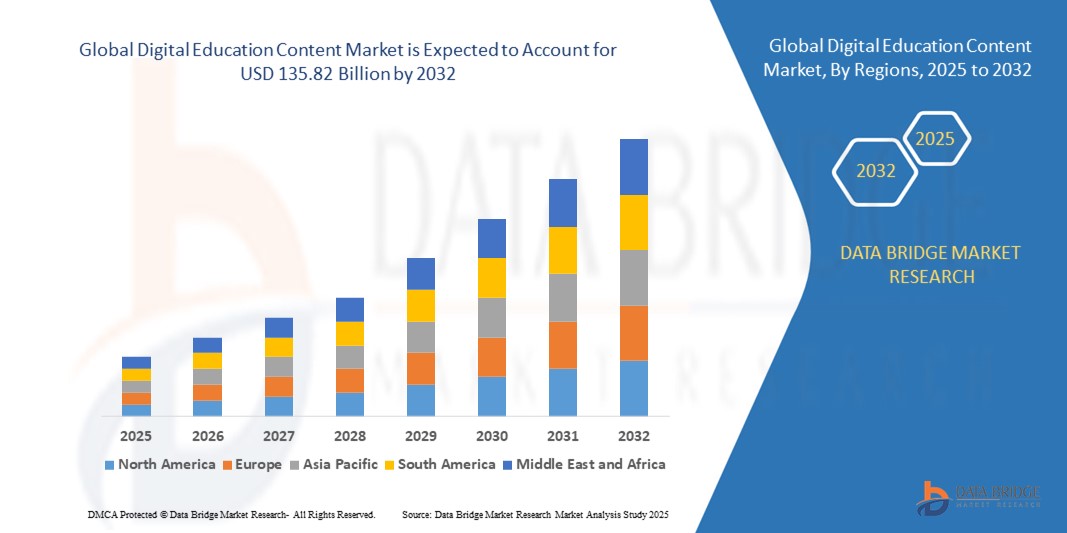
- The global digital education content market size was valued at USD 15.08 billion in 2024 and is projected to reach USD 135.82 billion by 2032, with a CAGR of 27.00% during the forecast period
- Market expansion is primarily driven by the rapid digital transformation in education, increased internet penetration, and the widespread adoption of smart devices, all contributing to the integration of technology into learning environments across the globe
- In addition, rising demand for flexible, personalized, and interactive learning solutions among students and professionals is reinforcing digital education content as a core component of modern education systems. These evolving dynamics are propelling significant growth within the digital education content industry
Digital Education Content Market Analysis
- Digital education content, encompassing e-learning materials, interactive modules, and multimedia resources, is becoming an essential part of modern education systems across K-12, higher education, and corporate training due to its accessibility, flexibility, and ability to enhance learner engagement and outcomes
- The surge in demand for digital education content is primarily driven by increased internet penetration, the rise of remote learning, and the growing emphasis on personalized and adaptive learning experiences that cater to diverse learner needs
- North America led the digital education content market with the largest revenue share of 42.67% in 2024, supported by a well-established digital infrastructure, early adoption of EdTech, and significant investments in educational innovation, with the U.S. seeing major growth through platforms offering AI-driven learning and immersive content solutions
- Asia-Pacific is projected to witness the fastest growth in the digital education content market during the forecast period, fueled by government initiatives in digital literacy, expanding access to mobile technology, and a large student population
- The self-paced online education segment dominated the market with the largest revenue share of 61.3% in 2024, driven by its flexibility, affordability, and accessibility across diverse demographics
Report Scope and Market Segmentation
|
Attributes |
Digital Education Content Key Market Insights |
|
Segments Covered |
|
|
Countries Covered |
North America
Europe
Asia-Pacific
Middle East and Africa
South America
|
|
Key Market Players |
|
|
Market Opportunities |
|
|
Value Added Data Infosets |
In addition to the insights on market scenarios such as market value, growth rate, segmentation, geographical coverage, and major players, the market reports curated by the Data Bridge Market Research also include in-depth expert analysis, pricing analysis, brand share analysis, consumer survey, demography analysis, supply chain analysis, value chain analysis, raw material/consumables overview, vendor selection criteria, PESTLE Analysis, Porter Analysis, and regulatory framework. |
Digital Education Content Market Trends
AI-Powered Personalization and Immersive Learning Experiences
- A major and accelerating trend in the global digital education content market is the integration of artificial intelligence (AI) and immersive technologies such as augmented reality (AR) and virtual reality (VR) to deliver more personalized, engaging, and adaptive learning experiences across educational levels and corporate training
- For instance, platforms such as Century Tech and Squirrel AI leverage AI algorithms to tailor educational content to individual learning styles and progress, helping students grasp difficult concepts more effectively and at their own pace. Similarly, immersive tools such as Nearpod and ClassVR are being used to create interactive 3D environments, bringing abstract concepts to life in subjects such as science, history, and engineering
- AI-enhanced digital education content enables real-time performance tracking, adaptive assessments, and intelligent feedback mechanisms, which help educators identify learning gaps and provide timely interventions. In addition, natural language processing is being used in language learning apps such as Duolingo to create conversational simulations that mimic real-world scenarios
- The integration of immersive and adaptive technologies also extends to corporate learning, where companies use AI-driven platforms to upskill employees through personalized content paths and virtual simulations. This trend is transforming workforce development by making training more efficient, measurable, and engaging
- EdTech providers such as BYJU’S, DreamBox, and Khan Academy are increasingly embedding AI-driven personalization and AR/VR content into their platforms to meet the growing demand for dynamic, learner-centric education
- As institutions and organizations prioritize outcomes-based learning, the demand for intelligent and immersive digital education content is rapidly rising, redefining how education is delivered and experienced in both academic and professional settings
Digital Education Content Market Dynamics
Driver
Rising Demand for Flexible, Personalized, and Accessible Learning Solutions
- The growing demand for flexible and accessible education, combined with the increasing emphasis on personalized learning experiences, is a major driver fueling the digital education content market’s expansion across academic and professional sectors
- For instance, in 2024, Coursera and Google partnered to launch job-focused micro-credentials integrated with AI-powered learning paths, aiming to equip users with in-demand skills through flexible online modules. Such initiatives are reshaping the education landscape and accelerating market adoption
- Digital content allows learners to access educational material anytime, anywhere, breaking the constraints of traditional classroom models. Features such as adaptive learning algorithms, real-time feedback, and multimedia-rich modules enhance engagement and retention, making digital content a preferred method of learning for students and professionals asuch as
- In addition, the surge in online education platforms, increased smartphone penetration, and government support for digital literacy initiatives are further reinforcing the shift towards e-learning. Organizations and institutions are increasingly investing in digital education content to facilitate remote learning, continuous skill development, and workforce training
- The ability to offer scalable, cost-effective, and customizable learning experiences—particularly through cloud-based platforms and mobile apps—is significantly boosting digital education content adoption across global markets
Restraint/Challenge
Digital Divide, Content Quality Concerns, and Data Privacy Issues
- Despite rapid growth, the digital education content market faces challenges related to unequal access to digital infrastructure, inconsistent content quality, and concerns over data privacy and security especially among young learners
- For instance, students in rural or underdeveloped areas may lack reliable internet connectivity or digital devices, hindering their ability to benefit from online education. This digital divide remains a major barrier to equitable access, particularly in developing regions
- In addition, the quality and credibility of digital education content can vary widely across platforms, raising concerns among educators and institutions about the effectiveness and academic integrity of such materials. Ensuring content alignment with educational standards and learning outcomes is critical for trust and adoption
- Data privacy concerns, especially around the collection and use of student data, have also intensified. With rising awareness of cybersecurity threats, parents and institutions are increasingly scrutinizing how EdTech platforms manage sensitive information. Incidents involving data breaches or lack of transparency in data usage policies can damage platform reputations and deter users
- Addressing these challenges through infrastructure investment, content standardization, robust data protection regulations, and transparent privacy practices will be essential for the sustainable and inclusive growth of the digital education content market
Digital Education Content Market Scope
The market is segmented on the basis of learning type, course type, and end-user.
- By Learning Type
On the basis of learning type, the online education market is segmented into self-paced online education and instructor-led online education. The self-paced online education segment dominated the market with the largest revenue share of 61.3% in 2024, driven by its flexibility, affordability, and accessibility across diverse demographics. Learners increasingly favor self-paced platforms due to the ability to learn anytime, anywhere, and at their own speed. Massive open online courses (MOOCs) and subscription-based platforms such as Coursera, Udemy, and edX further strengthen the segment’s adoption, particularly among working professionals balancing career and upskilling needs.
The instructor-led segment is projected to witness the fastest CAGR of 19.6% from 2025 to 2032, fueled by demand for interactive, real-time engagement and structured learning. Virtual classrooms, live webinars, and hybrid models enhance learner retention and satisfaction, making instructor-led learning especially popular in academic institutions and enterprise training programs.
- By Course Type
On the basis of course type, the online education market is segmented into science, technology, engineering, mathematics (STEM), business management, and others. The STEM segment accounted for the largest market revenue share of 47.8% in 2024, supported by global demand for technical skills in fields such as data science, AI, software development, and engineering. Government initiatives to boost STEM education and industry demand for skilled talent in technology-driven economies continue to propel this segment. Furthermore, STEM-focused e-learning platforms often provide certifications from reputed universities, enhancing employability and career advancement opportunities.
The business management segment is anticipated to grow at the fastest CAGR of 18.4% from 2025 to 2032, driven by the increasing need for leadership, finance, and project management skills among professionals. The rise of micro-learning modules and executive education programs tailored for corporate executives also contributes to strong growth in this segment.
- By End-user
On the basis of end-user, the online education market is segmented into academic institutions & individuals and enterprises. The academic institutions & individuals segment dominated the market with the largest share of 68.9% in 2024, driven by widespread adoption of digital learning platforms in schools, universities, and among independent learners. The rapid shift toward blended learning, coupled with government support for digital education initiatives, has made online learning a mainstream component of academic programs. In addition, students and lifelong learners increasingly use online platforms for test preparation, certifications, and skill development.
The enterprise segment is expected to witness the fastest CAGR of 20.3% from 2025 to 2032, fueled by corporate upskilling, compliance training, and the adoption of learning management systems (LMS). Enterprises prioritize continuous workforce development to stay competitive, leveraging online platforms for scalable, cost-effective training solutions tailored to evolving business needs.
Digital Education Content Market Regional Analysis
- North America led the digital education content market with the largest revenue share of 42.67% in 2024, supported by a well-established digital infrastructure, early adoption of EdTech, and significant investments in educational innovation, with the U.S. seeing major growth through platforms offering AI-driven learning and immersive content solutions
- Learners and educators in the region highly value the accessibility, personalization, and interactivity offered by digital content, including video lessons, simulations, and AI-driven adaptive learning platforms.
- This strong market presence is further supported by high internet penetration, increasing investment in EdTech, and a growing emphasis on upskilling and continuous learning. The shift toward hybrid and remote education models has further positioned digital content as a central component of modern learning in both academic and corporate environments.
U.S. Digital Education Content Market Insight
The U.S. digital education content market accounted for a significant revenue share within North America in 2023, driven by rapid adoption of online and hybrid learning. The country’s extensive use of digital classrooms, learning management systems (LMS), and mobile learning apps fuels growth. EdTech companies focus on AI-powered adaptive learning, personalized content, and interactive tools to enhance learner engagement. In addition, the U.S. government and private sector investments in digital education infrastructure and policies promoting remote learning accelerated demand. Corporate training and professional development platforms also see high adoption, as organizations prioritize workforce upskilling. The U.S. market benefits from a large learner base, technological innovation, and increasing demand for flexible learning options across education levels.
Europe Digital Education Content Market Insight
Europe’s digital education content market is expected to grow steadily, driven by increasing government support for digital learning and stringent education standards. The rise in digital literacy programs and the push for e-learning adoption in schools and universities fuels market expansion. European countries emphasize multilingual and accessible content, promoting inclusivity. Growing urbanization and demand for digital skills development in the workforce further contribute to market growth. The region also benefits from established EdTech startups and cross-border collaborations fostering innovation. Key markets such as the UK, Germany, and France are witnessing strong demand for digital content integrated with learning management systems. Sustainability and data privacy regulations shape content delivery and adoption trends across the continent.
U.K. Digital Education Content Market Insight
The U.K. digital education content market is growing rapidly, driven by government initiatives encouraging digital learning and technological integration in classrooms. The nation’s strong e-learning infrastructure, high internet penetration, and tech-savvy population support increased adoption across schools, universities, and corporate sectors. Concerns about educational equity and remote learning during disruptions have accelerated demand for engaging and accessible digital content. The U.K. is home to numerous EdTech startups focusing on AI, AR/VR, and gamification, enhancing learning experiences. In addition, corporate e-learning platforms are expanding due to growing demand for employee training and compliance education. The U.K.’s well-established digital retail ecosystem aids in widespread content distribution, supporting continuous market growth.
Germany Digital Education Content Market Insight
Germany’s digital education content market is expanding steadily, supported by strong government investments in digital education infrastructure and reforms promoting technology use in classrooms. The country prioritizes STEM education and vocational training, which fuels demand for specialized digital content tailored to skill development. Growing digitization in universities and corporate sectors also boosts market growth. German learners and institutions emphasize data privacy and content security, influencing market offerings. The presence of innovative EdTech companies and collaborations between academia and industry foster development of interactive, multilingual content. Sustainability and accessibility are key themes in content creation. Germany’s focus on lifelong learning and workforce upskilling further drives demand for diverse digital education resources.
Asia-Pacific Digital Education Content Market Insight
The Asia-Pacific digital education content market is poised to grow at the fastest CAGR of 13.5% during the forecast period of 2025 to 2032, driven by increasing internet penetration, rising disposable incomes, and government initiatives promoting digital literacy and smart classrooms in countries such as China, India, and Japan. The region’s large student population and growing mobile device adoption are accelerating demand for flexible and personalized learning solutions. Furthermore, APAC is emerging as a hub for EdTech innovation and localized content development, making digital education more accessible and affordable to a wider audience.
Japan Digital Education Content Market Insight
Japan’s digital education content market is growing steadily, supported by the country’s advanced technological infrastructure and high internet penetration. The government’s focus on integrating ICT in education and lifelong learning drives demand for digital learning solutions across K-12, higher education, and corporate training. Japanese learners value content that blends traditional education values with modern technology, emphasizing quality and precision. The aging population also increases demand for accessible, user-friendly digital learning tools tailored to adult education and professional development. Integration with AI, VR, and gamified learning enhances engagement. Japan’s well-developed EdTech ecosystem and collaborative efforts between educational institutions and technology providers further support market growth.
China Digital Education Content Market Insight
China holds the largest market share in Asia-Pacific for digital education content, driven by rapid digital transformation, government policies supporting smart education, and massive investments in EdTech startups. The expanding middle class and urbanization fuel demand for high-quality, interactive, and mobile-accessible content across K-12 and higher education sectors. The rise of online tutoring, live streaming, and AI-driven adaptive learning platforms is prominent. The government’s push for smart classrooms and digital campuses, along with initiatives for lifelong learning, further stimulate market growth. Domestic players dominate the market with localized content and affordable pricing. The focus on bridging urban-rural education divides and improving vocational training also shapes market dynamics in China.
Digital Education Content Market Share
Digital education content market leaders operating in the Market Are:
- Cengage (U.S.)
- Codecademy (U.S.)
- Duolingo (U.S.)
- edX (U.S.)
- Khan Academy (U.S.)
- John Wiley & Sons (U.S.)
- MasterClass (U.S.)
- McGraw-Hill Education (U.S.)
- Pearson (U.K.)
- Pluralsight (U.S.)
- Rosetta Stone (U.S.)
- Skillshare (U.S.)
- Udacity (U.S.)
- Udemy (U.S.)
- Coursera (U.S.)
Recent Developments in Global Digital Education Content Market
- In April 2023, Pearson PLC, a global leader in educational publishing and digital learning, launched a strategic initiative in Sub-Saharan Africa to expand access to digital education content across primary and secondary schools. This program aims to provide localized, curriculum-aligned resources to bridge educational gaps and improve learning outcomes. By leveraging its global expertise and digital platforms, Pearson reinforces its commitment to innovative and scalable education solutions, strengthening its position in the rapidly growing global digital education content market
- In March 2023, Kahoot! ASA introduced an AI-driven adaptive learning feature on its platform, designed to personalize student engagement and enhance knowledge retention for K-12 and corporate learners. This development highlights Kahoot!’s dedication to integrating cutting-edge technology to improve interactive learning experiences and tailor content to individual needs, reinforcing its leadership in the digital education content space
- In March 2023, Byju’s expanded its global footprint by acquiring a coding education platform focused on AI-powered, gamified learning experiences. This acquisition enriches Byju’s STEM content portfolio, targeting students worldwide and responding to rising demand for technology skills. The move underscores Byju’s strategy to diversify content offerings and boost its presence in international markets
- In February 2023, Coursera partnered with leading universities and tech companies to launch immersive AR/VR-enhanced courses for professional development. These courses offer practical, hands-on learning in emerging fields such as data science and cybersecurity, emphasizing Coursera’s commitment to integrating innovative technologies that meet evolving workforce demands
- In January 2023, Google for Education rolled out advanced analytics and personalized learning pathways within Google Classroom, enabling educators to customize content delivery and monitor student progress more effectively. This upgrade supports hybrid and remote learning models globally and reflects Google’s ongoing efforts to enhance digital education accessibility and interactivity

- Interactive Data Analysis Dashboard
- Company Analysis Dashboard for high growth potential opportunities
- Research Analyst Access for customization & queries
- Competitor Analysis with Interactive dashboard
- Latest News, Updates & Trend analysis
- Harness the Power of Benchmark Analysis for Comprehensive Competitor Tracking
Data collection and base year analysis are done using data collection modules with large sample sizes. The stage includes obtaining market information or related data through various sources and strategies. It includes examining and planning all the data acquired from the past in advance. It likewise envelops the examination of information inconsistencies seen across different information sources. The market data is analysed and estimated using market statistical and coherent models. Also, market share analysis and key trend analysis are the major success factors in the market report. To know more, please request an analyst call or drop down your inquiry.
The key research methodology used by DBMR research team is data triangulation which involves data mining, analysis of the impact of data variables on the market and primary (industry expert) validation. Data models include Vendor Positioning Grid, Market Time Line Analysis, Market Overview and Guide, Company Positioning Grid, Patent Analysis, Pricing Analysis, Company Market Share Analysis, Standards of Measurement, Global versus Regional and Vendor Share Analysis. To know more about the research methodology, drop in an inquiry to speak to our industry experts.
Data Bridge Market Research is a leader in advanced formative research. We take pride in servicing our existing and new customers with data and analysis that match and suits their goal. The report can be customized to include price trend analysis of target brands understanding the market for additional countries (ask for the list of countries), clinical trial results data, literature review, refurbished market and product base analysis. Market analysis of target competitors can be analyzed from technology-based analysis to market portfolio strategies. We can add as many competitors that you require data about in the format and data style you are looking for. Our team of analysts can also provide you data in crude raw excel files pivot tables (Fact book) or can assist you in creating presentations from the data sets available in the report.













