


What is the Display Module Market Size and Growth Rate?
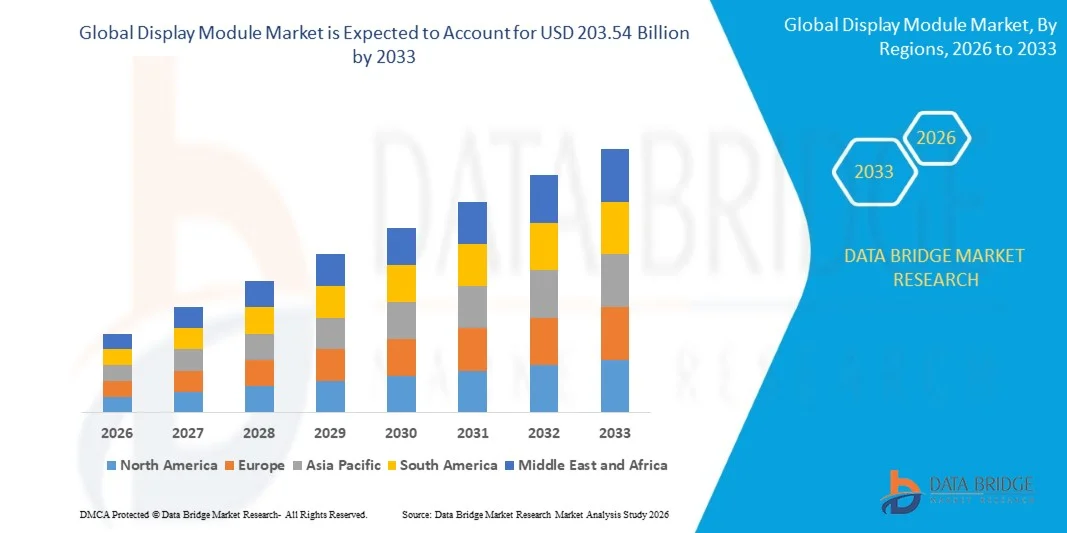
- As per Data Bridge Market Research analysis, the display module market was valued at USD 145.90 billion in 2025 and is projected to reach USD 203.54 billion by 2033, growing at a CAGR of 4.25% from 2026 to 2033.
- The market is experiencing consistent growth driven by rising demand for advanced display technologies in smartphones, consumer electronics, automotive displays, and industrial applications, along with rapid advancements in OLED, LCD, Mini-LED, and flexible display technologies.
- The increasing adoption of smart devices, connected vehicles, and immersive digital interfaces, combined with growing consumer preference for high-resolution and energy-efficient displays, is compelling electronics manufacturers and automotive companies to invest in advanced display modules. OLED, Mini-LED, and flexible display solutions are increasingly replacing conventional display technologies in premium smartphones, televisions, automotive dashboards, and other applications, offering enhanced image quality, thinner form factors, and improved user experiences.
Market Size & Forecast
- Global Market Value (2025): USD 145.90 Billion
- Expected Market Value (2033): USD 203.54 Billion
- Forecast CAGR (2026–2033): 4.25%
- Leading Region in 2025: North America
- Fastest Growing Region: Asia Pacific
What are the Major Takeaways of the Display Module Market?
- North America dominated the display module market with the largest revenue share of 39.0% in 2025, supported by increasing adoption of advanced display technologies across consumer electronics, automotive, healthcare, and industrial applications.
- Asia-Pacific is expected to be the fastest-growing region at a CAGR of 7.1% from 2026 to 2033, fueled by the presence of major display panel manufacturers, expanding consumer electronics production, and growing adoption of advanced display modules across China, Japan, South Korea, and India.
- The optical display modules segment led the market with a 75.80% share in 2025, driven by their extensive adoption across consumer electronics, automotive displays, industrial equipment, and medical visualization systems.
- Non-optical display modules are the fastest-growing type, projected to register a CAGR of 5.6%, reflecting the surge in adoption of electronic display solutions in specialized applications.
- The LCD modules segment dominated the display technology category with a 55.60% revenue share in 2025, led by widespread adoption across televisions, smartphones, laptops, automotive displays, industrial systems, and consumer electronics.
- FHD accounted for 35.40% of the market share in 2025, preferred by extensive adoption across smartphones, monitors, televisions, automotive displays, and industrial applications.
- The microdisplays segment is the fastest-growing display size category, with a CAGR of 12.50% driven by increasing adoption in augmented reality (AR), virtual reality (VR), wearable devices, and advanced optical systems.
Report Scope and Display Module Market Segmentation
|
Attributes |
Display Module Key Market Insights |
|
Segments Covered |
|
|
Countries Covered |
North America
Europe
Asia-Pacific
Middle East and Africa
South America
|
|
Key Market Players |
|
|
Market Opportunities |
|
|
Value Added Data Infosets |
In addition to the insights on market scenarios such as market value, growth rate, segmentation, geographical coverage, and major players, the market reports curated by the Data Bridge Market Research also include in-depth expert analysis, geographically represented company-wise production and capacity, network layouts of distributors and partners, detailed and updated price trend analysis and deficit analysis of supply chain and demand. |
What is the Key Trend in the Display Module Market?
- Display manufacturers are increasingly shifting toward OLED, flexible, foldable, and high-performance display modules to meet rising demand for thinner devices, improved image quality, lower power consumption, and differentiated form factors across consumer electronics and automotive applications.
- For instance, in July 2025, Samsung Display announced that its latest foldable OLED panel successfully completed a 500,000-fold durability test, exceeding its previous 200,000-fold internal benchmark and supporting the broader commercialization of durable foldable display modules.
- Advanced OLED architectures are enabling manufacturers to improve brightness, durability, refresh rates, energy efficiency, and overall display performance across smartphones, laptops, monitors, televisions, and automotive systems.
- Automotive manufacturers are increasingly integrating large, curved, pillar-to-pillar, and OLED display modules into software-defined vehicles to provide personalized infotainment, navigation, driver-assistance information, and enhanced cabin experiences.
- For instance, in February 2025, LG Display began mass production of a 40-inch Pillar-to-Pillar automotive display, designed to span the area in front of both driver and passenger seats and support the evolving requirements of software-defined vehicles.
- As display manufacturers continue prioritizing flexible form factors, OLED innovation, high-resolution panels, and automotive applications, the adoption of advanced display modules is expected to accelerate, reinforcing next-generation displays as a core component of connected consumer and mobility technologies.
What are the Key Drivers of the Display Module Market?
- The rapid expansion of smartphones, tablets, laptops, televisions, automotive displays, and connected devices has significantly increased demand for high-resolution, energy-efficient, and technologically advanced display modules capable of delivering improved visual experiences across diverse applications.
- For instance, in September 2024, Reuters reported that Apple was preparing to transition all upcoming iPhone models to OLED displays from 2025, expanding demand for OLED display panels and accelerating the shift away from conventional LCD technology in smartphones.
- Consumer electronics manufacturers, automotive OEMs, and technology companies are integrating advanced display modules into their products to improve visual quality, enable larger interactive interfaces, reduce power consumption, and differentiate premium devices and connected vehicle platforms.
- For instance, in February 2025, Samsung Display and Qualcomm Technologies announced a collaboration to expand automotive OLED applications, with Samsung providing a 34-inch 6K OLED display for Qualcomm's Snapdragon Cockpit Experience Development Platform to demonstrate AI graphics, personalized infotainment, and autonomous-driving information.
- With manufacturers increasingly investing in OLED, flexible, Mini-LED, and other advanced display technologies to satisfy evolving consumer and automotive requirements, display modules will remain indispensable for next-generation electronics and intelligent mobility applications.
What Factors are Challenging the Growth of the Display Module Market?
- Advanced display modules require significant upfront investment due to the integration of sophisticated OLED, Mini-LED, Micro-LED, semiconductor, fabrication, and precision manufacturing technologies.
- For instance, in June 2025, LG Display approved an investment of KRW 1.26 trillion in new OLED technologies and infrastructure, with the investment period extending from June 2025 through June 2027, demonstrating the substantial capital required to maintain technological competitiveness.
- These high capital requirements limit expansion among smaller manufacturers and increase financial pressure on established display companies operating in highly competitive and rapidly evolving technology markets.
- Intense competition, fluctuating demand, excess production capacity, and pricing pressure can further reduce profitability for manufacturers, particularly in conventional LCD and large-area display segments.
- For instance, in April 2024, LG Display reported an operating loss of KRW 469 billion for the first quarter, citing declining seasonal demand for large TV and small smartphone display panels, while reducing annual investment and shifting toward higher-end OLED products.
- The high capital investment and recurring technology-upgrade costs associated with advanced display manufacturing continue to restrict market participation, particularly for smaller companies, while demand fluctuations and intense price competition can slow investment returns and constrain widespread capacity expansion.
How is the Display Module Market Segmented?
The display module market is segmented on the basis of type, display technology, display resolution, display size, and application.
- By Type
On the basis of type, the display module market is segmented into optical display modules and non-optical display modules. The optical display modules segment dominated the market with a 75.80% share in 2025, owing to their extensive adoption across consumer electronics, automotive displays, industrial equipment, and medical visualization systems. Optical display modules provide enhanced image quality, brightness, contrast, and viewing performance, making them essential for modern display applications. These modules are widely integrated into smartphones, televisions, monitors, head-up displays, and digital signage systems. Increasing demand for high-resolution and interactive display solutions is supporting segment growth. Advancements in OLED, LCD, and Micro-LED technologies are further improving optical display capabilities.
The non-optical display modules segment is expected to witness steady growth at a CAGR of 5.6% from 2026 to 2033, driven by increasing adoption of electronic display solutions in specialized applications. These modules are used in applications where information presentation, low power consumption, and functional display requirements are prioritized. Growing demand for industrial indicators, electronic systems, and embedded display applications is supporting market expansion. Increasing integration of smart technologies in industrial automation and connected devices is creating new opportunities. Improvements in electronic display components are enhancing their reliability and performance.
- By Display Technology
On the basis of display technology, the display module market is segmented into LCD modules, OLED modules, Micro-LED modules, E-Paper / E-Ink modules, and others. The LCD modules segment dominated the market with a 55.60% share in 2025, supported by widespread adoption across televisions, smartphones, laptops, automotive displays, industrial systems, and consumer electronics. LCD modules offer cost-effectiveness, high availability, and mature manufacturing capabilities compared with emerging display technologies. Their scalability and reliability make them suitable for large-volume applications. Automotive manufacturers continue adopting LCD-based displays for infotainment systems, instrument clusters, and control panels. Industrial and commercial display applications also rely heavily on LCD technology due to durability and affordability.
The OLED modules segment is projected to be the fastest-growing segment at a CAGR of 8.0% from 2026 to 2033, driven by increasing demand for flexible, lightweight, high-resolution, and energy-efficient display solutions. OLED modules provide superior contrast ratio, faster response time, and better image quality compared with conventional display technologies. Growing adoption in premium smartphones, wearable devices, televisions, and automotive displays is accelerating segment expansion. Flexible OLED technology is enabling innovative applications such as foldable smartphones and curved displays. Increasing investments by major display manufacturers in OLED production capacity are further supporting growth.
- By Display Resolution
On the basis of display resolution, the display module market is segmented into lower than HD, HD, FHD, 4K, and 8K. The FHD segment dominated the market with a 35.40% share in 2025, supported by extensive adoption across smartphones, monitors, televisions, automotive displays, and industrial applications. FHD resolution provides a balance between image quality, energy efficiency, and manufacturing cost. It remains widely preferred for mainstream consumer electronics due to affordability and adequate visual performance. Increasing demand for enhanced viewing experiences in entertainment devices and digital displays continues to support adoption. Automotive manufacturers are also integrating FHD displays into digital cockpits and infotainment systems.
The 8K segment is expected to witness the fastest growth at a CAGR of 10.2% from 2026 to 2033, driven by increasing demand for ultra-high-definition visual experiences in premium televisions, professional displays, healthcare imaging, and digital content applications. 8K displays provide exceptional image clarity with higher pixel density and detailed visualization capabilities. Growing investments in advanced broadcasting, gaming, and professional visualization systems are supporting adoption. Healthcare and industrial sectors are increasingly exploring high-resolution displays for precise image analysis. Continuous improvements in display processing technologies are reducing barriers associated with 8K adoption.
- By Display Size
On the basis of display size, the display module market is segmented into microdisplays, small & medium-sized displays, and large displays. The small & medium-sized displays segment dominated the market with a 60.65% share in 2025, owing to extensive utilization in smartphones, tablets, laptops, wearable devices, automotive displays, and portable electronic products. These displays provide an ideal balance between portability, performance, and power efficiency. Increasing smartphone penetration and growing adoption of smart wearable devices are major factors supporting segment growth. Automotive manufacturers are increasingly integrating medium-sized displays into infotainment systems and digital instrument clusters. Demand for compact and interactive display solutions continues to expand across consumer and industrial applications.
The microdisplays segment is expected to register the fastest growth at a CAGR of 12.5% from 2026 to 2033, driven by increasing adoption in augmented reality (AR), virtual reality (VR), wearable devices, and advanced optical systems. Microdisplays offer compact size, high pixel density, and low power consumption, making them suitable for immersive applications. Growing investments in AR/VR technologies and smart glasses are creating new opportunities for microdisplay manufacturers. Defense, aerospace, and healthcare sectors are also adopting microdisplays for specialized visualization applications. Advancements in OLED microdisplay and Micro-LED technologies are improving performance. Rising demand for lightweight and immersive display solutions is expected to accelerate segment growth.
- By Application
On the basis of application, the display module market is segmented into consumer electronics, automotive, industrial & manufacturing, healthcare & medical, retail & digital signage, aerospace & defense, and others. The consumer electronics segment dominated the market with a 45.50% share in 2025, driven by increasing adoption of smartphones, televisions, laptops, tablets, and wearable devices. Display modules are essential components in electronic devices requiring high-resolution visuals and enhanced user interaction. Continuous innovation in OLED, AMOLED, and flexible display technologies is strengthening demand from consumer electronics manufacturers. Rising disposable income and growing demand for smart connected devices are supporting market expansion. Smartphone manufacturers continue integrating advanced display modules to improve user experience.
The automotive segment is expected to witness the fastest growth at a CAGR of 9.1% from 2026 to 2033, driven by increasing integration of digital cockpits, infotainment displays, head-up displays, and advanced driver assistance system (ADAS) interfaces. Modern vehicles increasingly rely on display modules for navigation, connectivity, vehicle monitoring, and driver assistance functions. Growing adoption of electric vehicles and connected vehicles is accelerating demand for advanced automotive displays. Automakers are investing in larger, curved, and interactive display solutions to enhance cabin experiences. Rising focus on vehicle digitalization is creating significant growth opportunities. The transition toward smart mobility is expected to continue driving automotive display module adoption.
Which Region Holds the Largest Share of the Display Module Market?
- North America dominated the display module market with the largest revenue share of 39.0% in 2025, supported by increasing adoption of advanced display technologies across consumer electronics, automotive, healthcare, and industrial applications.
- The region also benefits from rapid integration of advanced display modules in smart devices, connected vehicles, medical equipment, and industrial applications, along with continuous investments in next-generation display technologies. Increasing demand for high-performance displays, flexible OLED solutions, and digital visualization systems continues to strengthen North America’s leadership position in the global market.
U.S. Display Module Market Insight
The U.S. display module market is witnessing strong growth due to rising demand for advanced displays across consumer electronics, automotive, healthcare, and industrial applications. The country’s mature technology ecosystem, along with increasing adoption of OLED, Mini-LED, Micro-LED, and high-resolution display systems, is driving demand across multiple end-use industries. In addition, growing investments in connected vehicles, smart devices, digital signage, and advanced medical visualization systems are accelerating display module adoption across commercial and technology-driven applications.
Asia-Pacific Display Module Market Insight
The Asia-Pacific display module market is expected to witness rapid growth, driven by expanding consumer electronics manufacturing, increasing smartphone production, and rising investments in advanced display technologies across countries such as China, Japan, South Korea, and India. Growing demand for OLED, flexible, Mini-LED, and high-resolution displays is supporting regional market expansion. In addition, the strong presence of display panel manufacturers, expanding automotive production, and increasing adoption of smart devices are accelerating display module deployment across consumer, industrial, and automotive applications.
Japan Display Module Market Insight
The Japan display module market is witnessing consistent growth due to rising investments in advanced display technologies, automotive electronics, consumer devices, and industrial applications. Electronics manufacturers, automotive companies, and technology developers are increasingly adopting OLED, high-resolution, and compact display modules for next-generation products and connected systems. Moreover, increasing integration of advanced displays into vehicles, wearable devices, healthcare equipment, and smart technologies is further contributing to market growth.
China Display Module Market Insight
The China display module market is growing rapidly, driven by expanding electronics manufacturing, increasing smartphone and television production, and rising investments in domestic display technologies. Growing adoption of OLED, Mini-LED, Micro-LED, and flexible display solutions across consumer electronics and automotive applications is significantly boosting market demand. In addition, the strong presence of display manufacturers, increasing electric vehicle production, and rapid technological advancements are positioning China as one of the fastest-growing markets for display modules globally.
U.K. Display Module Market Insight
The U.K. display module market is experiencing steady growth, supported by rising adoption of advanced display technologies across automotive, healthcare, retail, consumer electronics, and industrial applications. Increasing investments in digital signage, smart interfaces, medical visualization, and connected mobility solutions are contributing to market growth. Furthermore, integration of OLED, high-resolution, and energy-efficient display technologies is improving product performance and functionality, positioning the U.K. as an important market for advanced display module applications.
Germany Display Module Market Insight
The Germany display module market is expanding steadily due to the country’s strong automotive manufacturing base, advanced industrial capabilities, and increasing adoption of next-generation display technologies. Automotive companies, electronics manufacturers, and industrial organizations are increasingly utilizing display modules for digital cockpits, infotainment systems, human-machine interfaces, and manufacturing equipment. Continuous advancements in OLED, high-resolution, and automotive display technologies, along with strong focus on industrial digitalization and connected mobility, are further driving market growth in Germany.
Which are the Top Companies in Display Module Market?
The display module industry is primarily led by well-established companies, including:
- Samsung Display Co.,Ltd. (South Korea)
- LG Display Co., Ltd. (South Korea)
- BOE Technology Group Co., Ltd. (China)
- AUO Corporation (Taiwan)
- Innolux Corporation (Taiwan)
- Japan Display Inc. (Japan)
- Tianma Microelectronics Co., Ltd. (China)
- Visionox Technology Inc. (China)
- TCL China Star Optoelectronics Technology Co., Ltd. (China)
- Sharp Corporation (Japan)
- Seiko Epson Corporation (Japan)
- Sony Corporation (Japan)
- Panasonic Holdings Corporation (Japan)
- KYOCERA Display Corporation (Japan)
- E Ink Holdings Inc. (Taiwan)
- Himax Technologies, Inc. (Taiwan)
- Novatek Microelectronics Corp. (Taiwan)
- Realtek Semiconductor Corp. (Taiwan)
- Raystar Optronics, Inc. (Taiwan)
- EverDisplay Optronics (Shanghai) Limited (China)
What are Latest Developments in Display Module Market?
- In January 2025, Samsung Display announced that it would showcase new IT and automotive OLED solutions at CES 2025, including the world’s first 18.1-inch foldable IT panel, slidable and multi-foldable displays, and advanced automotive OLED technologies. The company highlighted these innovations as part of its expansion of OLED applications beyond smartphones into laptops, monitors, and next-generation vehicles
- In May 2024, Samsung Display announced that it had surpassed 1 million cumulative shipments of QD-OLED monitor panels since entering the market, with the technology being adopted in more than 90 monitor products from global brands. The company also highlighted plans to expand QD-OLED applications from gaming monitors into professional and broadcast displays, demonstrating the growing commercialization of advanced OLED modules.
- In January 2023, LG Display unveiled next-generation automotive display solutions at CES 2023, including an 18-inch slidable automotive OLED panel, transparent OLED panels, a 57-inch automotive LCD, and a glasses-free 3D LCD cluster. These technologies were designed to support future mobility and demonstrate the increasing integration of advanced display modules into connected and autonomous vehicle interiors.
- In December 2021, LG Display unveiled its next-generation OLED EX technology, which uses deuterium and personalized algorithms to improve display brightness and picture quality while enabling thinner bezels. The company planned to integrate OLED EX technology into OLED TV displays manufactured at its production facilities in South Korea and China, strengthening its next-generation OLED portfolio.
- In May 2021, LG Display announced that it would showcase its latest OLED technologies at SID 2021, including an 83-inch next-generation OLED TV panel, a 12.8-inch rollable automotive display, and an ultra-large automotive display combining multiple panels. The showcase demonstrated the expansion of OLED technology into large-format consumer displays and innovative automotive applications.

- Interactive Data Analysis Dashboard
- Company Analysis Dashboard for high growth potential opportunities
- Research Analyst Access for customization & queries
- Competitor Analysis with Interactive dashboard
- Latest News, Updates & Trend analysis
- Harness the Power of Benchmark Analysis for Comprehensive Competitor Tracking
Global Display Module Market, Supply Chain Analysis and Ecosystem Framework
To support market growth and help clients navigate the impact of geopolitical shifts, DBMR has integrated in-depth supply chain analysis into its Global Display Module Market research reports. This addition empowers clients to respond effectively to global changes affecting their industries. The supply chain analysis section includes detailed insights such as Global Display Module Market consumption and production by country, price trend analysis, the impact of tariffs and geopolitical developments, and import and export trends by country and HSN code. It also highlights major suppliers with data on production capacity and company profiles, as well as key importers and exporters. In addition to research, DBMR offers specialized supply chain consulting services backed by over a decade of experience, providing solutions like supplier discovery, supplier risk assessment, price trend analysis, impact evaluation of inflation and trade route changes, and comprehensive market trend analysis.
Data collection and base year analysis are done using data collection modules with large sample sizes. The stage includes obtaining market information or related data through various sources and strategies. It includes examining and planning all the data acquired from the past in advance. It likewise envelops the examination of information inconsistencies seen across different information sources. The market data is analysed and estimated using market statistical and coherent models. Also, market share analysis and key trend analysis are the major success factors in the market report. To know more, please request an analyst call or drop down your inquiry.
The key research methodology used by DBMR research team is data triangulation which involves data mining, analysis of the impact of data variables on the market and primary (industry expert) validation. Data models include Vendor Positioning Grid, Market Time Line Analysis, Market Overview and Guide, Company Positioning Grid, Patent Analysis, Pricing Analysis, Company Market Share Analysis, Standards of Measurement, Global versus Regional and Vendor Share Analysis. To know more about the research methodology, drop in an inquiry to speak to our industry experts.
Data Bridge Market Research is a leader in advanced formative research. We take pride in servicing our existing and new customers with data and analysis that match and suits their goal. The report can be customized to include price trend analysis of target brands understanding the market for additional countries (ask for the list of countries), clinical trial results data, literature review, refurbished market and product base analysis. Market analysis of target competitors can be analyzed from technology-based analysis to market portfolio strategies. We can add as many competitors that you require data about in the format and data style you are looking for. Our team of analysts can also provide you data in crude raw excel files pivot tables (Fact book) or can assist you in creating presentations from the data sets available in the report.













