


DNA Profiling Kits Market Size
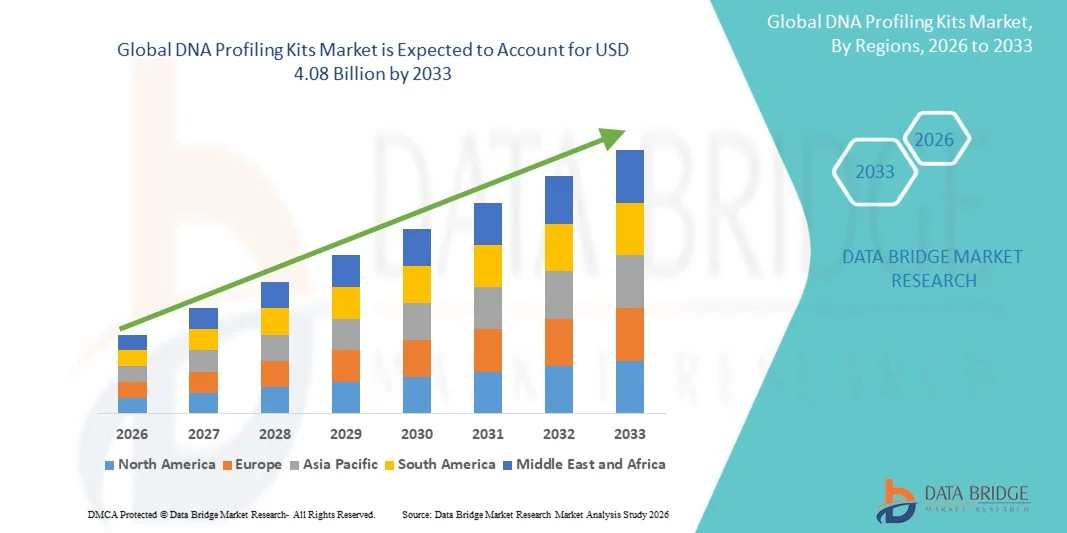
- The global DNA profiling kits market size was valued at USD 1.66 billion in 2025 and is expected to reach USD 4.08 billion by 2033, at a CAGR of 11.90% during the forecast period
- The market growth is largely fueled by advancements in DNA analysis technologies, increasing incorporation of next-generation sequencing and automated profiling workflows, and expanding use of DNA profiling across forensic, legal, clinical, and research applications, driving higher kit adoption and consumables usage globally
- Furthermore, rising demand for rapid, accurate, and high-sensitivity genetic identification solutions in criminal justice systems, paternity/relationship testing, and population genetics is driving stakeholders to adopt DNA profiling kits as the preferred method for reliable genomic analysis accelerating uptake and significantly boosting industry growth
DNA Profiling Kits Market Analysis
- DNA profiling kits, used for generating precise genetic identification profiles from biological samples, are becoming essential across forensic science, legal investigations, clinical diagnostics, and research due to their high accuracy, rapid processing capabilities, and compatibility with advanced technologies such as PCR, STR analysis, and next-generation sequencing
- The demand for DNA profiling kits is primarily driven by the rising need for reliable forensic tools, increasing criminal investigation workloads, growing adoption of paternity and relationship testing, and expanding applications in healthcare, biobanking, and population genetics, all of which are accelerating the adoption of standardized genetic identification workflows
- North America dominated the DNA profiling kits market with the largest revenue share of 39.5% in 2025, supported by well-established forensic laboratories, strong government funding for criminal justice modernization, high utilization of advanced sequencing technologies, and significant adoption in legal and biomedical research, with the U.S. showing notable growth in forensic automation and database expansion initiatives
- Asia-Pacific is expected to be the fastest-growing region during the forecast period due to increasing investments in forensic infrastructure, rising crime rates requiring advanced DNA analysis, and growing integration of DNA-based diagnostics in healthcare systems across China, India, and Southeast Asia
- The STR Profiling segment dominated the DNA profiling kits market with a market share of 46.4% in 2025, attributed to its widespread use as the gold-standard method for identification in forensic laboratories, strong regulatory acceptance, and proven accuracy, making STR-based profiling the most commonly adopted solution across global forensic and legal workflows
Report Scope and DNA Profiling Kits Market Segmentation
|
Attributes |
DNA Profiling Kits Key Market Insights |
|
Segments Covered |
|
|
Countries Covered |
North America
Europe
Asia-Pacific
Middle East and Africa
South America
|
|
Key Market Players |
|
|
Market Opportunities |
|
|
Value Added Data Infosets |
In addition to the insights on market scenarios such as market value, growth rate, segmentation, geographical coverage, and major players, the market reports curated by the Data Bridge Market Research also include in-depth expert analysis, patient epidemiology, pipeline analysis, pricing analysis, and regulatory framework |
DNA Profiling Kits Market Trends
“Rising Adoption of AI-Enhanced and Automated DNA Analysis Workflows”
- A significant and accelerating trend in the global DNA profiling kits market is the integration of artificial intelligence (AI) and automated workflows within forensic and clinical laboratories, enhancing accuracy, interpretation speed, and overall case-processing efficiency
- For instance, leading forensic platforms now incorporate AI-assisted STR interpretation tools that automatically detect anomalies, optimize allele calling, and reduce manual review times, supporting more consistent and defensible results
- AI integration in DNA profiling enables capabilities such as mixture deconvolution, improved detection of low-template or degraded DNA, and intelligent flagging of potential contamination events; for instance, some NGS-based systems use machine learning to enhance variant detection accuracy and provide automated quality assessments
- The seamless pairing of DNA profiling kits with automated sample preparation systems and digital LIMS platforms allows laboratories to centralize workflow management, track chain-of-custody, and integrate results with broader forensic databases, creating highly efficient and compliant processing environments
- This trend toward more intelligent, high-throughput, and interconnected profiling systems is reshaping expectations within forensic and biomedical fields, prompting companies such as Thermo Fisher Scientific and Qiagen to expand AI-enabled analysis tools and automation-compatible kits
- The demand for DNA profiling solutions featuring AI-based interpretation, automated extraction, and integrated digital reporting is rising rapidly across forensic, research, and clinical sectors as users increasingly prioritize precision, efficiency, and workflow standardization
DNA Profiling Kits Market Dynamics
Driver
“Growing Need Due to Rising Forensic Case Volume and Adoption of Advanced DNA Technologies”
- The increasing prevalence of criminal investigations, rising unresolved case backlogs, and expanding applications of genetic identification in legal, clinical, and research settings are significant drivers of heightened demand for DNA profiling kits
- For instance, in 2025, several forensic agencies announced modernization initiatives focused on automating DNA workflows and expanding database capabilities, reinforcing the adoption of high-throughput STR and NGS profiling kits across national laboratories
- As governments and institutions seek to improve crime resolution rates and ensure stronger judicial evidence standards, DNA profiling kits offering rapid results, enhanced sensitivity, and robust trace detection provide a compelling upgrade over conventional identification methods
- Furthermore, the growing popularity of genetic testing in paternity, ancestry, and biomedical research is making DNA profiling consumables an integral component of these expanding ecosystems, supported by technology upgrades and broader regulatory acceptance
- The convenience of automation-ready kits, faster turnaround times, and the ability to process challenging samples such as degraded, mixed, or low-quantity DNA are key factors propelling adoption across forensic and biomedical laboratories
- The trend toward digitized forensic operations and the availability of user-friendly, validated kits designed for both manual and automated platforms further contribute to market growth
Restraint/Challenge
“Contamination Risks, Ethical Concerns, and Regulatory Compliance Hurdles”
- Concerns surrounding contamination risks, ethical dilemmas, and stringent regulatory requirements for handling genetic material pose significant challenges to broader market expansion for DNA profiling kits
- For instance, high-profile discussions regarding privacy, misuse of genetic databases, and improper sample handling in forensic investigations have made several organizations cautious about expanding DNA profiling initiatives
- Addressing these concerns through validated workflows, strict chain-of-custody procedures, and advanced contamination-prevention technologies is crucial for building institutional trust; companies emphasize ISO-compliant protocols and enhanced quality-control features to reassure laboratories
- In addition, the high cost associated with advanced profiling technologies—such as NGS kits or multiplex STR panels can be a barrier for smaller or budget-constrained laboratories, particularly in developing regions where forensic infrastructure is still evolving
- While costs continue to gradually decline, the perceived premium for advanced genomics solutions can still hinder adoption among institutions that do not yet require the deeper analytical capabilities offered by newer platforms
- Overcoming these challenges through improved regulatory clarity, investment in training programs, and development of more cost-effective high-performance kits will be vital for sustained market growth
DNA Profiling Kits Market Scope
The market is segmented on the basis of product, technology, sample type, application, and end user.
- By Product
On the basis of product, the global DNA profiling kits market is segmented into kits, instruments, and software & services. The kits segment dominated the market in 2025, driven by its essential role as the primary consumable for STR, PCR, extraction, and NGS workflows; laboratories and DTC providers rely on validated, ready-to-use kits to ensure reproducibility, legal admissibility, and fast turnaround times. Kits generate recurring revenue through repeat purchases and are widely procured for national DNA database programs, paternity testing, and ancestry services, reinforcing their established market position. Standardization, regulatory acceptance, and broad compatibility with both manual and automated systems further support kit dominance across forensic, clinical, and commercial laboratories. The availability of multiplex STR kits, rapid DNA kits, and NGS library prep kits continues to expand kit utility and demand. Procurement driven by forensic backlog clearance and large-scale DTC sample processing cements the kits segment as the market leader.
The software & services segment is expected to witness the fastest growth from 2026 to 2033, fueled by rising adoption of bioinformatics, AI-assisted interpretation, cloud LIMS, and contract laboratory services. As NGS and complex mixture analysis gain traction, demand for probabilistic genotyping, automated allele calling, and secure data management platforms is accelerating. Cloud-based solutions and managed services address chain-of-custody, audit trails, and long-term storage needs, making them attractive to both public-sector labs and DTC firms. Service offerings—validation, accreditation support, custom panel development, and outsourced testing—are scaling rapidly to meet capacity constraints and specialized analytical requirements. Integration of AI for mixture deconvolution and phenotype inference further drives software adoption, supporting faster, more defensible reporting.
- By Technology
On the basis of technology, the market is segmented into STR Profiling, Real-time PCR, Next-Generation Sequencing (NGS), and Y-STR Analysis. The STR profiling segment dominated the market in 2025 with a market share of 46.4%, remaining the global forensic gold standard due to its proven discriminatory power, cost-effectiveness, and extensive legal and database infrastructure. STR methods are entrenched in court-admissible workflows, national databases, and routine casework for homicide, sexual assault, and missing-person investigations, which sustains robust demand for STR kits and compatible instruments. Established validation protocols, broad technician familiarity, and an extensive installed base of capillary electrophoresis systems further anchor STR’s leadership. Incremental improvements—expanded multiplexes and rapid STR assays—keep the technology current for most routine forensic needs. Regulatory frameworks and international database compatibility maintain STR as the backbone of human identification.
Next-Generation Sequencing (NGS) is projected to record the fastest CAGR from 2026 to 2033 as labs seek higher resolution, multiplexing, and the ability to analyze degraded or mixed samples in a single workflow. NGS enables simultaneous analysis of STRs, SNPs, mtDNA, and phenotypic markers, expanding investigative capabilities into ancestry, phenotype prediction, and complex kinship analysis. Falling sequencing costs, forensic-specific NGS panels, and improved bioinformatics pipelines are lowering barriers to adoption. Research, biobanking, and advanced forensic units are driving early investment, while integration with AI tools enhances interpretation of complex datasets. The versatility of NGS for both casework and population studies positions it as the fastest-growing technology.
- By Sample Type
On the basis of sample type, the market is segmented into blood, saliva swab, tissue, teeth, and environmental samples. The blood segment dominated in 2025 because of its high DNA yield, stability, and widespread acceptance for forensic and clinical testing; blood-derived DNA provides reliable, high-integrity results across STR, PCR, and NGS platforms. Standardized collection and extraction protocols for blood support consistent laboratory workflows and legal admissibility, making it a preferred specimen for violent crime investigations, medical genetics, and donor screening. High DNA content and reproducible quality reduce downstream failure rates and simplify interpretation, reinforcing laboratory preference. Blood remains central to many national forensic programs and clinical diagnostic pipelines, maintaining its leading role.
Environmental samples are expected to register the fastest growth from 2026 to 2033 as advances in extraction chemistry, ultra-sensitive amplification, and NGS interpretation enable recovery of actionable profiles from low-quantity and degraded traces. Forensic investigators increasingly rely on trace DNA to link suspects to objects or locations when direct biological samples are unavailable. eDNA expands applications into wildlife forensics, ecological monitoring, and biosecurity, broadening market demand. Portable rapid-DNA devices and improved contamination controls facilitate on-scene sampling and analysis of environmental matrices. As analytical sensitivity and bioinformatics improve, environmental sample testing becomes a major growth area.
- By Application
On the basis of application, the market is segmented into forensic & criminal investigation, paternity & relationship testing, dtc testing, clinical & diagnostic, research & biobanking, and animal identification. The forensic & criminal investigation segment dominated in 2025 due to the mission-critical nature of DNA evidence in solving crimes, identifying victims, and supporting prosecutions; national investments in forensic modernization and database expansion continue to drive procurement of kits, instruments, and software. Forensic workflows demand validated, court-defensible products and often adopt automation to reduce backlogs, increasing kit and instrument throughput. Rapid DNA systems, probabilistic genotyping software, and specialized extraction kits are increasingly used to accelerate case processing. The sustained need to resolve cold cases and handle growing caseloads secures forensic applications as the largest market.
Direct-to-consumer (DTC) testing is poised to be the fastest-growing application from 2026 to 2033 as consumer interest in ancestry, wellness, and trait insights fuels mass adoption of saliva-based collection kits and online genetic services. Lower per-sample costs, improved logistics for at-home collection, and digital delivery of insights drive scalability for DTC providers. Hybrid offerings that combine ancestry with health risk reporting and polygenic risk scores broaden addressable markets. Partnerships with research organizations and pharma for population studies and drug discovery further monetize consumer databases. Expansion into emerging markets and continuous product innovation make DTC the fastest-growing application area.
- By End User
On the basis of end user, the market is segmented into forensic laboratories, clinical & diagnostic laboratories, direct-to-consumer genetic testing companies, academic & research institutes, Pharmaceutical & Biotechnology Companies, and Animal Labs. Forensic laboratories dominated the market in 2025 as primary purchasers of validated DNA profiling kits, instruments, and interpretation software for criminal casework and national database submissions; public funding for forensic capacity building and backlog reduction sustains high procurement levels. Forensic labs require accredited workflows, chain-of-custody controls, and defensible analytical pipelines, which drive demand for certified kits and compatible automation. The operational need to process high caseloads and support cross-border investigations reinforces forensic laboratories’ central role. Adoption of advanced platforms (rapid DNA, NGS) and probabilistic genotyping further consolidates their market leadership.
Direct-to-consumer genetic testing companies are expected to be the fastest-growing end-user segment from 2026 to 2033, driven by high sample throughput demands, online distribution models, and expanding consumer interest in ancestry and health insights. DTC labs require high-throughput extraction and genotyping kits, scalable sequencing capacity, and automated workflows to manage millions of samples annually. Subscription models, recurring product offerings, and international expansion increase kit consumption. Integration with mobile apps and cloud analytics enhances user engagement and repeat business. Strategic collaborations with research institutions and biopharma for dataset access and studies further accelerate growth for DTC end users.
DNA Profiling Kits Market Regional Analysis
- North America dominated the DNA profiling kits market with the largest revenue share of 39.5% in 2025, supported by well-established forensic laboratories, strong government funding for criminal justice modernization, high utilization of advanced sequencing technologies, and significant adoption in legal and biomedical research
- The region benefits from well-established forensic infrastructure, routine integration of DNA testing in criminal investigations, and widespread use of genetic testing for paternity, ancestry, and clinical applications
- Growing investments in forensic modernization, high per-capita spending on genetic testing, and strong demand for rapid, automation-ready DNA profiling solutions firmly position North America as the leading market across forensic, clinical, and consumer genomics sectors
U.S. DNA Profiling Kits Market Insight
The U.S. DNA profiling kits market captured the largest revenue share within North America in 2025, fueled by the extensive use of DNA analysis in forensic casework, paternity testing, clinical diagnostics, and national database expansion programs. Laboratories across the country are increasingly prioritizing rapid, high-accuracy genetic identification enabled by STR, PCR, and NGS-based kits. The growing preference for automated workflows and advanced interpretation software further accelerates adoption across public and private labs. Moreover, widespread integration of DNA profiling tools into criminal justice reforms, missing-person investigations, and DTC ancestry testing is significantly contributing to market expansion.
Europe DNA Profiling Kits Market Insight
The Europe DNA profiling kits market is projected to expand at a substantial CAGR throughout the forecast period, primarily driven by stringent forensic standards, expanding national DNA databases, and increasing use of genetic testing in healthcare and research. The rise in urbanization and technological modernization across laboratories is fostering adoption of advanced STR, PCR, and sequencing kits. European institutions are also drawn to the reliability, traceability, and quality assurance offered by validated, accredited DNA profiling workflows. The region is experiencing strong growth across forensic, clinical, and academic applications, with profiling kits being deployed widely in both modernized labs and ongoing infrastructure upgrades.
U.K. DNA Profiling Kits Market Insight
The U.K. DNA profiling kits market is anticipated to grow at a noteworthy CAGR during the forecast period, driven by the country’s well-established forensic ecosystem and sustained investment in genetic testing technologies. Rising concerns regarding crime resolution and the need for high-quality forensic evidence are encouraging laboratories to adopt advanced DNA profiling solutions. The U.K.’s embrace of digital forensic systems, combined with expanding utilization of genetic tools in ancestry, paternity, and biomedical research, continues to stimulate market growth.
Germany DNA Profiling Kits Market Insight
The Germany DNA profiling kits market is expected to expand at a considerable CAGR during the forecast period, fueled by increasing awareness of genetic identification technologies and the demand for highly accurate, regulation-compliant solutions. Germany’s strong laboratory infrastructure, along with its emphasis on scientific innovation and data integrity, promotes widespread adoption of STR, PCR, and NGS profiling kits. The integration of DNA profiling technologies with digital documentation and automated workflows is becoming increasingly prevalent, aligning with the country’s preference for precision, security, and robust quality control.
Asia-Pacific DNA Profiling Kits Market Insight
The Asia-Pacific DNA profiling kits market is poised to grow at the fastest CAGR during the forecast period of 2026 to 2033, driven by increasing investments in forensic facilities, expanding healthcare diagnostics, and the rapid adoption of DNA-based testing in countries such as China, Japan, and India. The region’s growing focus on modernization, supported by government initiatives in digital forensics and healthcare innovation, is accelerating the use of DNA profiling kits. Furthermore, APAC’s rise as a major manufacturing hub for molecular diagnostics and sequencing technologies is expanding the affordability and availability of advanced DNA profiling solutions.
Japan DNA Profiling Kits Market Insight
The Japan DNA profiling kits market is gaining momentum due to the country’s strong technological infrastructure, rapid modernization of forensic facilities, and growing demand for high-precision genetic testing. Japan places significant emphasis on accuracy and data security, driving adoption of validated profiling kits across forensic, clinical, and academic settings. Integration of DNA profiling tools with high-end automation, digital LIMS platforms, and advanced sequencing systems is fueling growth. Moreover, the nation’s aging population and rising demand for personalized healthcare are such asly to drive expanded use of DNA-based diagnostics and identification tools.
India DNA Profiling Kits Market Insight
The India DNA profiling kits market accounted for the largest market revenue share in Asia-Pacific in 2025, attributed to the country’s expanding forensic infrastructure, rising demand for paternity and relationship testing, and increasing adoption of genetic diagnostics. India has rapidly become one of the leading markets for molecular testing, with profiling kits gaining popularity across government forensic labs, private diagnostic centers, and research institutions. National initiatives supporting forensic modernization, combined with the availability of affordable profiling solutions and strong domestic manufacturers, are key factors propelling the market.
DNA Profiling Kits Market Share
The DNA Profiling Kits industry is primarily led by well-established companies, including:
- Thermo Fisher Scientific Inc. (U.S.)
- QIAGEN (Netherlands)
- Illumina, Inc. (U.S.)
- Bio Rad Laboratories, Inc. (U.S.)
- Agilent Technologies, Inc. (U.S.)
- Promega Corporation (U.S.)
- GE Healthcare (U.S.)
- PerkinElmer, Inc. (U.S.)
- Analytik Jena AG (Germany)
- Zymo Research Corp. (U.S.)
- Norgen Biotek Corp. (Canada)
- Takara Bio Inc. (Japan)
- Eurofins Scientific (Luxembourg)
- New England Biolabs, Inc. (U.S.)
- Bioneer Corporation (South Korea)
- Beckman Coulter, Inc. (U.S.)
- Omega Bio tek, Inc. (U.S.)
- Kurabo Biomedical (Japan)
- Verogen, Inc. (U.S.)
What are the Recent Developments in Global DNA Profiling Kits Market?
- In October 2025, QIAGEN announced the launch of its EZ2 DNA Investigator Sep&Prep Kit, a fully automated solution for processing sexual assault samples that improves separation of sperm DNA and prepares high-quality DNA for downstream profiling in under 2.5 hours, significantly reducing manual handling and variability for forensic laboratories
- In May 2024, Promega Corporation introduced the PowerPlex® 18E System, an eight-color STR multiplex kit aimed at European forensic labs that amplifies all ENFSI-recommended loci with added markers, enabling better analysis of challenging and degraded DNA samples in human identification cases
- In May 2024, Promega first introduced eight-color STR multiplex chemistry, expanding the capacity of forensic DNA profiling kits beyond traditional dye channels and offering enhanced information from challenging human identification samples
- In September 2023, Eurofins Scientific launched a new forensic DNA testing kit leveraging NGS technology designed to enhance sensitivity and specificity of DNA profiling—especially for low-template and challenging forensic sample types marking a significant step in next-generation forensic solutions
- In January 2023, QIAGEN launched the EZ2 Connect MDx platform, enabling automated DNA and RNA sample processing in diagnostic labs with high throughput and rapid turnaround, supporting broader use of DNA profiling workflows in both clinical and forensic contexts

- Interactive Data Analysis Dashboard
- Company Analysis Dashboard for high growth potential opportunities
- Research Analyst Access for customization & queries
- Competitor Analysis with Interactive dashboard
- Latest News, Updates & Trend analysis
- Harness the Power of Benchmark Analysis for Comprehensive Competitor Tracking
Data collection and base year analysis are done using data collection modules with large sample sizes. The stage includes obtaining market information or related data through various sources and strategies. It includes examining and planning all the data acquired from the past in advance. It likewise envelops the examination of information inconsistencies seen across different information sources. The market data is analysed and estimated using market statistical and coherent models. Also, market share analysis and key trend analysis are the major success factors in the market report. To know more, please request an analyst call or drop down your inquiry.
The key research methodology used by DBMR research team is data triangulation which involves data mining, analysis of the impact of data variables on the market and primary (industry expert) validation. Data models include Vendor Positioning Grid, Market Time Line Analysis, Market Overview and Guide, Company Positioning Grid, Patent Analysis, Pricing Analysis, Company Market Share Analysis, Standards of Measurement, Global versus Regional and Vendor Share Analysis. To know more about the research methodology, drop in an inquiry to speak to our industry experts.
Data Bridge Market Research is a leader in advanced formative research. We take pride in servicing our existing and new customers with data and analysis that match and suits their goal. The report can be customized to include price trend analysis of target brands understanding the market for additional countries (ask for the list of countries), clinical trial results data, literature review, refurbished market and product base analysis. Market analysis of target competitors can be analyzed from technology-based analysis to market portfolio strategies. We can add as many competitors that you require data about in the format and data style you are looking for. Our team of analysts can also provide you data in crude raw excel files pivot tables (Fact book) or can assist you in creating presentations from the data sets available in the report.













