


What is the Durable Medical Equipment Market Size and Growth Rate?
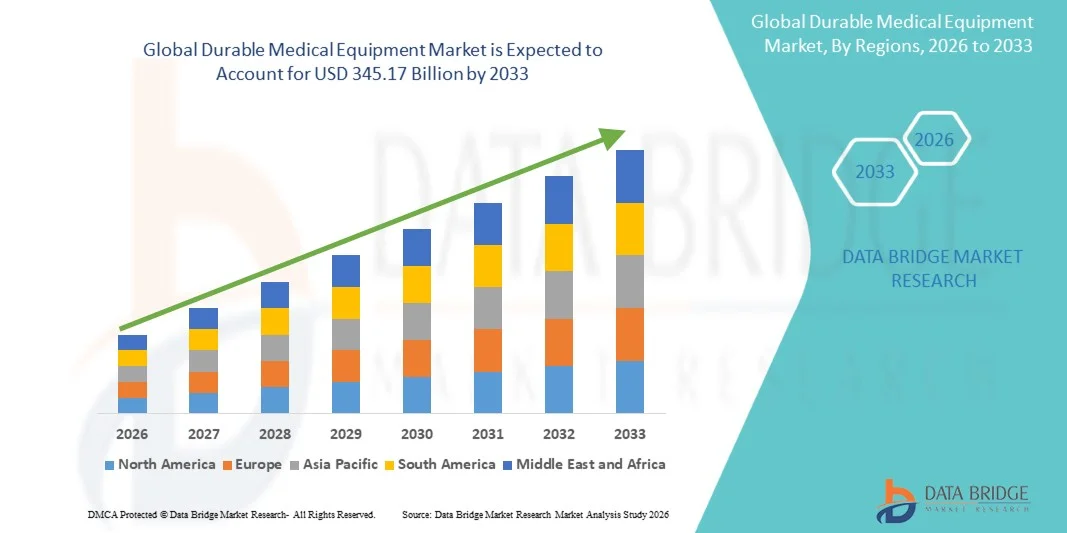
- As per Data Bridge Market Research Analysis the global durable medical equipment market size was valued at USD 219.20 billion in 2025 and is expected to reach USD 345.17 billion by 2033, at a CAGR of 5.84% during the forecast period
- The market growth is largely fueled by the rising prevalence of chronic diseases, a growing geriatric population, and expanding home healthcare adoption, alongside continuous technological advancements in monitoring, mobility, and therapeutic devices to support long‑term patient care
- Furthermore, increasing healthcare infrastructure investments, favorable reimbursement policies, and strong demand for quality, reliable patient support equipment in clinical and residential settings are positioning durable medical equipment as essential in modern healthcare delivery, significantly boosting industry growth over the forecast period
Market Size & Forecast
- Global Market Value (2025): USD 219.20 Billion
- Expected Market Value (2033): USD 345.17 Billion
- Forecast CAGR (2026–2033): 5.84%
Durable Medical Equipment Market Analysis
- Durable medical equipment (DME), including personal mobility devices, medical furniture, monitoring and therapeutic devices, and bathroom safety equipment, is increasingly essential in both clinical and home healthcare settings due to its role in enhancing patient care, improving mobility, and supporting long-term disease management
- The rising demand for durable medical equipment is primarily driven by the growing prevalence of chronic diseases, an aging global population, increasing preference for home-based healthcare, and advancements in technology-enabled monitoring and therapeutic devices
- North America dominated the durable medical equipment market with the largest revenue share of 40% in 2025, attributed to advanced healthcare infrastructure, high healthcare spending, early adoption of innovative medical devices, and a strong presence of key industry players, with the U.S. witnessing significant growth in home healthcare equipment adoption, supported by favorable reimbursement policies and integration of smart technologies
- Asia-Pacific is expected to be the fastest-growing region in the durable medical equipment market during the forecast period due to increasing healthcare access, urbanization, rising disposable incomes, and expanding awareness of home healthcare solutions
- The personal mobility devices segment dominated the durable medical equipment market with a share of 37.4% in 2025, driven by high demand for wheelchairs, walkers, and related devices to support elderly and physically challenged patients, along with ongoing innovations in lightweight, ergonomic, and smart mobility solutions
Report Scope and Durable Medical Equipment Market Segmentation
|
Attributes |
Durable Medical Equipment Key Market Insights |
|
Segments Covered |
|
|
Countries Covered |
North America
Europe
Asia-Pacific
Middle East and Africa
South America
|
|
Key Market Players |
|
|
Market Opportunities |
|
|
Value Added Data Infosets |
In addition to the insights on market scenarios such as market value, growth rate, segmentation, geographical coverage, and major players, the market reports curated by the Data Bridge Market Research also include in-depth expert analysis, patient epidemiology, pipeline analysis, pricing analysis, and regulatory framework |
What is the Key Trend in the Durable Medical Equipment Market?
“Increasing Adoption of Smart and Connected Devices”
- A significant and accelerating trend in the global durable medical equipment market is the integration of IoT-enabled and connected devices, allowing real-time monitoring, remote management, and data-driven insights for patients and healthcare providers
- For instance, personal mobility devices equipped with sensors can track patient movement and usage patterns, sending automatic alerts to caregivers or healthcare professionals if abnormal activity is detected
- Smart monitoring devices such as wearable vital sign trackers and home-based diagnostic equipment are being increasingly adopted, providing continuous health data that can inform proactive interventions
- The seamless connectivity of durable medical equipment with mobile apps and cloud platforms allows centralized management of multiple devices in home healthcare settings, improving patient adherence and outcomes
- This trend towards more intelligent, connected, and user-friendly medical devices is reshaping patient expectations, driving manufacturers to develop equipment with remote monitoring, automated alerts, and data analytics capabilities
- The demand for smart, connected durable medical equipment is rising rapidly across hospitals, clinics, and home healthcare environments as stakeholders prioritize patient safety, convenience, and continuous monitoring
- For instance, AI-enabled monitoring devices can predict patient deterioration and suggest timely interventions, reducing hospital readmissions and emergency visits
- Integration of telehealth platforms with durable medical equipment is expanding, enabling physicians to monitor patients remotely and make data-driven treatment adjustments efficiently
Durable Medical Equipment Market Dynamics
Driver
“Rising Prevalence of Chronic Diseases and Aging Population”
- The growing incidence of chronic diseases such as diabetes, cardiovascular disorders, and respiratory conditions, along with an increasing geriatric population, is a major driver for durable medical equipment demand
- For instance, hospitals and home healthcare providers are investing in advanced mobility aids, respiratory devices, and monitoring equipment to support long-term patient care and enhance quality of life
- Healthcare facilities are adopting durable medical equipment to reduce hospital stays, improve patient independence, and minimize complications from prolonged immobility or unmanaged chronic conditions
- Furthermore, the expanding home healthcare segment is increasing demand for devices that enable patients to safely and effectively manage their health outside clinical settings
- Convenience, enhanced patient monitoring, and improved health outcomes are key factors driving adoption of durable medical equipment across both clinical and residential settings
- For instance, government initiatives promoting aging-in-place programs and home healthcare support are boosting demand for mobility aids, bathroom safety devices, and remote monitoring equipment
- Technological advancements, such as lightweight, portable, and AI-enabled equipment, are making durable medical devices more appealing and accessible for both patients and healthcare providers
Restraint/Challenge
“High Costs and Regulatory Compliance Requirements”
- The relatively high initial investment required for advanced durable medical equipment poses a significant challenge, particularly for small healthcare facilities and price-sensitive consumers in emerging markets
- For instance, premium personal mobility devices, advanced monitoring systems, and home therapeutic equipment often carry higher price tags that may limit widespread adoption
- Compliance with stringent regulatory standards and certifications for safety, efficacy, and quality increases development costs and can delay product launches in multiple regions
- Furthermore, maintenance requirements, need for trained personnel, and occasional device malfunctions can hinder adoption, especially in home healthcare setups
- Addressing these challenges through cost-effective manufacturing, simplified device operation, and adherence to regulatory standards will be crucial for sustained growth in the durable medical equipment market
- For instance, differences in regulatory approvals across countries can slow global expansion and limit availability of certain advanced devices
- High dependency on trained professionals for setup, calibration, and monitoring of sophisticated equipment can act as a barrier in regions with workforce shortages
How is the Durable Medical Equipment Market Segmented?
The market is segmented on the basis of device type, end-user, and payer.
- By Device Type
On the basis of device type, the durable medical equipment market is segmented into personal mobility devices, medical furniture, monitoring and therapeutic devices, and bathroom safety devices. The personal mobility devices segment dominated the market with the largest revenue share of 37.4% in 2025, driven by strong demand for wheelchairs, walkers, and other mobility aids that enhance independence for elderly and physically challenged patients. Hospitals, clinics, and home healthcare providers often prioritize these devices due to their direct impact on patient mobility and rehabilitation outcomes. The market also sees sustained growth due to the continuous development of lightweight, foldable, and ergonomically designed products that improve usability. In addition, increasing awareness about mobility solutions and government initiatives supporting aging-in-place programs contribute to the high adoption of personal mobility devices. Technological integration, such as IoT-enabled monitoring and AI-assisted movement tracking, further enhances their appeal in modern healthcare environments.
The monitoring and therapeutic devices segment is anticipated to witness the fastest growth rate of 8% CAGR from 2026 to 2033, fueled by rising adoption of home healthcare solutions and remote patient monitoring technologies. These devices, including wearable vital sign monitors, portable diagnostic equipment, and therapeutic devices, are gaining popularity due to their ability to track health metrics in real time, enabling proactive medical interventions. Hospitals and home healthcare providers increasingly deploy these devices to reduce hospital readmissions and improve patient outcomes. The growth is further accelerated by technological advancements such as AI-enabled predictive analytics, integration with telehealth platforms, and mobile connectivity. Consumer preference for continuous, non-invasive monitoring also contributes to their rapid adoption.
- By End-User
On the basis of end-user, the durable medical equipment market is segmented into hospitals/clinics, ambulatory surgical centers, research centers, home healthcare, and others. The hospitals/clinics segment dominated the market in 2025, capturing the largest share due to the high demand for equipment that supports acute and long-term patient care. Hospitals and clinics require a broad range of devices including mobility aids, therapeutic equipment, and monitoring systems to manage inpatient care efficiently. The adoption is supported by structured procurement processes, higher budgets, and focus on patient safety and rehabilitation. Hospitals also prioritize durable medical equipment that meets regulatory standards, is reliable, and can integrate with existing healthcare IT systems. Furthermore, continuous advancements in hospital-grade equipment with enhanced features such as remote monitoring and automation drive this segment’s dominance.
The home healthcare segment is expected to witness the fastest growth from 2026 to 2033, driven by the rising elderly population, chronic disease prevalence, and preference for aging-in-place solutions. Patients and caregivers increasingly rely on durable medical equipment for independent living, remote monitoring, and convenience. Technological integration, including smart home connectivity and IoT-enabled devices, accelerates the adoption in home settings. The segment benefits from supportive reimbursement policies, rising awareness about home care solutions, and the availability of portable, user-friendly, and cost-effective devices suitable for residential use.
- By Payer
On the basis of payer, the durable medical equipment market is segmented into public, private, and out-of-pocket. The private payer segment dominated the market in 2025, owing to high healthcare spending by private insurance providers and individuals with comprehensive coverage. Private payers facilitate the procurement of advanced and technologically sophisticated durable medical equipment for both hospitals and home healthcare setups. The segment benefits from insurance reimbursement programs that encourage adoption of essential devices for chronic disease management and patient mobility. Furthermore, private payer coverage often allows access to premium equipment and smart devices that improve patient outcomes and quality of life.
The out-of-pocket segment is expected to witness the fastest growth from 2026 to 2033, driven by rising awareness among consumers regarding home healthcare and mobility solutions. Patients and caregivers increasingly invest in personal mobility devices, bathroom safety products, and monitoring equipment to enhance independent living. Growth is supported by the availability of affordable, user-friendly, and technologically enhanced devices designed for home use. Emerging markets, where insurance coverage is limited or inconsistent, contribute significantly to this segment’s rapid adoption.
Which Region Holds the Largest Share of the Durable Medical Equipment Market?
- North America dominated the durable medical equipment market with the largest revenue share of 40% in 2025, attributed to advanced healthcare infrastructure, high healthcare spending, early adoption of innovative medical devices, and a strong presence of key industry players
- Consumers and healthcare providers in the region highly value the reliability, technological sophistication, and integration of durable medical equipment with hospital IT systems and remote monitoring platforms
- This widespread adoption is further supported by high healthcare spending, well-established reimbursement policies, and a strong presence of key industry players, establishing durable medical equipment as an essential component in hospitals, clinics, and home healthcare settings
U.S. Durable Medical Equipment Market Insight
The U.S. durable medical equipment market captured the largest revenue share of 82% in 2025 within North America, driven by a high prevalence of chronic diseases, an aging population, and the increasing demand for home healthcare solutions. Patients and healthcare providers prioritize advanced mobility aids, monitoring devices, and therapeutic equipment that support independent living and improve quality of care. The growing preference for remote patient monitoring, telehealth integration, and portable devices further propels the market. Moreover, favorable reimbursement policies and strong investments in healthcare infrastructure significantly contribute to market expansion. Technological advancements, including AI-enabled monitoring and IoT connectivity, are also boosting adoption across hospitals, clinics, and home healthcare settings.
Europe Durable Medical Equipment Market Insight
The Europe durable medical equipment market is projected to expand at a substantial CAGR throughout the forecast period, primarily driven by the increasing prevalence of chronic diseases, a growing geriatric population, and government initiatives promoting home healthcare. Rising healthcare awareness and urbanization are fostering the adoption of mobility aids, medical furniture, and monitoring devices. European patients and caregivers value convenience, ease of use, and integration with healthcare IT systems. The market is witnessing strong growth across hospitals, rehabilitation centers, and home healthcare services, with advanced equipment increasingly incorporated into both new setups and upgrades.
U.K. Durable Medical Equipment Market Insight
The U.K. durable medical equipment market is anticipated to grow at a noteworthy CAGR during the forecast period, driven by the increasing focus on elderly care, chronic disease management, and home healthcare adoption. Concerns regarding patient safety, mobility, and rehabilitation are encouraging hospitals and caregivers to invest in mobility devices, monitoring systems, and bathroom safety equipment. The country’s well-established healthcare infrastructure and robust insurance coverage support the growing adoption of advanced durable medical equipment. Increasing use of portable, user-friendly, and technologically enhanced devices further stimulates market growth.
Germany Durable Medical Equipment Market Insight
The Germany durable medical equipment market is expected to expand at a considerable CAGR during the forecast period, fueled by rising awareness of healthcare quality, rehabilitation needs, and advanced patient care solutions. The country’s emphasis on innovation, safety standards, and technological adoption promotes the uptake of smart monitoring devices, mobility aids, and therapeutic equipment. Germany’s well-developed healthcare infrastructure ensures easy access to high-quality durable medical equipment for hospitals, clinics, and home healthcare users. Integration with digital health platforms and telehealth solutions is becoming increasingly prevalent, catering to both residential and clinical applications.
Asia-Pacific Durable Medical Equipment Market Insight
The Asia-Pacific durable medical equipment market is poised to grow at the fastest CAGR of 8% during the forecast period of 2026 to 2033, driven by increasing urbanization, rising disposable incomes, and the expanding geriatric population in countries such as China, Japan, and India. Growing awareness of chronic disease management, coupled with government initiatives promoting home healthcare and telemedicine, is accelerating adoption. The region’s emergence as a manufacturing hub for medical devices is improving affordability and accessibility. In addition, rapid technological adoption and the increasing inclination toward independent living are contributing to market expansion across residential, clinical, and long-term care settings.
Japan Durable Medical Equipment Market Insight
The Japan durable medical equipment market is gaining momentum due to the country’s aging population, advanced healthcare infrastructure, and high demand for convenient home healthcare solutions. Japanese patients and caregivers increasingly adopt mobility aids, monitoring devices, and therapeutic equipment to support independent living and chronic disease management. Integration with IoT-enabled platforms and telehealth services enhances the usability and effectiveness of durable medical equipment. Furthermore, technological innovation and the country’s emphasis on patient safety are fueling growth across hospitals, clinics, and home healthcare applications.
India Durable Medical Equipment Market Insight
The India durable medical equipment market accounted for the largest market revenue share in Asia-Pacific in 2025, attributed to rapid urbanization, rising disposable incomes, and increasing awareness of home healthcare solutions. The expanding middle class and government initiatives promoting smart healthcare infrastructure are key factors driving adoption. Hospitals, clinics, and home healthcare providers are increasingly investing in mobility aids, monitoring systems, and bathroom safety devices. Affordable products, strong domestic manufacturing capabilities, and growing consumer preference for independent living further propel market growth across residential, commercial, and long-term care settings.
Which are the Top Companies in Durable Medical Equipment Market?
The Durable Medical Equipment industry is primarily led by well-established companies, including:
- Invacare International Holdings Corp. (U.S.)
- Drive DeVilbiss Healthcare (U.S.)
- Stryker (U.S.)
- Koninklijke Philips NV (Netherlands)
- Medtronic (Ireland)
- ResMed Inc. (U.S.)
- GF Health Products, Inc. (U.S.)
- Cardinal Health (U.S.)
- 3M (U.S.)
- B. Braun SE (Germany)
- Baxter (U.S.)
- BD (U.S.)
- GE Healthcare (U.S.)
- Getinge AB (Sweden)
- Coloplast (Denmark)
- Permobil AB (Sweden)
- DJO Global, Inc. (U.S.)
- OMRON Healthcare (Japan)
- Pride Mobility Products Corp. (U.S.)
- Sunrise Medical LLC (U.K.)
What are the Recent Developments in Global Durable Medical Equipment Market?
- In August 2025, AdaptHealth Corp. partnered with a major national healthcare system to become the exclusive provider of home medical equipment and supplies across its network, covering over 10 million members, highlighting strategic expansion and increased integration of durable medical equipment in coordinated care models
- In June 2024, Optum unveiled DME Navigator, a benefit management solution designed to streamline the ordering, delivery, and payment of durable medical equipment for patients by integrating digital tools with electronic health records, speeding up clinician orders and improving access to necessary equipment
- In January 2024, Sunrise Medical launched the Switch‑It Vigo head control for power wheelchairs, a wireless proportional control system that enables users to operate their wheelchair using subtle head movements, improving accessibility and independence for users with limited upper‑body mobility
- In May 2023, Humana announced partnerships with AdaptHealth and Rotech Healthcare to provide durable medical equipment (DME) services under value‑based care contracts for its Medicare Advantage HMO members, aimed at expanding coordinated home healthcare equipment access
- In May 2023, Humana announced strategic partnerships with two national DME organizations (AdaptHealth and Rotech Healthcare) to expand access and improve value‑based home healthcare service delivery for Medicare Advantage HMO members, enhancing coordinated care and equipment access

- Interactive Data Analysis Dashboard
- Company Analysis Dashboard for high growth potential opportunities
- Research Analyst Access for customization & queries
- Competitor Analysis with Interactive dashboard
- Latest News, Updates & Trend analysis
- Harness the Power of Benchmark Analysis for Comprehensive Competitor Tracking
Data collection and base year analysis are done using data collection modules with large sample sizes. The stage includes obtaining market information or related data through various sources and strategies. It includes examining and planning all the data acquired from the past in advance. It likewise envelops the examination of information inconsistencies seen across different information sources. The market data is analysed and estimated using market statistical and coherent models. Also, market share analysis and key trend analysis are the major success factors in the market report. To know more, please request an analyst call or drop down your inquiry.
The key research methodology used by DBMR research team is data triangulation which involves data mining, analysis of the impact of data variables on the market and primary (industry expert) validation. Data models include Vendor Positioning Grid, Market Time Line Analysis, Market Overview and Guide, Company Positioning Grid, Patent Analysis, Pricing Analysis, Company Market Share Analysis, Standards of Measurement, Global versus Regional and Vendor Share Analysis. To know more about the research methodology, drop in an inquiry to speak to our industry experts.
Data Bridge Market Research is a leader in advanced formative research. We take pride in servicing our existing and new customers with data and analysis that match and suits their goal. The report can be customized to include price trend analysis of target brands understanding the market for additional countries (ask for the list of countries), clinical trial results data, literature review, refurbished market and product base analysis. Market analysis of target competitors can be analyzed from technology-based analysis to market portfolio strategies. We can add as many competitors that you require data about in the format and data style you are looking for. Our team of analysts can also provide you data in crude raw excel files pivot tables (Fact book) or can assist you in creating presentations from the data sets available in the report.













