


Edible Insect Protein Ingredients Market Size
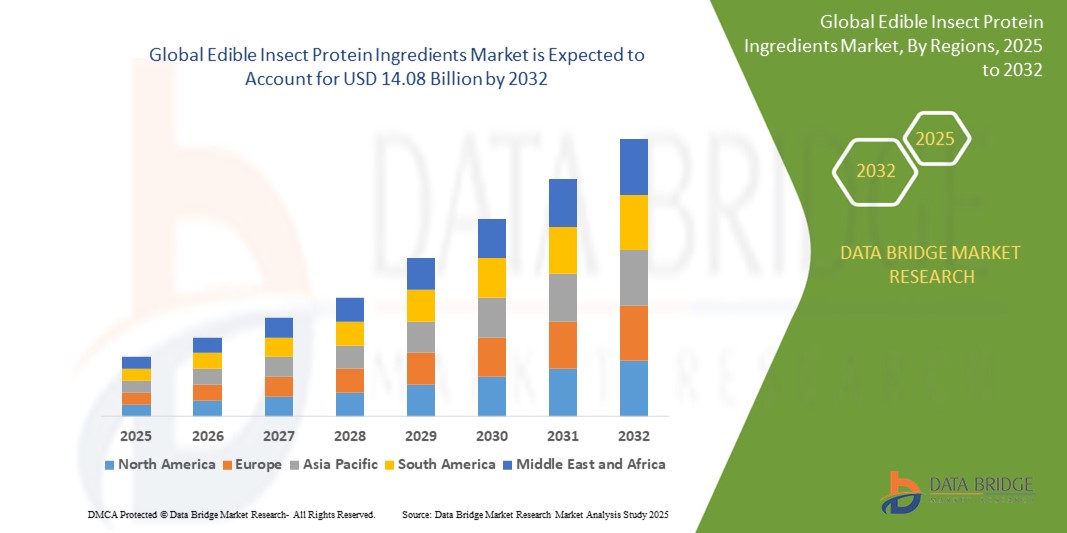
- The global edible insect protein ingredients market size was valued at USD 1.42 billion in 2024 and is expected to reach USD 14.08 billion by 2032, at a CAGR of 33.21% during the forecast period
- The market growth is largely fuelled by the increasing global demand for sustainable and alternative protein sources, driven by environmental concerns and the growing population
- Growing incorporation of insect protein in sports nutrition, snacks, and bakery products is further propelling market expansion across both developed and emerging economies
Edible Insect Protein Ingredients Market Analysis
- Rising awareness of the environmental benefits of insect farming, such as reduced greenhouse gas emissions and lower water and land usage, is significantly boosting adoption
- The market is witnessing rapid innovation in food technology, making insect protein more palatable and acceptable for both human and animal consumption
- Europe dominated the edible insect protein ingredients market with the largest revenue share of 37.8% in 2024, driven by increasing consumer demand for sustainable and alternative protein sources, along with strong regulatory support
- Asia-Pacific region is expected to witness the highest growth rate in the global edible insect protein ingredients market, driven by traditional dietary practices including insect consumption, increasing urbanization, rising demand for affordable high-protein food sources, and supportive research and government initiatives promoting insect farming and commercialization
- The insect protein segment held the largest market revenue share of 47.6% in 2024, driven by its high nutritional value, sustainability, and rising acceptance in sports nutrition and food supplements. This segment continues to attract attention due to its superior amino acid profile and ability to serve as a complete protein source, making it an ideal alternative to conventional animal proteins. The growing number of food and beverage manufacturers integrating insect protein into protein bars, shakes, and functional snacks is further fueling its dominance
Report Scope and Edible Insect Protein Ingredients Market Segmentation
|
Attributes |
Edible Insect Protein Ingredients Key Market Insights |
|
Segments Covered |
|
|
Countries Covered |
North America
Europe
Asia-Pacific
Middle East and Africa
South America
|
|
Key Market Players |
• Terramar GmbH (Germany) • EnviroFlight LLC (U.S.) |
|
Market Opportunities |
• Expansion into Emerging Economies with High Demand for Alternative Protein Sources • Development of Sustainable and Organic Insect Farming Practices |
|
Value Added Data Infosets |
In addition to the insights on market scenarios such as market value, growth rate, segmentation, geographical coverage, and major players, the market reports curated by the Data Bridge Market Research also include in-depth expert analysis, pricing analysis, brand share analysis, consumer survey, demography analysis, supply chain analysis, value chain analysis, raw material/consumables overview, vendor selection criteria, PESTLE Analysis, Porter Analysis, and regulatory framework. |
Edible Insect Protein Ingredients Market Trends
“Expansion of Insect Protein in Functional Food and Nutraceutical Sectors”
- Growing consumer demand for high-protein, sustainable alternatives is fueling the inclusion of insect protein in functional food products
- Companies are launching cricket- and mealworm-based protein powders, energy bars, and baked goods to meet fitness and wellness trends
- Insect protein is gaining popularity in the nutraceutical industry due to its amino acid profile, micronutrients, and digestibility
- Clean-label brands are incorporating insect-based ingredients as gluten-free and low-allergen options for health-conscious buyers
- For instance, Canadian brand Crickstart launched cricket protein bars and powders marketed toward athletes and eco-conscious consumers
Edible Insect Protein Ingredients Market Dynamics
Driver
“Rising Demand for Sustainable and Alternative Protein Sources”
- Traditional animal protein production strains natural resources, pushing interest in eco-friendly alternatives such as insect protein
- Insect farming has a smaller carbon footprint and uses less land and water, aligning with global sustainability goals
- The short lifecycle and high feed conversion rate of insects make them ideal for scalable, year-round protein production
- Government and private sector investment is accelerating research, product development, and commercialization of insect-based proteins
- For instance, The FAO reports crickets require 12 times less feed than cattle to produce the same amount of protein, highlighting efficiency
Restraint/Challenge
“Consumer Acceptance and Regulatory Barriers”
- Negative perceptions, cultural stigma, and the “yuck” factor deter widespread acceptance in many Western markets
- Limited retail shelf presence and inconsistent product labeling reduce visibility and confuse potential buyers
- Regulatory hurdles, such as novel food approval and allergen labeling, delay product rollouts in key regions
- Brands must invest in education and rebranding to make insect protein more approachable and palatable for the mass market
- For instance, In the EU, approval of yellow mealworms for human consumption under novel food regulations was only granted in 2021
Edible Insect Protein Ingredients Market Scope
The market is segmented on the basis of type.
- By Type
On the basis of type, the edible insect protein ingredients market is segmented into insect protein, crude protein, insect meal, and isolated protein. The insect protein segment held the largest market revenue share of 47.6% in 2024, driven by its high nutritional value, sustainability, and rising acceptance in sports nutrition and food supplements. This segment continues to attract attention due to its superior amino acid profile and ability to serve as a complete protein source, making it an ideal alternative to conventional animal proteins. The growing number of food and beverage manufacturers integrating insect protein into protein bars, shakes, and functional snacks is further fueling its dominance.
The isolated protein segment is expected to witness the fastest growth rate from 2025 to 2032, propelled by its application in high-purity formulations across nutraceuticals and specialized dietary products. Isolated insect proteins are gaining popularity for their low-fat content, enhanced digestibility, and suitability for fortifying beverages, dairy alternatives, and clinical nutrition products. The surge in clean-label trends and demand for customizable formulations are also accelerating the segment’s expansion across global markets.
Edible Insect Protein Ingredients Market Regional Analysis
- Europe dominated the edible insect protein ingredients market with the largest revenue share of 37.8% in 2024, driven by increasing consumer demand for sustainable and alternative protein sources, along with strong regulatory support
- Countries across the region are witnessing a rapid shift in dietary habits, with a growing preference for insect-based proteins due to their low environmental impact and high nutritional content
- The market growth is further strengthened by the European Union’s approval of insect protein for human consumption and the growing number of startups and food-tech companies entering the space
Germany Edible Insect Protein Ingredients Market Insight
The Germany edible insect protein ingredients market held a significant share within Europe in 2024, backed by high consumer awareness, a progressive regulatory framework, and a strong push for environmentally responsible protein alternatives. The country’s rising vegan and flexitarian population is embracing insect protein due to its rich nutritional value and minimal ecological footprint. Key players and innovative startups are collaborating with research institutions to develop high-quality, functional insect-based ingredients for food and beverage applications, propelling market expansion.
U.K. Edible Insect Protein Ingredients Market Insight
The U.K. edible insect protein ingredients market is expected to witness the fastest growth rate from 2025 to 2032, driven by rising interest in alternative proteins, food sustainability, and health-oriented diets. Consumers are increasingly exploring insect-based products such as protein powders, snacks, and bars as part of their shift toward low-impact food choices. Regulatory advancements post-Brexit have also opened opportunities for domestic insect farming and ingredient development. Several startups are innovating in this space by introducing palatable, nutrient-dense offerings that align with the country's growing flexitarian trend.
Asia-Pacific Edible Insect Protein Ingredients Market Insight
The Asia-Pacific edible insect protein ingredients market is expected to witness the fastest growth rate from 2025 to 2032, fueled by traditional entomophagy practices, increasing urbanization, and food security concerns. Countries such as Thailand, Vietnam, and China have long histories of consuming insects and are now advancing toward commercial-scale production and export of insect-based ingredients. Government initiatives to promote food innovation, along with consumer acceptance and cost-effective production, are significantly driving the regional market.
China Edible Insect Protein Ingredients Market Insight
The China edible insect protein ingredients market accounted for the largest revenue share in the Asia-Pacific region in 2024, driven by an expanding population, growing health consciousness, and rising demand for novel protein sources. The market is also bolstered by significant investment in insect farming infrastructure and processing technologies. China is rapidly becoming a hub for scalable production of insect meal and powder, primarily used in sports nutrition, functional food, and snacks.
Japan Edible Insect Protein Ingredients Market Insight
The Japan edible insect protein ingredients market is expected to witness the fastest growth rate from 2025 to 2032, supported by the country’s tech-forward food innovation landscape and traditional familiarity with insect consumption. Rising awareness of sustainable diets, combined with the need for protein-rich alternatives to address aging population needs, is promoting the adoption of insect-based ingredients. Japanese firms are focusing on precision farming and advanced processing methods to improve taste and functionality, especially in snack foods, supplements, and functional beverages. Government backing for food security and resource-efficient agriculture is expected to further stimulate market development.
North America Edible Insect Protein Ingredients Market Insight
The North America edible insect protein ingredients market is expected to witness the fastest growth rate from 2025 to 2032, supported by growing awareness of environmental sustainability and protein diversification. The presence of innovative startups and the increasing incorporation of insect protein into pet food, dietary supplements, and protein bars are expanding the regional market. Consumer acceptance is improving, particularly in urban areas, due to educational campaigns and product innovation focused on taste and health benefits.
U.S. Edible Insect Protein Ingredients Market Insight
The U.S. edible insect protein ingredients market is expected to witness the fastest growth rate from 2025 to 2032, led by the growing demand for clean-label, nutrient-rich, and sustainable protein alternatives. Companies in the U.S. are increasingly using crickets, mealworms, and black soldier flies to develop flour, protein bars, and powders. Regulatory support, along with the growing influence of eco-conscious consumers and fitness enthusiasts, is accelerating product penetration. In addition, venture capital investment and collaborations with food giants are supporting market scaling and innovation.
Edible Insect Protein Ingredients Market Share
The Edible Insect Protein Ingredients industry is primarily led by well-established companies, including:
• Terramar GmbH (Germany)
• WCRL (U.S.)
• Valley Proteins, Inc. (U.S.)
• Ridley Corporation Limited (Australia)
• DuPont (U.S.)
• EnviroFlight LLC (U.S.)
• Protix B.V. (Netherlands)
• AgriProtein Holdings Ltd. (U.K.)
• Ynsect (France)
• Aspire Food Group (Canada)

- Interactive Data Analysis Dashboard
- Company Analysis Dashboard for high growth potential opportunities
- Research Analyst Access for customization & queries
- Competitor Analysis with Interactive dashboard
- Latest News, Updates & Trend analysis
- Harness the Power of Benchmark Analysis for Comprehensive Competitor Tracking
Global Edible Insect Protein Ingredients Market, Supply Chain Analysis and Ecosystem Framework
To support market growth and help clients navigate the impact of geopolitical shifts, DBMR has integrated in-depth supply chain analysis into its Global Edible Insect Protein Ingredients Market research reports. This addition empowers clients to respond effectively to global changes affecting their industries. The supply chain analysis section includes detailed insights such as Global Edible Insect Protein Ingredients Market consumption and production by country, price trend analysis, the impact of tariffs and geopolitical developments, and import and export trends by country and HSN code. It also highlights major suppliers with data on production capacity and company profiles, as well as key importers and exporters. In addition to research, DBMR offers specialized supply chain consulting services backed by over a decade of experience, providing solutions like supplier discovery, supplier risk assessment, price trend analysis, impact evaluation of inflation and trade route changes, and comprehensive market trend analysis.
Data collection and base year analysis are done using data collection modules with large sample sizes. The stage includes obtaining market information or related data through various sources and strategies. It includes examining and planning all the data acquired from the past in advance. It likewise envelops the examination of information inconsistencies seen across different information sources. The market data is analysed and estimated using market statistical and coherent models. Also, market share analysis and key trend analysis are the major success factors in the market report. To know more, please request an analyst call or drop down your inquiry.
The key research methodology used by DBMR research team is data triangulation which involves data mining, analysis of the impact of data variables on the market and primary (industry expert) validation. Data models include Vendor Positioning Grid, Market Time Line Analysis, Market Overview and Guide, Company Positioning Grid, Patent Analysis, Pricing Analysis, Company Market Share Analysis, Standards of Measurement, Global versus Regional and Vendor Share Analysis. To know more about the research methodology, drop in an inquiry to speak to our industry experts.
Data Bridge Market Research is a leader in advanced formative research. We take pride in servicing our existing and new customers with data and analysis that match and suits their goal. The report can be customized to include price trend analysis of target brands understanding the market for additional countries (ask for the list of countries), clinical trial results data, literature review, refurbished market and product base analysis. Market analysis of target competitors can be analyzed from technology-based analysis to market portfolio strategies. We can add as many competitors that you require data about in the format and data style you are looking for. Our team of analysts can also provide you data in crude raw excel files pivot tables (Fact book) or can assist you in creating presentations from the data sets available in the report.













