


What is the Global Endobronchial Ultrasound Biopsy Devices Market Size and Growth Rate?
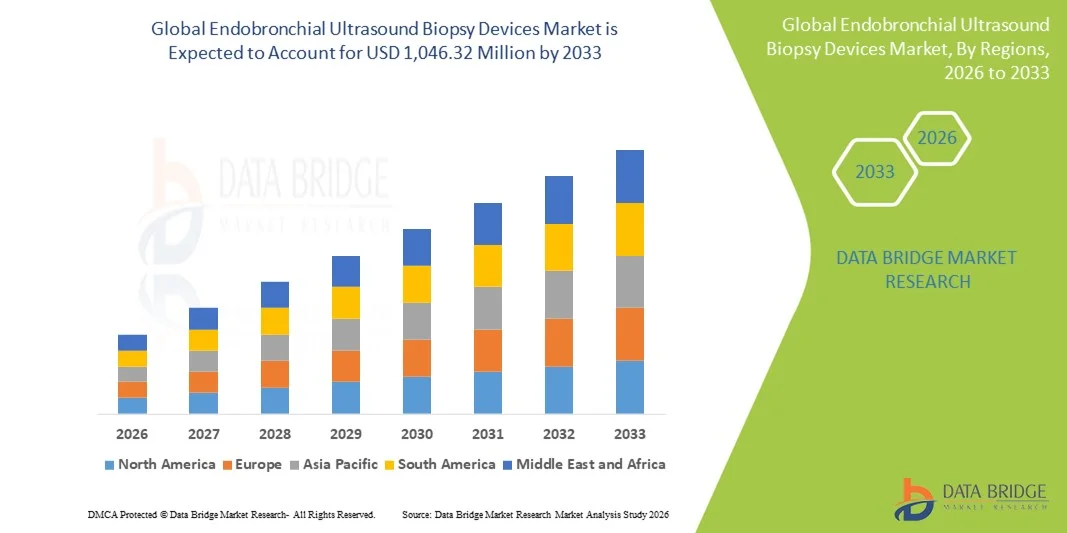
- As per Data Bridge Market Research analysis that the global endobronchial ultrasound biopsy devices market size was valued at USD 739.71 million in 2025 and is expected to reach USD 1,046.32 million by 2033, at a CAGR of 4.43% during the forecast period
- The market growth is largely fueled by the increasing prevalence of lung cancer and other respiratory diseases, rising healthcare investments in advanced diagnostic technologies, and the growing adoption of minimally invasive procedures that improve diagnostic accuracy and patient outcomes
- Furthermore, ongoing technological advancements such as improvements in EBUS scopes, needles, and imaging systems alongside expanding clinical adoption in hospitals and specialty clinics worldwide are driving demand. These converging factors are accelerating the uptake of endobronchial ultrasound biopsy devices as the preferred diagnostic tool in pulmonary care, thereby significantly boosting the industry’s growth
Market Size & Forecast
- Global Market Value (2025): USD 739.71 million
- Expected Market Value (2033): USD 1,046.32 million
- Forecast CAGR (2026–2033): 4.43%
What are the Major Takeaways of Endobronchial Ultrasound Biopsy Devices Market?
- Endobronchial ultrasound biopsy devices, comprising specialized instruments used to collect tissue and cell samples from the lungs and surrounding lymph nodes, are increasingly vital in modern pulmonary diagnostics due to their minimally invasive nature, real-time imaging capabilities, and ability to improve diagnostic accuracy for respiratory diseases
- The escalating demand for endobronchial ultrasound biopsy devices is primarily fueled by the rising prevalence of lung cancer and infectious respiratory conditions, increasing clinical preference for minimally invasive procedures over surgical biopsies, and growing investments in advanced medical technologies across healthcare facilities globally
- North America dominated the endobronchial ultrasound biopsy devices market in 2025, capturing a revenue share of 42.5%, attributed to well-established healthcare infrastructure, high adoption of advanced diagnostic tools, and strong presence of key industry players. The U.S. in particular has seen significant uptake of EBUS procedures, supported by comprehensive reimbursement frameworks and continued innovation in device technology
- Asia-Pacific is expected to be the fastest growing region during the forecast period due to expanding healthcare access, rising incidence of pulmonary diseases, increasing healthcare expenditure, and growing awareness of the clinical benefits of endobronchial ultrasound biopsy devices among medical professionals
- Biopsy needles dominated the market with a market share of 38.8% in 2025, driven by their essential role in tissue extraction with high precision and diagnostic yield
Report Scope and Endobronchial Ultrasound Biopsy Devices Market Segmentation
|
Attributes |
Endobronchial Ultrasound Biopsy Devices Key Market Insights |
|
Segments Covered |
|
|
Countries Covered |
North America
Europe
Asia-Pacific
Middle East and Africa
South America
|
|
Key Market Players |
|
|
Market Opportunities |
|
|
Value Added Data Infosets |
In addition to the insights on market scenarios such as market value, growth rate, segmentation, geographical coverage, and major players, the market reports curated by the Data Bridge Market Research also include in-depth expert analysis, patient epidemiology, pipeline analysis, pricing analysis, and regulatory framework |
What is the Key Trend in the Endobronchial Ultrasound Biopsy Devices Market?
Advancements in Imaging and Real-Time Guidance
- A significant and accelerating trend in the global endobronchial ultrasound biopsy devices market is the integration of high-resolution imaging and real-time guidance systems, enabling clinicians to perform minimally invasive procedures with greater precision and safety
- For instance, convex and radial probe EBUS systems now provide enhanced visualization of mediastinal and hilar lymph nodes, allowing targeted tissue sampling during bronchoscopy procedures
- These imaging advancements improve diagnostic yield and reduce the need for surgical biopsies, offering patients less invasive and safer alternatives for lung cancer and infection diagnosis
- The adoption of advanced imaging features, including Doppler and elastography, facilitates better differentiation between benign and malignant lesions, enhancing clinical decision-making
- This trend towards real-time, high-precision imaging is transforming procedural workflows, prompting manufacturers such as Olympus and Medtronic to develop next-generation EBUS devices with improved navigation, visualization, and biopsy capabilities
- The growing demand for devices that combine imaging, navigation, and sampling in a single platform is expected to accelerate market growth across hospitals, specialty clinics, and research centers worldwide. Increasing development of portable and compact EBUS systems allows expansion into smaller clinics and remote healthcare centers, creating new market opportunities
Endobronchial Ultrasound Biopsy Devices Market Dynamics
Driver
Rising Prevalence of Lung Cancer and Respiratory Diseases
- The increasing incidence of lung cancer, tuberculosis, and other respiratory diseases is a significant driver for the heightened adoption of endobronchial ultrasound biopsy devices
- For instance, in 2025, Medtronic highlighted the growing clinical adoption of its EBUS-guided biopsy platforms for lung cancer staging, supporting minimally invasive diagnostics
- As clinicians seek more accurate, real-time tissue sampling techniques, EBUS devices provide safer and faster alternatives to mediastinoscopy and surgical biopsies, enhancing diagnostic efficiency
- Furthermore, expanding awareness among pulmonologists and interventional specialists about the benefits of EBUS procedures is increasing their routine use in hospitals and specialized centers
- The integration of EBUS devices with hospital imaging systems, electronic health records, and navigation software enables streamlined workflows, driving adoption across both high-income and emerging markets
- The demand for minimally invasive diagnostic procedures and early disease detection is expected to continue propelling the adoption of endobronchial ultrasound biopsy devices globally. For instance, partnerships between device manufacturers and academic hospitals to conduct clinical studies are driving evidence-based adoption and encouraging wider clinical acceptance
- Growing investments in healthcare infrastructure in emerging economies are facilitating greater access to EBUS procedures, further fueling market growth
Restraint/Challenge
High Costs and Limited Skilled Workforce
- The relatively high cost of endobronchial ultrasound biopsy devices and associated maintenance requirements pose a significant challenge to widespread adoption, particularly in developing regions
- For instance, smaller hospitals and clinics may delay procurement due to budget constraints despite the clinical advantages of EBUS systems
- Limited availability of trained pulmonologists and interventional specialists capable of performing EBUS procedures further restricts market penetration in certain regions
- In addition, the need for specialized training and certification increases operational complexity and can slow adoption in smaller healthcare facilities
- While some manufacturers offer training programs and modular solutions to address skill gaps, scaling access to advanced procedures remains a barrier to rapid market growth
- Overcoming these challenges through cost reduction, affordable device variants, and expanded clinician training initiatives will be critical for the sustained growth of the endobronchial ultrasound biopsy devices market. For instance, regulatory hurdles and varying regional medical device approval processes can delay product launches in new markets, limiting market expansion
- Concerns about procedural complications and medico-legal liabilities associated with minimally invasive biopsies may make some healthcare providers cautious in adopting EBUS technologies
How is the Endobronchial Ultrasound Biopsy Devices Market Segmented?
The market is segmented on the basis of product and application.
- By Product
On the basis of product, the endobronchial ultrasound biopsy devices market is segmented into biopsy forceps, cytology brushes, biopsy needles, transbronchial aspiration needles, spray catheters, and others. The biopsy needles segment dominated the market with the largest revenue share of 38.8% in 2025, driven by their critical role in precise tissue extraction from mediastinal and hilar lymph nodes. Clinicians prefer biopsy needles due to their high diagnostic yield and ability to obtain adequate tissue for histopathological and molecular testing, especially in cancer diagnosis. Their compatibility with both convex and radial probe EBUS systems makes them versatile across various clinical procedures. In addition, biopsy needles are widely available in different sizes and designs, allowing customization for patient-specific requirements. The segment benefits from growing awareness among pulmonologists about minimally invasive procedures and increasing adoption in hospitals and specialty clinics. For instance, leading manufacturers such as Olympus and Medtronic continue to innovate needle designs to enhance precision and safety during EBUS procedures. These factors collectively sustain the dominance of biopsy needles in the market.
The transbronchial aspiration (TBNA) needles segment is anticipated to witness the fastest growth at a CAGR of 7.5% from 2026 to 2033, driven by rising demand for less invasive, rapid sampling procedures. TBNA needles allow clinicians to aspirate lymph nodes and lesions without the need for surgical interventions, reducing patient recovery time and procedural risks. Their increasing use in early lung cancer detection and staging contributes to higher adoption rates in diagnostic centers. Furthermore, technological advancements such as ultrasound-guided TBNA systems improve accuracy, making them highly attractive for pulmonologists. The integration of TBNA needles with portable and user-friendly EBUS platforms allows their deployment in smaller hospitals and remote settings, widening their market reach. For instance, emerging manufacturers are offering modular TBNA kits optimized for outpatient and ambulatory care procedures. These advantages position TBNA needles as the fastest-growing product segment in the EBUS devices market.
- By Application
On the basis of application, the endobronchial ultrasound biopsy devices market is segmented into cancer diagnosis, infection diagnosis, and others. The cancer diagnosis segment dominated the market with a share of 54% in 2025, driven by the increasing prevalence of lung cancer and the critical need for accurate, early-stage detection. EBUS devices are highly preferred for mediastinal and hilar lymph node sampling, offering a minimally invasive alternative to surgical biopsies. Clinicians rely on these devices to obtain tissue for histopathology, immunohistochemistry, and molecular profiling, which guide targeted therapies and treatment planning. The segment’s dominance is further strengthened by the widespread adoption of EBUS procedures in hospitals and specialty oncology centers. For instance, leading hospitals in North America and Europe have integrated EBUS as a standard diagnostic approach in lung cancer staging workflows. The precision, safety, and diagnostic yield of EBUS devices continue to make cancer diagnosis the largest application segment in the market.
The infection diagnosis segment is expected to witness the fastest growth at a CAGR of 7.8% from 2026 to 2033, fueled by rising awareness of respiratory infections such as tuberculosis, sarcoidosis, and fungal infections requiring precise tissue or cytology sampling. EBUS devices enable accurate sampling of affected lymph nodes and pulmonary tissue, improving pathogen detection rates compared to traditional methods. In addition, increasing adoption of minimally invasive procedures in regions with high infection burden supports segment growth. For instance, portable EBUS platforms are increasingly being deployed in emerging economies to improve diagnostic efficiency for infectious diseases. Technological advancements in needles and cytology brushes further enhance the ability to collect viable samples safely, driving adoption. As diagnostic centers prioritize rapid and accurate infection identification, this segment is positioned for strong growth during the forecast period.
Which Region Holds the Largest Share of the Endobronchial Ultrasound Biopsy Devices Market?
- North America dominated the endobronchial ultrasound biopsy devices market in 2025, capturing a revenue share of 42.5%, attributed to well-established healthcare infrastructure, high adoption of advanced diagnostic tools, and strong presence of key industry players
- Hospitals and specialty clinics in the region increasingly rely on EBUS devices for accurate staging of lung cancer and other respiratory diseases, reducing the need for surgical biopsies while improving patient outcomes
- This widespread adoption is further supported by well-established reimbursement frameworks, high healthcare spending, and continuous technological innovation, establishing EBUS devices as a preferred diagnostic solution for pulmonologists and interventional specialists in both clinical and research settings
U.S. Endobronchial Ultrasound Biopsy Devices Market Insight
The U.S. endobronchial ultrasound biopsy devices market captured the largest revenue share of 84% in 2025 within North America, fueled by advanced healthcare infrastructure, high adoption of minimally invasive diagnostic procedures, and strong presence of key market players. Hospitals and specialty clinics increasingly rely on EBUS devices for accurate staging of lung cancer and other respiratory diseases, reducing the need for surgical biopsies while improving patient outcomes. The growing preference for outpatient and ambulatory care procedures, combined with the integration of EBUS systems with hospital imaging and navigation platforms, further propels the market. In addition, continuous technological innovations, including high-resolution imaging and AI-assisted guidance, are expanding the capabilities and clinical adoption of EBUS devices.
Europe Endobronchial Ultrasound Biopsy Devices Market Insight
The Europe endobronchial ultrasound biopsy devices market is projected to expand at a substantial CAGR throughout the forecast period, primarily driven by increasing prevalence of lung cancer, growing demand for minimally invasive diagnostic procedures, and well-established healthcare systems. European hospitals and diagnostic centers are adopting EBUS devices to improve accuracy in mediastinal and hilar lymph node sampling, reducing the reliance on surgical biopsies. The focus on early disease detection, along with government initiatives promoting advanced medical technologies, is fostering adoption. Moreover, increasing awareness among pulmonologists and interventional specialists about the clinical benefits of EBUS procedures is further supporting growth.
U.K. Endobronchial Ultrasound Biopsy Devices Market Insight
The U.K. endobronchial ultrasound biopsy devices market is anticipated to grow at a noteworthy CAGR during the forecast period, driven by rising lung cancer incidence and growing demand for minimally invasive diagnostic solutions. The U.K.’s healthcare system, combined with an increasing focus on early detection and precise staging of pulmonary diseases, is supporting the uptake of EBUS devices. In addition, awareness programs and clinical training for pulmonologists and interventional specialists are encouraging broader adoption. Hospitals and specialty clinics are increasingly integrating EBUS procedures into routine diagnostics, particularly in cancer staging and infection diagnosis.
Germany Endobronchial Ultrasound Biopsy Devices Market Insight
The Germany endobronchial ultrasound biopsy devices market is expected to expand at a considerable CAGR during the forecast period, fueled by advanced healthcare infrastructure, high adoption of minimally invasive procedures, and a focus on precision diagnostics. Hospitals and clinics emphasize the use of EBUS devices for accurate mediastinal and hilar lymph node sampling, improving early detection of lung cancer and other respiratory diseases. Integration with hospital imaging systems and navigation software, along with continuous innovation by manufacturers, supports market growth. In addition, the country’s focus on quality, efficiency, and patient safety encourages adoption in both public and private healthcare facilities.
Asia-Pacific Endobronchial Ultrasound Biopsy Devices Market Insight
The Asia-Pacific endobronchial ultrasound biopsy devices market is poised to grow at the fastest CAGR of 25% during 2026–2033, driven by increasing prevalence of lung cancer, rapid expansion of healthcare infrastructure, and growing awareness of minimally invasive procedures. Countries such as China, Japan, and India are witnessing rising demand for EBUS procedures in hospitals, specialty clinics, and outpatient centers. Government initiatives promoting early diagnosis and digital healthcare adoption further support growth. Moreover, the emergence of cost-effective EBUS solutions and local manufacturing of devices improves accessibility, enabling wider adoption across both urban and semi-urban regions.
Japan Endobronchial Ultrasound Biopsy Devices Market Insight
The Japan endobronchial ultrasound biopsy devices market is gaining momentum due to the country’s technologically advanced healthcare system, high prevalence of pulmonary diseases, and focus on minimally invasive diagnostics. Increasing adoption of smart hospitals and integration of EBUS devices with advanced imaging and navigation platforms is driving growth. In addition, Japan’s aging population creates demand for safer, less invasive procedures with faster recovery times. The use of EBUS for both cancer staging and infection diagnosis in clinical practice is further fueling market expansion.
India Endobronchial Ultrasound Biopsy Devices Market Insight
The India endobronchial ultrasound biopsy devices market accounted for the largest revenue share in Asia-Pacific in 2025, attributed to rapid urbanization, rising lung cancer incidence, and expanding healthcare infrastructure. Hospitals and specialty clinics increasingly adopt EBUS procedures for accurate, minimally invasive tissue sampling. The country’s growing focus on early diagnosis, government initiatives supporting advanced medical technologies, and availability of cost-effective EBUS solutions are key factors propelling the market. In addition, awareness among pulmonologists and interventional specialists about the benefits of EBUS procedures supports broader adoption across urban and semi-urban healthcare facilities.
Which are the Top Companies in Endobronchial Ultrasound Biopsy Devices Market?
The Endobronchial Ultrasound Biopsy Devices industry is primarily led by well-established companies, including:
- Olympus Corporation (Japan)
- Boston Scientific Corporation (U.S.)
- Medtronic (Ireland)
- FUJIFILM Holdings Corporation (Japan)
- Cook (U.S.)
- Medi Globe Technologies GmbH (Germany)
- Veran Medical Technologies (U.S.)
- PENTAX Medical (Japan)
- GE Healthcare (U.S.)
- Siemens Healthineers AG (Germany)
- Koninklijke Philips N.V. (Netherlands)
- ACE Medical Devices Pvt. Ltd. (India)
- Praxis Medical (U.S.)
- Clinodevice (U.S.)
- Getinge AB (Sweden)
- Ambu A/S (Denmark)
- KARL STORZ SE & Co. KG (Germany)
- Merit Medical Systems, Inc. (U.S.)
- Invivo Corporation (U.S.)
- CONMED Corporation (U.S.)
What are the Recent Developments in Global Endobronchial Ultrasound Biopsy Devices Market?
- In September 2025, Olympus launched the BF‑UCP190F EBUS bronchoscope in EMEA and APAC markets, featuring a thinner outer diameter and wider angulation to reach deeper lung regions, enhancing precision in EBUS‑guided needle aspiration procedures for lung cancer diagnosis and staging
- In September 2024, FUJIFILM Healthcare Europe announced compatibility of its ARIETTA 750 FF ENDO ultrasound system with multiple FUJIFILM endoscopes and linear ultrasound bronchoscopes, enabling clearer ultrasound imaging and advanced diagnostic applications that support enhanced EBUS‑guided biopsies
- In September 2023, Broncus Medical launched the BioStar® Transbronchial Aspiration (TBNA) Needle, a next‑generation EBUS‑compatible needle designed with ultra‑thin walls for improved accessibility and accurate tissue sampling during EBUS‑TBNA procedures
- In February 2023, FUJIFILM India expanded its endoscopy solutions portfolio with the PB2020‑M2 compact ultrasonic probe system (for real‑time peripheral lung lesion imaging) showcased at BRONCHUS 2023, aiming to improve examination efficiency and support minimally invasive diagnostic practices
- In May 2021, Olympus announced the market launch of its BF‑UC190F EBUS bronchoscope, FDA 510(k)‑cleared and designed to aid minimally invasive lung cancer diagnosis and staging via improved scope angulation and visualization, marking a significant early‑market device introduction

- Interactive Data Analysis Dashboard
- Company Analysis Dashboard for high growth potential opportunities
- Research Analyst Access for customization & queries
- Competitor Analysis with Interactive dashboard
- Latest News, Updates & Trend analysis
- Harness the Power of Benchmark Analysis for Comprehensive Competitor Tracking
Data collection and base year analysis are done using data collection modules with large sample sizes. The stage includes obtaining market information or related data through various sources and strategies. It includes examining and planning all the data acquired from the past in advance. It likewise envelops the examination of information inconsistencies seen across different information sources. The market data is analysed and estimated using market statistical and coherent models. Also, market share analysis and key trend analysis are the major success factors in the market report. To know more, please request an analyst call or drop down your inquiry.
The key research methodology used by DBMR research team is data triangulation which involves data mining, analysis of the impact of data variables on the market and primary (industry expert) validation. Data models include Vendor Positioning Grid, Market Time Line Analysis, Market Overview and Guide, Company Positioning Grid, Patent Analysis, Pricing Analysis, Company Market Share Analysis, Standards of Measurement, Global versus Regional and Vendor Share Analysis. To know more about the research methodology, drop in an inquiry to speak to our industry experts.
Data Bridge Market Research is a leader in advanced formative research. We take pride in servicing our existing and new customers with data and analysis that match and suits their goal. The report can be customized to include price trend analysis of target brands understanding the market for additional countries (ask for the list of countries), clinical trial results data, literature review, refurbished market and product base analysis. Market analysis of target competitors can be analyzed from technology-based analysis to market portfolio strategies. We can add as many competitors that you require data about in the format and data style you are looking for. Our team of analysts can also provide you data in crude raw excel files pivot tables (Fact book) or can assist you in creating presentations from the data sets available in the report.













