


What is the Estrogen Receptor Modulators Market Size and Growth Rate?
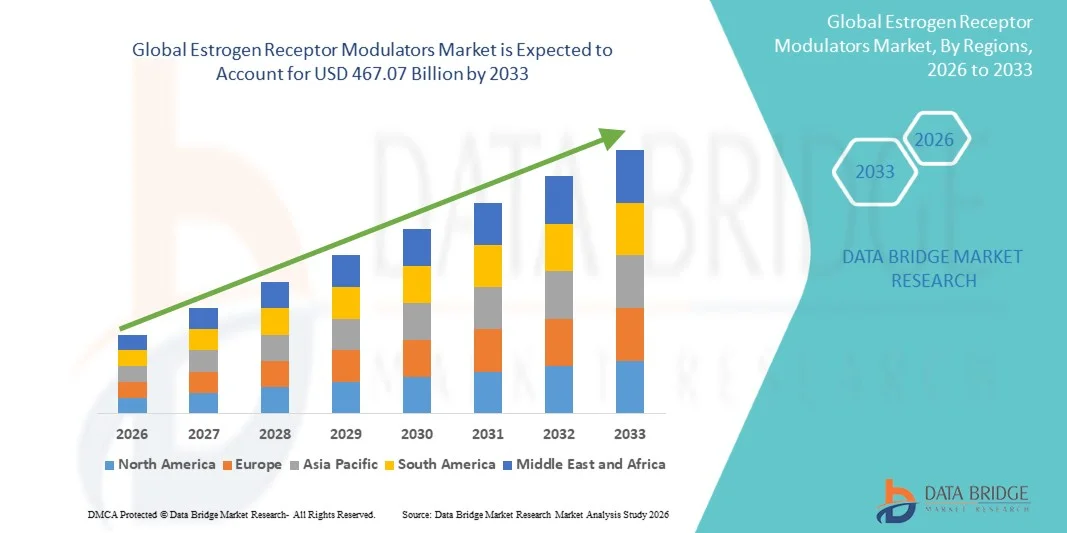
- As per Data Bridge Market Research Analysis the global estrogen receptor modulators market size was valued at USD 305.50 billion in 2025 and is expected to reach USD 467.07 billion by 2033, at a CAGR of 5.45% during the forecast period
- The market growth is largely fueled by the increasing prevalence of hormone-related conditions such as breast cancer and osteoporosis, along with continuous advancements in drug development and therapeutic approaches, leading to greater adoption of estrogen receptor modulators in clinical settings
- Furthermore, rising demand for effective, targeted, and well-tolerated treatment options among patients and healthcare providers is positioning estrogen receptor modulators as a preferred therapeutic choice. These factors are accelerating the adoption of Estrogen Receptor Modulators, thereby significantly boosting market growth
Market Size & Forecast
- Global Market Value (2025): USD 305.50 billion
- Expected Market Value (2033):USD 467.07 billion
- Forecast CAGR (2026–2033): 5.45%
Estrogen Receptor Modulators Market Analysis
- Estrogen receptor modulators, used for regulating estrogen activity in the body, play a crucial role in the treatment of hormone-dependent conditions such as breast cancer, osteoporosis, and infertility, making them essential components of modern therapeutic strategies
- The increasing demand for estrogen receptor modulators is primarily driven by the rising prevalence of breast cancer, growing awareness regarding women’s health, and advancements in targeted drug therapies that offer improved efficacy and safety profiles
- North America dominated the estrogen receptor modulators market with the largest revenue share of 38.5% in 2025, supported by advanced healthcare infrastructure, high awareness levels, strong presence of key pharmaceutical companies, and significant adoption of innovative hormone therapies, particularly in the U.S.
- Asia-Pacific is expected to be the fastest-growing region in the estrogen receptor modulators market during the forecast period, driven by a large patient population, increasing healthcare expenditure, improving access to treatment, and rising awareness of early diagnosis and therapy
- The Breast Cancer segment held the largest market revenue share of 52.8% in 2025, driven by the high global prevalence of hormone receptor-positive breast cancer cases
Report Scope and Estrogen Receptor Modulators Market Segmentation
|
Attributes |
Estrogen Receptor Modulators Key Market Insights |
|
Segments Covered |
|
|
Countries Covered |
North America
Europe
Asia-Pacific
Middle East and Africa
South America
|
|
Key Market Players |
|
|
Market Opportunities |
|
|
Value Added Data Infosets |
In addition to the insights on market scenarios such as market value, growth rate, segmentation, geographical coverage, and major players, the market reports curated by the Data Bridge Market Research also include in-depth expert analysis, patient epidemiology, pipeline analysis, pricing analysis, and regulatory framework. |
What is the Key Trend in the Estrogen Receptor Modulators Market?
“Advancements in Targeted Therapies and Expanding Clinical Applications”
- A significant and accelerating trend in the global estrogen receptor modulators market is the increasing focus on targeted therapies that selectively modulate estrogen receptors for improved efficacy and reduced side effects. These therapies are gaining traction in the treatment of hormone-dependent conditions such as breast cancer, osteoporosis, and infertility
- For instance, selective estrogen receptor modulators (SERMs) such as Tamoxifen and Raloxifene are widely used in clinical practice, demonstrating the growing importance of receptor-specific treatments in modern medicine
- Continuous research and development efforts are leading to the introduction of next-generation estrogen receptor modulators with improved safety profiles and enhanced therapeutic outcomes, particularly in oncology and women’s health
- The increasing adoption of combination therapies, where estrogen receptor modulators are used alongside chemotherapy or targeted biologics, is further enhancing treatment effectiveness and expanding their clinical utility
- Furthermore, advancements in precision medicine and biomarker-based diagnostics are enabling healthcare providers to tailor therapies based on individual patient profiles, improving treatment response rates
- This trend towards more effective, safer, and patient-specific therapies is reshaping treatment protocols and driving demand for innovative estrogen receptor modulators across global healthcare systems
What are the Key Drivers of Estrogen Receptor Modulators Market?
Driver
“Rising Prevalence of Hormone-Dependent Diseases and Expanding Therapeutic Use”
- The increasing prevalence of hormone-dependent conditions, particularly breast cancer and osteoporosis, is a major driver for the growth of the estrogen receptor modulators market. These conditions require long-term management, creating sustained demand for effective therapies
- For instance, breast cancer remains one of the most commonly diagnosed cancers globally, with estrogen receptor-positive (ER+) subtypes accounting for a significant proportion of cases, thereby driving the adoption of SERMs and related therapies
- The growing aging population, especially postmenopausal women, is contributing to a higher incidence of osteoporosis and related fractures, further increasing the demand for estrogen receptor modulators such as Raloxifene
- Increasing awareness regarding early diagnosis and treatment of hormone-related disorders, supported by screening programs and healthcare initiatives, is encouraging timely therapeutic intervention
- In addition, the expanding use of these modulators in fertility treatments and gynecological disorders is broadening their application scope and supporting market growth
- Strong research and development pipelines, along with increasing investments from pharmaceutical companies, are leading to the introduction of novel therapies, further propelling market expansion
- Favorable reimbursement policies and improved access to healthcare services in developed regions are also facilitating higher adoption rates of advanced estrogen receptor modulators
Restraint/Challenge
“Adverse Effects, Resistance Development, and High Treatment Costs”
- Despite their clinical benefits, estrogen receptor modulators are associated with certain adverse effects, including an increased risk of thromboembolic events and endometrial cancer, which can limit their long-term use in some patients
- For instance, long-term use of Tamoxifen has been linked in some cases to an elevated risk of endometrial cancer and blood clots, prompting careful patient monitoring and limiting its suitability for certain populations
- The development of drug resistance, particularly in breast cancer patients undergoing long-term therapy, poses a significant challenge to treatment effectiveness and disease management
- Variability in patient response due to genetic and hormonal differences can complicate treatment outcomes, necessitating more personalized approaches that may not be widely accessible
- High costs associated with newer and more advanced therapies can restrict access, particularly in low- and middle-income countries where healthcare budgets are limited
- Stringent regulatory requirements and lengthy approval processes for new drugs can delay market entry and limit the availability of innovative treatment options
- Limited awareness and underdiagnosis of certain hormone-related conditions in developing regions further hinder the adoption of estrogen receptor modulators
- Addressing these challenges requires ongoing research into safer drug alternatives, improved patient monitoring, and broader access to cost-effective treatment options
How is the Estrogen Receptor Modulators Market Segmented?
The market is segmented on the basis of drugs, indication, end-users, and distribution channel.
• By Drugs
On the basis of drugs, the Estrogen Receptor Modulators market is segmented into Raloxifene, Tamoxifen, Ospemifene, and Others. The Tamoxifen segment dominated the largest market revenue share of 44.6% in 2025, driven by its long-standing use as a gold standard therapy for hormone receptor-positive breast cancer. It is widely prescribed due to its proven efficacy in reducing recurrence rates and improving survival outcomes. Strong clinical evidence and inclusion in treatment guidelines further support its extensive use globally. The affordability of generic versions also contributes significantly to its widespread adoption. Physicians prefer tamoxifen for both early-stage and advanced breast cancer treatment. Its use in preventive therapy for high-risk patients further boosts demand. High awareness levels among patients and healthcare providers support consistent prescription volumes. Availability across multiple healthcare settings enhances accessibility. Government initiatives for cancer treatment also promote its use. Continuous research validating long-term benefits strengthens confidence in therapy. The drug’s versatility across different indications sustains its dominance. Increasing breast cancer prevalence globally further supports segment growth. Overall, its established clinical profile ensures continued market leadership.
The Ospemifene segment is anticipated to witness the fastest growth rate of 18.9% from 2026 to 2033, fueled by increasing demand for targeted therapies in menopausal conditions such as dyspareunia and vaginal atrophy. Ospemifene offers a non-hormonal alternative with selective estrogen receptor activity, making it a preferred option for certain patient groups. Rising awareness about women’s health issues drives its adoption. Increasing aging female population significantly contributes to demand. Improved diagnosis of menopausal disorders further accelerates growth. Physicians are increasingly recommending ospemifene due to its favorable safety profile. Expanding regulatory approvals across regions also support market expansion. Pharmaceutical companies are investing in marketing and awareness programs. Growing preference for oral therapies enhances patient compliance. Availability in developed healthcare systems boosts adoption. Continuous clinical advancements further validate its efficacy. Rising healthcare expenditure supports accessibility. Overall, innovation in women’s health therapeutics positions this segment as the fastest growing.
• By Indication
On the basis of indication, the Estrogen Receptor Modulators market is segmented into Breast Cancer, Vaginitis, Osteoporosis, and Others. The Breast Cancer segment held the largest market revenue share of 52.8% in 2025, driven by the high global prevalence of hormone receptor-positive breast cancer cases. Estrogen receptor modulators are widely used as first-line therapy in such conditions. Increasing screening programs lead to early diagnosis, boosting treatment demand. Strong clinical guidelines recommend these drugs for both treatment and prevention. Rising awareness about breast cancer further supports segment growth. Availability of multiple therapeutic options enhances treatment accessibility. Government initiatives for cancer control programs contribute significantly. Advanced healthcare infrastructure in developed regions supports higher adoption. Continuous research in oncology strengthens treatment outcomes. The growing burden of cancer globally sustains demand. Pharmaceutical innovations further improve drug efficacy. High patient adherence to long-term therapy supports consistent revenue. Overall, the segment’s critical role in cancer management ensures its dominance.
The Vaginitis segment is expected to witness the fastest CAGR of 17.6% from 2026 to 2033, driven by increasing awareness of postmenopausal health conditions. Rising prevalence of vaginal atrophy and related disorders significantly contributes to demand. Improved diagnosis rates encourage timely treatment adoption. Availability of targeted therapies such as ospemifene supports growth. Increasing focus on women’s health globally enhances market expansion. Patients are seeking effective non-invasive treatment options. Growing geriatric female population further accelerates demand. Healthcare providers are emphasizing quality-of-life treatments. Rising healthcare spending supports access to therapies. Expansion of specialty care centers boosts treatment availability. Awareness campaigns by healthcare organizations contribute to growth. Continuous innovation in drug formulations improves outcomes. Overall, the focus on women’s wellness positions this segment as the fastest growing.
• By End-Users
On the basis of end-users, the Estrogen Receptor Modulators market is segmented into Hospitals, Homecare, Speciality Centres, and Others. The Hospitals segment accounted for the largest market revenue share of 49.3% in 2025, driven by the availability of advanced diagnostic and treatment facilities. Hospitals serve as primary centers for cancer diagnosis and management. Presence of skilled healthcare professionals ensures effective treatment delivery. High patient inflow supports increased drug utilization. Availability of comprehensive care including surgery and medication enhances demand. Government and private hospital networks expand access to treatment. Strong reimbursement policies in hospitals support affordability. Integration of advanced technologies improves patient outcomes. Hospitals also participate in clinical trials, boosting drug adoption. Increasing cancer cases lead to higher hospital visits. Multidisciplinary treatment approaches strengthen patient care. Rising healthcare investments further enhance infrastructure. Overall, hospitals remain the dominant end-user segment.
The Homecare segment is expected to witness the fastest CAGR of 16.8% from 2026 to 2033, driven by increasing preference for at-home treatment and long-term medication management. Patients prefer homecare settings for convenience and reduced hospital visits. Growing adoption of oral therapies supports home-based treatment. Aging population significantly contributes to segment growth. Advancements in telemedicine improve patient monitoring. Healthcare systems are encouraging cost-effective care models. Increased awareness about self-administration boosts adoption. Availability of support services enhances patient compliance. Chronic disease management trends favor homecare solutions. Rising healthcare costs drive shift toward home settings. Pharmaceutical companies are supporting patient assistance programs. Improved access to medications through pharmacies further supports growth. Overall, patient-centric care trends position this segment as the fastest growing.
• By Distribution Channel
On the basis of distribution channel, the Estrogen Receptor Modulators market is segmented into Hospital Pharmacy, Online Pharmacy, and Retail Pharmacy. The Hospital Pharmacy segment held the largest market revenue share of 46.7% in 2025, driven by the direct dispensing of medications to patients undergoing treatment in hospital settings. Hospitals ensure availability of prescribed drugs, improving treatment adherence. Strong integration with healthcare providers supports efficient distribution. Patients rely on hospital pharmacies for trusted medication supply. Availability of specialized oncology drugs enhances demand. Reimbursement coverage in hospitals further boosts accessibility. Increasing hospital admissions contribute to higher sales volumes. Pharmacist guidance improves patient compliance. Expansion of hospital infrastructure supports growth. Reliable supply chains ensure consistent drug availability. Growing prevalence of chronic diseases increases demand. Hospitals remain primary distribution points for critical medications. Overall, their central role ensures market dominance.
The Online Pharmacy segment is expected to witness the fastest CAGR of 20.3% from 2026 to 2033, driven by the rapid growth of e-commerce and digital healthcare platforms. Increasing internet penetration supports online medicine purchases. Patients prefer home delivery for convenience and accessibility. Competitive pricing and discounts attract more consumers. Expansion of digital payment systems facilitates transactions. Rising adoption of telemedicine complements online pharmacy growth. Availability of a wide range of medications enhances consumer choice. Improved logistics networks ensure timely delivery. Regulatory support in several regions encourages digital healthcare. Increasing awareness about online platforms boosts adoption. Busy lifestyles drive demand for convenient solutions. Pharmaceutical companies are partnering with online platforms. Overall, digital transformation in healthcare positions this segment as the fastest growing.
Which Region Holds the Largest Share of the Estrogen Receptor Modulators Market?
- North America dominated the estrogen receptor modulators market with the largest revenue share of 38.5% in 2025, supported by advanced healthcare infrastructure, high awareness levels, strong presence of key pharmaceutical companies, and significant adoption of innovative hormone therapies, particularly in the U.S.
- For instance, the widespread clinical use of therapies such as Tamoxifen and Raloxifene in the region highlights the strong treatment penetration and well-established clinical guidelines supporting estrogen receptor modulator usage
- This dominance is further reinforced by robust research and development activities, favorable reimbursement frameworks, and the presence of leading oncology and women’s health treatment centers, driving consistent market growth
U.S. Estrogen Receptor Modulators Market Insight
The U.S. estrogen receptor modulators market captured the largest revenue share of 81% in 2025 within North America, driven by a high prevalence of hormone receptor-positive breast cancer and strong awareness among healthcare providers and patients. The country benefits from advanced diagnostic capabilities, including early screening programs and biomarker testing, which support timely treatment initiation. Furthermore, the presence of major pharmaceutical companies, ongoing clinical trials, and rapid adoption of novel therapies are significantly contributing to market expansion. Favorable reimbursement policies and well-established treatment protocols further enhance patient access to effective estrogen receptor modulator therapies.
Europe Estrogen Receptor Modulators Market Insight
The Europe estrogen receptor modulators market is projected to expand at a substantial CAGR throughout the forecast period, primarily driven by increasing awareness of hormone-dependent diseases and strong government support for cancer care and women’s health initiatives. The region benefits from well-established healthcare systems and standardized clinical guidelines for breast cancer treatment. In addition, rising investment in research and increasing adoption of targeted therapies are contributing to steady market growth. The growing emphasis on early diagnosis and preventive care is further supporting the uptake of estrogen receptor modulators across the region.
U.K. Estrogen Receptor Modulators Market Insight
The U.K. estrogen receptor modulators market is anticipated to grow at a noteworthy CAGR during the forecast period, driven by increasing awareness of breast cancer and improved access to healthcare services through the National Health Service (NHS). The country’s focus on early screening programs and structured treatment pathways is enabling timely diagnosis and management of hormone-related conditions. In addition, ongoing research collaborations and rising adoption of advanced therapies are expected to further stimulate market growth in the U.K.
Germany Estrogen Receptor Modulators Market Insight
The Germany estrogen receptor modulators market is expected to expand at a considerable CAGR during the forecast period, fueled by a strong healthcare infrastructure and high healthcare spending. Germany’s emphasis on innovation and clinical research supports the adoption of advanced therapeutic options, including next-generation estrogen receptor modulators. Increasing awareness regarding early disease detection and the availability of specialized oncology centers are further contributing to market expansion.
Asia-Pacific Estrogen Receptor Modulators Market Insight
The Asia-Pacific estrogen receptor modulators market is expected to be the fastest-growing region during the forecast period, driven by a large patient population, increasing healthcare expenditure, improving access to treatment, and rising awareness of early diagnosis and therapy. Rapid urbanization and expanding healthcare infrastructure are enabling better access to diagnostic and treatment services across the region. In addition, growing government initiatives and increasing investments in cancer care are supporting the adoption of advanced therapies, contributing to significant market growth.
Japan Estrogen Receptor Modulators Market Insight
The Japan estrogen receptor modulators market is gaining momentum due to the country’s advanced healthcare system and strong focus on early disease detection. Increasing prevalence of age-related conditions such as breast cancer and osteoporosis is driving demand for effective therapies. Japan’s continuous investment in research and adoption of innovative treatment approaches are further supporting the growth of the market. In addition, the aging population is contributing to sustained demand for long-term hormone therapy solutions.
China Estrogen Receptor Modulators Market Insight
The China estrogen receptor modulators market accounted for the largest market revenue share in Asia Pacific in 2025, attributed to the country’s rapidly expanding healthcare infrastructure and large patient base. Increasing awareness of breast cancer and other hormone-related conditions, along with rising healthcare expenditure, is driving demand for effective therapies. Furthermore, government initiatives aimed at improving cancer diagnosis and treatment, along with the growing presence of domestic and international pharmaceutical companies, are significantly contributing to market growth in China.
Which are the Top Companies in Estrogen Receptor Modulators Market ?
The Estrogen Receptor Modulators industry is primarily led by well-established companies, including:
- Pfizer (U.S.)
- Eli Lilly and Company (U.S.)
- AstraZeneca (U.K.)
- Novartis (Switzerland)
- F. Hoffmann-La Roche (Switzerland)
- GlaxoSmithKline (U.K.)
- Sanofi (France)
- Johnson & Johnson (U.S.)
- Merck & Co. (U.S.)
- Bristol Myers Squibb (U.S.)
- AbbVie (U.S.)
- Teva Pharmaceutical Industries (Israel)
- Amgen (U.S.)
- Sun Pharmaceutical Industries (India)
- Cipla (India)
- Dr. Reddy's Laboratories (India)
- Lupin (India)
- Zydus Lifesciences (India)
- Aurobindo Pharma (India)
What are Latest Developments in Estrogen Receptor Modulators Market?
- In October 2021, Radius Health and Menarini Group reported positive Phase 3 results from the EMERALD trial evaluating elacestrant, an oral selective estrogen receptor degrader (SERD), demonstrating improved progression-free survival in patients with ER-positive, HER2-negative advanced breast cancer. This development marked a significant advancement toward the first oral SERD therapy and highlighted innovation beyond traditional selective estrogen receptor modulators
- In November 2022, preclinical and translational research published in npj Breast Cancer confirmed that elacestrant showed strong anti-estrogenic activity in endocrine-resistant and fulvestrant-resistant breast cancer models, reinforcing its potential as a next-generation estrogen receptor-targeting therapy and accelerating its clinical adoption prospects
- In January 2023, the U.S. Food and Drug Administration approved elacestrant (Orserdu) for the treatment of postmenopausal women and adult men with ER-positive, HER2-negative, ESR1-mutated advanced or metastatic breast cancer, making it the first oral selective estrogen receptor degrader and a major breakthrough in hormone-driven cancer treatment
- In September 2023, the European Commission granted approval for elacestrant (Orserdu) in the European Union for ER-positive, HER2-negative advanced or metastatic breast cancer, expanding access to this novel estrogen receptor-targeting therapy and strengthening the global regulatory landscape for next-generation modulators
- In September 2025, the U.S. Food and Drug Administration approved imlunestrant, developed by Eli Lilly and Company, for the treatment of ER-positive, HER2-negative, ESR1-mutated advanced or metastatic breast cancer, further expanding the class of next-generation estrogen receptor-targeting therapies and intensifying competition in the market

- Interactive Data Analysis Dashboard
- Company Analysis Dashboard for high growth potential opportunities
- Research Analyst Access for customization & queries
- Competitor Analysis with Interactive dashboard
- Latest News, Updates & Trend analysis
- Harness the Power of Benchmark Analysis for Comprehensive Competitor Tracking
Data collection and base year analysis are done using data collection modules with large sample sizes. The stage includes obtaining market information or related data through various sources and strategies. It includes examining and planning all the data acquired from the past in advance. It likewise envelops the examination of information inconsistencies seen across different information sources. The market data is analysed and estimated using market statistical and coherent models. Also, market share analysis and key trend analysis are the major success factors in the market report. To know more, please request an analyst call or drop down your inquiry.
The key research methodology used by DBMR research team is data triangulation which involves data mining, analysis of the impact of data variables on the market and primary (industry expert) validation. Data models include Vendor Positioning Grid, Market Time Line Analysis, Market Overview and Guide, Company Positioning Grid, Patent Analysis, Pricing Analysis, Company Market Share Analysis, Standards of Measurement, Global versus Regional and Vendor Share Analysis. To know more about the research methodology, drop in an inquiry to speak to our industry experts.
Data Bridge Market Research is a leader in advanced formative research. We take pride in servicing our existing and new customers with data and analysis that match and suits their goal. The report can be customized to include price trend analysis of target brands understanding the market for additional countries (ask for the list of countries), clinical trial results data, literature review, refurbished market and product base analysis. Market analysis of target competitors can be analyzed from technology-based analysis to market portfolio strategies. We can add as many competitors that you require data about in the format and data style you are looking for. Our team of analysts can also provide you data in crude raw excel files pivot tables (Fact book) or can assist you in creating presentations from the data sets available in the report.












