


What is the Explosive Detection Systems (EDS) Market Size and Growth Rate?
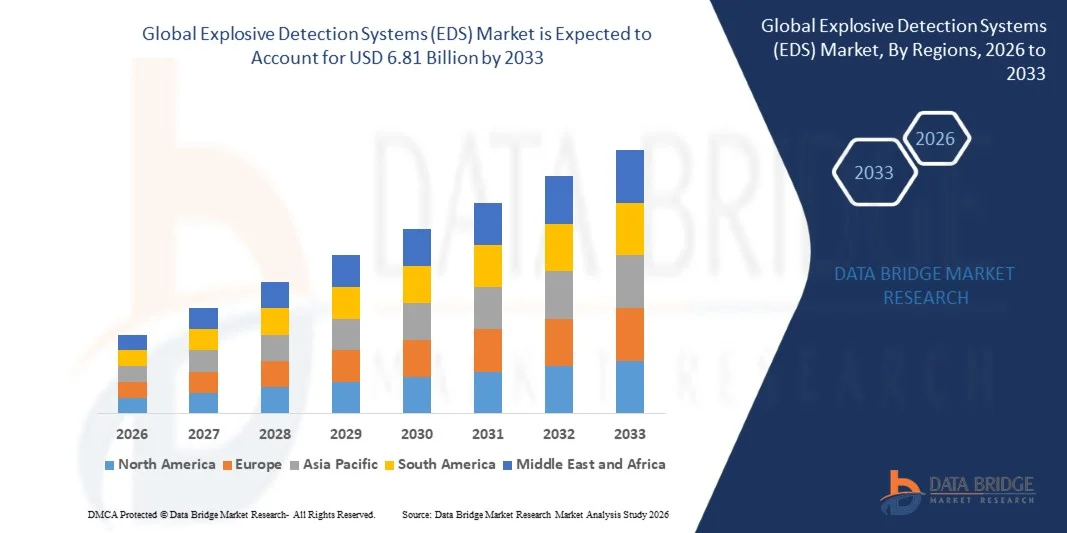
- As per Data Bridge Market Research analysis, the explosive detection systems (EDS) market was valued at USD 4.21 billion in 2025 and is projected to reach USD 6.81 billion by 2033, growing at a CAGR of 6.20% from 2026 to 2033.
- The market is experiencing steady growth driven by increasing global security threats, rising investments in homeland security, and continuous technological advancements in explosive detection technologies, including AI-powered image analysis, computed tomography (CT), trace detection, and multi-sensor screening systems.
- The growing threat of terrorism, stricter aviation and border security regulations, and increasing protection requirements for airports, public transportation hubs, government facilities, and critical infrastructure are accelerating the adoption of advanced explosive detection systems worldwide. Modern EDS platforms are increasingly replacing conventional screening methods by delivering faster, more accurate, and automated threat detection while reducing false alarms and improving passenger throughput, making them an essential component of next-generation security infrastructure.
Market Size & Forecast
- Global Market Value (2025): USD 4.21 Billion
- Expected Market Value (2033): USD 6.81 Billion
- Forecast CAGR (2026–2033): 6.20%
- Leading Region in 2025: North America
- Fastest Growing Region: Asia Pacific
What are the Major Takeaways of the Explosive Detection Systems (EDS) Market?
- North America dominated the explosive detection systems (EDS) market with the largest revenue share of 34.06% in 2025, supported by stringent aviation security regulations, continuous homeland security investments, and widespread deployment of advanced screening systems.
- Asia-Pacific is expected to be the fastest-growing region at a CAGR of 7.0% from 2026 to 2033, fueled by expanding airport infrastructure, increasing air passenger traffic, and growing adoption of advanced explosive detection and security screening technologies across China, India, Japan, and Southeast Asia.
- The checked baggage explosive detection segment led the market with a 42.4% share in 2025, driven by mandatory screening requirements and extensive deployment across commercial airports.
- Explosive trace detection (ETD) systems are the fastest-growing product type, projected to register a CAGR of 7.2%, reflecting the surge in demand for sensitive detection of microscopic explosive residues
- The computed tomography (CT) segment dominated the detection technology category with a 53.30% revenue share in 2025, led by increasing adoption of three-dimensional imaging for automated baggage screening.
- Inline systems accounted for 45% of the market share in 2025, preferred by extensive integration into automated airport baggage-handling infrastructure
- The handheld systems segment is the fastest-growing mobility category, with a CAGR of 7.8%, driven by rising demand for rapid and flexible secondary screening.
Report Scope and Explosive Detection Systems (EDS) Market Segmentation
|
Attributes |
Explosive Detection Systems (EDS) Key Market Insights |
|
Segments Covered |
|
|
Countries Covered |
North America
Europe
Asia-Pacific
Middle East and Africa
South America
|
|
Key Market Players |
|
|
Market Opportunities |
|
|
Value Added Data Infosets |
In addition to the market insights such as market value, growth rate, market segments, geographical coverage, market players, and market scenario, the market report curated by the Data Bridge Market Research team includes in-depth expert analysis, import/export analysis, pricing analysis, production consumption analysis, and pestle analysis. |
What is the Key Trend in the Explosive Detection Systems (EDS) Market?
- Airports and security authorities are increasingly adopting AI-enabled computed tomography (CT) and automated image-analysis technologies to improve explosive detection accuracy, reduce operator workload, and increase passenger screening throughput.
- For instance, in March 2025, Smiths Detection partnered with South Korean AI company Deepnoid to test AI integration with its baggage screening systems, with future trials planned for CT screening to improve detection speed, precision, and efficiency.
- Modern CT-based EDS platforms generate high-resolution three-dimensional images that enable automated identification of explosives and other concealed threats while supporting faster security decisions.
- Airport operators are also increasingly deploying automated screening systems that integrate AI-powered threat recognition with existing baggage-handling and checkpoint infrastructure.
- For instance, in October 2025, Smiths Detection delivered three HI-SCAN 6040 CTiX scanners to Airports of Thailand, marking Thailand's first deployment of these CT checkpoint systems for automated explosive and threat detection.
- As aviation security authorities increasingly prioritize automated detection, higher screening throughput, and improved threat recognition, the adoption of AI-enabled CT and next-generation EDS technologies is expected to accelerate across airports, cargo facilities, and other high-security environments.
What are the Key Drivers of the Explosive Detection Systems (EDS) Market?
- The increasing need for advanced aviation security and automated threat detection is significantly increasing demand for EDS technologies capable of identifying explosives concealed within checked baggage, cabin baggage, and air cargo.
- For instance, in September 2024, the Canadian Air Transport Security Authority (CATSA) announced a multi-year nationwide rollout of computed tomography (CT) technology at airport security checkpoints, with CT systems using advanced three-dimensional imaging to enhance the detection of explosives and other threats.
- Airport operators and aviation authorities are integrating CT imaging, automated detection algorithms, and networked screening systems to improve security effectiveness while increasing baggage-processing efficiency and reducing manual screening requirements.
- For instance, in August 2024, Smiths Detection announced the successful integration and testing of SeeTrue’s AI-based threat-detection software with its HI-SCAN 6040 CTiX systems. The combined solution integrates automatic explosives-detection algorithms with AI-based prohibited-item detection, supporting higher levels of automated security screening and operational efficiency at airports.
- With regulatory requirements and aviation security programs increasingly emphasizing automated explosive detection, EDS technologies will remain essential for strengthening airport security, supporting higher passenger volumes, and improving screening efficiency across global transportation infrastructure.
What Factors are Challenging the Growth of the Explosive Detection Systems (EDS) Market?
- Advanced EDS installations require substantial capital investment because CT scanners, automated baggage-handling infrastructure, facility modifications, electrical upgrades, and associated integration systems increase deployment costs for airports.
- For instance, in October 2023, the U.S. Government Accountability Office (GAO) reported that TSA faced challenges in ensuring deployed screening technologies consistently continued to meet explosive-detection requirements, with some previously tested explosive trace detection units no longer meeting detection requirements
- These high infrastructure and installation costs can limit adoption among smaller airports and organizations with constrained security-technology budgets, particularly where existing terminals require extensive modifications for in-line EDS deployment.
- U.S. Government Accountability Office review found that in-line EDS installations were capital-intensive because they required terminal reconfiguration, new conveyor systems, and electrical upgrades, with industry estimates placing nationwide installation costs at USD 3 billion to more than USD 5 billion.
- For instance, in March 2024, GAO reported that TSA's security-technology programs continued to involve substantial lifecycle costs, while airport screening technologies require ongoing upgrades and operational investment. The broader TSA technology portfolio illustrates the financial burden associated with maintaining and modernizing advanced airport screening infrastructure.
- The substantial capital requirements, together with ongoing maintenance, technology upgrades, and infrastructure integration expenses, continue to create financial barriers for smaller airports and security operators, potentially slowing the replacement of conventional screening equipment with advanced EDS technologies.
How is the Explosive Detection Systems (EDS) Market Segmented?
The explosive detection systems (EDS) market is segmented on the basis of product type, detection technology, installation type, mobility, component, end user, and distribution channel.
- By Product Type
On the basis of product type, the explosive detection systems (EDS) market is segmented into checked baggage explosive detection systems, cabin baggage explosive detection systems, cargo & pallet explosive detection systems, explosive trace detection (ETD) systems, and portable explosive detection systems. The checked baggage explosive detection systems segment dominated the market with an estimated 42.4% share in 2025, owing to mandatory screening requirements and extensive deployment across commercial airports. These systems are designed to inspect large volumes of checked baggage for concealed explosive materials. Increasing passenger traffic is creating sustained demand for high-throughput baggage screening infrastructure. Integration with automated baggage handling systems enables continuous screening with limited manual intervention. Advanced CT-based checked-baggage systems are also improving automated threat recognition capabilities.
The explosive trace detection (ETD) systems segment is projected to register the fastest growth at an estimated CAGR of 7.2% from 2026 to 2033, driven by increasing demand for sensitive detection of microscopic explosive residues. ETD systems analyze samples collected from baggage, surfaces, vehicles, and other objects. Their ability to provide secondary screening makes them complementary to X-ray and CT-based systems. Portable ETD configurations are expanding their use across airports, borders, military facilities, and law-enforcement operations. Technological improvements are increasing detection sensitivity and reducing analysis time. Growing requirements for flexible and rapid security screening are supporting broader deployment.
- By Detection Technology
On the basis of detection technology, the explosive detection systems (EDS) market is segmented into computed tomography (CT), dual-energy X-ray, multi-energy X-ray, backscatter X-ray, explosive trace detection (ETD), neutron-based detection, Raman spectroscopy, and artificial intelligence assisted detection. The computed tomography (CT) segment dominated the market with an estimated 53.30% share in 2025, supported by increasing adoption of three-dimensional imaging for automated baggage screening. CT systems generate detailed volumetric images that allow security personnel and automated algorithms to examine baggage from multiple angles. The technology supports automated explosives detection and improves identification of complex concealed threats. Airports are increasingly replacing conventional screening equipment with CT-based platforms to meet evolving security requirements. Integration with automated threat-recognition software is further strengthening CT capabilities.
The artificial intelligence assisted detection segment is projected to register the fastest growth at an estimated CAGR of 8.9% from 2026 to 2033, driven by increasing integration of automated image-analysis technologies with advanced screening equipment. AI algorithms can analyze large volumes of CT and X-ray images to identify suspicious objects and potential threats. Machine-learning capabilities can support continuous improvements in automated detection performance. Integration of AI with CT systems can reduce operator workload and support faster alarm resolution. Airports and security agencies are increasingly evaluating AI-based technologies to improve screening efficiency. Growing availability of high-resolution imaging data is creating additional opportunities for machine-learning applications.
- By Installation Type
On the basis of installation type, the explosive detection systems (EDS) market is segmented into inline systems, standalone systems, mobile systems, and portable systems. The inline systems segment dominated the market with an estimated 45% share in 2025, supported by extensive integration into automated airport baggage-handling infrastructure. Inline EDS systems continuously screen baggage as it moves through established conveyor networks. This configuration enables high-volume processing without requiring separate manual screening steps for every bag. Large commercial airports particularly benefit from automated routing of cleared and alarmed baggage. Integration with centralized airport security systems can improve operational coordination and screening efficiency.
The mobile systems segment is projected to register the fastest growth at an estimated CAGR of 7.5% from 2026 to 2033, driven by increasing requirements for flexible and rapidly deployable security screening. Mobile EDS units can be relocated according to changing security requirements and operational conditions. They are suitable for temporary checkpoints, special events, military operations, and emergency deployments. Mobile systems can also provide additional screening capacity when fixed infrastructure becomes congested. Improvements in equipment design are making mobile units easier to transport and deploy. Growing security requirements at public venues and transportation facilities are expanding potential applications.
- By Mobility
On the basis of mobility, the explosive detection systems (EDS) market is segmented into fixed systems, mobile systems, and handheld systems. The fixed systems segment dominated the market with an estimated 50% share in 2025, supported by widespread installation at airports, border checkpoints, cargo facilities, and military installations. Fixed systems provide continuous and standardized screening within established security infrastructure. They can be integrated with baggage conveyors, checkpoint equipment, and centralized security networks. High-volume transportation facilities require reliable equipment capable of operating continuously. Fixed installations also facilitate integration with automated threat-recognition technologies. Long-term investments in airport and border infrastructure continue to support demand for fixed EDS solutions.
The handheld systems segment is projected to register the fastest growth at an estimated CAGR of 7.8% from 2026 to 2033, driven by rising demand for rapid and flexible secondary screening. Handheld detectors allow security personnel to inspect baggage, vehicles, packages, and surfaces where fixed systems cannot be deployed. Their compact configuration enables rapid movement between inspection areas and security checkpoints. Handheld systems are particularly useful for military, border protection, law-enforcement, and critical-infrastructure applications. Advances in explosive trace detection technologies are improving sensitivity and operational usability. Battery-powered designs further increase deployment flexibility in field environments.
- By Component
On the basis of component, the explosive detection systems (EDS) market is segmented into hardware, software, and services. The hardware segment dominated the market with an estimated 65% share in 2025, owing to the extensive requirement for CT scanners, X-ray systems, detectors, sampling equipment, and associated screening infrastructure. Hardware represents the physical foundation of explosive detection operations. Airports and security agencies require high-performance equipment capable of continuous operation under demanding conditions. Replacement of aging screening equipment is generating additional demand for advanced hardware. Integration of imaging, sensing, and detection technologies is improving the capabilities of new-generation systems. Airport construction and modernization projects are also creating substantial equipment requirements.
The software segment is projected to register the fastest growth at an estimated CAGR of 8.5% from 2026 to 2033, driven by increasing integration of AI, machine learning, automated threat recognition, and data analytics. Software enables screening equipment to interpret complex imaging and sensor data more efficiently. AI-powered algorithms can assist operators by identifying suspicious objects and potential explosive threats. Software upgrades can enhance detection capabilities without requiring complete replacement of hardware. Increasing connectivity between screening equipment and centralized security platforms is expanding software applications. Improvements in computer vision and machine-learning algorithms are supporting continued innovation.
- By End User
On the basis of end user, the explosive detection systems (EDS) market is segmented into commercial airports, military airbases, air cargo operators, customs & border protection agencies, and aircraft OEMs & MRO facilities. The commercial airports segment dominated the market with an estimated 63% share in 2025, owing to stringent aviation security requirements and the need to screen large volumes of passenger baggage. Airports deploy EDS technologies across checked-baggage and passenger-screening processes. Increasing air passenger traffic is creating greater requirements for high-throughput security systems. Airport modernization programs are encouraging replacement of conventional screening technologies with advanced CT-based solutions. Integration with automated baggage-handling systems can further improve operational efficiency.
The customs & border protection agencies segment is projected to register the fastest growth at an estimated CAGR of 8.0% from 2026 to 2033, driven by increasing emphasis on preventing explosives and other illicit materials from crossing international borders. Border agencies require flexible screening solutions for luggage, vehicles, parcels, and cargo. Portable and mobile EDS technologies allow officers to conduct inspections across land borders, ports, and remote checkpoints. Growing cross-border trade and passenger movement are increasing screening requirements. Governments are investing in advanced detection technologies to strengthen border inspection capabilities. Integration of AI, trace detection, and imaging technologies is improving detection efficiency.
- By Distribution Channel
On the basis of distribution channel, the explosive detection systems (EDS) market is segmented into direct sales, channel partner sales, project-based procurement, and online sales. The direct sales segment dominated the market with an estimated 55% share in 2025, supported by the technical complexity, high value, and customized integration requirements of EDS equipment. Airports, military organizations, and government agencies typically require direct engagement with manufacturers for system specification and deployment. Direct sales enable suppliers to provide installation, training, maintenance, and technical support. Large-scale security projects require extensive coordination between equipment manufacturers and end users. Customized solutions and regulatory requirements further favor direct manufacturer relationships.
The project-based procurement segment is projected to register the fastest growth at an estimated CAGR of 8.3% from 2026 to 2033, driven by airport modernization, border-security, military, and critical-infrastructure projects. EDS installations frequently form part of broader security infrastructure contracts rather than isolated equipment purchases. Project-based procurement allows authorities to combine equipment, software, installation, integration, training, and maintenance within a single deployment program. New airport construction and terminal expansion projects are creating opportunities for comprehensive EDS deployments. Government security initiatives are also supporting large-scale procurement programs. Increasing complexity of integrated screening infrastructure is encouraging end users to adopt turnkey project approaches.
Which Region Holds the Largest Share of the Explosive Detection Systems (EDS) Market?
- North America dominated the explosive detection systems (EDS) market with the largest revenue share of 34.06% in 2025, supported by stringent aviation security regulations, continuous homeland security investments, and widespread deployment of advanced screening systems.
- The region also benefits from continuous modernization of airport screening infrastructure, increasing adoption of computed tomography (CT)-based detection systems, and a strong presence of leading security technology providers. Growing focus on enhancing border security, improving threat detection capabilities, and upgrading transportation security systems continues to strengthen North America’s leadership position in the global market.
U.S. Explosive Detection Systems (EDS) Market Insight
The U.S. explosive detection systems (EDS) market is witnessing strong growth due to continued investments in aviation security, advanced baggage screening infrastructure, and next-generation threat detection technologies. The country's extensive airport network, along with widespread deployment of CT-based EDS and explosive trace detection systems, is driving demand across commercial aviation and transportation security applications. In addition, ongoing modernization of screening equipment and integration of automated detection algorithms are supporting the adoption of advanced EDS technologies across U.S. airports.
Asia-Pacific Explosive Detection Systems (EDS) Market Insight
The Asia-Pacific explosive detection systems (EDS) market is expected to witness rapid growth, driven by expanding airport infrastructure, increasing passenger traffic, and rising investments in aviation security across countries such as China, India, and Japan. Growing adoption of CT-based baggage screening, automated threat detection technologies, and advanced X-ray systems is supporting regional market expansion. In addition, increasing modernization of airport security infrastructure and growing emphasis on strengthening explosive detection capabilities are accelerating EDS adoption across commercial airports and air cargo facilities.
Japan Explosive Detection Systems (EDS) Market Insight
The Japan explosive detection systems (EDS) market is witnessing consistent growth due to rising investments in advanced airport security technologies, baggage screening infrastructure, and automated threat detection systems. Airports are increasingly adopting CT-based screening and advanced X-ray technologies to improve security effectiveness, screening efficiency, and passenger throughput. Moreover, continued modernization of aviation security infrastructure and increasing integration of automated explosives detection capabilities are further contributing to market growth in Japan.
China Explosive Detection Systems (EDS) Market Insight
The China explosive detection systems (EDS) market is growing rapidly, driven by expanding aviation infrastructure, increasing air transportation activity, and rising focus on airport security modernization. Growing adoption of CT-based EDS, dual-energy X-ray systems, and advanced baggage and cargo screening technologies is significantly supporting market demand. In addition, certification of advanced EDS technologies for use in China and increasing deployment of automated threat detection solutions are strengthening the country's position as an important market for explosive detection systems in the Asia-Pacific region.
U.K. Explosive Detection Systems (EDS) Market Insight
The U.K. explosive detection systems (EDS) market is experiencing steady growth, supported by increasing adoption of advanced CT screening technologies across airports and air cargo facilities. Investments in airport security modernization and the deployment of high-performance hold-baggage and cargo screening systems are contributing to market growth. Furthermore, increasing regulatory emphasis on advanced explosives detection standards and the integration of automated threat detection capabilities are strengthening demand for next-generation EDS solutions across the U.K. aviation sector.
Germany Explosive Detection Systems (EDS) Market Insight
The Germany explosive detection systems (EDS) market is expanding steadily due to the country's strong aviation infrastructure, stringent security requirements, and increasing adoption of advanced CT-based screening technologies. Airports and security authorities are increasingly utilizing automated image-analysis and threat-detection technologies to enhance screening effectiveness and operational efficiency. Continuous certification of AI-enabled detection technologies and the adoption of next-generation screening solutions are further supporting market growth in Germany.
Which are the Top Companies in Explosive Detection Systems (EDS) Market?
The explosive detection systems (EDS) industry is primarily led by well-established companies, including:
- Smiths Detection (U.K.)
- Leidos, Inc. (U.S.)
- Rapiscan Systems (U.S.)
- NUCTECH COMPANY LIMITED (China)
- C.E.I.A. S.p.A. (Italy)
- Autoclear LLC (U.S.)
- LINEV Systems US, Inc. (U.S.)
- Astrophysics Inc. (U.S.)
- SureScan Corporation (U.S.)
- Vehant Technologies Pvt. Ltd. (India)
- VMI Security (Brazil)
- Gilardoni S.p.A. (Italy)
- DetectaChem Inc. (U.S.)
- 908 Devices Inc. (U.S.)
- MS Tech (South Korea)
- SCANNA MSC LTD (U.K.)
- Chemring Group PLC (U.K.)
- FISCAN (China)
- Securina Detection System Co., Limited (U.S.)
- 3DX-RAY (U.K.)
What are Latest Developments in Explosive Detection Systems (EDS) Market?
- In October 2025, Smiths Detection announced the launch of its SDX 10080 SCT, a modular hold-baggage and air-cargo screening solution incorporating advanced dual-energy computed tomography (CT) technology. The system is designed to provide high-performance explosive detection while offering flexible configurations, energy efficiency, and readiness for evolving aviation-security requirements. This launch strengthens the company’s portfolio of next-generation EDS solutions for airports and air-cargo facilities.
- In August 2024, Smiths Detection announced the successful integration and testing of SeeTrue’s AI-based threat-detection technology with its HI-SCAN 6040 CTiX security checkpoint scanners. The combined solution integrates prohibited-item detection with Smiths Detection’s automatic explosives-detection algorithms, supporting advanced carry-on baggage screening and improved security-screening efficiency. The development highlights the increasing integration of artificial intelligence with CT-based EDS technologies.
- In July 2023, Smiths Detection announced that its HI-SCAN 7555 DV dual-view X-ray scanner received ECAC EDS CB C1 certification for cabin-baggage explosive detection. The system uses an automated explosives-detection algorithm to screen cabin baggage and is designed to reduce the need for additional random searches using explosive trace detectors or detection dogs. The certification expanded the availability of automated explosive-detection technology for airport security checkpoints.
- In March 2022, Smiths Detection announced that it would supply 47 CTX 9800 DSi explosive detection systems to the U.S. Transportation Security Administration (TSA) for deployment across U.S. airports. The CTX 9800 DSi provides high-resolution three-dimensional imaging and dual-energy material discrimination for hold-baggage screening. The deployment represented continued investment in advanced CT-based EDS technology to strengthen aviation security screening capabilities.
- In November 2021, Smiths Detection was awarded a USD 20 million contract by the U.S. Transportation Security Administration to supply CTX 9800 Explosive Detection Systems for baggage screening at several U.S. airports. The systems provide advanced screening capabilities for detecting explosives and incorporate technologies intended to improve security and operational efficiency. The contract demonstrates continued modernization of airport baggage-screening infrastructure through next-generation EDS technology.

- Interactive Data Analysis Dashboard
- Company Analysis Dashboard for high growth potential opportunities
- Research Analyst Access for customization & queries
- Competitor Analysis with Interactive dashboard
- Latest News, Updates & Trend analysis
- Harness the Power of Benchmark Analysis for Comprehensive Competitor Tracking
Data collection and base year analysis are done using data collection modules with large sample sizes. The stage includes obtaining market information or related data through various sources and strategies. It includes examining and planning all the data acquired from the past in advance. It likewise envelops the examination of information inconsistencies seen across different information sources. The market data is analysed and estimated using market statistical and coherent models. Also, market share analysis and key trend analysis are the major success factors in the market report. To know more, please request an analyst call or drop down your inquiry.
The key research methodology used by DBMR research team is data triangulation which involves data mining, analysis of the impact of data variables on the market and primary (industry expert) validation. Data models include Vendor Positioning Grid, Market Time Line Analysis, Market Overview and Guide, Company Positioning Grid, Patent Analysis, Pricing Analysis, Company Market Share Analysis, Standards of Measurement, Global versus Regional and Vendor Share Analysis. To know more about the research methodology, drop in an inquiry to speak to our industry experts.
Data Bridge Market Research is a leader in advanced formative research. We take pride in servicing our existing and new customers with data and analysis that match and suits their goal. The report can be customized to include price trend analysis of target brands understanding the market for additional countries (ask for the list of countries), clinical trial results data, literature review, refurbished market and product base analysis. Market analysis of target competitors can be analyzed from technology-based analysis to market portfolio strategies. We can add as many competitors that you require data about in the format and data style you are looking for. Our team of analysts can also provide you data in crude raw excel files pivot tables (Fact book) or can assist you in creating presentations from the data sets available in the report.












