


What is the Facial Tracking Solution Market Size and Growth Rate?
As per Data Bridge Market Research Analysis the Facial Tracking Solutions Market was valued at USD 6.15 billion in 2025 and is projected to reach USD 18.73 billion by 2033, growing at a CAGR of 14.95% from 2026 to 2033. The market is experiencing rapid growth driven by increasing adoption of artificial intelligence and computer vision technologies, rising demand for biometric authentication and facial recognition systems, and expanding applications across healthcare, gaming, automotive, retail, and security sectors.
The growing emphasis on contactless identification, personalized digital experiences, and real-time human-machine interaction is encouraging organizations to deploy advanced facial tracking solutions across a wide range of applications. AI-powered facial tracking technologies are increasingly being integrated into smartphones, augmented reality (AR) and virtual reality (VR) devices, driver monitoring systems, healthcare diagnostics, and intelligent surveillance platforms to enhance user engagement, safety, and operational efficiency. In addition, advancements in deep learning algorithms, 3D facial mapping, edge computing, and sensor technologies are improving tracking accuracy, speed, and reliability under diverse environmental conditions. The increasing adoption of smart devices, rising investments in immersive digital experiences, and growing demand for emotion recognition and behavioral analytics continue to create significant growth opportunities for the Facial Tracking Solutions Market.
Key Market Trends & Insights
- North America dominated the facial tracking solutions market with the largest revenue share of 39.26% in 2025, supported by strong investments in artificial intelligence technologies, widespread deployment of biometric security systems, advanced digital infrastructure, and the presence of major technology companies driving innovation in facial recognition and tracking solutions.
- Asia-Pacific is expected to be the fastest-growing region, recording a CAGR of 16.8% from 2026 to 2033. Growth is driven by rapid digitalization, increasing smart city initiatives, expanding adoption of facial recognition technologies, rising investments in artificial intelligence, and growing demand for biometric authentication systems across China, Japan, India, and South Korea.
- The Software Tools segment held the largest market revenue share of approximately 71.6% in 2025 driven by increasing deployment of AI-powered facial recognition algorithms, real-time tracking platforms, 3D facial mapping technologies, and analytics solutions across security, healthcare, gaming, and consumer electronics applications. Organizations increasingly prefer software-based solutions due to their scalability, continuous updates, and integration capabilities with existing digital ecosystems.
- The Services segment is projected to register the fastest growth at a CAGR of 16.3% from 2026 to 2033, driven by growing demand for implementation, customization, consulting, system integration, and maintenance services. Increasing adoption of facial tracking technologies across enterprises and government agencies is accelerating the need for specialized service providers and technical support solutions.
- The Access Control segment accounted for the largest market revenue share of approximately 34.8% in 2025 driven by rising adoption of biometric authentication systems across corporate offices, airports, healthcare facilities, educational institutions, and financial organizations. Growing concerns regarding identity fraud and unauthorized access continue to support widespread deployment of facial tracking-enabled access management systems.
- The Emotion Recognition segment is projected to witness the fastest growth at a CAGR of 17.4% from 2026 to 2033, driven by increasing utilization in customer experience management, healthcare diagnostics, gaming, advertising analytics, and human-machine interaction applications. Advancements in artificial intelligence and behavioral analytics are significantly expanding the commercial adoption of emotion recognition technologies.
- The Government and Defense segment held the largest market revenue share of approximately 29.5% in 2025 driven by extensive deployment of facial tracking technologies for surveillance, border security, public safety monitoring, criminal identification, and national security operations. Governments worldwide continue to invest heavily in intelligent monitoring infrastructure to enhance threat detection and security management capabilities.
- The Healthcare segment is expected to register the fastest growth at a CAGR of 18.1% from 2026 to 2033, driven by increasing adoption of facial tracking solutions for patient monitoring, neurological assessments, mental health analysis, rehabilitation programs, and remote healthcare services. Growing investments in AI-powered healthcare technologies and precision diagnostics are supporting rapid segment expansion.
Market Size & Forecast
- Global Market Value (2025): USD 6.15 Billion
- Expected Market Value (2033): USD 18.73 Billion
- Forecast CAGR (2026–2033): 14.95%
- Leading Region in 2025: North America
- Fastest Growing Region: Asia-Pacific
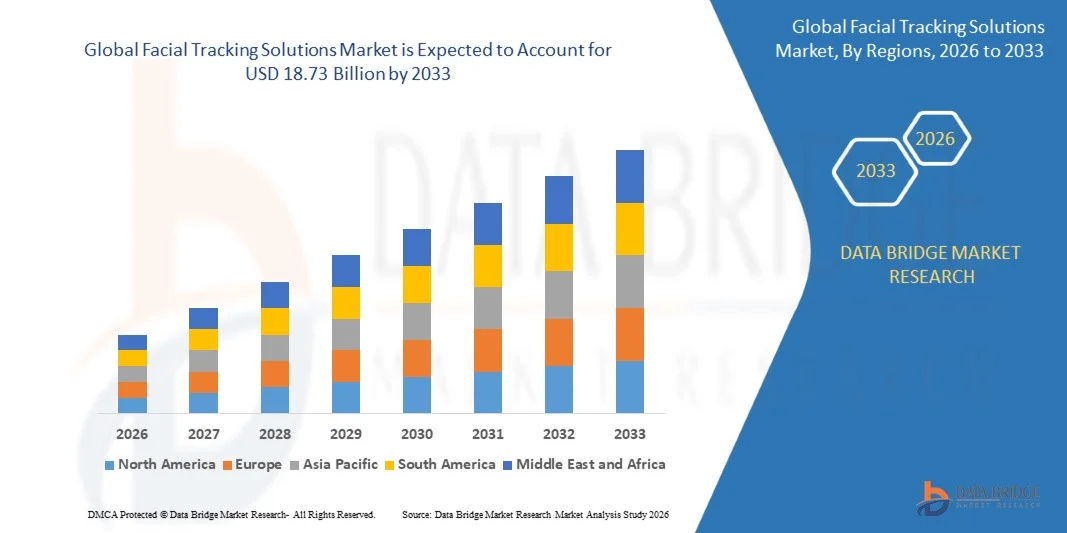
Report Scope and Facial Tracking Solutions Market Segmentation
|
Attributes |
Facial Tracking Solutions Key Market Insights |
|
Segments Covered |
· By Components: Software Tools and Services · By ApplicationArea: Emotion Recognition, Attendance Tracking and Monitoring, Access Control, Law Enforcement, and Other Application Areas · By Vertical: Banking, Financial Services and Insurance, Government and Defense, Retail, Ecommerce, Healthcare, Education, Automotive, and Others |
|
Countries Covered |
North America · U.S. · Canada · Mexico Europe · Germany · France · U.K. · Netherlands · Switzerland · Belgium · Russia · Italy · Spain · Turkey · Rest of Europe Asia-Pacific · China · Japan · India · South Korea · Singapore · Malaysia · Australia · Thailand · Indonesia · Philippines · Rest of Asia-Pacific Middle East and Africa · Saudi Arabia · U.A.E. · South Africa · Egypt · Israel · Rest of Middle East and Africa South America · Brazil · Argentina · Rest of South America |
|
Key Market Players |
• Herta Security (Spain) |
|
Market Opportunities |
• Expansion Of Facial Tracking Integration In AR And VR Platforms • Growing Adoption Of AI-Powered Biometric Authentication Solutions |
|
Value Added Data Infosets |
In addition to the market insights such as market value, growth rate, market segments, geographical coverage, market players, and market scenario, the market report curated by the Data Bridge Market Research team includes in-depth expert analysis, import/export analysis, pricing analysis, production consumption analysis, and pestle analysis. |
What is the Key Trend in the Facial Tracking Solutions Market?
Trend: Growing Integration Of Facial Tracking In AR/VR, Gaming, And Human-Machine Interaction Applications
The increasing demand for immersive digital experiences and intelligent user interaction technologies is accelerating the adoption of facial tracking solutions across gaming, augmented reality (AR), virtual reality (VR), healthcare, and consumer electronics sectors. Traditional motion tracking systems often rely on external sensors and limited gesture recognition capabilities, encouraging organizations to deploy AI-powered facial tracking technologies capable of delivering real-time facial expression analysis and enhanced user engagement.
Major technology companies are increasingly integrating facial tracking systems into AR and VR headsets, For instance to enable avatar personalization, emotion mapping, and natural user interaction within virtual environments. In gaming applications, facial tracking technologies are being used to translate player expressions directly into digital characters, improving realism and engagement. The healthcare sector is also adopting facial tracking for patient monitoring, neurological assessments, and rehabilitation programs that require precise facial movement analysis.
The rapid growth of the metaverse ecosystem, immersive entertainment platforms, and next-generation wearable devices is further increasing demand for highly accurate tracking technologies. In addition, leading consumer electronics manufacturers continue to incorporate advanced facial recognition and tracking features into smartphones and smart devices. Industry developments during 2025 demonstrated that next-generation AR headsets equipped with AI-powered facial tracking achieved expression recognition accuracy levels exceeding 95% in controlled testing environments, supporting broader commercial adoption.
Facial Tracking Solutions Market Dynamics
Key Market Driver: Rising Adoption Of Biometric Authentication And Intelligent Surveillance Systems
Organizations worldwide are increasingly prioritizing secure, contactless, and efficient identity verification solutions to strengthen security infrastructure and improve user experiences. Traditional authentication methods such as passwords, access cards, and PIN-based systems are becoming increasingly vulnerable to fraud and unauthorized access, creating strong demand for advanced biometric technologies capable of delivering real-time facial identification and verification.
Industries such as banking, healthcare, government, transportation, and retail are increasingly deploying facial tracking and recognition systems to improve access control, customer authentication, and public safety operations. For instance, financial institutions are integrating facial biometric verification into digital banking platforms to reduce identity fraud and streamline customer onboarding. Airports and border control agencies are also implementing facial tracking technologies to accelerate passenger processing and enhance security screening procedures.
Similarly, smart city projects and intelligent surveillance networks are utilizing AI-powered facial tracking systems to improve situational awareness and threat detection capabilities. Real-world deployments across major international airports during 2024 reported passenger identity verification times reduced by approximately 30–50% following implementation of facial recognition-enabled security systems.
Key Restraint/Challenge: Privacy Concerns And Regulatory Compliance Requirements
Despite rapid technological advancements, facial tracking solutions continue to face significant challenges related to data privacy, ethical concerns, and regulatory compliance. Facial tracking systems collect and process sensitive biometric information, creating concerns regarding consent management, unauthorized surveillance, data misuse, and cybersecurity risks. These issues have resulted in increased scrutiny from regulators and privacy advocacy groups worldwide.
In addition, organizations deploying facial tracking technologies must comply with evolving data protection frameworks and biometric privacy regulations across multiple jurisdictions. Compliance requirements often increase implementation complexity, operational costs, and legal risks for solution providers and end users. Public concerns regarding algorithmic bias and tracking accuracy across diverse demographic groups further influence technology adoption decisions.
Regulatory assessments and industry studies indicate that more than 60% of consumers express concerns regarding the collection and storage of biometric data, while several countries have introduced stricter governance frameworks governing facial recognition and tracking applications in public environments.
Key Market Opportunity: Expansion Of Facial Tracking In Healthcare And Next-Generation Consumer Devices
Healthcare providers, wearable technology manufacturers, and consumer electronics companies are increasingly exploring facial tracking solutions to support advanced diagnostics, personalized experiences, and real-time user monitoring. Conventional monitoring methods often lack continuous observation capabilities, creating opportunities for AI-powered facial tracking systems capable of detecting subtle behavioral and physiological changes.
Healthcare organizations are increasingly utilizing facial tracking technologies, For instance for neurological disorder assessment, pain detection, mental health monitoring, and patient rehabilitation programs. Consumer electronics manufacturers are also integrating advanced facial tracking into smartphones, smart glasses, and wearable devices to enable secure authentication, emotion recognition, and personalized user experiences. In automotive applications, driver monitoring systems equipped with facial tracking are helping detect fatigue, distraction, and impaired driving behaviors to improve road safety.
In addition, advancements in edge AI, 3D facial mapping, and deep learning algorithms are improving tracking accuracy and enabling deployment across a broader range of real-time applications. Automotive testing programs and healthcare pilot projects conducted during 2025 reported facial tracking-based monitoring systems achieving detection accuracy rates of approximately 90–97% for fatigue recognition and facial movement analysis under operational conditions.
How is the Facial Tracking Solutions Market Segmented?
The market is segmented on the basis of components, application area, and vertical.
- By Components
On the basis of components, the facial tracking solutions market is segmented into Software Tools and Services. The Software Tools segment held the largest market revenue share of approximately 71.6% in 2025 driven by increasing deployment of AI-powered facial recognition algorithms, real-time tracking platforms, 3D facial mapping technologies, and analytics solutions across security, healthcare, gaming, and consumer electronics applications. Organizations increasingly prefer software-based solutions due to their scalability, continuous updates, and integration capabilities with existing digital ecosystems.
The Services segment is projected to register the fastest growth at a CAGR of 16.3% from 2026 to 2033, driven by growing demand for implementation, customization, consulting, system integration, and maintenance services. Increasing adoption of facial tracking technologies across enterprises and government agencies is accelerating the need for specialized service providers and technical support solutions.
- By Application Area
On the basis of application area, the facial tracking solutions market is segmented into Emotion Recognition, Attendance Tracking and Monitoring, Access Control, Law Enforcement, and Other Application Areas. The Access Control segment accounted for the largest market revenue share of approximately 34.8% in 2025 driven by rising adoption of biometric authentication systems across corporate offices, airports, healthcare facilities, educational institutions, and financial organizations. Growing concerns regarding identity fraud and unauthorized access continue to support widespread deployment of facial tracking-enabled access management systems.
The Emotion Recognition segment is projected to witness the fastest growth at a CAGR of 17.4% from 2026 to 2033, driven by increasing utilization in customer experience management, healthcare diagnostics, gaming, advertising analytics, and human-machine interaction applications. Advancements in artificial intelligence and behavioral analytics are significantly expanding the commercial adoption of emotion recognition technologies.
- By Vertical
On the basis of vertical, the facial tracking solutions market is segmented into Banking, Financial Services and Insurance, Government and Defense, Retail, Ecommerce, Healthcare, Education, Automotive, and Others. The Government and Defense segment held the largest market revenue share of approximately 29.5% in 2025 driven by extensive deployment of facial tracking technologies for surveillance, border security, public safety monitoring, criminal identification, and national security operations. Governments worldwide continue to invest heavily in intelligent monitoring infrastructure to enhance threat detection and security management capabilities.
The Healthcare segment is expected to register the fastest growth at a CAGR of 18.1% from 2026 to 2033, driven by increasing adoption of facial tracking solutions for patient monitoring, neurological assessments, mental health analysis, rehabilitation programs, and remote healthcare services. Growing investments in AI-powered healthcare technologies and precision diagnostics are supporting rapid segment expansion.
Which Region Holds the Largest Share of the Facial Tracking Solutions Market?
North America Facial Tracking Solutions Market Insight
North America dominated the facial tracking solutions market with the largest revenue share of 39.26% in 2025, supported by strong adoption of artificial intelligence technologies, advanced digital infrastructure, and increasing deployment of biometric authentication systems across public and private sectors. Organizations in the region are increasingly utilizing facial tracking solutions for security, healthcare, automotive, gaming, and enterprise applications. The presence of major technology companies, growing investments in computer vision technologies, and rising demand for contactless identification systems continue to strengthen market growth.
U.S. Facial Tracking Solutions Market Insight
The U.S. facial tracking solutions market captured the largest revenue share in 2025 within North America, fueled by the rapid adoption of facial recognition technologies, increasing investments in AI-powered analytics, and expanding use of biometric authentication across banking, healthcare, and government sectors. Organizations are increasingly implementing facial tracking systems to improve security, enhance customer experiences, and streamline identity verification processes. The growing popularity of AR/VR platforms, smart devices, and intelligent surveillance solutions is further contributing to market expansion.
Europe Facial Tracking Solutions Market Insight
The Europe facial tracking solutions market is expected to witness the fastest growth rate from 2026 to 2033, primarily driven by increasing investments in digital security infrastructure, rising adoption of AI-powered surveillance technologies, and growing demand for biometric authentication solutions. Organizations across the region are deploying facial tracking technologies to enhance public safety, improve operational efficiency, and support digital transformation initiatives. Expanding smart city projects and increasing integration of facial analytics into commercial applications are further accelerating market growth.
U.K. Facial Tracking Solutions Market Insight
The U.K. facial tracking solutions market is expected to witness the fastest growth rate from 2026 to 2033, driven by increasing demand for advanced security technologies, rising adoption of biometric identity verification systems, and growing investments in artificial intelligence applications. Financial institutions, healthcare providers, and public sector organizations are increasingly deploying facial tracking solutions to strengthen security and improve user experiences. The country's strong technology ecosystem and digital innovation initiatives continue to support market development.
Germany Facial Tracking Solutions Market Insight
The Germany facial tracking solutions market is expected to witness the fastest growth rate from 2026 to 2033, fueled by increasing adoption of industrial automation technologies, growing emphasis on digital security, and rising demand for intelligent monitoring systems. German organizations are increasingly integrating facial tracking solutions into automotive, healthcare, manufacturing, and public safety applications. The country's strong focus on technological innovation and advanced engineering capabilities is further driving market expansion.
Asia-Pacific Facial Tracking Solutions Market Insight
The Asia-Pacific facial tracking solutions market is expected to witness the fastest growth rate from 2026 to 2033, supported by rapid digitalization, expanding smart city initiatives, increasing smartphone penetration, and growing investments in artificial intelligence technologies. Countries such as China, Japan, India, and South Korea are witnessing rising deployment of facial tracking solutions across government, retail, healthcare, and financial services sectors. Growing demand for biometric authentication and intelligent surveillance systems is accelerating regional market growth.
Japan Facial Tracking Solutions Market Insight
The Japan facial tracking solutions market is expected to witness the fastest growth rate from 2026 to 2033 due to the country's advanced technology ecosystem, increasing adoption of robotics and AI applications, and growing demand for intelligent human-machine interaction systems. Japanese organizations are increasingly utilizing facial tracking technologies in healthcare diagnostics, automotive safety systems, consumer electronics, and smart retail environments. The integration of facial analytics with next-generation digital services continues to support market expansion.
China Facial Tracking Solutions Market Insight
The China facial tracking solutions market accounted for the largest market revenue share in Asia-Pacific in 2025, attributed to the country's extensive investments in artificial intelligence, large-scale smart city initiatives, and widespread deployment of facial recognition technologies. China remains one of the largest adopters of facial tracking solutions across public security, transportation, retail, and financial services applications. Strong government support for digital infrastructure development, combined with the presence of leading AI technology providers, continues to drive significant market growth across the country.
Facial Tracking Solutions Market Share
The Facial Tracking Solutions industry is primarily led by well-established companies, including:
• Herta Security (Spain)
• FacePhi (Spain)
• Sightcorp B.V. Netherlands)
• Beijing Kuangshi Technology Co., Ltd. (China)
• FaceFirst, Inc. (U.S.)
• Animetrics, Inc. (U.S.)
• id3 Technologies (France)
• Innovatrics (Slovakia)
• Neurotechnology (Lithuania)
• Techno Brain Group (Kenya)
• StereoVision Imaging, Inc. (U.S.)
• Cognitec Systems GmbH (Germany)
• IDEMIA (France)
• Daon, Inc. (U.S.)
• Ayonix Corporation (Japan)
• Aware, Inc. (U.S.)
• NEC Corporation (Japan)
• Thales Group (France)
• Panasonic Security Solutions (Japan)
• Expedient (U.S.)
• BIOS Middle East Group (U.A.E.)
• Veeam Software (U.S.)
• Internap Holding LLC (U.S.)
• Fine Telecommunications, Inc. (U.S.)
What are Latest Developments in Facial Tracking Solutions Market?
- In February 2026, IDEMIA (France), Product Enhancement, expanded its biometric identity verification platform with advanced AI-driven facial tracking capabilities. The development was designed to improve authentication accuracy, strengthen fraud prevention, and accelerate digital onboarding processes. The enhancement supported broader adoption of facial biometrics across banking, government, and enterprise applications, reinforcing market growth.
- In September 2025, Google (U.S.), Product Launch, introduced a facial recognition API for developers to enable seamless integration of facial tracking and recognition functionalities into third-party applications. The solution was aimed at simplifying deployment, accelerating innovation, and expanding AI-powered user experiences. The launch strengthened the facial tracking ecosystem and increased commercial adoption across multiple industries.
- In August 2025, Apple Inc. (U.S.), Technology Upgrade, enhanced its Face ID platform with advanced machine learning algorithms to improve facial recognition speed, accuracy, and security performance. The upgrade was intended to deliver a more secure user authentication experience while supporting next-generation consumer devices. The development further accelerated demand for facial tracking technologies in the consumer electronics sector.
- In July 2024, NVIDIA Corporation (U.S.), Product Launch, introduced high-performance GPUs optimized for facial recognition and computer vision workloads. The new hardware was developed to support real-time facial tracking, AI inference, and analytics applications across security, retail, and smart city environments. The launch strengthened processing capabilities and enabled wider deployment of advanced facial tracking solutions.
- In May 2023, NEC Corporation (Japan), Technology Development, expanded its biometric authentication portfolio with enhanced facial recognition algorithms designed for large-scale public safety and transportation applications. The development improved identification accuracy in complex operating environments and supported increasing demand for intelligent surveillance and access control systems.
- In October 2022, Thales Group (France), Strategic Expansion, strengthened its digital identity and biometric solutions portfolio through investments in AI-powered facial recognition technologies. The initiative was aimed at improving secure identity verification, border management, and public security operations. The expansion contributed to growing commercialization of facial tracking solutions across government and enterprise sectors.

- Interactive Data Analysis Dashboard
- Company Analysis Dashboard for high growth potential opportunities
- Research Analyst Access for customization & queries
- Competitor Analysis with Interactive dashboard
- Latest News, Updates & Trend analysis
- Harness the Power of Benchmark Analysis for Comprehensive Competitor Tracking
Data collection and base year analysis are done using data collection modules with large sample sizes. The stage includes obtaining market information or related data through various sources and strategies. It includes examining and planning all the data acquired from the past in advance. It likewise envelops the examination of information inconsistencies seen across different information sources. The market data is analysed and estimated using market statistical and coherent models. Also, market share analysis and key trend analysis are the major success factors in the market report. To know more, please request an analyst call or drop down your inquiry.
The key research methodology used by DBMR research team is data triangulation which involves data mining, analysis of the impact of data variables on the market and primary (industry expert) validation. Data models include Vendor Positioning Grid, Market Time Line Analysis, Market Overview and Guide, Company Positioning Grid, Patent Analysis, Pricing Analysis, Company Market Share Analysis, Standards of Measurement, Global versus Regional and Vendor Share Analysis. To know more about the research methodology, drop in an inquiry to speak to our industry experts.
Data Bridge Market Research is a leader in advanced formative research. We take pride in servicing our existing and new customers with data and analysis that match and suits their goal. The report can be customized to include price trend analysis of target brands understanding the market for additional countries (ask for the list of countries), clinical trial results data, literature review, refurbished market and product base analysis. Market analysis of target competitors can be analyzed from technology-based analysis to market portfolio strategies. We can add as many competitors that you require data about in the format and data style you are looking for. Our team of analysts can also provide you data in crude raw excel files pivot tables (Fact book) or can assist you in creating presentations from the data sets available in the report.













