What is the Feed Yeast Market Size and Growth Rate?
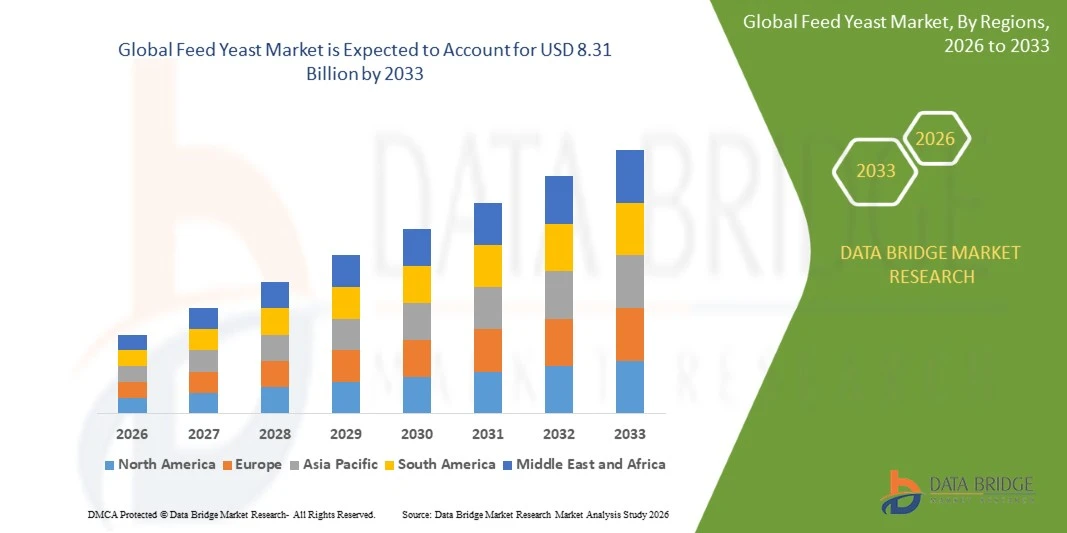
- As per Data Bridge Market Research analysis, the Feed Yeast market was valued at USD 3.89 billion in 2025 and is projected to reach USD 8.31 billion by 2033, growing at a CAGR of 9.95% from 2026 to 2033.
- The market is expanding due to the increasing demand for livestock production, growing adoption of natural and functional feed additives, rising awareness of animal gut health and nutrition, and the shift toward alternatives to antibiotic growth promoters. Feed yeast is increasingly used to support digestion, nutrient utilization, immune response, feed efficiency, and overall animal productivity.
- Feed yeast comprises yeast-based feed ingredients and additives, including probiotic yeast, brewer’s yeast, specialty yeast, and yeast derivatives, which are incorporated into animal diets to support gut health, digestion, immunity, and production performance. The market covers applications across ruminants, poultry, swine, aquaculture, pets, and other animal categories, while advancements in fermentation processes and yeast-strain development are supporting the development of specialized feed solutions
Market Size & Forecast
- Global Market Value (2025): USD 3.89 billion
- Expected Market Value (2033): USD 8.31 billion
- Forecast CAGR (2026–2033): 9.95%
- Leading Region in 2025: North America
- Fastest Growing Region: Asia-Pacific
What are the Major Takeaways of the Feed Yeast Market?
- North America accounted for a significant share of 38.11% in 2025, supported by established animal-nutrition practices, increasing adoption of functional feed additives, and the presence of major feed-yeast manufacturers.
- Asia-Pacific is projected to register the fastest regional growth at a CAGR of 3.75% through 2026 to 2033, supported by expanding poultry, livestock, and aquaculture production and increasing adoption of yeast-based feed additives.
- Yeast derivatives dominated the type/sub-additive segment with a 36.15% revenue share in 2025, supported by their stability during feed-pelleting processes and the increasing use of concentrated beta-glucans and mannan-oligosaccharides in animal nutrition.
- Poultry dominated the livestock segment with a 44.95% revenue share in 2025, supported by increasing use of yeast-based feed ingredients for gut health, feed conversion, immunity, and productivity in broiler and layer production.
- Dry feed yeast accounted for approximately 68.0% of the global Feed Yeast Market in 2025, supported by its longer shelf life, ease of transportation and storage, and suitability for incorporation into compound feed and premix manufacturing.
- The Aquatic Animals segment is expected to expand at a 4.12% CAGR from 2026 to 2033, driven by the growing aquaculture industry, increasing emphasis on sustainable animal nutrition, and rising adoption of functional feed additives to support growth performance, immunity, and disease resistance.
- The Instant segment is projected to grow at a 3.11% CAGR from 2026 to 2033, supported by its convenient handling, rapid incorporation into feed formulations, and increasing demand for user-friendly yeast-based nutritional products.
Report Scope and Feed Yeast Market Segmentation
|
Attributes |
Feed Yeast Key Market Insights |
|
Segments Covered |
|
|
Countries Covered |
North America
Europe
Asia-Pacific
Middle East and Africa
South America
|
|
Key Market Players |
|
|
Market Opportunities |
|
|
Value Added Data Infosets |
In addition to the insights on market scenarios such as market value, growth rate, segmentation, geographical coverage, and major players, the market reports curated by the Data Bridge Market Research also include import export analysis, production capacity overview, production consumption analysis, price trend analysis, climate change scenario, supply chain analysis, value chain analysis, raw material/consumables overview, vendor selection criteria, PESTLE Analysis, Porter Analysis, and regulatory framework. |
What is the Key Trend in the Feed Yeast Market?
- The Feed Yeast market is increasingly shifting toward natural and functional feed additives as livestock producers seek alternatives to antibiotic growth promoters. Yeast-based products are being used to support gut microbiota, nutrient utilization, immunity, and animal productivity. The increasing restrictions on antimicrobial use in food-animal production are further supporting the adoption of yeast and yeast derivatives as functional feed ingredients.
- For instance, in April 2025, the European Food Safety Authority (EFSA) issued a scientific opinion on the renewal of authorization for Saccharomyces cerevisiae CBS 493.94 (Yea-Sacc) as a zootechnical feed additive for dairy cows, cattle for fattening, and other ruminant species. The continued regulatory assessment of specific yeast strains highlights the industry's movement toward strain-specific and scientifically validated feed yeast solutions for improving animal nutrition and production performance.
- The market is also moving toward specialized yeast derivatives and functional formulations, particularly products containing beta-glucans, mannan-oligosaccharides, nucleotides, and selenium. These ingredients are increasingly being used for immune support, pathogen management, nutrient utilization, and animal resilience.
- Overall, the Feed Yeast market is increasingly shaped by the development of strain-specific yeast products, functional yeast derivatives, antibiotic-free nutrition, improved gut-health solutions, sustainable feed ingredients, aquaculture applications, and methane-reduction strategies. Manufacturers are focusing not only on conventional live yeast but also on specialized derivatives, selenium yeast, microencapsulation, and application-specific formulations to improve stability, efficacy, and nutritional performance across livestock species.
What are the Key Drivers of the Feed Yeast Market?
- The growing shift toward antibiotic-free animal nutrition is driving demand for feed yeast, as livestock producers increasingly seek natural alternatives to antibiotic growth promoters. Feed yeast supports beneficial microbial balance, digestion, immune response, and animal performance, making it an attractive nutritional solution in poultry, swine, and ruminant production. Regulatory pressure to reduce antibiotic use and concerns regarding antimicrobial resistance are further supporting adoption of yeast-based feed additives.
- For instance, in April 2025, the European Food Safety Authority (EFSA) published a scientific opinion on the renewal of authorization for a Saccharomyces cerevisiae preparation for dairy cows, cattle for fattening, and other ruminants. The assessment involved Yea-Sacc, a dried-cell yeast preparation used as a zootechnical feed additive. Such regulatory evaluations support the continued development and use of defined yeast strains in livestock nutrition.
- Rising demand for meat, dairy, poultry, and aquaculture products is further increasing the need for efficient animal nutrition solutions. Feed yeast is being incorporated into livestock diets to support growth, digestion, immunity, and feed utilization. The trend is particularly relevant to intensive poultry and livestock production, where producers are seeking ways to maintain productivity and animal health while reducing reliance on conventional antibiotic-based approaches.
- Overall, the Feed Yeast Market is increasingly shaped by the transition toward natural feed additives, improved gut health, antibiotic-reduction strategies, precision animal nutrition, and strain-specific yeast formulations. Advancements in yeast strain development, yeast derivatives such as beta-glucans and mannan-oligosaccharides, and formulations designed for specific livestock categories are expanding the applications of feed yeast across poultry, ruminants, swine, aquatic animals, pets, and equine.
What Factors Are Challenging the Growth of the Accelerometer-Based Digital Pen Market?
- The availability and price volatility of fermentation-based raw materials represent a key challenge for the Feed Yeast Market. Molasses and other fermentation by-products are important inputs for yeast production, but their availability can be affected by sugarcane and sugar-beet yields and competition from the food, beverage, pharmaceutical, and feed industries. Fluctuations in raw-material availability can increase production costs and ultimately affect feed-yeast prices.
- The market also faces challenges related to quality standardization and differentiation of yeast-based products. The large number of probiotics, live-yeast, spent-yeast, and yeast-derivative products makes it difficult for buyers to compare composition, viable yeast levels, active components, and expected biological effects. Scientific literature has also highlighted difficulties in accurately quantifying yeast and yeast-derived components in different feed products.
- For insatcne, in June 2025, the development is the Lesaffre and Zilor/Biorigin collaboration. In June 2025, Lesaffre completed the acquisition of a 70% stake in Biorigin and formed a joint venture with Zilor to combine their capabilities in yeast derivatives and ingredients for food and feed applications. This illustrates how manufacturers are investing in broader yeast-derivative portfolios and fermentation capabilities as competition within the market increases.
- Price sensitivity among livestock producers and competition from alternative feed additives can restrict adoption of premium feed-yeast products, particularly in cost-sensitive markets. Producers may compare yeast-based solutions with probiotics, enzymes, prebiotics, phytogenics, and other functional feed additives based on cost and demonstrated performance. The commercialization of duplicate and low-quality products at lower prices can further create competitive pressure and affect confidence in the category.
How is the Feed Yeast Market Segmented?
The feed yeast market is segmented on the basis of type, livestock, form, and genus.
- By Type
On the basis of type, the global feed yeast market is segmented into probiotic yeast, brewer’s yeast, specialty yeast, and yeast derivatives. The yeast derivatives segment dominated the market with a 36.15% revenue share in 2025, supported by the increasing use of beta-glucans, mannan-oligosaccharides, and other functional yeast-derived ingredients for animal gut health, immunity, and feed efficiency.
The brewer’s yeast is projected to grow at a CAGR of 6.26% from 2026 to 2033 of livestock producers increasingly adopt functional feed additives that support digestive health and animal performance
- By Form
On the basis of form, the global feed yeast market is segmented into fresh, instant, and dry. The dry segment accounted for approximately 68.0% of the feed yeast market in 2025, supported by its longer shelf life, ease of transportation and storage, and suitability for incorporation into compound feeds and premixes.
The dry segment is expected to grow at a CAGR OF 6.6% from 2026 to 2033, to continue expanding as manufacturers and livestock producers favor convenient, stable, and easily transportable yeast-based feed products.
- By Genus
On the basis of genus, the feed yeast market is segmented into saccharomyces spp., kluyveromyces spp., and others. The saccharomyces spp. segment dominated the market with 70.21% revenue share in 2025, owing to extensive commercial use of saccharomyces cerevisiae in animal nutrition products. Saccharomyces-based feed yeast is widely recognized for improving digestion, nutrient absorption, rumen fermentation, and immune function.
The kluyveromyces spp. segment is expected to register the fastest growth at a CAGR of 7.0% during the forecast period, driven by increasing research into alternative yeast species for specialized animal nutrition applications.
Which Region Holds the Largest Share of the Feed Yeast Market?
- North America accounted for a significant share of 38.11% in 2025, supported by established animal-nutrition practices, increasing adoption of functional feed additives, and the presence of major feed-yeast manufacturers.
- The region also benefits from the strong presence of commercial dairy and poultry producers, advanced animal nutrition practices, and increasing demand for natural alternatives to antibiotic growth promoters. Growing awareness regarding feed efficiency, animal productivity, digestive health, and sustainable livestock production across the U.S. and Canada continues to strengthen North America’s position in the global Feed Yeast Market.
U.S. Feed Yeast Market Insight
The U.S. Feed yeast market is witnessing steady growth, supported by the expanding livestock and poultry industries and increasing demand for functional feed additives. Yeast-based feed products are increasingly used to improve animal gut health, digestion, nutrient utilization, immunity, and overall feed efficiency. Growing awareness regarding antibiotic alternatives is further supporting the adoption of yeast-derived solutions in animal nutrition. In addition, advancements in yeast fermentation technologies and the development of specialized yeast products are contributing to product innovation. Increasing demand for high-quality animal protein is expected to create further opportunities for feed yeast manufacturers across the U.S.
Canada Feed Yeast Market Insight
The Canada feed yeast market is supported by the country’s established livestock and animal nutrition industry, particularly across poultry, swine, dairy, and beef production. Growing emphasis on feed efficiency, animal health, gut function, and alternatives to antibiotic growth promoters is supporting the adoption of yeast-based feed ingredients. Canada’s regulatory framework also recognizes several yeast-based ingredients, including dehydrated yeast biomass, brewer’s yeast, yeast hydrolysates, and yeast cell wall products.
Germany Feed Yeast Market Insight
Germany’s feed yeast market is supported by the country’s well-established livestock and animal nutrition industry, increasing emphasis on animal health, and growing adoption of functional feed additives. Feed yeast is increasingly incorporated into livestock diets to support gut health, digestion, immunity, and feed efficiency across poultry, swine, and ruminants. Demand is also being influenced by efforts to reduce antibiotic use and improve sustainable animal production practices. The presence of established feed manufacturers, stringent quality standards, and ongoing development of specialized yeast-based nutritional solutions is expected to support market growth in Germany during the forecast period.
U.K. Feed Yeast Market Insight
The U.K. Feed yeast market is supported by a strong pharmaceutical research ecosystem, advanced healthcare infrastructure, and increasing investment in innovative drug development. Growing demand for targeted therapies for metabolic disorders, cancer, and other chronic conditions is supporting market expansion. The country benefits from established biotechnology and pharmaceutical companies, academic research institutions, and clinical development capabilities that facilitate peptide discovery and commercialization. Increasing interest in peptide-based therapies, including treatments for obesity and diabetes, is further contributing to market development. Advances in drug delivery technologies are also improving the potential for convenient peptide administration.
Asia-Pacific Feed Yeast Market Insight
The Asia-pacific feed yeast market is witnessing steady growth, supported by the expanding livestock and poultry sectors, rising demand for high-quality animal nutrition, and increasing awareness of gut health and feed efficiency. Countries such as China, India, Japan, And Australia are contributing to regional demand through large-scale animal production and growing adoption of functional feed additives. Increasing use of yeast-based products to improve digestion, immunity, nutrient utilization, and animal performance is further supporting market expansion. Technological advancements in yeast fermentation and the development of specialized feed formulations are also creating opportunities for manufacturers in the region.
China Feed Yeast Market Insight
China’s feed yeast market is expanding as livestock producers increasingly adopt functional feed additives to improve animal health, digestion, nutrient utilization, and feed efficiency. Growing poultry, swine, ruminant, and aquaculture production is supporting demand for yeast-based nutritional solutions. The increasing focus on reducing antibiotic use and improving gut health is further encouraging the adoption of probiotic yeast and yeast derivatives. Domestic feed manufacturers are also expanding their use of specialty yeast products containing beta-glucans and mannan-oligosaccharides. Advances in fermentation technologies and rising demand for sustainable animal nutrition solutions are expected to further support market growth in China.
Japan Feed Yeast Market Insight
The Japan feed yeast market is supported by increasing demand for functional feed additives that improve animal health, feed efficiency, and nutrient utilization across poultry, swine, livestock, and aquaculture applications. Japan’s established livestock and aquaculture industries and emphasis on feed quality and animal health are supporting the adoption of yeast-based feed solutions. Demand is also being encouraged by the shift toward microbial-based feed additives and reduced reliance on antibiotic-based solutions.
Which are the Top Companies in Feed Yeast Market?
The Feed Yeast industry is primarily led by well-established companies, including:
- Lallemand Inc. (Canada)
- Lesaffre International (France)
- Alltech, Inc. (U.S.)
- dsm-firmenich (Netherlands)
- Novonesis A/S (Denmark)
- Angel Yeast Co., Ltd. (China)
- Kerry Group plc (Ireland)
- Associated British Foods plc (U.K.)
- Chr. Hansen Holding A/S (Denmark)
- Kemin Industries, Inc. (U.S.)
- Biorigin SA (Brazil)
- Leiber (Germany)
- Phileo (France)
- Cargill, Incorporated (U.S.)
- ICC (Brazil)
- OHLY GmbH (Germany)
- Bio-Ingredients Ltd. (U.K.)
- Vland Biotech Group Co., Ltd. (China)
- Titan Biotech. (India)
- Biomin Holding GmbH (Austria)
What are Latest Developments in Feed Yeast Market?
- In June 2025, Lesaffre completed the acquisition of a 70% stake in Biorigin, a Zilor business unit, leading to a joint venture combining Biorigin and Biospringer by Lesaffre capabilities. The collaboration is focused on expanding yeast derivative and natural yeast-based solutions for food and animal feed, while strengthening production and supply capabilities.
- In July 2026, Biorigin announced that it had become part of Phileo by Lesaffre, strengthening its position in aqua and pet nutrition. The integration is expected to create technical synergies in yeast and functional solutions, expand R&D and regulatory support, and strengthen supply-chain capabilities.
- In August 2025, dsm-firmenich inaugurated a new Animal Nutrition & Health feed-additive plant in Jadcherla, Hyderabad. The facility strengthens local production and supply capabilities for animal nutrition solutions across India and the Asia-Pacific region.
- In December 2025, Hy-D, produced using Saccharomyces cerevisiae CBS 146008, received European Union authorization for use in aquaculture and all other animal species, expanding its approved application beyond pigs, poultry, and ruminants. The authorization became commercially applicable from December 31, 2025.
- In September 2025, dsm-firmenich Animal Nutrition & Health partnered with FarmTrace to support sustainable farming through improved environmental-footprint measurement. The collaboration strengthens digital capabilities around animal production and sustainability, supporting the broader animal-feed ecosystem.

- Interactive Data Analysis Dashboard
- Company Analysis Dashboard for high growth potential opportunities
- Research Analyst Access for customization & queries
- Competitor Analysis with Interactive dashboard
- Latest News, Updates & Trend analysis
- Harness the Power of Benchmark Analysis for Comprehensive Competitor Tracking
Data collection and base year analysis are done using data collection modules with large sample sizes. The stage includes obtaining market information or related data through various sources and strategies. It includes examining and planning all the data acquired from the past in advance. It likewise envelops the examination of information inconsistencies seen across different information sources. The market data is analysed and estimated using market statistical and coherent models. Also, market share analysis and key trend analysis are the major success factors in the market report. To know more, please request an analyst call or drop down your inquiry.
The key research methodology used by DBMR research team is data triangulation which involves data mining, analysis of the impact of data variables on the market and primary (industry expert) validation. Data models include Vendor Positioning Grid, Market Time Line Analysis, Market Overview and Guide, Company Positioning Grid, Patent Analysis, Pricing Analysis, Company Market Share Analysis, Standards of Measurement, Global versus Regional and Vendor Share Analysis. To know more about the research methodology, drop in an inquiry to speak to our industry experts.
Data Bridge Market Research is a leader in advanced formative research. We take pride in servicing our existing and new customers with data and analysis that match and suits their goal. The report can be customized to include price trend analysis of target brands understanding the market for additional countries (ask for the list of countries), clinical trial results data, literature review, refurbished market and product base analysis. Market analysis of target competitors can be analyzed from technology-based analysis to market portfolio strategies. We can add as many competitors that you require data about in the format and data style you are looking for. Our team of analysts can also provide you data in crude raw excel files pivot tables (Fact book) or can assist you in creating presentations from the data sets available in the report.