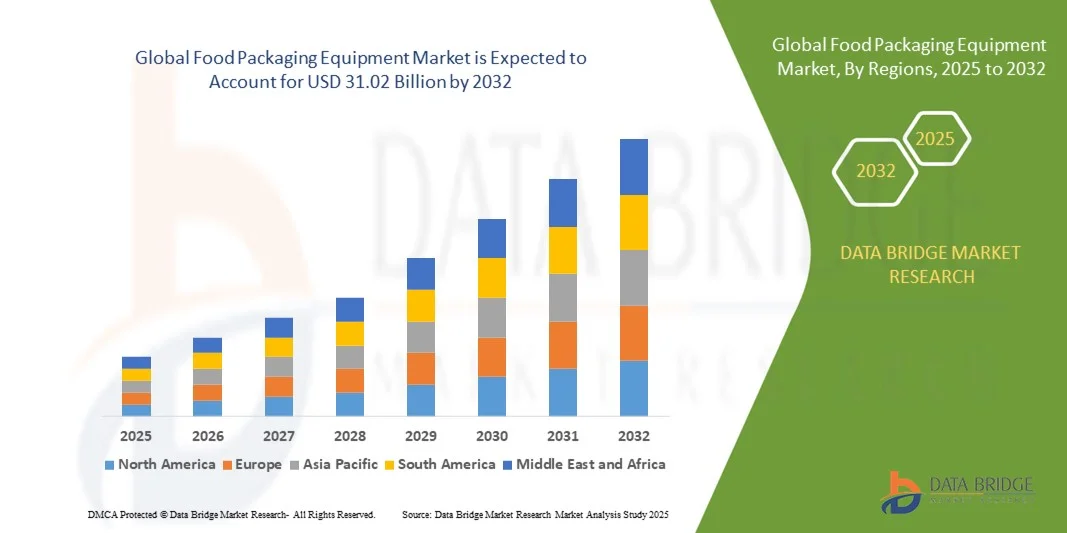
What is the Global Food Packaging Equipment Market Size and Growth Rate?
- The global food packaging equipment market size was valued at USD 21.10 billion in 2024 and is expected to reach USD 31.02 billion by 2032, at a CAGR of5.00% during the forecast period
- The increase in demand for hygienic food packaging across the globe acts as one of the major factors driving the growth of food packaging equipment market. The implementation of stringent government regulations to control the quality of equipment, and latest trend offering technological advancement in industries including the manufacturing sector accelerate the market growth
- The rise in demand for ready-to-eat, dairy and other perishable products, and convenience food items owning to the busy lifestyle, and increase in demand for attractive, innovative, and convenient-to-carry packaging for differentiating the product further influence the market
What are the Major Takeaways of Food Packaging Equipment Market?
- expansion of distribution channels, surge in purchasing power of middle-income groups, rise in awareness about the products and strategic marketing activities positively affect the food packaging equipment market
- Furthermore, emergence of packaging as a tool for product differentiation extend profitable opportunities to the market
- Asia-Pacific dominated the food packaging equipment market with the largest revenue share of 45.28% in 2024, driven by rapid industrialization, growing food processing industries, and increasing adoption of automation technologies across manufacturing facilities
- The Middle East and Africa food packaging equipment market is anticipated to register the fastest CAGR of 11.69% during 2025 to 2032. This growth is fueled by rapid urbanization, expansion of food processing industries, and increasing foreign investments in modern manufacturing facilities
- The Controlled segment dominated the market with the largest revenue share of 42.5% in 2024, driven by its ability to maintain precise packaging conditions such as temperature, humidity, and shelf-life, which is essential for sensitive food products
Report Scope and Food Packaging Equipment Market Segmentation
|
Attributes |
Food Packaging Equipment Key Market Insights |
|
Segments Covered |
|
|
Countries Covered |
North America
Europe
Asia-Pacific
Middle East and Africa
South America
|
|
Key Market Players |
|
|
Market Opportunities |
|
|
Value Added Data Infosets |
In addition to the insights on market scenarios such as market value, growth rate, segmentation, geographical coverage, and major players, the market reports curated by the Data Bridge Market Research also include in-depth expert analysis, pricing analysis, brand share analysis, consumer survey, demography analysis, supply chain analysis, value chain analysis, raw material/consumables overview, vendor selection criteria, PESTLE Analysis, Porter Analysis, and regulatory framework. |
What is the Key Trend in the Food Packaging Equipment Market?
Automation and Smart Technology Integration
- A major trend in the global food packaging equipment market is the increasing integration of automation, artificial intelligence (AI), and IoT-enabled monitoring systems. These technologies are enhancing operational efficiency, precision, and real-time tracking in packaging processes
- For instance, automated cartoning and robotic palletizing systems now utilize AI-driven sensors to optimize speed, reduce material waste, and ensure consistent packaging quality. Similarly, smart labeling machines can adjust settings dynamically based on product dimensions and weight
- AI-powered equipment enables predictive maintenance by monitoring machine health and performance, minimizing downtime, and providing actionable alerts to operators. These systems improve overall productivity and reduce operational costs while maintaining high-quality standards
- Integration with digital platforms allows centralized monitoring of multiple machines, enabling manufacturers to manage production lines remotely and synchronize operations across facilities
- This trend toward automated, connected, and intelligent packaging systems is reshaping user expectations and operational standards. Companies such as Bosch and Coesia are developing AI-enabled Food Packaging Equipment with predictive analytics and smart monitoring capabilities
- Demand for automated, smart, and connected packaging equipment is rapidly growing across food and beverage industries as manufacturers increasingly seek efficiency, flexibility, and real-time operational insights
What are the Key Drivers of Food Packaging Equipment Market?
- The rising demand for packaged and processed food products, coupled with the need for faster production and higher efficiency, is a primary driver for food packaging equipment adoption
- For instance, in 2023, Bosch introduced advanced robotic packaging lines for confectionery and bakery products, improving throughput and consistency. Such innovations drive industry growth during the forecast period
- Manufacturers are increasingly prioritizing automation to reduce labor dependency, minimize errors, and ensure hygiene standards. Smart sensors and AI integration enable real-time quality control and error detection
- Growing consumer demand for customized, labeled, and ready-to-eat products is driving investment in flexible and adaptive packaging equipment that can handle multiple SKUs efficiently
- Environmental concerns are also influencing equipment design, with manufacturers adopting eco-friendly packaging solutions and energy-efficient machinery, further propelling market growth
Which Factor is Challenging the Growth of the Food Packaging Equipment Market?
- The high initial cost of automated and AI-integrated food packaging equipment is a key barrier, particularly for small and medium-sized manufacturers. Advanced systems require significant capital investment, training, and maintenance
- For instance, small food processors often hesitate to adopt robotic packaging lines due to cost, despite efficiency gains
- Cybersecurity and data privacy concerns in IoT-enabled machinery also pose challenges, as connected systems can be vulnerable to hacking or operational disruptions. Companies are focusing on secure platforms and encrypted communication to build trust
- Complexity of operation and maintenance requirements may limit adoption in regions with limited skilled workforce or technical expertise
- Overcoming these challenges through affordable solutions, modular equipment options, and robust training programs will be crucial for sustained market growth globally
How is the Food Packaging Equipment Market Segmented?
The market is segmented on the basis of type, material, and application.
- By Type
On the basis of type, the food packaging equipment market is segmented into Controlled, Active, Intelligent, Aseptic, Biodegradable, and Others. The Controlled segment dominated the market with the largest revenue share of 42.5% in 2024, driven by its ability to maintain precise packaging conditions such as temperature, humidity, and shelf-life, which is essential for sensitive food products. Controlled packaging ensures quality, minimizes waste, and improves product safety, making it highly preferred by dairy, bakery, and meat processing industries.
The Intelligent segment is anticipated to witness the fastest growth at a CAGR of 23.1% from 2025 to 2032, fueled by the adoption of AI, IoT, and sensor-based systems that enable real-time monitoring, predictive maintenance, and dynamic process adjustments. Manufacturers are increasingly deploying intelligent packaging lines to enhance efficiency, traceability, and reduce operational costs, creating a competitive advantage in high-demand and high-volume food processing sectors.
- By Material
On the basis of material, the food packaging equipment market is segmented into Metal, Glass and Wood, Paper and Paperboard, Plasticsa, and Others. The Plastics segment dominated the market with the largest revenue share of 46.8% in 2024, due to its lightweight, cost-effectiveness, and adaptability for diverse packaging applications. Plastic packaging enables flexibility in design, provides durability, and ensures a longer shelf life, making it widely used across processed foods, beverages, and frozen products.
The Paper and Paperboard segment is expected to grow the fastest at a CAGR of 21.4% from 2025 to 2032, driven by sustainability initiatives and consumer preference for eco-friendly packaging. Increasing environmental awareness, government regulations on single-use plastics, and the demand for recyclable and biodegradable packaging solutions are propelling the adoption of paper-based materials in dairy, bakery, and convenience food segments globally.
- By Application
On the basis of application, the food packaging equipment market is segmented into Dairy and Dairy Products, Bakery Products, Confectionery Products, Poultry, Seafood, and Meat Products, Convenience Foods, Fruits and Vegetables, and Others. The Dairy and Dairy Products segment dominated the market with the largest revenue share of 38.9% in 2024, due to the high sensitivity of dairy products to spoilage and the critical need for temperature-controlled and hygienic packaging. Dairy processors prefer advanced packaging solutions that preserve freshness, enhance shelf life, and ensure product safety.
The Convenience Foods segment is expected to witness the fastest growth at a CAGR of 24.2% from 2025 to 2032, propelled by the rising demand for ready-to-eat meals, on-the-go snacks, and frozen foods in urban and semi-urban regions. Increased consumer reliance on convenience foods, coupled with automation and intelligent packaging equipment adoption, is driving rapid growth in this segment.
Which Region Holds the Largest Share of the Food Packaging Equipment Market?
- Asia-Pacific dominated the food packaging equipment market with the largest revenue share of 45.28% in 2024, driven by rapid industrialization, growing food processing industries, and increasing adoption of automation technologies across manufacturing facilities
- Consumers and manufacturers in the region highly value advanced packaging systems for efficiency, product safety, and extended shelf life, which are crucial for perishable and processed foods
- The widespread adoption is further supported by increasing investments in modern food processing plants, government initiatives promoting industrial automation, and rising consumer demand for packaged foods, positioning Asia-Pacific as a key market hub for both domestic consumption and export-oriented production
China Food Packaging Equipment Market Insight
The China market captured the largest revenue share of 35% within Asia-Pacific in 2024, fueled by a robust food processing sector and increasing demand for packaged convenience foods. Rising urbanization, technological adoption, and the push toward smart manufacturing are key factors driving growth. The integration of automated and intelligent packaging systems in both small-scale and large-scale facilities is significantly contributing to market expansion.
Japan Food Packaging Equipment Market Insight
The Japan market is experiencing notable growth due to the country’s technologically advanced manufacturing infrastructure and strong emphasis on quality control in food processing. The demand for automation, eco-friendly packaging, and high-efficiency solutions is boosting adoption across dairy, seafood, and convenience food sectors. Aging demographics further encourage manufacturers to implement user-friendly and efficient packaging systems.
Which Region is the Fastest Growing Region in the Food Packaging Equipment Market?
The Middle East and Africa food packaging equipment market is anticipated to register the fastest CAGR of 11.69% during 2025 to 2032. This growth is fueled by rapid urbanization, expansion of food processing industries, and increasing foreign investments in modern manufacturing facilities. Rising demand for packaged foods, including convenience and frozen products, alongside the expansion of supermarkets, hypermarkets, and retail chains, is boosting the adoption of advanced packaging systems. In addition, governments in the region are actively promoting industrial modernization and food safety initiatives, creating a favorable environment for automated, intelligent, and sustainable food packaging solutions across MEA.
Saudi Arabia Food Packaging Equipment Market Insight
The Saudi Arabia food packaging equipment market is witnessing significant growth due to strategic government initiatives focused on food security, industrial modernization, and enhancing manufacturing efficiency. Rising imports of advanced automated and intelligent packaging equipment are complementing the local food processing sector’s expansion. The increasing demand for packaged convenience foods, dairy, and frozen products is driving investment in high-capacity, efficient packaging lines. Moreover, Saudi Arabia’s vision to modernize its industrial base, coupled with incentives for adopting smart manufacturing technologies, is encouraging both domestic and international players to establish and expand operations, further strengthening the country’s position as a regional packaging hub.
U.A.E. Food Packaging Equipment Market Insight
The U.A.E. food packaging equipment market is expanding steadily due to rising consumer demand for packaged and convenience foods, dairy products, and frozen items. Investments in smart factories, automated packaging lines, and eco-friendly technologies are accelerating market adoption. Government initiatives supporting industrial innovation, food safety, and modernization of the food processing sector are creating a favorable growth environment. The country’s strategic position as a trade hub enables easy access to regional markets, encouraging manufacturers to adopt advanced packaging equipment. In addition, increasing focus on sustainability, efficiency, and technological integration in production lines is propelling the growth of the UAE Food Packaging Equipment market.
South Africa Food Packaging Equipment Market Insight
The South Africa food packaging equipment market is growing as local food processing industries modernize to meet rising consumer expectations for quality and safety. The demand for packaged products in dairy, meat, confectionery, and convenience food segments is driving investment in automated, intelligent, and efficient packaging systems. Rising awareness regarding food safety standards, coupled with government support for industrial growth and modernization, is encouraging the adoption of advanced packaging technologies. In addition, manufacturers are focusing on improving production efficiency, minimizing waste, and enhancing shelf life through innovative solutions, positioning South Africa as a growing market for modern food packaging equipment in the African region.
Which are the Top Companies in Food Packaging Equipment Market?
The food packaging equipment industry is primarily led by well-established companies, including:
- Bosch Limited (Germany)
- Coesia S.p.A (Italy)
- Arpac (U.S.)
- IMA (Italy)
- Ishida (Japan)
- GEA Group Aktiengesellschaft (Germany)
- Multivac Inc (Germany)
- Oystar (Germany)
- Nichrome Packaging Solutions (India)
- Omori Machinery (Japan)
- Lindquist Machine Corporation (U.S.)
- Kaufman Engineered Systems (U.S.)
- ADELPHI GROUP OF COMPANIES (U.S.)
What are the Recent Developments in Global Food Packaging Equipment Market?
- In March 2025, ULMA Packaging launched the new TFX series of transforming machines tailored for the food packaging industry, designed to address challenges in production efficiency, digitalization, and sustainability. The machines help optimize workflows, reduce operational footprints, and support eco-friendly packaging practices, aligning with rising environmental concerns. This launch underscores the company’s commitment to sustainable innovation and operational excellence in the food packaging sector
- In December 2024, Tetra Pak announced a strategic partnership with Yellow Dreams to enhance carton recycling capabilities across the European Union, focusing on improving recycling infrastructure for beverage cartons and other food packaging equipment. The initiative aims to boost recycling rates, support the circular economy, and minimize environmental impact. This collaboration highlights Tetra Pak’s commitment to sustainability and innovative solutions for environmentally responsible packaging
- In July 2024, Cama Group, a leading robotics and automation manufacturer, introduced a new top-loading packaging machine designed to increase production rates while reducing machinery footprint. The machine addresses the challenges of multipack packaging in the food industry and optimizes operational efficiency. This innovation demonstrates the company’s dedication to enhancing productivity and sustainable packaging solutions
- In July 2024, Eliter Packaging Machinery launched the latest automatic sleeving machine for multipacks, engineered to wrap cardboard sleeves around various containers in multipack and cluster formats. This high-speed packaging solution enables efficient handling of multiple products simultaneously and supports improved workflow in food packaging lines. The launch reflects Eliter Packaging Machinery’s focus on innovation and operational efficiency
- In May 2024, Velteko unveiled a new vertical packaging machine, designed to maintain the highest standards of hygiene and sanitation in the food industry. It is especially suitable for packaging frozen foods, meat, sauces, and fish, ensuring a contamination-free and safe production environment. This release emphasizes Velteko’s commitment to food safety and clean, efficient packaging solutions

- Interactive Data Analysis Dashboard
- Company Analysis Dashboard for high growth potential opportunities
- Research Analyst Access for customization & queries
- Competitor Analysis with Interactive dashboard
- Latest News, Updates & Trend analysis
- Harness the Power of Benchmark Analysis for Comprehensive Competitor Tracking
Data collection and base year analysis are done using data collection modules with large sample sizes. The stage includes obtaining market information or related data through various sources and strategies. It includes examining and planning all the data acquired from the past in advance. It likewise envelops the examination of information inconsistencies seen across different information sources. The market data is analysed and estimated using market statistical and coherent models. Also, market share analysis and key trend analysis are the major success factors in the market report. To know more, please request an analyst call or drop down your inquiry.
The key research methodology used by DBMR research team is data triangulation which involves data mining, analysis of the impact of data variables on the market and primary (industry expert) validation. Data models include Vendor Positioning Grid, Market Time Line Analysis, Market Overview and Guide, Company Positioning Grid, Patent Analysis, Pricing Analysis, Company Market Share Analysis, Standards of Measurement, Global versus Regional and Vendor Share Analysis. To know more about the research methodology, drop in an inquiry to speak to our industry experts.
Data Bridge Market Research is a leader in advanced formative research. We take pride in servicing our existing and new customers with data and analysis that match and suits their goal. The report can be customized to include price trend analysis of target brands understanding the market for additional countries (ask for the list of countries), clinical trial results data, literature review, refurbished market and product base analysis. Market analysis of target competitors can be analyzed from technology-based analysis to market portfolio strategies. We can add as many competitors that you require data about in the format and data style you are looking for. Our team of analysts can also provide you data in crude raw excel files pivot tables (Fact book) or can assist you in creating presentations from the data sets available in the report.