


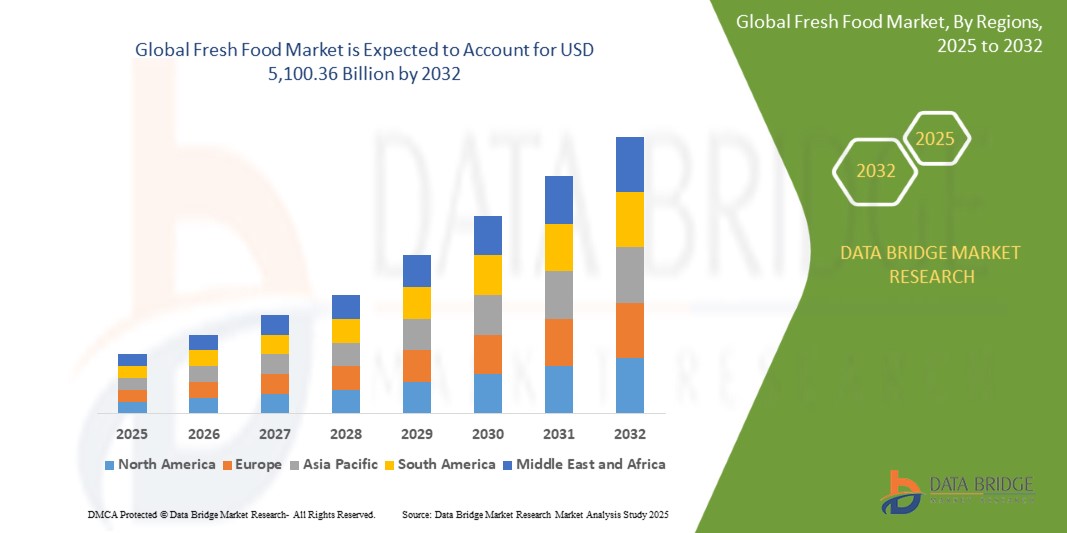
Fresh Food Market Size
- The global fresh food market was valued at USD 3,532.05 billion in 2024 and is expected to reach USD 5,100.36 billion by 2032
- During the forecast period of 2025 to 2032 the market is likely to grow at a CAGR of 4.70%, primarily driven by increasing consumer awareness of health and wellness
- This growth is driven by rising disposable incomes and changing lifestyles are fueling demand for convenient, ready-to-eat, and fresh meal options
Fresh Food Market Analysis
- The fresh food market has witnessed substantial growth due to increasing consumer preference for organic, chemical-free, and minimally processed foods. The rising awareness of food safety, nutrition, and sustainability has driven demand for fresh fruits, vegetables, dairy, and meat products. In addition, growing concerns over preservatives and artificial additives are prompting consumers to shift towards fresh and naturally sourced ingredients. Advancements in cold storage, packaging, and supply chain technologies are further enhancing product quality and shelf life, making fresh food more accessible to a wider audience
- The market is primarily driven by the rising demand for ready-to-eat fresh food options, farm-to-table initiatives, and sustainable agricultural practices. Increasing investments in vertical farming, hydroponics, and organic food production are improving the availability and affordability of fresh produce. In addition, the expansion of direct-to-consumer sales models and the integration of AI-driven inventory management systems are optimizing distribution networks, reducing food waste, and ensuring year-round supply
- For instance, in the U.S., major grocery chains and online food delivery services are expanding their fresh food categories, offering farm-direct organic produce, dairy, and meats to meet growing consumer expectations for quality and transparency
- Globally, fresh food is becoming an integral part of dietary trends, with a significant shift towards healthier meal choices, functional nutrition, and environmentally responsible food sourcing. Innovations such as plant-based fresh protein alternatives, AI-driven precision farming, and smart packaging solutions are reshaping industry trends, enhancing food security, and driving long-term market expansion.
Report Scope and Fresh Food Market Segmentation
|
Attributes |
Fresh Food Key Market Insights |
|
Segments Covered |
|
|
Countries Covered |
North America
Europe
Asia-Pacific
Middle East and Africa
South America
|
|
Key Market Players |
|
|
Market Opportunities |
|
|
Value Added Data Infosets |
In addition to the insights on market scenarios such as market value, growth rate, segmentation, geographical coverage, and major players, the market reports curated by the Data Bridge Market Research also include in-depth expert analysis, pricing analysis, brand share analysis, consumer survey, demography analysis, supply chain analysis, value chain analysis, raw material/consumables overview, vendor selection criteria, PESTLE Analysis, Porter Analysis, and regulatory framework |
Fresh Food Market Trends
“Expansion of E-Commerce and Direct-to-Consumer Fresh Food Sales”
- The growing preference for online grocery shopping and direct-to-consumer (DTC) food delivery services is fueling the expansion of fresh food sales through digital platforms, offering consumers convenience, transparency, and farm-fresh quality
- Major food retailers, startups, and farm cooperatives are launching online marketplaces, subscription-based fresh food boxes, and farm-to-door delivery services to meet the rising demand for organic, locally sourced, and minimally processed food products
- Advancements in cold chain logistics, smart packaging, and AI-driven inventory management are improving the efficiency of online fresh food distribution, reducing spoilage, and ensuring timely delivery of perishable goods
For instance,
- In February 2024, Fresh Harvest launched a DTC online marketplace offering consumers access to organic fruits, vegetables, dairy, and meat, sourced directly from local farms
- Companies such as Thrive Market offer subscription-based grocery delivery services, providing organic and non-GMO foods tailored to various dietary needs
- Startups such as Guac specialize in AI-driven demand forecasting and replenishment solutions for grocery stores, aiming to reduce food waste and increase product availability
- As digital transformation in the food industry accelerates, e-commerce and DTC models will continue reshaping the fresh food market, offering consumers greater accessibility, freshness, and sustainable sourcing options while driving market growth and innovation
Fresh Food Market Dynamics
Driver
“Rising Demand for Farm-to-Table and Locally Sourced Fresh Food”
- Increasing consumer preference for transparency, traceability, and sustainable food sourcing is driving demand for farm-to-table and locally grown fresh food products, ensuring higher nutritional value, freshness, and minimal processing
- Restaurants, grocery stores, and online retailers are actively partnering with local farms and producers to offer seasonal, organic, and pesticide-free fresh food options, catering to the growing demand for clean-label and ethically sourced products
- The rise of farmers' markets, community-supported agriculture (CSA) programs, and direct farm-to-consumer sales is further accelerating fresh food consumption, as consumers seek fresher, healthier, and more eco-friendly food choices
For instance,
- Stores such as Seed to Table in Naples, Florida, have emphasized offering fresh, locally sourced produce to consumers
- Organizations such as Agricultural Connections offer Community Supported Agriculture (CSA) subscription boxes, providing customers with weekly fresh produce directly from local farms
- As consumer demand for fresh, sustainable, and locally sourced food continues to rise, the farm-to-table movement will play a crucial role in shaping the fresh food market, fostering healthier eating habits and environmentally responsible food choices
Opportunity
“Growing Adoption of Fresh Food in Sustainable Packaging Solutions”
- The rising demand for eco-friendly and biodegradable packaging is creating new opportunities for fresh food brands to enhance product appeal through sustainable and innovative packaging solutions that reduce environmental impact
- Food manufacturers and retailers are investing in compostable, recyclable, and plant-based packaging materials, ensuring longer shelf life, minimal plastic usage, and improved freshness of fresh food products
- Increasing government regulations and consumer awareness regarding plastic waste reduction and carbon footprint minimization are further driving the transition toward green packaging alternatives in the fresh food market
For instance,
- In November 2024, Bolthouse Fresh Foods unveiled compostable packaging for their baby carrots, which won the Best Sustainable Packaging Award at the International Fresh Produce Association’s Global Produce and Floral Show
- Upfield, in collaboration with Footprint, introduced an oil-proof, plastic-free, recyclable paper solution for its plant butters and spreads, aiming to replace up to two billion plastic tubs by 2030
- Researchers from Chungnam National University developed an edible, recyclable coating made of chitosan and gallic acid, designed to protect fruits from post-harvest degradation by preventing water loss and gas exchange
- As sustainability becomes a key industry focus, fresh food brands adopting eco-friendly packaging solutions will gain a competitive edge, enhancing consumer trust, reducing environmental impact, and supporting long-term market growth
Restraint/Challenge
“Limited Cold Chain Infrastructure Affecting Fresh Food Distribution”
- The lack of efficient cold chain logistics and temperature-controlled storage remains a major challenge in the fresh food market, leading to higher spoilage rates, reduced product quality, and increased supply chain inefficiencies
- Many developing regions face insufficient refrigerated transport, inadequate storage facilities, and power reliability issues, making it difficult to maintain the freshness and safety of perishable food products throughout the supply chain
- The high costs associated with cold storage investments, energy consumption, and advanced preservation technologies further limit the ability of small and mid-sized producers to expand their fresh food distribution networks
For instance,
- In February 2025, Nigeria's horticulture sector faced challenges from high freight costs and inadequate cold chain infrastructure, making it difficult for exporters to compete globally and resulting in potential losses of perishable goods
- To overcome these challenges, industry players must invest in advanced refrigeration technologies, improve cold storage capacity, and collaborate with logistics providers to ensure efficient and cost-effective fresh food distribution worldwide
Fresh Food Market Scope
The market is segmented on the basis of product type and distribution channel.
|
Segmentation |
Sub-Segmentation |
|
By Product Type |
|
|
By Distribution Channel |
|
Fresh Food Market Regional Analysis
“North America is the Dominant Region in the Fresh Food Market”
- North America is expected to lead the fresh food market in revenue and market share, driven by increasing consumer awareness of healthy lifestyles
- Higher disposable income levels are fueling demand for convenient food products, supporting market expansion
- There is a significant shift towards healthier and more convenient food choices, reflecting evolving consumer behavior
- With these trends, North America will remain a dominant force in the global fresh food market in the foreseeable future
“Asia-Pacific is projected to register the Highest Growth Rate”
- Asia-Pacific is projected to be the fastest-growing region due to changing consumer eating habits and rapid urbanization, especially in India and China
- The expanding middle-class population is driving higher spending on household groceries, boosting market demand
- The region's dynamic and evolving market landscape is expected to fuel continued industry growth
- With these factors in play, Asia-Pacific is set to emerge as a key driver of global market expansion in the coming years
Fresh Food Market Share
The market competitive landscape provides details by competitor. Details included are company overview, company financials, revenue generated, market potential, investment in research and development, new market initiatives, global presence, production sites and facilities, production capacities, company strengths and weaknesses, product launch, product width and breadth, application dominance. The above data points provided are only related to the companies' focus related to market.
The Major Market Leaders Operating in the Market Are:
- Del Monte Foods Corporation II Inc (U.S.)
- Dole Plc (U.S.)
- Greenyard (Belgium)
- NatureSweet Tomatoes (U.S.)
- Cargill, Incorporated (U.S.)
- Hain Celestial (U.S.)
- Dairy Farmers of America, Inc. (U.S.)
- General Mills Inc. (U.S.)
- Danone (France)
- UNFI (U.S.)
- GCMMF (India)
- Organic Valley (U.S.)
- Conagra Brands, Inc. (U.S.)
- Eden Foods (U.S.)
- SunOpta (Canada)
- Organic Store (U.S.)
- Taylor Farms (U.S.)
Latest Developments in Global Fresh Food Market
- In June 2023, FreshPoint Inc. acquired BIX Produce to expand its customer base, introduce freshly cut items, and enhance its specialty offerings in new markets. This strategic move is set to strengthen FreshPoint’s market presence and drive growth in untapped regions
- In January 2023, Dole plc sold its Fresh Vegetables Division to Fresh Express Incorporated to drive innovation, efficiency, and food safety while enhancing future product offerings and services. This acquisition is expected to boost Fresh Express’s position in the fresh produce sector
- In December 2022, Keelings partnered with the charitable organization FareShare to combat food waste and alleviate hunger by providing nutritious and fresh food to families and children. This collaboration aims to promote sustainability and support vulnerable communities
- In July 2022, Wayne Farms and Sanderson Farms merged to establish Wayne-Sanderson Farms, consolidating their presence in the poultry industry. This merger is set to enhance operational efficiency and strengthen their market footprint
- In June 2021, iD Fresh Food, headquartered in Bengaluru, announced plans to expand its workforce by hiring 500 individuals across different sectors to support its operations in India and the Gulf Cooperation Council (GCC) region. Despite pandemic challenges, this hiring initiative demonstrates iD Fresh Food’s resilience and commitment to growth
- In March 2021, iD Fresh Food launched its first online store, introducing iD Instant Filter Coffee Liquid as part of its shift toward direct consumer engagement and adaptation to e-commerce trends. This initiative is expected to strengthen its digital presence and broaden its customer reach

- Interactive Data Analysis Dashboard
- Company Analysis Dashboard for high growth potential opportunities
- Research Analyst Access for customization & queries
- Competitor Analysis with Interactive dashboard
- Latest News, Updates & Trend analysis
- Harness the Power of Benchmark Analysis for Comprehensive Competitor Tracking
Table of Content
1 INTRODUCTION
1.1 OBJECTIVES OF THE STUDY
1.2 MARKET DEFINITION
1.3 OVERVIEW OF GLOBAL FRESH FOOD MARKET
1.4 CURRENCY AND PRICING
1.5 LIMITATION
1.6 MARKETS COVERED
2 MARKET SEGMENTATION
2.1 MARKETS COVERED
2.2 ARRIVING AT THE GLOBAL FRESH FOOD MARKET
2.3 VENDOR POSITIONING GRID
2.4 TECHNOLOGY LIFE LINE CURVE
2.5 MARKET GUIDE
2.6 COMPANY POSITIONING GRID
2.7 COMAPANY MARKET SHARE ANALYSIS
2.8 MULTIVARIATE MODELLING
2.9 DEMAND AND SUPPLY-SIDE VARIABLES
2.1 CONSUMPTION TREND OF END PRODUCTS
2.11 TOP TO BOTTOM ANALYSIS
2.12 STANDARDS OF MEASUREMENT
2.13 VENDOR SHARE ANALYSIS
2.14 DATA POINTS FROM KEY PRIMARY INTERVIEWS
2.15 DATA POINTS FROM KEY SECONDARY DATABASES
2.16 GLOBAL FRESH FOOD MARKET : RESEARCH SNAPSHOT
2.17 ASSUMPTIONS
3 MARKET OVERVIEW
3.1 DRIVERS
3.2 RESTRAINTS
3.3 OPPORTUNITIES
3.4 CHALLENGES
4 EXECUTIVE SUMMARY
5 PREMIUM INSIGHTS
5.1 SUPPLY CHAIN ANALYSIS
5.2 IMPORT-EXPORT SCENARIO
5.3 PRIVATE LABEL VS BRAND ANALYSIS
5.4 SHOPPING BEHAVIOUR AND DYNAMICS
5.4.1 RECOMMENDATION FROM FAMILY & FRIENDS
5.4.2 RESEARCH
5.4.3 IMPULSIVE
5.4.4 ADVERTISEMENT
5.4.4.1. TELEVISION ADVERTISEMENT
5.4.4.2. ONLINE ADVERTISEMENT
5.4.4.3. IN-STORE ADVERTISEMENT
5.4.4.4. OUTDOOR ADVERTISEMENT
5.5 PROMOTIONAL ACTIVITIES
5.6 NEW PRODUCT LAUNCH STRATEGY
5.6.1 NUMBER OF NEW PRODUCT LAUNCH
5.6.1.1. LINE EXTENSTION
5.6.1.2. NEW PACKAGING
5.6.1.3. RE-LAUNCHED
5.6.1.4. NEW FORMULATION
5.6.2 DIFFERNTIAL PRODUCT OFFERING
5.6.3 MEETING CONSUMER REQUIREMENT
5.6.4 PACKAGE DESIGNING
5.6.5 PRICING ANALYSIS
5.6.6 PRODUCT POSITIONING
5.7 FACTORS INFLUENCING PURCHASING DECISION OF CUSTOMERS
5.8 MARKETING STRATEGIES ADOPTED BY KEY MARKET PLAYERS
5.9 NEW PRODUCT LAUNCHES
6 IMPACT OF ECONOMIC SLOW DOWN ON MARKET
6.1 IMPACT ON PRICE
6.2 IMPACT ON SUPPLY CHAIN
6.3 IMPACT ON SHIPMENT
6.4 IMPACT ON COMPANY’S STRATEGIC DECISIONS
7 REGULATORY FRAMEWORK AND GUIDELINES
8 PRICING ANALYSIS
9 PRODUCTION CAPACITY OF KEY MANUFACTURERES
10 BRAND OUTLOOK
10.1 COMPARATIVE BRAND ANALYSIS
10.2 PRODUCT VS BRAND OVERVIEW
11 SUPPLY CHAIN ANALYSIS
11.1 OVERVIEW
11.2 LOGISTIC COST SCENARIO
11.3 IMPORTANCE OF LOGISTICS SERVICE PROVIDERS
12 CLIMATE CHANGE SCENARIO
12.1 ENVIRONMENTAL CONCERNS
12.2 INDUSTRY RESPONSE
12.3 GOVERNMENT’S ROLE
12.4 ANALYST RECOMMENDATIONS
13 GLOBAL FRESH FOOD MARKET , BY PRODUCT TYPE, 2018-2032 (USD MILLION) (MARKET VOLUME)
13.1 OVERVIEW
13.2 BAKERY PRODUCTS
13.2.1 BREADS AND ROLLS
13.2.2 PUFFS & PIES (PREPACKED)
13.2.3 DONUTS AND MUFFINS (PREPACKED)
13.2.4 CAKES, PASTRIES & TRUFFLE
13.2.5 BISCUIT
13.2.6 TART & PIES
13.2.7 BROWNIES
13.2.8 COOKIES & CRACKERS
13.2.9 TORTILLA
13.2.10 OTHERS
13.3 PLANT BASED MEAT PRODUCTS
13.3.1 PLANT BASED MEAT PRODUCTS, BY TYPE
13.3.1.1. PLANT BASED MEAT PATTIES
13.3.1.2. PLANT BASED SAUSAGES
13.3.1.3. PLANT BASED STRIPS & NUGGETS
13.3.1.4. PLANT BASED MEATBALLS
13.3.1.5. PLANT BASED MEAT JERKY
13.3.1.6. OTHERS
13.3.2 PLANT BASED MEAT PRODUCTS BY SOURCE
13.3.2.1. SOY
13.3.2.2. ALMOND
13.3.2.3. HEMP
13.3.2.4. COCONUT
13.3.2.5. RICE
13.3.2.6. CASHEW
13.3.2.7. PEA
13.3.2.8. OATS
13.3.2.9. POTATO
13.3.2.10. SEITAN
13.3.2.11. MUSHROOM
13.3.2.12. QUORN
13.3.2.13. NATTO
13.3.2.14. LEGUMES
13.3.2.15. OTHERS
13.4 SEAFOOD
13.5 SPECIALTY CHEESE
13.5.1 ANIMAL BASED CHEESE
13.5.1.1. COW
13.5.1.2. BUFFALO
13.5.1.3. GOAT
13.5.1.4. SHEEP
13.5.1.5. OTHERS
13.5.2 PLANT BASED CHEESE
13.5.2.1. SOY
13.5.2.2. ALMOND
13.5.2.3. HEMP
13.5.2.4. COCONUT
13.5.2.5. RICE
13.5.2.6. CASHEW
13.5.2.7. PEA
13.5.2.8. OATS
13.5.2.9. POTATO
13.5.2.10. SEITAN
13.5.2.11. MUSHROOMS
13.5.2.12. QUORN
13.5.2.13. NATTO
13.5.2.14. LEGUMES
13.5.2.15. OTHERS
13.6 SAVORY SNACKS
13.6.1 WAFERS& CHIPS
13.6.2 PRETZELS
13.6.3 CRACKERS & CRISPBREADS
13.6.4 BISCUITS & COOKIES
13.6.5 OTHERS
13.7 CEREALS
13.7.1 COLD CEREALS
13.7.2 HOT CEREALS
13.8 SAUCES, CONDIMENTS, DRESSINGS, AND MARINADES
13.9 FRUIT SPREADS, JAMS, JELLY AND PRESERVES
13.1 FRUITS & VEGETABLES
13.10.1 FRUITS
13.10.1.1. FRUITS, BY TYPE
13.10.1.1.1. ORANGE
13.10.1.1.2. GRAPE
13.10.1.1.3. PLUM
13.10.1.1.4. POMEGRANTE
13.10.1.1.5. MELON
13.10.1.1.6. APPLE
13.10.1.1.7. MANGO
13.10.1.1.8. LEMON
13.10.1.1.9. PINEAPPLE
13.10.1.1.10. PEACH
13.10.1.1.11. KIWI
13.10.1.1.12. PASSION FRUIT
13.10.1.1.13. BANANA
13.10.1.1.13.1 CHERRY
13.10.1.1.13.2 BERRY
13.10.1.1.13.3 STRAWBERRY
13.10.1.1.13.4 BLUEBERRY
13.10.1.1.13.5 RASPBERRY
13.10.1.1.13.6 WILD BERRY
13.10.1.1.13.7 GRAPES
13.10.1.1.13.8 ACAI BERRY
13.10.1.1.13.9 GOJI BERRY
13.10.1.1.13.10 JUNIPER BERRY
13.10.1.1.13.11 MARIONBERRY
13.10.1.1.13.12 GOOSEBERRY
13.10.1.1.14. OTHERS
13.10.2 VEGETABLES
13.10.2.1. LEAFY VEGETABLES, BY TYPES
13.10.2.1.1. LEAFY GREEN
13.10.2.1.2. CRUCIFEROUS VEGETABLES
13.10.2.1.3. MARROW
13.10.2.1.4. PEPPER
13.10.2.1.5. ROOT
13.10.2.1.6. EDIBLE PLANT STEM
13.10.2.1.7. OTHERS
13.11 CONFECTIONERY
13.11.1 HARD-BOILED SWEETS
13.11.2 MINTS
13.11.3 GUMS & JELLIES
13.11.4 CHOCOLATE
13.11.5 CHOCOLATE SYRUPS
13.11.6 CARAMELS & TOFFEES
13.11.7 OTHERS
13.12 PROCESSED FOOD
13.12.1 READY MEALS
13.12.2 SAUCES, DRESSINGS AND CONDIMENTS
13.12.3 SOUPS
13.12.4 JAMS, PRESERVES & MARMALADES
13.12.5 CANNED FRUITS & VEGETABLES
13.12.6 FRUIT & VEGETABLE PUREE
13.12.7 OTHERS
13.13 NUTS & SEED BUTTER
13.13.1 ALMOND
13.13.2 CASHEW
13.13.3 PISTACHIO
13.13.4 OTHERS
13.14 PICKLES
13.15 DAIRY PRODUCTS
13.15.1 YOGURT
13.15.2 ICE CREAM
13.15.3 CHEESE
13.15.4 OTHERS
13.16 NUTRITIONAL BARS
13.16.1 CEREAL BARS
13.16.1.1. GRANOLA BARS
13.16.1.2. OAT BARS
13.16.1.3. RICE BARS
13.16.1.4. MIXED CEREAL BARS
13.16.1.5. OTHERS
13.16.2 NUT BARS
13.16.2.1. ALMOND
13.16.2.2. CASHEW
13.16.2.3. PEANUT
13.16.2.4. DATES
13.16.2.5. HAZELNUTS
13.16.2.6. OTHERS
13.17 CONVENIENCE FOOD
13.17.1 NOODLES
13.17.1.1. NOODLES, BY TYPE
13.17.1.1.1. REGULAR NOODLES
13.17.1.1.2. INSTANT NOODLES
13.17.2 PIZZA & PASTA
13.17.3 SANCKS & EXTRUDED SNACKS
13.17.4 BITES
13.17.5 WEDGES
13.17.6 NUGGETS
13.17.7 OTHERS
13.18 OTHERS
14 GLOBAL FRESH FOOD MARKET, BY NATURE, 2018-2032 (USD MILLION)
14.1 OVERVIEW
14.2 ORGANIC
14.3 CONVENTIONAL
15 GLOBAL FRESH FOOD MARKET, BY BRAND CATEGORY, 2018-2032 (USD MILLION)
15.1 OVERVIEW
15.2 BRANDED
15.3 PRIVATE LABEL
16 GLOBAL FRESH FOOD MARKET, BY PACKAGING, 2018-2032 (USD MILLION)
16.1 OVERVIEW
16.2 POUCHES/SACHETS
16.3 BOTTLES
16.3.1 GLASS BOTTLES
16.3.2 PLASTIC BOTTLES
16.4 TRAYS
16.5 CANS
16.6 BOXES
16.7 JARS AND CONTAINERS
16.8 OTHERS
17 GLOBAL FRESH FOOD MARKET, BY PRICE RANGE, 2018-2032 (USD MILLION)
17.1 OVERVIEW
17.2 MASS
17.3 PREMIUM
17.4 LUXURY
18 GLOBAL FRESH FOOD MARKET, BY END USER, 2018-2032 (USD MILLION)
18.1 OVERVIEW
18.2 HOUSEHOLD/ RETAIL
18.3 FOOD SERVICE SECTOR
18.3.1 HOTEL
18.3.2 RESTAURANTS
18.3.3 CAFÉ
18.3.4 BARS / CLUBS
18.3.5 OTHERS
19 GLOBAL FRESH FOOD MARKET, BY DISTRIBUTION CHANNEL, 2018-2032 (USD MILLION)
19.1 OVERVIEW
19.2 STORE-BASED RETAILERS
19.2.1 GROCERY RETAILERS
19.2.2 MODERN GROCERY RETAILERS
19.2.3 CONVENIENCE STORES
19.2.4 DISCOUNTERS STORES
19.2.5 FORECOURT RETAILERS
19.2.6 HYPERMARKETS/ SUPERMARKETS
19.2.7 TRADITIONAL GROCERY STORES
19.2.8 INDEPENDENT SMALL GROCERS’ STORES
19.2.9 OTHERS
19.3 NON-STORE RETAILERS
19.3.1 VENDING
19.3.2 COMPANY OWNED WEBSITE
19.3.3 E-COMMERCE WEBSITES
20 GLOBAL FRESH FOOD MARKET, BY REGION, 2018-2032 (USD MILLION) (MARKET VOLUME)
20.1 GLOBAL FRESH FOOD MARKET, (ALL SEGMENTATION PROVIDED ABOVE IS REPRESENTED IN THIS CHAPTER BY COUNTRY)
20.2 NORTH AMERICA
20.2.1 U.S.
20.2.2 CANADA
20.2.3 MEXICO
20.3 EUROPE
20.3.1 GERMANY
20.3.2 U.K.
20.3.3 ITALY
20.3.4 FRANCE
20.3.5 SPAIN
20.3.6 SWITZERLAND
20.3.7 NETHERLANDS
20.3.8 BELGIUM
20.3.9 RUSSIA
20.3.10 DENMARK
20.3.11 SWEDEN
20.3.12 POLAND
20.3.13 TURKEY
20.3.14 REST OF EUROPE
20.4 ASIA-PACIFIC
20.4.1 JAPAN
20.4.2 CHINA
20.4.3 SOUTH KOREA
20.4.4 INDIA
20.4.5 AUSTRALIA
20.4.6 SINGAPORE
20.4.7 THAILAND
20.4.8 INDONESIA
20.4.9 MALAYSIA
20.4.10 PHILIPPINES
20.4.11 NEW ZEALAND
20.4.12 VIETNAM
20.4.13 REST OF ASIA-PACIFIC
20.5 SOUTH AMERICA
20.5.1 BRAZIL
20.5.2 ARGENTINA
20.5.3 REST OF SOUTH AMERICA
20.6 MIDDLE EAST AND AFRICA
20.6.1 SOUTH AFRICA
20.6.2 UAE
20.6.3 SAUDI ARABIA
20.6.4 OMAN
20.6.5 QATAR
20.6.6 KUWAIT
20.6.7 REST OF MIDDLE EAST AND AFRICA
21 GLOBAL FRESH FOOD MARKET, COMPANY LANDSCAPE
21.1 COMPANY SHARE ANALYSIS: GLOBAL
21.2 COMPANY SHARE ANALYSIS: NORTH AMERICA
21.3 COMPANY SHARE ANALYSIS: EUROPE
21.4 COMPANY SHARE ANALYSIS: ASIA-PACIFIC
21.5 COMPANY SHARE ANALYSIS: MIDDLE EAST AND AFRICA
21.6 MERGERS & ACQUISITIONS
21.7 NEW PRODUCT DEVELOPMENT & APPROVALS
21.8 EXPANSIONS & PARTNERSHIP
21.9 REGULATORY CHANGES
22 GLOBAL FRESH FOOD MARKET - SWOT AND DBMR ANALYSIS
23 GLOBAL FRESH FOOD MARKET, COMPANY PROFILES
23.1 GENERAL MILLS, INC.
23.1.1 COMPANY OVERVIEW
23.1.2 REVENUE ANALYSIS
23.1.3 PRODUCT PORTFOLIO
23.1.4 RECENT DEVELOPMENTS
23.2 DANONE
23.2.1 COMPANY OVERVIEW
23.2.2 REVENUE ANALYSIS
23.2.3 PRODUCT PORTFOLIO
23.2.4 RECENT DEVELOPMENTS
23.3 UNITED NATURAL FOODS, INC.
23.3.1 COMPANY OVERVIEW
23.3.2 REVENUE ANALYSIS
23.3.3 PRODUCT PORTFOLIO
23.3.4 RECENT DEVELOPMENTS
23.4 AMY’S KITCHEN
23.4.1 COMPANY OVERVIEW
23.4.2 REVENUE ANALYSIS
23.4.3 PRODUCT PORTFOLIO
23.4.4 RECENT DEVELOPMENTS
23.5 ORGANIC VALLEY
23.5.1 COMPANY OVERVIEW
23.5.2 REVENUE ANALYSIS
23.5.3 PRODUCT PORTFOLIO
23.5.4 RECENT DEVELOPMENTS
23.6 DOLE FOOD COMPANY, INC.
23.6.1 COMPANY OVERVIEW
23.6.2 REVENUE ANALYSIS
23.6.3 PRODUCT PORTFOLIO
23.6.4 RECENT DEVELOPMENTS
23.7 PEPSICO INC.
23.7.1 COMPANY OVERVIEW
23.7.2 REVENUE ANALYSIS
23.7.3 PRODUCT PORTFOLIO
23.7.4 RECENT DEVELOPMENTS
23.8 THE KROGER CO.
23.8.1 COMPANY OVERVIEW
23.8.2 REVENUE ANALYSIS
23.8.3 PRODUCT PORTFOLIO
23.8.4 RECENT DEVELOPMENTS
23.9 CLIF BAR & COMPANY
23.9.1 COMPANY OVERVIEW
23.9.2 REVENUE ANALYSIS
23.9.3 PRODUCT PORTFOLIO
23.9.4 RECENT DEVELOPMENTS
23.1 THE KRAFT HEINZ COMPANY
23.10.1 COMPANY OVERVIEW
23.10.2 REVENUE ANALYSIS
23.10.3 PRODUCT PORTFOLIO
23.10.4 RECENT DEVELOPMENTS
23.11 HAIN CELESTIAL
23.11.1 COMPANY OVERVIEW
23.11.2 REVENUE ANALYSIS
23.11.3 PRODUCT PORTFOLIO
23.11.4 RECENT DEVELOPMENTS
23.12 DAIRY FARMERS OF AMERICA, INC.
23.12.1 COMPANY OVERVIEW
23.12.2 REVENUE ANALYSIS
23.12.3 PRODUCT PORTFOLIO
23.12.4 RECENT DEVELOPMENTS
23.13 THE HERSHEY COMPANY
23.13.1 COMPANY OVERVIEW
23.13.2 REVENUE ANALYSIS
23.13.3 PRODUCT PORTFOLIO
23.13.4 RECENT DEVELOPMENTS
23.14 CONAGRA BRANDS, INC.
23.14.1 COMPANY OVERVIEW
23.14.2 REVENUE ANALYSIS
23.14.3 PRODUCT PORTFOLIO
23.14.4 RECENT DEVELOPMENTS
23.15 NESTLÉ
23.15.1 COMPANY OVERVIEW
23.15.2 REVENUE ANALYSIS
23.15.3 PRODUCT PORTFOLIO
23.15.4 RECENT DEVELOPMENTS
23.16 EDEN FOODS
23.16.1 COMPANY OVERVIEW
23.16.2 REVENUE ANALYSIS
23.16.3 PRODUCT PORTFOLIO
23.16.4 RECENT DEVELOPMENTS
23.17 SUNOPTA
23.17.1 COMPANY OVERVIEW
23.17.2 REVENUE ANALYSIS
23.17.3 PRODUCT PORTFOLIO
23.17.4 RECENT DEVELOPMENTS
23.18 UNCLE MATT'S ORGANIC
23.18.1 COMPANY OVERVIEW
23.18.2 REVENUE ANALYSIS
23.18.3 PRODUCT PORTFOLIO
23.18.4 RECENT DEVELOPMENTS
23.19 THE COCA-COLA COMPANY
23.19.1 COMPANY OVERVIEW
23.19.2 REVENUE ANALYSIS
23.19.3 PRODUCT PORTFOLIO
23.19.4 RECENT DEVELOPMENTS
23.2 LOUIS DREYFUS COMPANY
23.20.1 COMPANY OVERVIEW
23.20.2 REVENUE ANALYSIS
23.20.3 PRODUCT PORTFOLIO
23.20.4 RECENT DEVELOPMENTS
23.21 LUNDBERG FAMILY FARMS
23.21.1 COMPANY OVERVIEW
23.21.2 REVENUE ANALYSIS
23.21.3 PRODUCT PORTFOLIO
23.21.4 RECENT DEVELOPMENTS
23.22 NATURE'S PATH
23.22.1 COMPANY OVERVIEW
23.22.2 REVENUE ANALYSIS
23.22.3 PRODUCT PORTFOLIO
23.22.4 RECENT DEVELOPMENTS
23.23 STONYFIELD
23.23.1 COMPANY OVERVIEW
23.23.2 REVENUE ANALYSIS
23.23.3 PRODUCT PORTFOLIO
23.23.4 RECENT DEVELOPMENTS
23.24 BARNANA
23.24.1 COMPANY OVERVIEW
23.24.2 REVENUE ANALYSIS
23.24.3 PRODUCT PORTFOLIO
23.24.4 RECENT DEVELOPMENTS
23.25 PATAGONIA PROVISIONS
23.25.1 COMPANY OVERVIEW
23.25.2 REVENUE ANALYSIS
23.25.3 PRODUCT PORTFOLIO
23.25.4 RECENT DEVELOPMENTS
23.26 ONE DEGREE ORGANICS
23.26.1 COMPANY OVERVIEW
23.26.2 REVENUE ANALYSIS
23.26.3 PRODUCT PORTFOLIO
23.26.4 RECENT DEVELOPMENTS
23.27 FRONTIER CO-OP
23.27.1 COMPANY OVERVIEW
23.27.2 REVENUE ANALYSIS
23.27.3 PRODUCT PORTFOLIO
23.27.4 RECENT DEVELOPMENTS
23.28 NOW FOODS
23.28.1 COMPANY OVERVIEW
23.28.2 REVENUE ANALYSIS
23.28.3 PRODUCT PORTFOLIO
23.28.4 RECENT DEVELOPMENTS
23.29 PLUM ORGANICS
23.29.1 COMPANY OVERVIEW
23.29.2 REVENUE ANALYSIS
23.29.3 PRODUCT PORTFOLIO
23.29.4 RECENT DEVELOPMENTS
NOTE: THE COMPANIES PROFILED IS NOT EXHAUSTIVE LIST AND IS AS PER OUR PREVIOUS CLIENT REQUIREMENT. WE PROFILE MORE THAN 100 COMPANIES IN OUR STUDY AND HENCE THE LIST OF COMPANIES CAN BE MODIFIED OR REPLACED ON REQUEST
24 CONCLUSION
25 REFERENCE
26 QUESTIONNAIRE
27 RELATED REPORTS
28 ABOUT DATA BRIDGE MARKET RESEARCH

Global Fresh Food Market, Supply Chain Analysis and Ecosystem Framework
To support market growth and help clients navigate the impact of geopolitical shifts, DBMR has integrated in-depth supply chain analysis into its Global Fresh Food Market research reports. This addition empowers clients to respond effectively to global changes affecting their industries. The supply chain analysis section includes detailed insights such as Global Fresh Food Market consumption and production by country, price trend analysis, the impact of tariffs and geopolitical developments, and import and export trends by country and HSN code. It also highlights major suppliers with data on production capacity and company profiles, as well as key importers and exporters. In addition to research, DBMR offers specialized supply chain consulting services backed by over a decade of experience, providing solutions like supplier discovery, supplier risk assessment, price trend analysis, impact evaluation of inflation and trade route changes, and comprehensive market trend analysis.
Data collection and base year analysis are done using data collection modules with large sample sizes. The stage includes obtaining market information or related data through various sources and strategies. It includes examining and planning all the data acquired from the past in advance. It likewise envelops the examination of information inconsistencies seen across different information sources. The market data is analysed and estimated using market statistical and coherent models. Also, market share analysis and key trend analysis are the major success factors in the market report. To know more, please request an analyst call or drop down your inquiry.
The key research methodology used by DBMR research team is data triangulation which involves data mining, analysis of the impact of data variables on the market and primary (industry expert) validation. Data models include Vendor Positioning Grid, Market Time Line Analysis, Market Overview and Guide, Company Positioning Grid, Patent Analysis, Pricing Analysis, Company Market Share Analysis, Standards of Measurement, Global versus Regional and Vendor Share Analysis. To know more about the research methodology, drop in an inquiry to speak to our industry experts.
Data Bridge Market Research is a leader in advanced formative research. We take pride in servicing our existing and new customers with data and analysis that match and suits their goal. The report can be customized to include price trend analysis of target brands understanding the market for additional countries (ask for the list of countries), clinical trial results data, literature review, refurbished market and product base analysis. Market analysis of target competitors can be analyzed from technology-based analysis to market portfolio strategies. We can add as many competitors that you require data about in the format and data style you are looking for. Our team of analysts can also provide you data in crude raw excel files pivot tables (Fact book) or can assist you in creating presentations from the data sets available in the report.













