


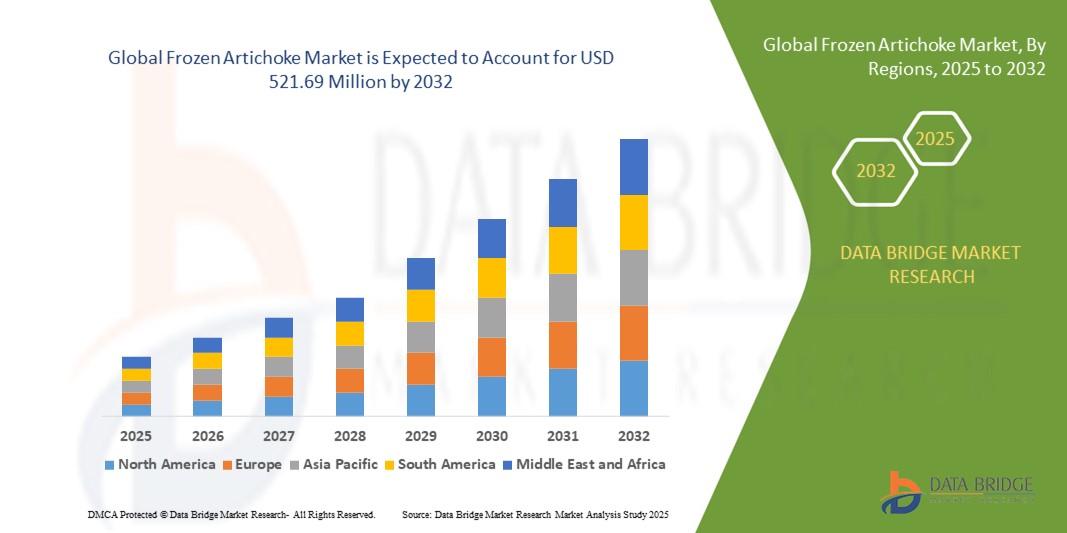
What is the Global Frozen Artichoke Market Size and Growth Rate?
- The global frozen artichoke market size was valued at USD 317.60 million in 2024 and is expected to reach USD 521.69 million by 2032, at a CAGR of 6.40% during the forecast period
- Increasing consumer preference for convenient and easy-to-prepare food options drives the demand for frozen artichokes, which offer pre-prepared and ready-to-use convenience in cooking is expected to fuel the growth of the global frozen artichoke market
- In addition, emerging economies present untapped potential for the frozen artichoke market, driven by evolving consumer preferences and the growth of modern retail infrastructure offers the favorable growth opportunities
What are the Major Takeaways of Frozen Artichoke Market?
- The consumers are increasingly seeking convenient food options that require minimal preparation time. Frozen artichokes provide a convenient way to incorporate this nutritious vegetable into meals without the hassle of cleaning and preparing fresh artichokes. This trend drives the demand for frozen artichokes, particularly among busy consumers and households
- As consumers become more health-conscious, they are seeking out nutrient-rich foods such as artichokes known for their health benefits, such as high fiber content and antioxidants. The demand for frozen artichokes increases as consumers look for convenient ways to include healthier options in their diets
- Asia Pacific dominated the frozen artichoke market with the largest revenue share of 42.3% in 2024, supported by rapid urbanization, rising disposable incomes, and a strong consumer shift towards convenient, ready-to-eat frozen foods
- North America is projected to grow at the fastest CAGR of 8.22% from 2025 to 2032, driven by demand for healthy frozen vegetables, convenience, and sustainable farming practices. Increasing consumer preference for organic and non-GMO frozen vegetables is fueling adoption
- The Frozen Artichoke Hearts segment dominated the market with a revenue share of 41.8% in 2024, owing to their wide usage in salads, pasta, pizzas, and Mediterranean dishes. Their convenience, quick cooking time, and ability to retain flavor make them the most preferred choice among both retail consumers and food service operators
Report Scope and Frozen Artichoke Market Segmentation
|
Attributes |
Frozen Artichoke Key Market Insights |
|
Segments Covered |
|
|
Countries Covered |
North America
Europe
Asia-Pacific
Middle East and Africa
South America
|
|
Key Market Players |
|
|
Market Opportunities |
|
|
Value Added Data Infosets |
In addition to the insights on market scenarios such as market value, growth rate, segmentation, geographical coverage, and major players, the market reports curated by the Data Bridge Market Research also include in-depth expert analysis, pricing analysis, brand share analysis, consumer survey, demography analysis, supply chain analysis, value chain analysis, raw material/consumables overview, vendor selection criteria, PESTLE Analysis, Porter Analysis, and regulatory framework. |
What is the Key Trend in the Frozen Artichoke Market?
Rising Demand for Ready-to-Cook and Convenience-Based Frozen Vegetables
- A significant trend in the global frozen artichoke market is the increasing consumer preference for ready-to-cook and convenience-oriented frozen foods due to busy lifestyles and growing urbanization. Consumers are seeking nutritious meal options that save time without compromising on quality
- Food service operators and retail chains are expanding their offerings of frozen artichokes in formats such as quartered, sliced, or marinated versions, catering to both household and commercial buyers
- For instance, Orogel Group (Italy) launched premium frozen vegetable lines, including artichokes, specifically targeting the food service industry in Europe, reflecting the surge in demand for convenience formats
- Growing integration of frozen vegetables into modern retail, e-commerce platforms, and quick-commerce grocery delivery services is further fueling availability and accessibility of frozen artichokes worldwide
- This trend highlights a broader industry movement toward healthy convenience, where frozen artichokes meet the demand for time-saving, year-round availability, and nutritional retention. As a result, the frozen artichoke market is positioned as a core segment within the frozen vegetables industry
What are the Key Drivers of Frozen Artichoke Market?
- Rising consumer demand for nutritious and plant-based diets is a primary driver for frozen artichokes, which are rich in fiber, antioxidants, and essential nutrients
- For instance, in March 2024, La Petite Bretonne (Canada) expanded its frozen product line, including vegetables such as artichokes, in response to growing demand for healthy snacking and meal-prep solutions
- Increasing penetration of modern retail chains, hypermarkets, and online grocery platforms has expanded the reach of frozen artichokes to urban consumers
- Frozen artichokes also offer extended shelf life compared to fresh alternatives, making them highly attractive to households and restaurants seeking reduced food waste
- In addition, the growth of food service and hospitality sectors is fueling demand, as frozen artichokes provide standardized quality, ease of preparation, and reliable year-round supply. The rising popularity of Mediterranean cuisine is also driving product adoption
Which Factor is Challenging the Growth of the Frozen Artichoke Market?
- One of the key challenges is the high cost of frozen artichokes compared to fresh produce, particularly in regions where artichokes are seasonally abundant. This makes frozen options less attractive to price-sensitive consumers
- For instance, in many parts of Southern Europe, local fresh artichokes are available at lower prices during harvest seasons, creating stiff competition for frozen products
- Another significant restraint is the limited cold chain infrastructure in developing countries, which restricts distribution and storage, thereby slowing market penetration
- Consumer perception also plays a role, as some buyers believe frozen vegetables lose flavor or nutritional value compared to fresh ones, despite advances in freezing technology
- Addressing these issues through cost optimization, awareness campaigns on nutritional retention, and expansion of cold storage facilities will be crucial. Companies such as Campo Rico (Spain) are focusing on supply chain improvements to overcome these barriers and strengthen frozen artichoke adoption globally
How is the Frozen Artichoke Market Segmented?
The market is segmented on the basis of product type, distribution channel, and end-use.
- By Product Type
On the basis of product type, the frozen artichoke market is segmented into Whole Frozen Artichokes, Frozen Artichoke Hearts, Frozen Artichoke Bottoms, and Frozen Artichoke Halves/Quarters. The Frozen Artichoke Hearts segment dominated the market with a revenue share of 41.8% in 2024, owing to their wide usage in salads, pasta, pizzas, and Mediterranean dishes. Their convenience, quick cooking time, and ability to retain flavor make them the most preferred choice among both retail consumers and food service operators. Whole Frozen Artichokes are also gaining traction for gourmet cooking and traditional recipes.
The Frozen Artichoke Bottoms segment is anticipated to grow at the fastest CAGR of 8.6% from 2025 to 2032, driven by their demand in premium restaurants and specialized food processing. Their versatility in stuffing and fine dining cuisines contributes significantly to this growth. Rising global awareness of Mediterranean diets is boosting demand across all product categories.
- By Distribution Channel
On the basis of distribution channel, the Frozen Artichoke market is segmented into Supermarkets/Hypermarkets, Specialty Stores, Online Retail, and Food Service Providers. The Supermarkets/Hypermarkets segment accounted for the largest market revenue share of 46.3% in 2024, supported by consumers’ preference for one-stop shopping and the wide variety of frozen vegetable assortments available in these outlets. Specialty stores continue to serve niche markets, catering to health-conscious and gourmet consumers.
The Online Retail segment is projected to witness the fastest CAGR of 9.2% from 2025 to 2032, driven by the rapid adoption of e-commerce platforms, rising smartphone penetration, and the convenience of doorstep delivery with proper cold-chain packaging. Food service providers also form a critical channel, supported by rising consumption in restaurants, hotels, and catering services. Increasing digital grocery platforms and online food delivery apps are reshaping distribution dynamics, providing significant opportunities for frozen artichoke producers to expand their reach globally.
- By End-Use
On the basis of end-use, the Frozen Artichoke market is segmented into Retail, Food Service, and Food Processing. The Food Service segment dominated the market with the largest revenue share of 44.7% in 2024, fueled by strong demand from restaurants, hotels, and catering businesses that rely on frozen artichokes for consistent quality and year-round availability. Retail consumption also remains strong, particularly in households adopting healthier diets and quick-to-cook meal options.
The Food Processing segment is expected to register the fastest CAGR of 8.1% from 2025 to 2032, driven by its use in canned products, ready-to-eat meals, and packaged frozen dishes. Manufacturers benefit from frozen artichokes’ extended shelf life, ensuring stable supply chains for large-scale food production. As Mediterranean-inspired cuisine and plant-based diets gain global momentum, frozen artichokes are increasingly integrated into packaged foods, boosting their relevance across the processing sector. The end-use diversification continues to strengthen market growth globally.
Which Region Holds the Largest Share of the Frozen Artichoke Market?
- Asia Pacific dominated the frozen artichoke market with the largest revenue share of 42.3% in 2024, supported by rapid urbanization, rising disposable incomes, and a strong consumer shift towards convenient, ready-to-eat frozen foods
- The region’s diverse culinary traditions and increasing incorporation of artichokes in healthy diets have amplified demand across households, restaurants, and foodservice chains
- Moreover, the growth of modern retail infrastructure, rising frozen food penetration, and advancements in cold chain logistics further strengthened the consumption of Frozen Artichokes across emerging and developed Asian economies
China Frozen Artichoke Market Insight
China frozen artichoke market led Asia-Pacific with the largest share in 2024, supported by the country’s massive middle-class population and growing preference for convenient frozen food products. Rapid urbanization and busy lifestyles are fueling the shift from fresh to frozen vegetables, with artichokes gaining popularity in household cooking and the foodservice sector. Strong domestic farming and investments in cold storage infrastructure also ensure stable supply. China’s push for smart agriculture and food processing technologies enhances efficiency and quality. Moreover, the rise of e-commerce grocery platforms has made Frozen Artichokes more accessible, strengthening their market penetration.
Japan Frozen Artichoke Market Insight
Japan frozen artichoke market is expanding steadily due to the nation’s high demand for premium, health-oriented frozen foods. Japanese consumers, known for their preference for nutritious and convenient products, are increasingly incorporating Frozen Artichokes into their diets. Rapid urban lifestyles, coupled with a rising number of single-person households, have spurred adoption. The market is further supported by advanced food processing technologies and strong cold-chain logistics. In addition, Japan’s aging population values easy-to-cook, nutrient-rich products, boosting demand. Foodservice operators and retail outlets are also expanding Frozen Artichoke offerings, making Japan an essential contributor to Asia-Pacific’s dominant position.
India Frozen Artichoke Market Insight
India frozen artichoke market is witnessing rapid growth, driven by the nation’s expanding urban middle class, rising disposable incomes, and increasing acceptance of frozen foods. Busy lifestyles in metropolitan cities are encouraging consumers to prefer ready-to-cook and nutrient-rich vegetables such as frozen artichokes. Growth is further supported by the rapid expansion of modern retail formats, supermarkets, and online grocery platforms. Government initiatives to improve cold storage and food processing facilities are boosting supply chain efficiency. With rising health consciousness and demand for western cuisines, India is becoming a high-potential market for Frozen Artichokes within Asia-Pacific.
Which Region is the Fastest Growing Region in the Frozen Artichoke Market?
North America is projected to grow at the fastest CAGR of 8.22% from 2025 to 2032, driven by demand for healthy frozen vegetables, convenience, and sustainable farming practices. Increasing consumer preference for organic and non-GMO frozen vegetables is fueling adoption. Rising home dining trends, coupled with expanding frozen food retail networks, are key drivers. The region’s advanced cold storage infrastructure and innovation in value-added frozen meals position North America as the fastest-growing Frozen Artichoke market worldwide.
U.S. Frozen Artichoke Market Insight
U.S. frozen artichoke market accounted for over 80% of North America’s share in 2024, led by strong consumer preference for healthy, convenient, and organic frozen foods. Growing awareness about the nutritional benefits of artichokes, including antioxidants and fiber content, is fueling demand. The expansion of frozen food retail chains and meal-kit services has also boosted availability. Increasing adoption of frozen artichokes in restaurants, pizzerias, and ready-meal providers is another driver. Moreover, rising health-consciousness and the popularity of Mediterranean diets have positioned the U.S. as the leading growth engine for North America’s Frozen Artichoke market.
Canada Frozen Artichoke Market Insight
Canada frozen artichoke market is steadily expanding, driven by consumer demand for convenient, premium frozen vegetables. Canadian households increasingly favor Frozen Artichokes as part of healthy, balanced diets, supported by awareness of their digestive and cardiovascular benefits. The rise in dual-income households and busy work lifestyles is accelerating adoption. In addition, Canada’s cold climate and shorter fresh produce availability drive reliance on frozen imports. The growth of organic frozen product ranges in supermarkets and the popularity of Mediterranean cuisines are boosting demand. With strong trade relations and imports from Europe and the U.S., Canada remains a vital market.
Mexico Frozen Artichoke Market Insight
Mexico frozen artichoke market is emerging strongly, supported by rising urbanization, growing incomes, and dietary diversification. Consumers are increasingly adopting Frozen Artichokes in households and foodservice chains, particularly in Italian and Mediterranean cuisine. The nation’s developing retail infrastructure and penetration of modern supermarkets are expanding frozen product availability. Rising collaborations with U.S. suppliers and regional distributors ensure stable supply and affordability. Health-conscious consumers, particularly younger demographics, are driving demand for nutrient-rich vegetables. In addition, increasing awareness of the benefits of frozen foods for reducing waste and enhancing shelf-life supports Mexico’s growing Frozen Artichoke market.
Which are the Top Companies in Frozen Artichoke Market?
The frozen artichoke industry is primarily led by well-established companies, including:
- Monteray Farm’s Flowers & Gift (U.S.)
- Orogel Group (Italy)
- La Petite Bretonne (Canada)
- Armanino Foods of Distinction (U.S.)
- Campo Rico (Spain)
- Olive Delights (Greece)
- Al-Ghani Pty Ltd (Australia)
- Panafruit (France)
What are the Recent Developments in Global Frozen Artichoke Market?
- In April 2024, Orogel, an Italian frozen food company, secured a leading position in the frozen artichoke market, holding a 67% market share. This strong dominance highlights the company’s competitive edge and influence in shaping market trends
- In March 2024, researchers at the University of Florida focused on improving artichoke preservation through advanced breeding by analyzing RNA sequences of artichoke cultivars to identify genetic markers for traits such as longer shelf life, resistance to physiological disorders, and reduced postharvest deterioration. These advancements are expected to significantly enhance the quality and durability of artichokes in the global market
- In October 2021, Enzymedica, a company specializing in digestive enzymes, introduced a nutraceutical formula combining artichoke leaf extract, apple cider vinegar, and ginger root CO2 extract to aid digestive transport and stomach emptying. This launch reinforced the growing role of artichoke-based supplements in functional nutrition
- In September 2021, Waphyto, a Japanese botanical company, released three body oils enriched with artichoke leaf extracts, namely Enhance Body Oil, Balance Body Oil, and Unwind Body Oil, tailored for the winter season. This product line reflects the rising integration of artichoke extracts into the wellness and personal care sector

- Interactive Data Analysis Dashboard
- Company Analysis Dashboard for high growth potential opportunities
- Research Analyst Access for customization & queries
- Competitor Analysis with Interactive dashboard
- Latest News, Updates & Trend analysis
- Harness the Power of Benchmark Analysis for Comprehensive Competitor Tracking
Global Frozen Artichoke Market, Supply Chain Analysis and Ecosystem Framework
To support market growth and help clients navigate the impact of geopolitical shifts, DBMR has integrated in-depth supply chain analysis into its Global Frozen Artichoke Market research reports. This addition empowers clients to respond effectively to global changes affecting their industries. The supply chain analysis section includes detailed insights such as Global Frozen Artichoke Market consumption and production by country, price trend analysis, the impact of tariffs and geopolitical developments, and import and export trends by country and HSN code. It also highlights major suppliers with data on production capacity and company profiles, as well as key importers and exporters. In addition to research, DBMR offers specialized supply chain consulting services backed by over a decade of experience, providing solutions like supplier discovery, supplier risk assessment, price trend analysis, impact evaluation of inflation and trade route changes, and comprehensive market trend analysis.
Data collection and base year analysis are done using data collection modules with large sample sizes. The stage includes obtaining market information or related data through various sources and strategies. It includes examining and planning all the data acquired from the past in advance. It likewise envelops the examination of information inconsistencies seen across different information sources. The market data is analysed and estimated using market statistical and coherent models. Also, market share analysis and key trend analysis are the major success factors in the market report. To know more, please request an analyst call or drop down your inquiry.
The key research methodology used by DBMR research team is data triangulation which involves data mining, analysis of the impact of data variables on the market and primary (industry expert) validation. Data models include Vendor Positioning Grid, Market Time Line Analysis, Market Overview and Guide, Company Positioning Grid, Patent Analysis, Pricing Analysis, Company Market Share Analysis, Standards of Measurement, Global versus Regional and Vendor Share Analysis. To know more about the research methodology, drop in an inquiry to speak to our industry experts.
Data Bridge Market Research is a leader in advanced formative research. We take pride in servicing our existing and new customers with data and analysis that match and suits their goal. The report can be customized to include price trend analysis of target brands understanding the market for additional countries (ask for the list of countries), clinical trial results data, literature review, refurbished market and product base analysis. Market analysis of target competitors can be analyzed from technology-based analysis to market portfolio strategies. We can add as many competitors that you require data about in the format and data style you are looking for. Our team of analysts can also provide you data in crude raw excel files pivot tables (Fact book) or can assist you in creating presentations from the data sets available in the report.













