Global Frozen Shoulder Market
Market Size in USD Billion
CAGR :
% 
 USD
1.30 Billion
USD
2.78 Billion
2025
2033
USD
1.30 Billion
USD
2.78 Billion
2025
2033
 Forecast Period Forecast Period |
2026 –2033 |
 Market Size (Base Year) Market Size (Base Year) |
USD 1.30 Billion |
 Market Size (Forecast Year) Market Size (Forecast Year) |
USD 2.78 Billion |
 CAGR CAGR |
% |
| Major Markets Players |
|
Frozen Shoulder Market Size
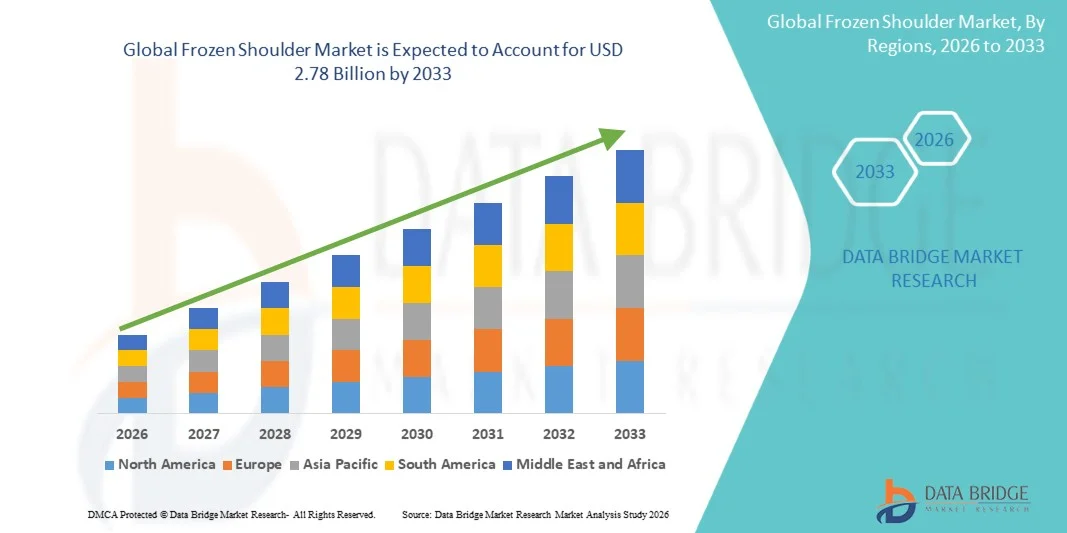
- The global frozen shoulder market size was valued at USD 1.30 billion in 2025 and is expected to reach USD 2.78 billion by 2033, at a CAGR of 10.00% during the forecast period
- The market growth is largely fueled by the rising prevalence of musculoskeletal disorders, increasing geriatric population, and growing awareness regarding early diagnosis and treatment options, leading to higher adoption of therapeutic interventions across healthcare settings
- Furthermore, increasing demand for minimally invasive treatment approaches, advancements in physiotherapy techniques, and the availability of effective pain management solutions are establishing frozen shoulder treatment as a critical component of orthopedic care. These converging factors are accelerating the adoption of treatment solutions, thereby significantly boosting the industry's growth
Frozen Shoulder Market Analysis
- Frozen shoulder, also known as adhesive capsulitis, is a musculoskeletal condition characterized by pain, stiffness, and restricted shoulder movement, making its diagnosis and treatment increasingly important across orthopedic and rehabilitation care settings due to its impact on daily functioning and quality of life
- The escalating demand for frozen shoulder treatment is primarily fueled by the rising prevalence of diabetes and other chronic conditions, a growing geriatric population, and increasing awareness regarding early diagnosis and physiotherapy-based management
- North America dominated the frozen shoulder market with the largest revenue share of 38.50% in 2025, characterized by advanced healthcare infrastructure, high healthcare expenditure, and strong adoption of innovative treatment approaches, with the United States experiencing substantial growth in patient diagnosis and treatment rates, supported by the presence of leading pharmaceutical and rehabilitation solution providers
- Asia-Pacific is expected to be the fastest growing region in the frozen shoulder market during the forecast period due to increasing healthcare access, rising awareness, and a growing patient pool driven by aging populations and lifestyle-related disorders
- Physical Therapy segment dominated the frozen shoulder market with a market share of 42.80% in 2025, driven by its effectiveness as a first-line treatment, non-invasive nature, and widespread recommendation by healthcare professionals for restoring shoulder mobility and reducing pain
Report Scope and Frozen Shoulder Market Segmentation
|
Attributes |
Frozen Shoulder Key Market Insights |
|
Segments Covered |
|
|
Countries Covered |
North America
Europe
Asia-Pacific
Middle East and Africa
South America
|
|
Key Market Players |
|
|
Market Opportunities |
|
|
Value Added Data Infosets |
In addition to the insights on market scenarios such as market value, growth rate, segmentation, geographical coverage, and major players, the market reports curated by the Data Bridge Market Research also include in-depth expert analysis, patient epidemiology, pipeline analysis, pricing analysis, and regulatory framework |
Frozen Shoulder Market Trends
“Rising Adoption of Non-Invasive and Digital Rehabilitation Solutions”
- A significant and accelerating trend in the global frozen shoulder market is the increasing adoption of non-invasive treatment approaches combined with digital rehabilitation platforms and tele-physiotherapy solutions. This convergence is significantly improving patient access to continuous and personalized care
- For instance, digital health platforms and physiotherapy apps are enabling guided exercise programs and remote monitoring for patients suffering from adhesive capsulitis, reducing the need for frequent hospital visits. Similarly, wearable rehabilitation devices are being used to track shoulder mobility and recovery progress in real time
- The integration of advanced rehabilitation technologies enables features such as real-time feedback, personalized exercise plans, and data-driven recovery tracking. For instance, some physiotherapy solutions utilize AI-based motion tracking to enhance exercise accuracy and ensure adherence to prescribed therapy. Furthermore, remote access capabilities offer patients the ease of undergoing treatment from home, improving compliance and outcomes
- The seamless integration of physiotherapy, pain management, and digital monitoring solutions facilitates a more comprehensive and coordinated approach to treatment. Through unified platforms, healthcare providers can monitor patient progress, adjust therapy plans, and improve clinical outcomes across care settings
- This trend towards more accessible, patient-centric, and technology-enabled treatment solutions is fundamentally reshaping care delivery for frozen shoulder management. Consequently, companies are developing advanced rehabilitation tools and minimally invasive therapies to enhance treatment effectiveness and patient experience
- The demand for non-invasive and digitally integrated treatment solutions is growing rapidly across healthcare systems, as patients and providers increasingly prioritize convenience, cost-effectiveness, and improved recovery outcomes
- Growing investments in wearable rehabilitation devices and smart physiotherapy equipment are enhancing treatment precision and enabling real-time monitoring of patient recovery progress
Frozen Shoulder Market Dynamics
Driver
“Growing Need Due to Rising Musculoskeletal Disorders and Aging Population”
- The increasing prevalence of musculoskeletal conditions, coupled with a rapidly growing aging population, is a significant driver for the heightened demand for frozen shoulder treatment solutions
- For instance, in recent years, healthcare providers have expanded physiotherapy and rehabilitation services to address the rising burden of shoulder-related disorders, improving access to early-stage treatment and intervention
- As individuals age and the incidence of chronic conditions such as diabetes increases, the likelihood of developing frozen shoulder also rises, driving the need for effective and timely treatment options
- Furthermore, the growing awareness regarding early diagnosis and the importance of physiotherapy in restoring mobility are making frozen shoulder management an essential component of orthopedic care pathways
- The availability of advanced treatment options, including corticosteroid injections, physical therapy, and minimally invasive procedures, is supporting improved patient outcomes and accelerating treatment adoption across healthcare facilities
- The shift towards patient-centric care and increased healthcare spending are further contributing to the widespread adoption of frozen shoulder treatment solutions in both developed and emerging markets
- Rising incidence of lifestyle-related conditions such as obesity and sedentary behavior is further increasing the patient pool requiring shoulder rehabilitation therapies
- Expanding healthcare infrastructure in emerging economies is improving access to orthopedic care and rehabilitation services, thereby driving market growth
Restraint/Challenge
“Limited Awareness and High Treatment Costs in Emerging Regions”
- Concerns surrounding limited awareness and delayed diagnosis of frozen shoulder, particularly in developing regions, pose a significant challenge to broader market growth. Many patients often misinterpret symptoms, leading to late-stage treatment and prolonged recovery
- For instance, inadequate access to specialized orthopedic care and physiotherapy services in rural or underserved areas has restricted timely diagnosis and effective management of the condition
- Addressing these awareness gaps through patient education, early screening programs, and improved healthcare accessibility is crucial for enhancing treatment outcomes. Healthcare providers are increasingly focusing on outreach initiatives to promote early intervention and rehabilitation adherence
- In addition, the relatively high cost of advanced treatment options, including imaging diagnostics and specialized physiotherapy sessions, can be a barrier for price-sensitive patients, particularly in low- and middle-income countries
- While basic physiotherapy remains accessible, advanced therapies and long-term rehabilitation programs often involve recurring expenses, limiting adoption among certain patient groups
- Overcoming these challenges through cost-effective treatment solutions, expansion of healthcare infrastructure, and increased investment in rehabilitation services will be vital for sustained market growth
- Limited availability of skilled physiotherapists and rehabilitation specialists in certain regions further restricts effective treatment delivery and patient outcomes
- Variability in treatment protocols and lack of standardized clinical guidelines across healthcare systems can lead to inconsistent patient management and slower recovery rates
Frozen Shoulder Market Scope
The market is segmented on the basis of treatment type, route of administration, end-users, and distribution channel.
- By Treatment Type
On the basis of treatment type, the frozen shoulder market is segmented into medication, joint distension, physical therapy, surgery, and others. The physical therapy segment dominated the market with the largest market revenue share of 42.80% in 2025, driven by its position as the first-line treatment for adhesive capsulitis and its strong clinical effectiveness in restoring mobility and reducing pain. Physical therapy is widely recommended by healthcare professionals due to its non-invasive nature and cost-effectiveness compared to surgical interventions. The segment benefits from increasing patient preference for conservative treatment approaches and growing awareness regarding early-stage rehabilitation. In addition, advancements in physiotherapy techniques, including guided exercise regimens and manual therapy, are enhancing patient outcomes. The widespread availability of physiotherapy services across hospitals and outpatient settings further strengthens its dominance in the market.
The joint distension segment is anticipated to witness the fastest growth rate from 2026 to 2033, fueled by its increasing adoption as a minimally invasive procedure for improving shoulder mobility. Joint distension, also known as hydrodilatation, is gaining traction due to its ability to provide rapid pain relief and improved range of motion in patients who do not respond to conventional therapies. The growing preference for outpatient procedures and shorter recovery times is supporting the expansion of this segment. Furthermore, increasing clinical evidence supporting its efficacy is encouraging healthcare providers to adopt this approach more widely. The rising demand for targeted and efficient treatment options is also contributing to the growth of joint distension procedures globally.
- By Route of Administration
On the basis of route of administration, the frozen shoulder market is segmented into oral, parenteral, and others. The oral segment dominated the market with the largest revenue share in 2025, driven by the widespread use of oral medications such as nonsteroidal anti-inflammatory drugs (NSAIDs) for pain management. Oral administration offers ease of use, accessibility, and cost-effectiveness, making it a preferred choice among patients and healthcare providers. The segment is further supported by the availability of a wide range of over-the-counter and prescription medications. In addition, oral therapies are often used as an initial treatment option before progressing to more advanced interventions. The convenience and non-invasive nature of oral medications contribute significantly to their continued dominance in the market.
The parenteral segment is expected to witness the fastest CAGR from 2026 to 2033, driven by the increasing use of injectable therapies such as corticosteroid injections for targeted pain relief. Parenteral administration provides faster onset of action and improved efficacy in reducing inflammation compared to oral medications. The growing adoption of image-guided injection techniques is further enhancing treatment precision and patient outcomes. In addition, the rising demand for localized and effective treatment options is encouraging the use of injectable therapies. Healthcare providers are increasingly recommending parenteral treatments for patients with moderate to severe symptoms, thereby supporting segment growth.
- By End-Users
On the basis of end-users, the frozen shoulder market is segmented into hospitals, homecare, specialty clinics, and others. The hospitals segment dominated the market with the largest revenue share in 2025, driven by the availability of advanced diagnostic tools, skilled healthcare professionals, and comprehensive treatment facilities. Hospitals serve as primary centers for the diagnosis and management of frozen shoulder, particularly in moderate to severe cases. The segment benefits from high patient inflow and the availability of multidisciplinary care, including orthopedic specialists and physiotherapists. In addition, the presence of advanced imaging technologies supports accurate diagnosis and treatment planning. The strong infrastructure and ability to handle complex procedures further reinforce the dominance of hospitals in this market.
The homecare segment is anticipated to witness the fastest growth rate from 2026 to 2033, fueled by the increasing preference for home-based rehabilitation and physiotherapy services. Homecare settings offer convenience and cost savings, particularly for elderly patients and those requiring long-term therapy. The growing adoption of digital health platforms and remote monitoring tools is enabling effective home-based treatment. In addition, the shift towards patient-centric care models is encouraging the expansion of homecare services. The rising demand for continuous and personalized rehabilitation solutions is further driving the growth of this segment.
- By Distribution Channel
On the basis of distribution channel, the frozen shoulder market is segmented into hospital pharmacy, online pharmacy, and retail pharmacy. The hospital pharmacy segment dominated the market with the largest revenue share in 2025, driven by the high volume of prescriptions generated within hospital settings. Hospital pharmacies ensure the availability of prescribed medications, including pain relievers and injectable therapies, for immediate patient use. The segment benefits from strong integration with hospital treatment protocols and physician recommendations. In addition, patients undergoing procedures or receiving inpatient care rely heavily on hospital pharmacies for medication access. The trust and reliability associated with hospital-based dispensing further contribute to its dominance.
The online pharmacy segment is expected to witness the fastest CAGR from 2026 to 2033, driven by the increasing adoption of e-commerce platforms for purchasing medications. Online pharmacies offer convenience, competitive pricing, and home delivery services, making them an attractive option for patients requiring long-term treatment. The growing penetration of digital technologies and rising internet usage are supporting the expansion of this segment. In addition, the availability of a wide range of medications and easy access to information are enhancing consumer preference for online channels. The shift towards digital healthcare solutions is expected to further accelerate the growth of online pharmacies in the coming years.
Frozen Shoulder Market Regional Analysis
- North America dominated the frozen shoulder market with the largest revenue share of 38.50% in 2025, characterized by advanced healthcare infrastructure, high healthcare expenditure, and strong adoption of innovative treatment approaches
- Patients in the region highly value the availability of advanced treatment options, effective pain management solutions, and well-established physiotherapy and rehabilitation services for improved recovery outcomes
- This widespread adoption is further supported by high healthcare expenditure, advanced medical infrastructure, and a strong presence of skilled healthcare professionals, establishing frozen shoulder treatment as a key component of orthopedic and rehabilitation care across both hospitals and outpatient settings
U.S. Frozen Shoulder Market Insight
The U.S. frozen shoulder market captured the largest revenue share in 2025 within North America, fueled by the high prevalence of musculoskeletal disorders and increasing awareness regarding early diagnosis and treatment. Patients are increasingly prioritizing effective pain management and mobility restoration through advanced therapeutic interventions. The growing preference for minimally invasive procedures, combined with strong demand for physiotherapy and rehabilitation services, further propels the market. Moreover, the increasing integration of digital health platforms and tele-rehabilitation solutions is significantly contributing to the market's expansion.
Europe Frozen Shoulder Market Insight
The Europe frozen shoulder market is projected to expand at a substantial CAGR throughout the forecast period, primarily driven by the rising geriatric population and increasing burden of chronic conditions such as diabetes. The increase in healthcare awareness, coupled with the demand for effective rehabilitation services, is fostering the adoption of frozen shoulder treatments. European patients are also drawn to non-invasive therapies and structured physiotherapy programs. The region is experiencing significant growth across hospital and outpatient care settings, with treatment solutions being incorporated into both early-stage management and long-term rehabilitation plans.
U.K. Frozen Shoulder Market Insight
The U.K. frozen shoulder market is anticipated to grow at a noteworthy CAGR during the forecast period, driven by the increasing demand for physiotherapy services and a desire for improved patient outcomes. In addition, concerns regarding mobility limitations and chronic pain are encouraging both patients and healthcare providers to adopt early intervention strategies. The U.K.’s strong healthcare system, alongside its growing emphasis on rehabilitation and outpatient care, is expected to continue to stimulate market growth.
Germany Frozen Shoulder Market Insight
The Germany frozen shoulder market is expected to expand at a considerable CAGR during the forecast period, fueled by increasing awareness of orthopedic conditions and the demand for advanced rehabilitation solutions. Germany’s well-developed healthcare infrastructure, combined with its emphasis on innovation and quality care, promotes the adoption of frozen shoulder treatments, particularly in hospitals and specialty clinics. The integration of advanced physiotherapy techniques and minimally invasive procedures is also becoming increasingly prevalent, aligning with patient expectations for effective and efficient treatment outcomes.
Asia-Pacific Frozen Shoulder Market Insight
The Asia-Pacific frozen shoulder market is poised to grow at the fastest CAGR during the forecast period of 2026 to 2033, driven by increasing healthcare access, rising disposable incomes, and growing awareness regarding musculoskeletal health in countries such as China, Japan, and India. The region's growing inclination towards early diagnosis and rehabilitation, supported by improving healthcare infrastructure, is driving the adoption of treatment solutions. Furthermore, as Asia-Pacific emerges as a key region for healthcare expansion, the accessibility and affordability of frozen shoulder treatments are improving across a wider patient population.
Japan Frozen Shoulder Market Insight
The Japan frozen shoulder market is gaining momentum due to the country’s aging population, advanced healthcare system, and demand for effective rehabilitation solutions. The Japanese market places a significant emphasis on early diagnosis and structured physiotherapy, and the adoption of treatment solutions is driven by the increasing prevalence of age-related musculoskeletal conditions. The integration of advanced rehabilitation technologies and outpatient care services is fueling growth. Moreover, Japan's focus on improving quality of life for elderly patients is likely to spur demand for efficient and patient-friendly treatment approaches in both residential and clinical settings.
India Frozen Shoulder Market Insight
The India frozen shoulder market accounted for the largest market revenue share in Asia Pacific in 2025, attributed to the country's expanding population base, rising prevalence of lifestyle-related disorders, and improving healthcare access. India stands as one of the key markets for orthopedic and rehabilitation services, and frozen shoulder treatments are becoming increasingly common across hospitals, clinics, and homecare settings. The push towards healthcare infrastructure development and increasing awareness regarding physiotherapy, alongside the availability of cost-effective treatment options, are key factors propelling the market in India.
Frozen Shoulder Market Share
The Frozen Shoulder industry is primarily led by well-established companies, including:
- Stryker (U.S.)
- Zimmer Biomet (U.S.)
- Johnson & Johnson Services, Inc. (U.S.)
- Smith & Nephew (U.K.)
- Medtronic (Ireland)
- Arthrex, Inc. (U.S.)
- CONMED Corporation (U.S.)
- Olympus Corporation (Japan)
- Boston Scientific Corporation (U.S.)
- Karl Storz SE & Co. KG (Germany)
- Össur hf. (Iceland)
- GSK plc (U.K.)
- Dr. Reddy’s Laboratories Ltd. (India)
- Sun Pharmaceutical Industries Ltd. (India)
- Teva Pharmaceutical Industries Ltd. (Israel)
- Perrigo Company plc (Ireland)
- Amneal Pharmaceuticals, Inc. (U.S.)
- Marksans Pharma Ltd. (India)
- Glenmark Pharmaceuticals Ltd. (India)
- Pfizer Inc. (U.S.)
What are the Recent Developments in Global Frozen Shoulder Market?
- In December 2025, researchers at the Sanjay Gandhi Post Graduate Institute of Medical Sciences (SGPGI) in India developed an improved treatment approach combining platelet-rich plasma (PRP), pain blockers, and targeted physiotherapy for frozen shoulder patients. This integrated method demonstrated enhanced pain relief and improved mobility compared to conventional therapies, highlighting advancements in multimodal treatment strategies for adhesive capsulitis
- In April 2025, a novel shoulder rehabilitation robot designed to improve range of motion in frozen shoulder patients was introduced, incorporating advanced scapulohumeral rhythm stabilization. The technology enables personalized physiotherapy by replicating natural shoulder movements and correcting compensatory patterns, marking a significant development in automated rehabilitation solutions
- In July 2024, a systematic review and meta-analysis confirmed that platelet-rich plasma (PRP) therapy significantly improves pain reduction, shoulder function, and range of motion in frozen shoulder patients compared to conventional treatments. This development reinforces the growing adoption of regenerative therapies as effective alternatives to corticosteroid injections
- In March 2023, clinical studies evaluating platelet-rich plasma (PRP) injections for adhesive capsulitis demonstrated statistically significant improvements in pain relief and functional outcomes. These findings supported the increasing clinical acceptance of PRP as a safe and effective non-invasive treatment option in orthopedic practice
- In June 2021, clinical research highlighted the effectiveness of intra-articular corticosteroid injections in providing rapid pain relief and improved mobility in frozen shoulder patients, particularly during early disease stages. This reinforced corticosteroid injections as a standard first-line interventional treatment in global clinical guidelines
SKU-
Get online access to the report on the World's First Market Intelligence Cloud

- Interactive Data Analysis Dashboard
- Company Analysis Dashboard for high growth potential opportunities
- Research Analyst Access for customization & queries
- Competitor Analysis with Interactive dashboard
- Latest News, Updates & Trend analysis
- Harness the Power of Benchmark Analysis for Comprehensive Competitor Tracking
Research Methodology
Data collection and base year analysis are done using data collection modules with large sample sizes. The stage includes obtaining market information or related data through various sources and strategies. It includes examining and planning all the data acquired from the past in advance. It likewise envelops the examination of information inconsistencies seen across different information sources. The market data is analysed and estimated using market statistical and coherent models. Also, market share analysis and key trend analysis are the major success factors in the market report. To know more, please request an analyst call or drop down your inquiry.
The key research methodology used by DBMR research team is data triangulation which involves data mining, analysis of the impact of data variables on the market and primary (industry expert) validation. Data models include Vendor Positioning Grid, Market Time Line Analysis, Market Overview and Guide, Company Positioning Grid, Patent Analysis, Pricing Analysis, Company Market Share Analysis, Standards of Measurement, Global versus Regional and Vendor Share Analysis. To know more about the research methodology, drop in an inquiry to speak to our industry experts.
Customization Available
Data Bridge Market Research is a leader in advanced formative research. We take pride in servicing our existing and new customers with data and analysis that match and suits their goal. The report can be customized to include price trend analysis of target brands understanding the market for additional countries (ask for the list of countries), clinical trial results data, literature review, refurbished market and product base analysis. Market analysis of target competitors can be analyzed from technology-based analysis to market portfolio strategies. We can add as many competitors that you require data about in the format and data style you are looking for. Our team of analysts can also provide you data in crude raw excel files pivot tables (Fact book) or can assist you in creating presentations from the data sets available in the report.