Functional Confectionery Market Overview
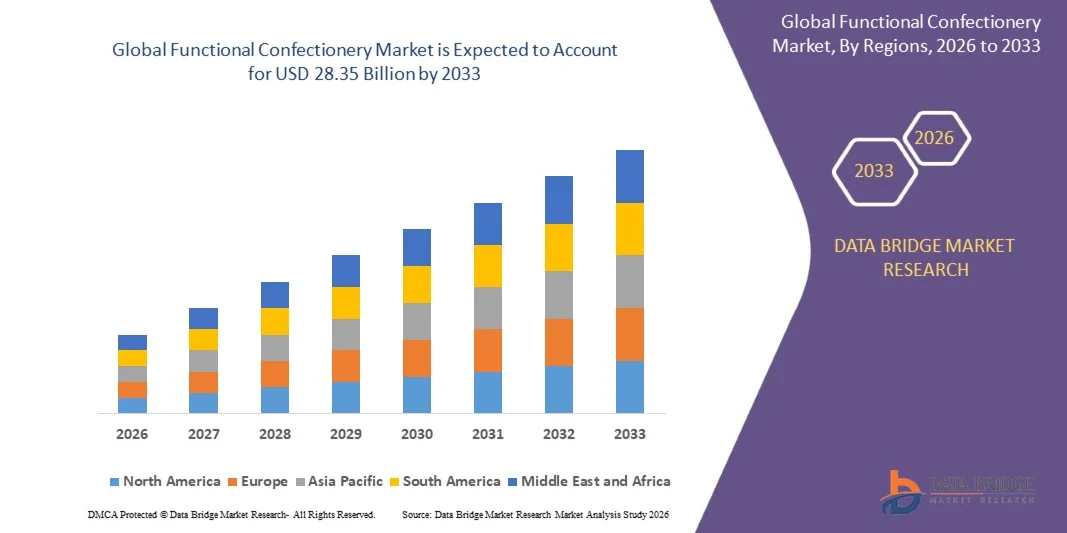
As per Data Bridge Market Research Analysis the functional confectionery market was valued at USD 12.30 billion in 2025 and is projected to reach USD 28.35 billion by 2033, growing at a CAGR of 11% from 2026 to 2033. The market is experiencing consistent and accelerating growth driven by rising consumer demand for confectionery products that combine indulgence with measurable health benefits, rapid advancements in functional ingredient formulation, and expanding applications across immunity support, cognitive wellness, digestive health, and performance enhancement categories.
The increasing prevalence of lifestyle diseases including diabetes, obesity, and cardiovascular conditions globally, combined with growing consumer awareness about the health risks of excessive sugar consumption, is compelling manufacturers, retailers, and food innovators to develop and commercialize advanced functional confectionery solutions. Sugar-free, low-calorie, and clean-label confectionery products enriched with vitamins, minerals, probiotics, fibre, and plant-based extracts are replacing traditional sugar-laden alternatives across many markets, offering health-conscious consumers nutritionally enhanced, indulgent, and guilt-free options for daily consumption and wellness management.
Market Size & Forecast
- Global Market Value (2025): USD 12.30 Billion
- Expected Market Value (2033): USD 28.35 Billion
- Forecast CAGR (2026–2033): 11%
- Leading Region in 2025: Europe
- Fastest Growing Region: Asia-Pacific
Key Market Trends & Insights
- Europe is the dominant region with 37.98% share in the global functional confectionery market, driven by high consumer demand for healthier confectionery options offering additional benefits such as vitamins, probiotics, and lower sugar formulations, along with strong adoption of clean-label products and growing preference for sugar-free/low-sugar choices.
- Asia-Pacific is projected to register the highest growth rate, supported by rapid urbanization, rising disposable incomes, and a shift towards healthier lifestyles. Countries such as China, India, and Japan are increasingly prioritizing wellness-forward confectionery featuring functional ingredients such as probiotics, fibre, and vitamins, further accelerated by expanded online/e-commerce access.
- The market is witnessing strong momentum in functional ingredient-enabled offerings (e.g., vitamins & minerals, probiotics, protein, and omega fatty acids), as manufacturers develop confectionery that delivers both indulgence and measurable nutrition/health support, reinforcing consumer value perception and repeat purchase behaviour.
- The chocolate confectionary segment dominated the product type category with a 36.42% revenue share in 2025, owing to high consumer appeal, ease of consumption, versatility in delivering precise dosages of functional ingredients, and rising popularity of nutraceutical snacks among paediatric and geriatric demographics.
- Chocolate-based and sugar confectionery formats continue to hold significant consumer appeal due to broad reach, strong brand presence, and continuous product innovation—especially new formulations emphasizing health benefits such as immunity support, gut health, and performance-oriented nutrition.
- Online retail and indirect sales channels are expanding as consumers increasingly purchase functional confectionery through e-commerce platforms for convenience, product variety, and easier access to health-focused options—supporting growth for both established and smaller brands with global reach.
Report Scope and Functional Confectionery Market Segmentation
|
Attributes |
Functional Confectionery Key Market Insights |
|
Segments Covered |
|
|
Countries Covered |
North America
Europe
Asia-Pacific
Middle East and Africa
South America
|
|
Key Market Players |
|
|
Market Opportunities |
|
|
Value Added Data Infosets |
In addition to the insights on market scenarios such as market value, growth rate, segmentation, geographical coverage, and major players, the market reports curated by the Data Bridge Market Research also include in-depth expert analysis, pricing analysis, brand share analysis, consumer survey, demography analysis, supply chain analysis, value chain analysis, raw material/consumables overview, vendor selection criteria, PESTLE Analysis, Porter Analysis, and regulatory framework. |
Functional Confectionery Market Trends
Trend: Rising Demand for Probiotic & Gut-Health-Focused Confectionery
Manufacturers are increasingly fortifying chocolates, gummies, and candies with probiotic strains and digestive-health ingredients to align with the growing microbiome-awareness trend among consumers. Global probiotic-confectionery innovation activity increased by roughly 38% in 2025 compared to 2023, while nearly 33% of new functional confectionery innovations now incorporate probiotics or digestive-health ingredients. This is paralleled by rising demand for clean-label, sugar-free, and plant-based/vegan variants, with plant-based chocolate launches rising by approximately 22% year-over-year, as brands respond to consumers seeking indulgence paired with measurable wellness value.
Functional Confectionery Market Dynamics
Key Market Driver: Growing Consumer Demand for Wellness-Oriented Snacking
Increasing health consciousness is driving strong uptake of confectionery fortified with vitamins, minerals, probiotics, and botanical extracts. Approximately 52% of consumers actively seek snacks offering added nutritional benefits, while nearly 46% prefer products containing vitamins or minerals. Immunity-support formulations influence around 49% of purchase decisions, and vitamin-enriched confectionery contributes close to 29% of category demand—reinforcing sustained category growth as brands like Nestlé and Mars expand fortified product lines.
Key Restraint/Challenge: High Cost of Functional Ingredients and Sugar-Content/Taste Trade-offs
The high cost of sourcing functional ingredients such as probiotics, plant-based extracts, and vitamins/minerals continues to raise production and retail pricing, limiting accessibility for price-sensitive consumers. Additionally, nearly 22% of consumers cite taste compromise as a deterrent to purchasing functional confectionery, while around 24–28% of manufacturers face regulatory-labelling complexity and premium-pricing sensitivity that slow broader mass-market adoption.
Key Market Opportunity: Expansion of Plant-Based, Sugar-Free, and Immunity-Focused Innovation
Rising interest in plant-based diets and sugar reduction is unlocking strong innovation opportunities. Nearly 35% of new chocolate variants launched globally in 2024 carried vegan or organic labels, while sugar-free/low-sugar product introductions rose by around 19% the same year. Combined with growing e-commerce-driven accessibility (functional confectionery e-commerce distribution accounts for roughly 28% of sales), manufacturers have a significant runway to scale better-for-you, direct-to-consumer product portfolios.
Functional Confectionery Market Scope
The Functional Confectionery market is segmented on the basis of nature, types, function, ingredients, application and distribution channel.
- By Nature
On the basis of nature, the global functional confectionery market is segmented into organic and conventional. The Conventional segment dominated the market with more than a 69.4% share in 2024, supported by wide consumer acceptance, cost-effectiveness, and extensive availability across supermarkets and retail chains globally. The Organic segment is projected to register the fastest growth over the forecast period, driven by rising clean-label preferences and consumers' growing scrutiny of artificial additives and preservatives.
- By Type
On the basis of type, the market is segmented into sugar confectionery, bakery confectionery, and chocolate confectionery. The Chocolate Confectionery segment held the leading share, accounting for approximately 34% of the market, owing to strong brand penetration by players such as Nestlé, Mars, and Hershey's, alongside continuous innovation in fortified and low-sugar chocolate formats. The Sugar Confectionery segment (including functional gummies) is expected to witness the fastest growth, supported by rising demand for probiotic and vitamin-fortified gummies, which account for nearly 31–33% of category innovation activity.
- By Function
On the basis of function, the market is segmented into cognitive wellness, performance enhancers, wellness enhancers, oral care, and others. The Wellness Enhancers segment dominated the market with more than a 28.3% share, driven by strong consumer preference for general health-supportive confectionery incorporating vitamins, minerals, and antioxidants. The Cognitive Wellness segment is anticipated to record the fastest growth, fuelled by rising launches of brain-health-focused products such as functional chocolate bars fortified with nootropic and cognitive-support ingredients.
- By Ingredients
On the basis of ingredients, the market is segmented into protein, omega 3 and omega 6, vitamins and minerals, probiotics, and others. The Vitamins and Minerals segment led the market, contributing close to 29% of total functional ingredient demand, supported by strong consumer preference for immunity- and wellness-boosting confectionery. The Probiotics segment is projected to grow at the fastest pace, with probiotic-confectionery product launches rising by approximately 38% globally, reflecting increasing consumer focus on gut-health and digestive wellness.
- By Application
On the basis of application, the market is segmented into children, middle age, senior, and youth. The Middle Age segment dominated the market with more than a 37.50% share, driven by heightened health awareness and preventive-wellness purchasing behaviour among this demographic. The Youth segment is expected to witness the fastest growth, supported by rising demand for convenient, immunity- and energy-supporting confectionery among younger consumers, who represent roughly 35% of overall category demand.
Functional Confectionery Market Regional Analysis
Europe dominated the Functional Confectionery market and accounted for the largest revenue share of 35.12% in 2025, supported by stringent food safety regulations, a highly mature health-conscious consumer base, and the strong presence of leading global confectionery manufacturers investing heavily in R&D for functional formulations. The region also benefits from well-established retail infrastructure, high consumer trust in clean-label and fortified products, and growing adoption of natural sweeteners and functional ingredients such as vitamins, probiotics, and botanical extracts. Increasing focus on sugar-reduction initiatives and premiumization of functional chocolate and confectionery continues to strengthen Europe's leadership position in the global market.
U.K. Functional Confectionery Market Insight
The U.K. functional confectionery market is experiencing steady growth, supported by rising consumer demand for wellness-oriented snacking, growing adoption of clean-label formulations, and increasing preference for sugar-free and low-sugar confectionery. Increasing investments by manufacturers in functional gummies, fortified chocolates, and probiotic-enriched products are contributing to market growth. Furthermore, integration of natural sweeteners, transparent ingredient labelling, and digital retail channels is improving product accessibility and consumer trust, positioning the U.K. as a key innovation hub in the functional confectionery industry.
Germany Functional Confectionery Market Insight
The Germany functional confectionery market is expanding steadily due to the country's strong confectionery manufacturing base, advanced food-science research capabilities, and increasing adoption of next-generation functional formulations. Confectionery companies, ingredient suppliers, and research institutes are increasingly utilizing vitamins, minerals, and plant-based extracts for product fortification and health-benefit validation. Continuous advancements in clean-label formulation, sugar-reduction technologies, and probiotic integration, along with strong regulatory focus on food safety and nutritional transparency, are further driving market growth in Germany.
U.S. Functional Confectionery Market Insight
The U.S. functional confectionery market is witnessing strong growth due to rising consumer investments in preventive health, immunity-support supplementation, and growing demand for better-for-you indulgence. The country's mature confectionery ecosystem, along with increasing adoption of vitamin-fortified, probiotic-enriched, and sugar-free product formats, is driving demand across retail, e-commerce, and specialty channels. In addition, growing emphasis on reducing sugar intake and improving nutritional transparency is accelerating functional confectionery adoption across supermarkets, online platforms, and direct-to-consumer brands.
Asia-Pacific Functional Confectionery Market Insight
The Asia-Pacific functional confectionery market is expected to witness rapid growth, driven by increasing urbanization, expanding disposable incomes, and rising health-conscious consumption across countries such as China, India, and Japan. Growing awareness regarding immunity support, rising adoption of functional ingredients such as probiotics and botanical extracts, and increasing demand for affordable, accessible wellness snacking solutions are supporting regional market expansion. Additionally, the growing presence of e-commerce platforms and expanding modern retail trade is accelerating functional confectionery adoption across urban and semi-urban markets.
Japan Functional Confectionery Market Insight
The Japan functional confectionery market is witnessing consistent growth due to rising investments in fortified snack innovation, strong consumer focus on preventive nutrition, and long-standing cultural acceptance of functional foods. Confectionery manufacturers and research institutes are increasingly developing gummies and chocolates fortified with vitamins, collagen, and digestive-health ingredients for skill enhancement in wellness positioning. Moreover, increasing integration of clean-label formulations and the country's focus on aging-population health needs are further contributing to market growth.
China Functional Confectionery Market Insight
The China functional confectionery market is growing rapidly, driven by increasing urbanization, expanding modern retail and e-commerce infrastructure, and rising government focus on nutritional health and food safety standards. Growing adoption of vitamin-fortified and probiotic-enriched confectionery formats across urban consumer segments is significantly boosting market demand. In addition, rising investments in domestic confectionery R&D, increasing awareness regarding immunity and digestive health, and rapid expansion of online retail channels are positioning China as one of the fastest-growing markets for functional confectionery globally.
Functional Confectionery Market Share
The functional confectionery market industry is primarily led by well-established companies, including:
- Barry Callebaut (Switzerland)
- Olam International (Singapore)
- The Hershey Company (U.S.)
- Mars, Incorporated (U.S.)
- Ingredion Incorporated (U.S.)
- Koninklijke DSM N.V. (Netherlands)
- Kerry Group plc (Ireland)
- Tate & Lyle PLC (U.K.)
- Nestle SA (Switzerland)
- Cargill, Incorporated (U.S.)
- Blommer Chocolate Company (U.S.)
- Foley's Candies LP (Canada)
- Puratos Group Nv (Belgium)
- Ferrero International S.A. (Italy)
- Mondelez International, Inc. (U.S.)
- Chocoladefabriken Lindt & Sprüngli AG (Switzerland)
- HARIBO GmbH & Co. KG (Germany)
- Perfetti Van Melle S.p.A. (Italy)
- Lotte Confectionery Co Ltd (South Korea)
- Jelly Belly Candy Company (U.S.)
Latest Developments in Functional Confectionery Market
- In January 2025, the Functional Chocolate Company launched several new and innovative products reflecting the growing trend toward healthier, functional options. Notable introductions include FunCho Kids by The Functional Chocolate Company, offering plant-based functional chocolate for children, and MOSH's new Raspberry White Chocolate Crunch bar, designed to boost brain health with added functional ingredients. Additionally, Kodiak launched its Apple Brown Sugar Pecan Oatmeal, enriched with prebiotic fiber and protein to cater to rising demand for nutritious breakfast options.
- In February 2025, Confectionery News highlighted the latest trends and launches in the confectionery industry. Notable releases include KitKat's sharing bars with multiple flavors, Mars' nostalgic Milky Way Crispy Rolls along with new Twix and Bounty crispy rolls, and Hotel Chocolat's Easter 2025 collection, which includes innovative and indulgent chocolate eggs. Additionally, Meiji expanded its Hello Panda range with fun new designs, and Cartwright & Butler launched a luxury chocolate-coated indulgence range.
- In February 2025, in the bakery sector, Flowers Foods announced the acquisition of Simple Mills, a brand known for its natural snacks, expanding its reach into healthier snack offerings. Additionally, Keebler introduced new Fudge Stripes Double Fudge cookies and Chips Ahoy launched Baked Bites in Blondie variety, both offering innovative twists on traditional products.
- In January 2022, Cadbury, a brand of Mondelez International, introduced the Twist Wrap packaging solution for its Duos range, allowing consumers to snack in small portions by twisting and sealing the package after consuming half of the functional bar.
- In September 2021, in collaboration with Lagardère, Ferrero pre-launched the new Ferrero Rocher Tablets in the travel-retail channel. Ferrero entered the functional tablet market with the new product, available in three flavours: milk, dark 55 percent cocoa, and white.

- Interactive Data Analysis Dashboard
- Company Analysis Dashboard for high growth potential opportunities
- Research Analyst Access for customization & queries
- Competitor Analysis with Interactive dashboard
- Latest News, Updates & Trend analysis
- Harness the Power of Benchmark Analysis for Comprehensive Competitor Tracking
Data collection and base year analysis are done using data collection modules with large sample sizes. The stage includes obtaining market information or related data through various sources and strategies. It includes examining and planning all the data acquired from the past in advance. It likewise envelops the examination of information inconsistencies seen across different information sources. The market data is analysed and estimated using market statistical and coherent models. Also, market share analysis and key trend analysis are the major success factors in the market report. To know more, please request an analyst call or drop down your inquiry.
The key research methodology used by DBMR research team is data triangulation which involves data mining, analysis of the impact of data variables on the market and primary (industry expert) validation. Data models include Vendor Positioning Grid, Market Time Line Analysis, Market Overview and Guide, Company Positioning Grid, Patent Analysis, Pricing Analysis, Company Market Share Analysis, Standards of Measurement, Global versus Regional and Vendor Share Analysis. To know more about the research methodology, drop in an inquiry to speak to our industry experts.
Data Bridge Market Research is a leader in advanced formative research. We take pride in servicing our existing and new customers with data and analysis that match and suits their goal. The report can be customized to include price trend analysis of target brands understanding the market for additional countries (ask for the list of countries), clinical trial results data, literature review, refurbished market and product base analysis. Market analysis of target competitors can be analyzed from technology-based analysis to market portfolio strategies. We can add as many competitors that you require data about in the format and data style you are looking for. Our team of analysts can also provide you data in crude raw excel files pivot tables (Fact book) or can assist you in creating presentations from the data sets available in the report.