


Hajdu-Cheney Syndrome Market Size
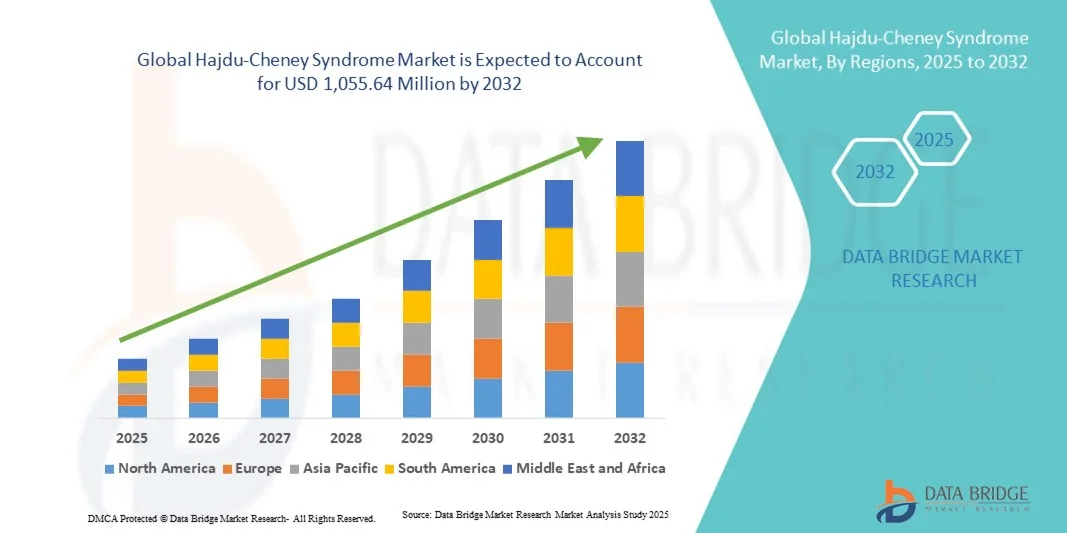
- The global Hajdu-Cheney Syndrome market size was valued at USD 820.50 million in 2024 and is expected to reach USD 1,055.64 million by 2032, at a CAGR of 3.20% during the forecast period
- The market growth is largely fueled by increasing research initiatives, advancements in genetic testing, and the development of novel therapeutic approaches targeting rare bone disorders, which are enhancing early diagnosis and management of Hajdu-Cheney syndrome
- Furthermore, rising awareness among healthcare professionals, growing patient support networks, and expanded funding for orphan disease research are positioning Hajdu-Cheney syndrome treatment as an emerging niche in the rare disease landscape. These factors collectively contribute to accelerating progress and expanding opportunities in this market
Hajdu-Cheney Syndrome Market Analysis
- Hajdu-Cheney syndrome (HCS), also known by several synonyms such as Acro-Dento-Osteo-Dysplasia and Cheney Syndrome, is a rare hereditary disorder characterized by progressive bone loss, skeletal deformities, and craniofacial abnormalities, increasingly diagnosed through advancements in molecular genetics and next-generation sequencing technologies
- The rising focus on the diagnosis and treatment of HCS is primarily driven by expanding research on NOTCH2 gene mutations, growing awareness of rare skeletal disorders, and increasing collaboration between research organizations and pharmaceutical companies developing targeted orphan therapies
- North America dominated the Hajdu-Cheney syndrome market with the largest revenue share of 39.8% in 2024, supported by advanced healthcare infrastructure, strong clinical research capabilities, and favorable regulatory initiatives for orphan drug development
- Asia-Pacific is projected to be the fastest-growing region during the forecast period, driven by rising healthcare expenditure, improved access to genetic testing, and growing awareness of rare disease management programs
- Acroosteolysis Dominant Type segment dominated the Hajdu-Cheney syndrome market with a share of 45.3% in 2024, attributed to its relatively higher clinical recognition, detailed documentation in medical literature, and concentrated research efforts aimed at understanding its specific skeletal abnormalities and genetic profile
Report Scope and Hajdu-Cheney Syndrome Market Segmentation
|
Attributes |
Hajdu-Cheney Syndrome Key Market Insights |
|
Segments Covered |
|
|
Countries Covered |
North America
Europe
Asia-Pacific
Middle East and Africa
South America
|
|
Key Market Players |
|
|
Market Opportunities |
|
|
Value Added Data Infosets |
In addition to the insights on market scenarios such as market value, growth rate, segmentation, geographical coverage, and major players, the market reports curated by the Data Bridge Market Research also include in-depth expert analysis, patient epidemiology, pipeline analysis, pricing analysis, and regulatory framework |
Hajdu-Cheney Syndrome Market Trends
Advancements in Genetic Research and Targeted Therapy Development
- A significant and accelerating trend in the global Hajdu-Cheney syndrome (HCS) market is the increasing focus on genetic and molecular research aimed at identifying targeted therapeutic approaches, particularly involving the NOTCH2 gene mutation responsible for the disorder
- For instance, several research collaborations between academic institutions and biotech firms are exploring gene expression pathways linked to bone resorption and connective tissue degradation in HCS, paving the way for potential precision medicine solutions
- Advancements in molecular diagnostics, including next-generation sequencing and exome analysis, have enabled earlier and more accurate diagnosis of HCS, facilitating better clinical management and patient monitoring over time. Furthermore, the development of patient registries and genomic databases is strengthening understanding of disease variability and treatment response
- The integration of AI-assisted genetic analysis platforms allows for rapid identification of pathogenic variants and supports personalized therapeutic strategies for patients with HCS, improving research efficiency and clinical outcomes
- This trend toward precision-based, genetics-driven diagnosis and treatment is fundamentally reshaping the rare bone disorder landscape, encouraging investment in rare disease R&D. Consequently, companies and research organizations are increasingly focusing on targeted therapy development to address the unmet medical needs in HCS
- The demand for advanced diagnostic technologies and personalized therapeutics targeting the molecular basis of Hajdu-Cheney syndrome is growing rapidly, as patients and clinicians prioritize early intervention and customized care strategies
Hajdu-Cheney Syndrome Market Dynamics
Driver
Rising Awareness and Increasing Orphan Drug Research Initiatives
- The growing awareness of rare genetic disorders, combined with expanding research initiatives for orphan drug development, is a major driver accelerating growth in the Hajdu-Cheney syndrome market
- For instance, in February 2024, the National Organization for Rare Disorders (NORD) and partnering biotech firms announced funding to support translational research for skeletal rare diseases, including Hajdu-Cheney syndrome, emphasizing early therapeutic discovery and development
- As genetic testing becomes more accessible and clinicians gain deeper insights into the molecular mechanisms of HCS, diagnostic rates are improving, enabling earlier patient management and supportive care planning
- Furthermore, favorable government policies for orphan drug approvals and incentives such as tax credits, fee reductions, and extended market exclusivity are encouraging pharmaceutical companies to invest in rare bone disorder therapies
- The increasing collaboration between hospitals, genetic laboratories, and academic research institutions is fostering knowledge exchange, supporting the discovery of novel biomarkers and targeted treatment options for HCS. The rising involvement of patient advocacy groups also plays a crucial role in promoting awareness and research funding
- The growing focus on precision medicine and clinical innovation for rare diseases is expected to sustain market momentum, offering opportunities for long-term therapeutic breakthroughs in Hajdu-Cheney syndrome management
Restraint/Challenge
Limited Clinical Data and High Treatment Development Costs
- The rarity of Hajdu-Cheney syndrome presents a significant challenge to clinical research, as limited patient populations restrict large-scale studies and slow the pace of therapeutic validation
- For instance, most available data on HCS originate from case reports and small cohort studies, making it difficult to establish standardized treatment guidelines or assess long-term efficacy of emerging therapies
- The high costs associated with developing targeted therapies and conducting rare disease trials often deter smaller biotech companies from investing, especially given the limited commercial potential compared to common disorders
- Furthermore, the complexity of regulatory pathways for orphan drugs and the requirement for extensive safety and efficacy data extend timelines for drug approval, hindering faster market entry
- The scarcity of specialized treatment centers and limited physician familiarity with HCS further constrain diagnostic accuracy and patient access to advanced care options, particularly in low- and middle-income regions. While international research networks are emerging, global clinical trial participation remains minimal
- Overcoming these challenges through enhanced international collaboration, increased funding for rare disease programs, and the creation of centralized patient registries will be crucial for advancing research and improving therapeutic availability in the Hajdu-Cheney syndrome market
Hajdu-Cheney Syndrome Market Scope
The market is segmented on the basis of Synonyms and characteristics.
- By Synonyms
On the basis of synonyms, the Hajdu-Cheney syndrome (HCS) market is segmented into Acro-Dento-Osteo-Dysplasia, Acroosteolysis Dominant Type, Acroosteolysis With Osteoporosis And Changes In Skull And Mandible, Arthrodentoosteodysplasia, and Cheney Syndrome. The Acroosteolysis Dominant Type segment dominated the market with the largest revenue share of 45.3% in 2024, primarily due to its higher clinical recognition and frequent reporting in medical literature compared to other subtypes. This variant is most commonly associated with severe bone resorption in the distal phalanges and pronounced craniofacial abnormalities, making it a key focus of diagnostic and therapeutic research. Its dominance is further supported by increasing inclusion in rare disease registries, growing physician awareness, and the concentration of clinical studies investigating targeted interventions for skeletal manifestations. The segment’s prevalence and clearer diagnostic phenotype also facilitate better tracking of disease progression, contributing to its strong market position.
The Arthrodentoosteodysplasia segment is anticipated to witness the fastest growth rate of 20.9% from 2025 to 2032, driven by rising detection rates through advanced genetic testing technologies and its emerging recognition as a distinct clinical entity within the HCS spectrum. This subtype is characterized by unique joint and dental abnormalities, drawing increased research attention for early clinical intervention and symptom management. In addition, ongoing studies exploring its correlation with NOTCH2 gene mutations are expanding the understanding of genotype-phenotype variations, thereby accelerating diagnostic accuracy and research funding.
- By Characteristics
On the basis of characteristics, the Hajdu-Cheney syndrome market is segmented into inflammation, pain, swelling, and abnormal sensations such as burning or tingling (Paresthesia). The Pain segment dominated the market with the largest revenue share of 41.7% in 2024, as pain remains one of the most common and persistent symptoms experienced by patients with HCS due to progressive bone resorption and joint instability. This symptom significantly affects patient quality of life and often necessitates long-term medical management, including anti-inflammatory drugs, physiotherapy, and supportive care. The growing focus on pain management research, coupled with the development of rare disease–specific palliative treatments, has contributed to this segment’s leading position. Increased patient awareness and documentation of chronic pain through clinical case studies have also reinforced its clinical and therapeutic importance within the HCS spectrum.
The Swelling segment is projected to be the fastest-growing characteristic category, with an expected CAGR of 21.3% from 2025 to 2032, driven by better symptom recognition and advancements in imaging modalities that help detect underlying inflammatory processes. Swelling, often associated with localized bone and connective tissue degeneration, is increasingly being studied as an early diagnostic marker in HCS. Ongoing clinical investigations exploring anti-inflammatory and supportive therapies are expected to further enhance segment growth by improving patient outcomes and reducing disease progression associated with skeletal inflammation.
Hajdu-Cheney Syndrome Market Regional Analysis
- North America dominated the Hajdu-Cheney syndrome market with the largest revenue share of 39.8% in 2024, supported by advanced healthcare infrastructure, strong clinical research capabilities, and favorable regulatory initiatives for orphan drug development
- Patients and healthcare providers in the region benefit from improved access to next-generation sequencing technologies, specialized diagnostic centers, and clinical trials focusing on skeletal and connective tissue disorders, fostering early diagnosis and personalized care approaches
- This strong regional growth is further supported by high healthcare expenditure, active collaboration between academic institutions and biotechnology companies, and increasing awareness of genetic disorders, positioning North America as the leading hub for innovation and treatment development in Hajdu-Cheney syndrome
U.S. Hajdu-Cheney Syndrome Market Insight
The U.S. Hajdu-Cheney syndrome market captured the largest revenue share of 82% in 2024 within North America, driven by advanced genetic testing infrastructure and robust investment in rare disease research. The nation’s strong network of academic institutions and biotechnology firms is accelerating the development of targeted therapies and orphan drugs. Growing awareness among healthcare professionals and patient communities is promoting earlier diagnosis and clinical trial participation. The U.S. Food and Drug Administration’s (FDA) incentives for orphan drug development and rare disease grants are further stimulating research activity. Moreover, increasing integration of genomic sequencing technologies into clinical practice continues to reinforce the U.S. position as the leading contributor to global Hajdu-Cheney syndrome research and innovation.
Europe Hajdu-Cheney Syndrome Market Insight
The Europe Hajdu-Cheney syndrome market is projected to expand at a steady CAGR throughout the forecast period, primarily driven by growing government support for rare disease programs and advancements in genomic medicine. The implementation of the European Reference Networks (ERNs) for rare and complex diseases enhances collaboration among specialized centers, improving diagnosis and treatment accessibility. Rising awareness campaigns and genetic screening initiatives are also strengthening patient identification and registry development. European countries are investing in cross-border clinical research and personalized medicine programs, further supporting market growth. Moreover, collaborations between pharmaceutical companies and academic research institutes are promoting innovation in rare skeletal disorder therapeutics.
U.K. Hajdu-Cheney Syndrome Market Insight
The U.K. Hajdu-Cheney syndrome market is anticipated to grow at a notable CAGR during the forecast period, fueled by its expanding rare disease infrastructure and emphasis on precision healthcare. The National Health Service (NHS) Genomic Medicine Service plays a critical role in integrating whole-genome sequencing for early identification of HCS. Rising clinical awareness among specialists and improved patient registry systems are facilitating better disease tracking and care coordination. The U.K.’s commitment to advancing orphan drug research, supported by academic partnerships and non-profit organizations, continues to create opportunities for innovation. In addition, patient advocacy groups are contributing to stronger research funding and awareness efforts across the country.
Germany Hajdu-Cheney Syndrome Market Insight
The Germany Hajdu-Cheney syndrome market is expected to expand at a considerable CAGR during the forecast period, supported by the country’s robust medical research ecosystem and strong presence of biotechnology companies specializing in genetic and bone disorders. Germany’s emphasis on translational medicine and collaboration between universities and healthcare institutions accelerates the development of targeted therapies for HCS. Increased adoption of molecular diagnostic tools and participation in European rare disease networks are further enhancing diagnostic precision. Furthermore, patient access to specialized healthcare services and reimbursement support for genetic testing are contributing to the market’s sustained expansion.
Asia-Pacific Hajdu-Cheney Syndrome Market Insight
The Asia-Pacific Hajdu-Cheney syndrome market is poised to grow at the fastest CAGR of 23.7% during 2025–2032, driven by the expanding availability of genetic testing and growing awareness of rare diseases across countries such as Japan, China, and India. Government initiatives promoting rare disease registries and research funding are boosting regional development. The rapid growth of healthcare infrastructure and the entry of international research collaborations are improving access to diagnostic and therapeutic services. Increasing partnerships between Asian hospitals and global biotech firms are also facilitating clinical trials and knowledge transfer. As genomic technologies become more affordable, Asia-Pacific is emerging as a key growth frontier for Hajdu-Cheney syndrome diagnostics and care.
Japan Hajdu-Cheney Syndrome Market Insight
The Japan Hajdu-Cheney syndrome market is gaining momentum owing to the country’s advanced biotechnology sector, strong focus on genomic medicine, and government-backed rare disease programs. Japan’s initiatives under its Rare Disease Initiative and Orphan Drug Promotion Act are supporting early diagnosis and research on skeletal dysplasia disorders, including HCS. For instance, growing collaborations between Japanese research institutes and hospitals are accelerating data collection and genetic analysis. The aging population and rising demand for precision treatments are further stimulating market growth. Moreover, the integration of AI and bioinformatics in genetic diagnostics is enhancing Japan’s leadership in the regional rare disease landscape.
India Hajdu-Cheney Syndrome Market Insight
The India Hajdu-Cheney syndrome market accounted for the largest market revenue share in Asia-Pacific in 2024, attributed to the nation’s growing focus on rare disease awareness, genetic testing expansion, and domestic research initiatives. India’s National Policy for Rare Diseases (2021) has provided a framework for funding and treatment support, improving accessibility for affected patients. The establishment of dedicated genetic diagnostic laboratories and partnerships with international research organizations are strengthening the local ecosystem. Rising healthcare investments, a growing middle-class population, and increased collaboration between public and private sectors are fueling diagnostic advancements. Furthermore, India’s cost-effective clinical research environment is attracting global interest for Hajdu-Cheney syndrome studies and drug development.
Hajdu-Cheney Syndrome Market Share
The Hajdu-Cheney Syndrome industry is primarily led by well-established companies, including:
- Amgen Inc. (U.S.)
- UCB S.A.(Belgium)
- Novartis AG (Switzerland)
- F. Hoffmann-La Roche Ltd (Switzerland)
- BioMarin (U.S.)
- Amicus Therapeutics Inc. (U.S.)
- Regeneron Pharmaceuticals (U.S.)
- Takeda Pharmaceutical Company (Japan)
- Sobi (Sweden)
- Vertex Pharmaceuticals (U.S.)
- Illumina, Inc. (U.S.)
- Natera, Inc. (U.S.)
- Invitae Corporation (U.S.)
- Blueprint Genetics (Finland)
- GeneDx (U.S.)
- BGI Genomics (China)
- PerkinElmer (U.S.)
- Thermo Fisher Scientific Inc. (U.S.)
- Eurofins (Luxembourg)
- Labcorp (U.S.)
What are the Recent Developments in Global Hajdu-Cheney Syndrome Market?
- In March 2025, an early-onset HCS case report presented at the Society for Endocrinology BES meeting showed significant improvement in bone mineral density (BMD) after treatment with zoledronic acid in a preschool-aged patient, suggesting potential therapeutic benefit of bisphosphonate infusions in HCS
- In May 2024, a case report titled “Orofacial characteristics in a child with Hajdu-Cheney syndrome” was published describing dental and facial anomalies in a 6-year-old girl with HCS, highlighting the broadening recognition of orofacial manifestations and the need for multidisciplinary care
- In September 2023, a case report was published of a 6-year-old female with HCS carrying a novel variant in the NOTCH2 gene (c.7021C > T: p.Q2341X) which expands the genotypic spectrum of the disorder and emphasises the importance of comprehensive genetic testing in HCS
- In November 2023, the “Solitary Band Acro-osteolysis in Hajdu-Cheney Syndrome” paper (in The Journal of Rheumatology) described a distinct skeletal phenotype in HCS, offering improved phenotypic characterisation that may lead to earlier diagnosis
- In August 2021, a case report was published detailing oral surgery procedures in an HCS patient treated with Denosumab which is significant because it documented clinical management of bone-loss in HCS using a biologic agent outside of standard osteoporosis treatment regimens

- Interactive Data Analysis Dashboard
- Company Analysis Dashboard for high growth potential opportunities
- Research Analyst Access for customization & queries
- Competitor Analysis with Interactive dashboard
- Latest News, Updates & Trend analysis
- Harness the Power of Benchmark Analysis for Comprehensive Competitor Tracking
Data collection and base year analysis are done using data collection modules with large sample sizes. The stage includes obtaining market information or related data through various sources and strategies. It includes examining and planning all the data acquired from the past in advance. It likewise envelops the examination of information inconsistencies seen across different information sources. The market data is analysed and estimated using market statistical and coherent models. Also, market share analysis and key trend analysis are the major success factors in the market report. To know more, please request an analyst call or drop down your inquiry.
The key research methodology used by DBMR research team is data triangulation which involves data mining, analysis of the impact of data variables on the market and primary (industry expert) validation. Data models include Vendor Positioning Grid, Market Time Line Analysis, Market Overview and Guide, Company Positioning Grid, Patent Analysis, Pricing Analysis, Company Market Share Analysis, Standards of Measurement, Global versus Regional and Vendor Share Analysis. To know more about the research methodology, drop in an inquiry to speak to our industry experts.
Data Bridge Market Research is a leader in advanced formative research. We take pride in servicing our existing and new customers with data and analysis that match and suits their goal. The report can be customized to include price trend analysis of target brands understanding the market for additional countries (ask for the list of countries), clinical trial results data, literature review, refurbished market and product base analysis. Market analysis of target competitors can be analyzed from technology-based analysis to market portfolio strategies. We can add as many competitors that you require data about in the format and data style you are looking for. Our team of analysts can also provide you data in crude raw excel files pivot tables (Fact book) or can assist you in creating presentations from the data sets available in the report.












