


What is the Haloperidol Market Size and Growth Rate?
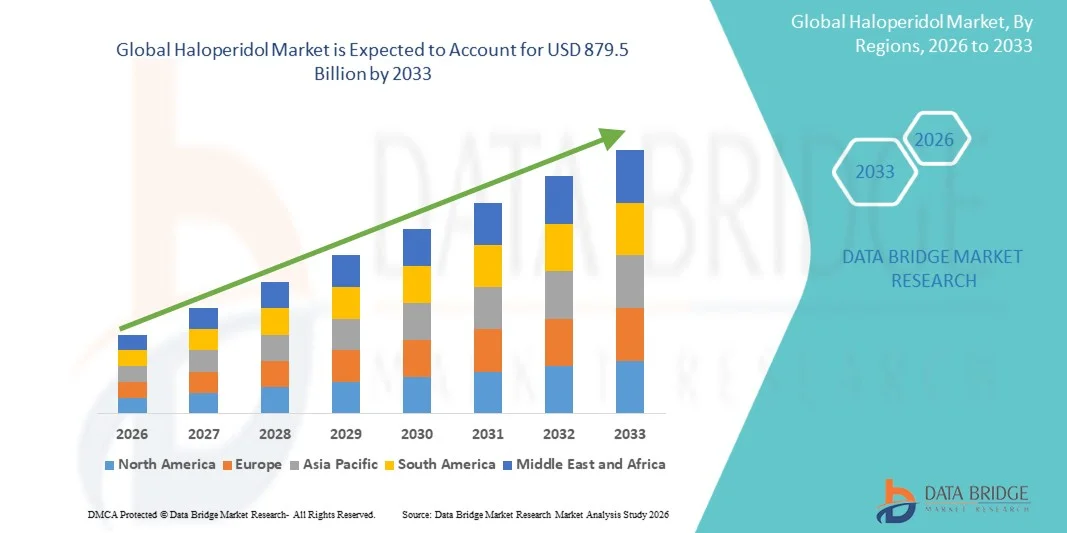
- As per Data Bridge Market Research analysis, the global haloperidol market was valued at USD 628.0 million in 2025 and is projected to reach USD 879.5 million by 2033, growing at a CAGR of 4.30% from 2026 to 2033.
- The market is experiencing steady growth driven by haloperidol's sustained role as a low-cost, well-established first-generation antipsychotic used across schizophrenia management, acute psychiatric emergency care, and hospital agitation and delirium protocols.
- Persistently high global schizophrenia and psychotic disorder prevalence, combined with the drug's continued affordability relative to newer atypical antipsychotics, continues to sustain demand, even as periodic manufacturing discontinuations of branded injectable formulations create localized supply challenges that generic manufacturer continue to help address.
Market Size & Forecast
- Global Market Value (2025): USD 628.0 Million
- Expected Market Value (2033): USD 879.5 Million
- Forecast CAGR (2026–2033): 4.30%
- Leading Region in 2025: North America
- Fastest Growing Region: Asia-Pacific
What are the Major Takeaways of the Haloperidol Market?
- North America dominated the global haloperidol market with the largest revenue share of 33.75% in 2025, supported by established psychiatric hospital infrastructure, extensive generic injectable supply networks, and standardized acute agitation management protocols.
- Asia-Pacific is expected to be the fastest-growing region at a CAGR of 6.05% from 2026 to 2033, fueled by rising diagnosis and treatment rates for schizophrenia, expanding psychiatric care infrastructure, and growing government mental health procurement programs across India and Southeast Asia.
- The tablets segment led the market with a 44.50% share in 2025, driven by widespread use in long-term outpatient schizophrenia management.
- The injectable segment is the fastest-growing dosage form, projected to register a CAGR of 6.30%, reflecting rising adoption of long-acting decanoate formulations for relapse prevention.
- The schizophrenia segment dominated the application category with a 52.15% revenue share in 2025, supported by haloperidol's long-standing role as a low-cost first-generation antipsychotic.
- On the basis of prescription type, the generic segment dominated the market with an 89.70% share in 2025, reflecting haloperidol's long off-patent status and broad multinational generic manufacturing base.
- The branded segment is projected to grow at a comparatively modest CAGR of 3.85% from 2026 to 2033, supported by continued demand for select branded long-acting injectable formulations.
Report Scope and Haloperidol Market Segmentation
|
Attributes |
Haloperidol Key Market Insights |
|
Segments Covered |
|
|
Countries Covered |
North America
Europe
Asia-Pacific
Middle East and Africa
South America
|
|
Key Market Players |
|
|
Market Opportunities |
|
|
Value Added Data Infosets |
In addition to the insights on market scenarios such as market value, growth rate, segmentation, geographical coverage, and major players, the market reports curated by the Data Bridge Market Research also include in-depth expert analysis, patient epidemiology, pipeline analysis, pricing analysis, and regulatory framework. |
What is the Key Trend in the Haloperidol Market?
- Manufacturers and health systems continue to navigate periodic discontinuations and shortages of branded and generic haloperidol injectable formulations, prompting supply diversification across multiple generic producers.
- For instance, in April 2025, Janssen Pharmaceuticals discontinued its Haldol decanoate injection in the 50 mg/mL and 100 mg/mL presentations, with final batches expiring between May 2025 and October 2025, prompting hospitals to rely more heavily on generic decanoate and lactate injection suppliers such as Fresenius Kabi and Viatris.
- Regulatory agencies continue to reinforce cardiovascular and mortality-related safety monitoring requirements for haloperidol, shaping prescribing practices, particularly for intravenous use and in elderly populations.
- Continued differentiation between conventional and atypical antipsychotic safety labeling continues to influence prescribing patterns, particularly in geriatric psychiatry.
- For instance, In 2025, January, the FDA continued to recognize the established cardiovascular safety considerations associated with haloperidol, including QT-interval prolongation and the potential for serious ventricular arrhythmias, reinforcing the importance of appropriate risk assessment and monitoring when haloperidol is administered, particularly by the intravenous route.
As health systems continue to balance affordability, established clinical familiarity, and evolving safety monitoring requirements, haloperidol is expected to retain a durable role within schizophrenia management and acute psychiatric care worldwide.
What are the Key Drivers of the Haloperidol Market?
- The persistently high global prevalence of schizophrenia and related psychotic disorders continues to sustain demand for well-established, cost-effective antipsychotic therapies such as haloperidol.
- For instance, in 2022, January, according to the World Health Organization's schizophrenia fact sheet, schizophrenia affects approximately 24 million people worldwide, underscoring the scale of ongoing demand for accessible antipsychotic treatment options.
- The low production cost and long-standing generic manufacturing base make haloperidol one of the most cost-effective antipsychotic therapies available, sustaining its use in public health systems and cost-constrained psychiatric care settings.
- For instance, in 2025, October, the U.S. FDA revised the prescribing information for Haldol Decanoate (haloperidol decanoate injection), reaffirming the boxed warning regarding increased mortality in elderly patients with dementia-related psychosis and maintaining specific warnings concerning QTc interval prolongation, torsades de pointes, and sudden death. The updated labeling continues to guide the safe use and monitoring of haloperidol in clinical practice.
- Growing hospital emphasis on structured acute agitation and delirium management protocols is supporting incremental demand for rapid-acting injectable haloperidol formulations in emergency and critical care settings.
With schizophrenia and related psychotic disorders remaining a significant global health burden and healthcare systems continuing to prioritize affordable, clinically familiar therapies, haloperidol is expected to remain a foundational option within the broader antipsychotic treatment landscape.
Which Factors are Challenging the Growth of the Haloperidol Market?
- Declining clinician preference in higher-income markets, driven by safety and tolerability concerns relative to newer atypical antipsychotics, is limiting growth in developed regions.
- For instance, in 2025, the U.S. FDA's updated Haldol Decanoate prescribing information continued to carry a boxed warning regarding increased mortality in elderly patients with dementia-related psychosis. The updated labeling also retains warnings related to QTc prolongation, torsades de pointes, and sudden death, reinforcing safety concerns that can contribute to more cautious use of haloperidol in vulnerable patient populations.
- Regulatory and safety monitoring requirements, particularly for intravenous and high-dose use, add compliance and clinical oversight burdens for healthcare providers.
- For instance, in 2025, the updated U.S. prescribing information for Haldol Decanoate continued to recommend ECG monitoring when haloperidol is used with other drugs known to prolong the QTc interval and highlighted the potential for serious arrhythmias and sudden death. Such requirements can increase monitoring and clinical oversight requirements compared with antipsychotic therapies with fewer cardiovascular safety considerations.
- Periodic manufacturing disruptions and brand discontinuations have contributed to intermittent shortages of injectable formulations, affecting consistent hospital supply.
- For instance, following Janssen's April 2025 discontinuation of Haldol decanoate injection in its 50 mg/mL and 100 mg/mL presentations, hospitals and pharmacy networks were required to transition affected patients to alternate generic suppliers ahead of the final batch expirations between May 2025 and October 2025.
- The combination of declining utilization in high-income markets, heightened safety monitoring requirements, and periodic manufacturing disruptions continues to create headwinds for the haloperidol market, even as its established clinical familiarity and low cost sustain demand within schizophrenia management and acute psychiatric care settings globally.
How is the Haloperidol Market Segmented?
The global haloperidol market is segmented on the basis of dosage form, application, route of administration, distribution channel, end user, patient demographics, and prescription type.
- By Dosage Form
On the basis of dosage form, the global haloperidol market is segmented into tablets, oral solution/concentrate, and injectable (lactate & decanoate). The tablets segment dominated the market with a 44.50% share in 2025, owing to its widespread use in long-term outpatient management of schizophrenia and other chronic psychotic disorders.
The injectable segment is projected to register the fastest growth at a CAGR of 6.30% from 2026 to 2033, driven by rising adoption of long-acting decanoate formulations that improve medication adherence in relapse prevention, as well as continued hospital use of lactate injection for acute agitation management.
- By Application
On the basis of application, the global haloperidol market is segmented into schizophrenia, acute psychosis & agitation, Tourette's disorder, delirium management, and bipolar mania (adjunct). The schizophrenia segment dominated the market with a 52.15% share in 2025, supported by haloperidol's decades-long role as a well-established, low-cost first-generation antipsychotic used across both public and private mental healthcare systems.
The acute psychosis & agitation segment is expected to witness the fastest CAGR of 6.45% from 2026 to 2033, driven by rising hospital emergency department and psychiatric intensive care use of rapid-acting injectable haloperidol for severe agitation.
- By Route of Administration
On the basis of route of administration, the global haloperidol market is segmented into oral, intramuscular, and intravenous. The oral segment dominated the market with a 58.60% share in 2025, owing to its widespread use in long-term outpatient schizophrenia management.
The intramuscular segment is anticipated to witness the fastest CAGR of 6.10% from 2026 to 2033, supported by growing use of long-acting injectable decanoate formulations and rapid-acting lactate injections in acute care settings.
- By Distribution Channel
On the basis of distribution channel, the global haloperidol market is segmented into hospital pharmacies, retail pharmacies, and online pharmacies. The hospital pharmacies segment dominated the market with a 40.85% share in 2025, driven by high consumption of injectable haloperidol formulations in psychiatric emergency and inpatient care settings.
The online pharmacies segment is expected to witness the fastest CAGR of 6.75% from 2026 to 2033, supported by expanding digital prescription fulfillment infrastructure for chronic psychiatric medication management.
- By End User
On the basis of end user, the global haloperidol market is segmented into hospitals & psychiatric care centers, homecare settings, and long-term care facilities. The hospitals & psychiatric care centers segment dominated the market with a 47.30% share in 2025, supported by its central role in acute psychiatric crisis management and inpatient schizophrenia treatment.
The homecare settings segment is projected to witness the fastest CAGR of 5.85% from 2026 to 2033, driven by growing preference for long-term outpatient management of chronic psychotic disorders.
- By Patient Demographics
On the basis of patient demographics, the global haloperidol market is segmented into adult, pediatric, and geriatric. The adult segment dominated the market with a 61.40% share in 2025, reflecting the peak onset age range for schizophrenia and other chronic psychotic disorders.
The geriatric segment is expected to witness the fastest CAGR of 5.95% from 2026 to 2033, driven by rising off-label hospital use in delirium management for elderly patients, despite continued regulatory caution around use in dementia-related psychosis.
- By Prescription Type
On the basis of prescription type, the global haloperidol market is segmented into generic and branded. The generic segment dominated the market with an 89.70% share in 2025, reflecting haloperidol's long off-patent status and broad multinational generic manufacturing base.
The branded segment is projected to grow at a comparatively modest CAGR of 3.85% from 2026 to 2033, supported by continued demand for select branded long-acting injectable formulations.
Which Region Holds the Largest Share of the Global Haloperidol Market?
- North America dominated the global haloperidol market and accounted for the largest revenue share of 33.75% in 2025, supported by established psychiatric hospital infrastructure, extensive generic injectable supply networks, and standardized acute agitation management protocols.
- The region also benefits from well-established drug safety monitoring frameworks, strong hospital pharmacy penetration, and continued reliance on generic haloperidol amid periodic branded formulation discontinuations. Continued focus on supply diversification among generic manufacturers is expected to further reinforce regional supply stability.
U.S. Haloperidol Market Insight
The U.S. haloperidol market remains anchored by its established role in schizophrenia management, psychiatric emergency care, and long-standing generic prescribing practices. Regulatory oversight requiring cardiac monitoring for intravenous use and boxed warnings for geriatric dementia-related psychosis continues to shape clinical protocols, while the April 2025 discontinuation of Janssen's Haldol decanoate injection has accelerated reliance on generic suppliers to maintain hospital-level injectable supply.
Germany Haloperidol Market Insight
The Germany haloperidol market continues to benefit from a well-established generic pharmaceutical manufacturing base and long-standing clinical familiarity with the molecule across both inpatient and outpatient psychiatric care. Continued use in schizophrenia management, alongside steady export activity to other European markets, supports stable demand in the country.
Asia-Pacific Haloperidol Market Insight
The Asia-Pacific haloperidol market is expected to witness the fastest growth globally, driven by rising diagnosis and treatment rates for schizophrenia, expanding psychiatric care infrastructure, and continued reliance on low-cost, off-patent antipsychotic medications across large and price-sensitive patient populations in India, China, and Southeast Asia.
India Haloperidol Market Insight
The India haloperidol market benefits from a large domestic generic manufacturing base, government mental health procurement programs, and continued use of haloperidol as an affordable first-generation antipsychotic across both public and private healthcare settings. Expanding psychiatric care access in rural regions continues to support steady demand.
Japan Haloperidol Market Insight
The Japan haloperidol market is witnessing steady demand, supported by an established psychiatric healthcare system, continued clinical use in schizophrenia and acute agitation management, and a mature generic pharmaceutical manufacturing base. Regulatory alignment with international safety monitoring standards continues to shape prescribing practices in the country.
Which are the Top Companies in the Haloperidol Market?
The global haloperidol industry is primarily led by well-established generic and specialty pharmaceutical companies, including:
- Janssen Pharmaceuticals, Inc. (U.S.)
- Viatris Inc. (U.S.)
- Fresenius Kabi AG (Germany)
- Teva Pharmaceutical Industries Ltd. (Israel)
- Hikma Pharmaceuticals PLC (U.K.)
- Sun Pharmaceutical Industries Ltd. (India)
- Zydus Lifesciences Ltd. (India)
- Lupin Ltd. (India)
- Cipla Ltd. (India)
- Torrent Pharmaceuticals Ltd. (India)
- Aurobindo Pharma Ltd. (India)
- Amneal Pharmaceuticals, Inc. (U.S.)
- Alkem Laboratories Ltd. (India)
- Wockhardt Ltd. (India)
- Micro Labs Ltd. (India)
- Piramal Critical Care, Inc. (India)
- Rising Pharmaceuticals, Inc. (U.S.)
- Alembic Pharmaceuticals Ltd. (India)
- Sandoz International GmbH (Germany)
- Endo, Inc. (U.S.)
What are the Latest Developments in the Haloperidol Market?
- In April 2025, Janssen Pharmaceuticals discontinued its Haldol decanoate injection in the 50 mg/mL and 100 mg/mL presentations, with final batches expiring between May 2025 and October 2025, prompting a shift in hospital procurement toward generic decanoate suppliers.
- As of May 2026, generic haloperidol lactate injection from Fresenius Kabi and Viatris remained available in the U.S. market following Sagent's discontinuation of its haloperidol lactate injection in late 2025, helping maintain hospital-level supply continuity.
- In June 2008, the FDA required a boxed warning on conventional antipsychotics, including haloperidol, regarding increased mortality risk in elderly patients with dementia-related psychosis, a labeling requirement that continues to shape geriatric prescribing guidance today.
- In September 2007, the FDA strengthened intravenous haloperidol labeling to include warnings on QT prolongation and torsades de pointes risk, a safety requirement that remains central to hospital cardiac monitoring protocols for the drug.

- Interactive Data Analysis Dashboard
- Company Analysis Dashboard for high growth potential opportunities
- Research Analyst Access for customization & queries
- Competitor Analysis with Interactive dashboard
- Latest News, Updates & Trend analysis
- Harness the Power of Benchmark Analysis for Comprehensive Competitor Tracking
Data collection and base year analysis are done using data collection modules with large sample sizes. The stage includes obtaining market information or related data through various sources and strategies. It includes examining and planning all the data acquired from the past in advance. It likewise envelops the examination of information inconsistencies seen across different information sources. The market data is analysed and estimated using market statistical and coherent models. Also, market share analysis and key trend analysis are the major success factors in the market report. To know more, please request an analyst call or drop down your inquiry.
The key research methodology used by DBMR research team is data triangulation which involves data mining, analysis of the impact of data variables on the market and primary (industry expert) validation. Data models include Vendor Positioning Grid, Market Time Line Analysis, Market Overview and Guide, Company Positioning Grid, Patent Analysis, Pricing Analysis, Company Market Share Analysis, Standards of Measurement, Global versus Regional and Vendor Share Analysis. To know more about the research methodology, drop in an inquiry to speak to our industry experts.
Data Bridge Market Research is a leader in advanced formative research. We take pride in servicing our existing and new customers with data and analysis that match and suits their goal. The report can be customized to include price trend analysis of target brands understanding the market for additional countries (ask for the list of countries), clinical trial results data, literature review, refurbished market and product base analysis. Market analysis of target competitors can be analyzed from technology-based analysis to market portfolio strategies. We can add as many competitors that you require data about in the format and data style you are looking for. Our team of analysts can also provide you data in crude raw excel files pivot tables (Fact book) or can assist you in creating presentations from the data sets available in the report.












