


What is the Healthcare CRM Market Size and Overview?
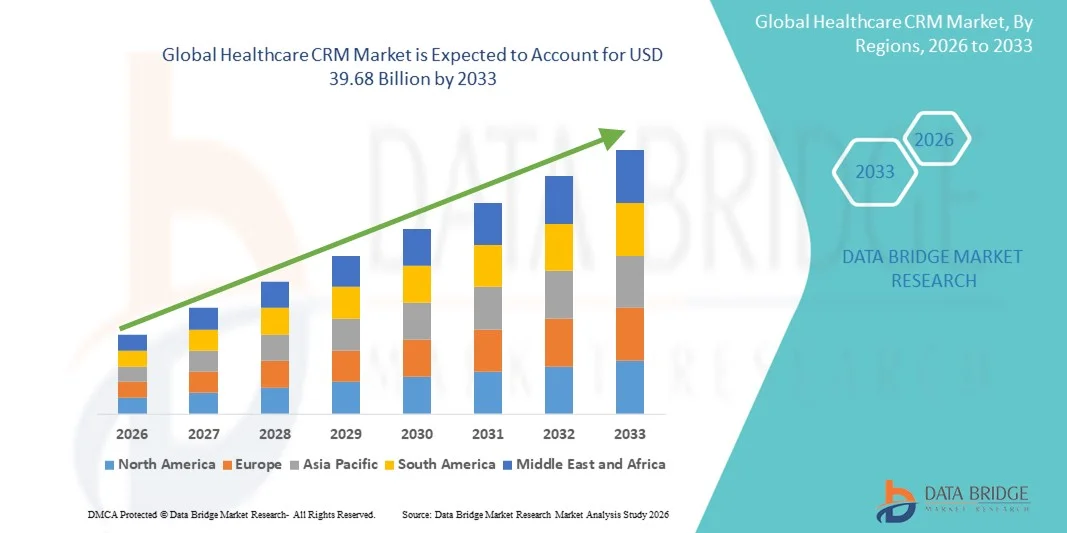
- As per Data Bridge Market Research Analysis the global healthcare CRM market size was valued at USD 18.81 billion in 2025 and is expected to reach USD 39.68 billion by 2033, at a CAGR of 9.78% during the forecast period
- The market growth is primarily driven by increasing adoption of digital healthcare solutions, rising demand for patient engagement tools, and the integration of AI and analytics in healthcare operations, enabling better relationship management and personalized care
- Moreover, growing focus on patient retention, regulatory compliance, and streamlined communication between providers, payers, and patients is positioning healthcare CRM systems as essential tools in modern healthcare management. These factors collectively are accelerating market adoption, thereby significantly driving industry growth
Market Size & Forecast
- Global Market Value (2025): USD 18.81 Billion
- Expected Market Value (2033): USD 39.68 Billion
- Forecast CAGR (2026–2033): 9.78%
What are the Major Takeaways of Healthcare CRM Market?
- Healthcare CRM systems, providing digital solutions for managing patient relationships, communications, and data, are becoming increasingly critical in modern healthcare delivery across hospitals, clinics, and healthcare service providers due to their ability to enhance patient engagement, streamline operations, and enable personalized care
- The rising adoption of healthcare CRM is mainly driven by growing demand for patient-centric care, the need for efficient communication between providers and patients, and the integration of AI, analytics, and automation to improve operational efficiency and patient satisfaction
- North America dominated the healthcare CRM market with the largest revenue share of 39.1% in 2025, supported by advanced healthcare infrastructure, high digital adoption, and the presence of major CRM solution providers, with the U.S. witnessing significant deployment of CRM systems across hospitals, specialty clinics, and telehealth platforms, propelled by AI-driven patient engagement and predictive analytics solutions
- Asia-Pacific is expected to be the fastest-growing region in the healthcare CRM market during the forecast period due to increasing digitalization in healthcare, rising investments in healthcare IT, and expanding healthcare infrastructure in emerging economies such as India and China
- Cloud-based segment dominated the healthcare CRM market with a market share of 45.3% in 2025, driven by their scalability, cost-effectiveness, ease of deployment, and ability to provide real-time patient insights across multiple healthcare touchpoints
Report Scope and Healthcare CRM Market Segmentation
|
Attributes |
Healthcare CRM Key Market Insights |
|
Segments Covered |
|
|
Countries Covered |
North America
Europe
Asia-Pacific
Middle East and Africa
South America
|
|
Key Market Players |
|
|
Market Opportunities |
|
|
Value Added Data Infosets |
In addition to the insights on market scenarios such as market value, growth rate, segmentation, geographical coverage, and major players, the market reports curated by the Data Bridge Market Research also include in-depth expert analysis, patient epidemiology, pipeline analysis, pricing analysis, and regulatory framework |
What is the Key Trend in the Healthcare CRM Market?
AI-Driven Personalized Patient Engagement
- A significant and accelerating trend in the global healthcare CRM market is the increasing integration of artificial intelligence (AI) and machine learning to deliver personalized patient interactions, optimize care plans, and predict patient needs
- For instance, Salesforce Health Cloud leverages AI to provide predictive insights, enabling healthcare providers to proactively manage patient care and tailor engagement strategies
- AI integration in healthcare CRM allows features such as patient segmentation, risk scoring, and automated communication, helping organizations deliver timely reminders, follow-ups, and alerts. For instance, Microsoft Dynamics 365 uses AI to analyze patient behavior patterns and improve appointment adherence
- The seamless integration of healthcare CRM platforms with EHR systems, telehealth solutions, and mobile health apps enables centralized management of patient interactions, ensuring coordinated care across multiple touchpoints
- This trend toward more intelligent, data-driven, and patient-centric engagement is fundamentally reshaping expectations for healthcare providers. For instance, companies such as Oracle Cerner are developing AI-powered CRM solutions that provide personalized outreach and predictive patient insights
- Integration of IoT-enabled medical devices with CRM systems is emerging as a trend, allowing real-time health data to feed directly into patient engagement workflows, improving proactive care. For instance, Salesforce Health Cloud can incorporate wearable device data to adjust care plans dynamically
- The demand for healthcare CRM solutions with AI-driven personalization is growing rapidly as providers prioritize improved patient satisfaction, adherence, and overall health outcomes
Healthcare CRM Market Dynamics
Driver
Increasing Need for Patient-Centric Care and Digital Engagement
- The rising emphasis on patient-centric healthcare delivery, coupled with the accelerated adoption of digital engagement tools, is a significant driver for the growing demand for healthcare CRM solutions
- For instance, in March 2025, Epic Systems launched new patient engagement features in its CRM platform to enhance remote monitoring and personalized care delivery
- As healthcare providers aim to improve patient retention, satisfaction, and outcomes, CRM systems offer advanced features such as automated communication, patient journey tracking, and predictive analytics, providing a compelling advantage over traditional administrative methods
- Furthermore, the growing popularity of telehealth and mobile health applications is making healthcare CRM an integral component for managing virtual care, patient follow-ups, and seamless communication across multiple channels
- The convenience of centralized patient data, automated reminders, and real-time reporting are key factors propelling the adoption of healthcare CRM across hospitals, clinics, and specialty care providers. The trend toward scalable cloud-based deployments and user-friendly interfaces further contributes to market growth
- Expansion of value-based care models is driving demand for CRM solutions that track patient outcomes and engagement metrics to ensure quality care. For instance, Allscripts CRM supports population health management and performance analytics
- Growing collaboration between healthcare providers, payers, and pharmaceutical companies is increasing the need for integrated CRM platforms that enable multi-stakeholder communication and coordinated patient programs. For instance, Veeva Systems facilitates engagement across providers and pharma partners
Restraint/Challenge
Data Privacy Concerns and Integration Complexity
- Concerns regarding patient data privacy, security, and regulatory compliance pose a significant challenge to broader adoption of healthcare CRM systems. As these platforms handle sensitive health information, they are subject to strict regulations such as HIPAA and GDPR
- For instance, high-profile data breaches in healthcare organizations have made some providers hesitant to fully integrate CRM solutions without robust security measures
- Addressing these data privacy concerns through encryption, secure access controls, and compliance certifications is crucial for building trust among healthcare providers and patients. For instance, Veeva Systems emphasizes HIPAA-compliant infrastructure and secure cloud storage in its CRM offerings. In addition, integration with legacy EHR systems and multiple digital platforms can be complex and resource-intensive, creating implementation barriers for some organizations
- While cloud-based solutions simplify deployment, perceived technical complexity and interoperability challenges can hinder adoption, particularly among smaller providers or facilities with limited IT capabilities
- Overcoming these challenges through enhanced security protocols, regulatory compliance support, and simplified integration tools will be vital for sustained growth in the healthcare CRM market
- Limited digital literacy among healthcare staff in certain regions may slow CRM adoption, requiring training programs and support initiatives. For instance, smaller clinics in emerging markets often need structured onboarding to effectively use CRM functionalities
- High implementation and customization costs for large-scale CRM deployments can be a restraint, especially for mid-sized providers. For instance, comprehensive solutions such as Oracle Health CRM may require significant investment in IT infrastructure and consultancy services
How is the Healthcare CRM Market Segmented?
The market is segmented on the basis of type, component, mode of delivery, application, and end user.
- By Type
On the basis of type, the healthcare CRM market is segmented into Operational CRM, Analytical CRM, and Collaborative CRM. The Operational CRM segment dominated the market with the largest revenue share of 42.5% in 2025, driven by its focus on automating patient-facing processes such as scheduling, appointment reminders, and communication workflows. Healthcare providers increasingly prioritize operational CRM for streamlining daily administrative tasks, improving patient engagement, and ensuring consistent communication across multiple channels. Its ability to centralize patient data and integrate with EHR systems enhances workflow efficiency, reduces errors, and improves overall care delivery. The segment also benefits from strong adoption in hospitals and specialty clinics where patient volume management and personalized follow-ups are critical. In addition, operational CRM solutions often support multi-channel communication, including email, SMS, and telehealth notifications, further reinforcing their utility and demand.
The Collaborative CRM segment is anticipated to witness the fastest growth rate of 22.1% from 2026 to 2033, fueled by the increasing need for coordinated care among multiple stakeholders such as providers, payers, and pharmaceutical companies. Collaborative CRM enables seamless sharing of patient information, care plans, and engagement strategies, ensuring that all parties involved can make informed decisions. Its adoption is further accelerated by the rise of integrated care models and population health management initiatives, which require synchronized communication across care teams. In addition, collaborative CRM supports patient portals and remote monitoring, enhancing real-time interaction with patients and fostering higher engagement. The growth is also driven by technological advancements such as cloud-based collaboration tools, AI-driven recommendations, and analytics-enabled insights.
- By Component
On the basis of component, the healthcare CRM market is segmented into software and services. The Software segment dominated the market with the largest revenue share of 47.8% in 2025, driven by the widespread adoption of CRM platforms that enable automated patient management, analytics, and engagement features. Healthcare providers increasingly invest in robust software solutions to streamline operations, enhance patient satisfaction, and comply with regulatory requirements. Software solutions provide scalability, integration with EHRs, and advanced functionalities such as predictive analytics and reporting, making them indispensable for modern healthcare operations. In addition, the software segment benefits from continuous technological upgrades, AI integration, and user-friendly interfaces that cater to providers of all sizes. The strong demand also stems from cloud-based deployments, which allow secure and flexible access across multiple healthcare facilities.
The Services segment is expected to witness the fastest growth rate of 20.4% from 2026 to 2033, fueled by the rising demand for implementation, consulting, customization, and training services. Healthcare organizations require expert guidance to integrate CRM solutions seamlessly with existing IT infrastructure and to maximize platform benefits. Services also include technical support, software updates, and data migration, which are critical for ensuring smooth operation and regulatory compliance. As the complexity of healthcare IT ecosystems grows, outsourcing CRM-related services becomes a cost-effective and efficient solution for many providers.
- By Mode of Delivery
On the basis of mode of delivery, the market is segmented into cloud-based and on-premise. The Cloud-Based segment dominated the market with the largest revenue share of 45.3% in 2025, driven by its scalability, cost-effectiveness, and ease of deployment across multiple healthcare facilities. Cloud-based CRM enables real-time access to patient data, seamless integration with telehealth platforms, and automated updates without the need for heavy IT infrastructure. Providers increasingly prefer cloud solutions for their flexibility, remote accessibility, and reduced upfront costs, making them ideal for both large hospitals and smaller clinics. The segment also benefits from strong adoption in regions with high digital healthcare penetration and growing telemedicine usage.
The On-Premise segment is anticipated to witness the fastest CAGR of 19.8% from 2026 to 2033, fueled by the need for enhanced data control, security, and compliance with local regulations in certain regions. On-premise CRM deployments appeal to healthcare organizations with strict privacy requirements, legacy IT infrastructure, or limited internet connectivity. The ability to maintain complete control over sensitive patient data and customize the CRM environment according to specific organizational workflows drives its adoption. In addition, on-premise solutions offer greater flexibility for integrations with specialized medical software and local databases.
- By Application
On the basis of application, the healthcare CRM market is segmented into communication module, patient management, task management, and report module. The Patient Management segment dominated the market with the largest revenue share of 44.6% in 2025, driven by the critical need to manage appointments, medical histories, and treatment plans efficiently. Providers rely on patient management CRM features to enhance engagement, reduce no-shows, and improve overall care coordination. These systems integrate with EHRs and telehealth platforms to provide a 360-degree view of patient interactions. The strong adoption is further fueled by regulatory requirements, patient-centric care initiatives, and the need to track outcomes effectively.
The Communication Module segment is expected to witness the fastest growth rate of 21.5% from 2026 to 2033, fueled by the rising need for multi-channel patient engagement through emails, SMS, chatbots, and telehealth notifications. Communication modules allow providers to deliver timely reminders, educational content, and personalized messages, improving adherence and patient satisfaction. The growth is accelerated by the increasing focus on remote patient care and digital health initiatives, which require seamless and automated communication workflows.
- By End User
On the basis of end user, the healthcare CRM market is segmented into healthcare providers and healthcare payers. The Healthcare Providers segment dominated the market with the largest revenue share of 55.3% in 2025, driven by hospitals, clinics, and specialty care providers seeking to improve patient engagement, streamline administrative tasks, and enhance care coordination. Providers increasingly implement CRM systems to manage large patient volumes, reduce operational inefficiencies, and improve overall satisfaction. Integration with EHRs, telehealth platforms, and analytics tools makes these systems indispensable for modern healthcare delivery.
The Healthcare Payers segment is anticipated to witness the fastest growth rate of 20.9% from 2026 to 2033, fueled by the need to manage member engagement, claims processing, and personalized health programs. Payers adopt CRM solutions to improve communication with policyholders, enhance care management programs, and reduce churn. The segment growth is further supported by the increasing emphasis on value-based care models and analytics-driven risk assessment, allowing payers to deliver better health outcomes and operational efficiency.
Which Region Holds the Largest Share of the Healthcare CRM Market?
- North America dominated the healthcare CRM market with the largest revenue share of 39.1% in 2025, supported by advanced healthcare infrastructure, high digital adoption, and the presence of major CRM solution providers
- Healthcare providers and payers in the region prioritize CRM systems for their ability to streamline patient engagement, automate administrative workflows, and integrate seamlessly with EHR and telehealth platforms
- This widespread adoption is further supported by high healthcare IT spending, strong presence of leading CRM vendors, and regulatory incentives for improving patient outcomes, establishing healthcare CRM as a critical tool for hospitals, clinics, and specialty care providers
U.S. Healthcare CRM Market Insight
The U.S. healthcare CRM market captured the largest revenue share of 82% in 2025 within North America, driven by the rapid adoption of digital health solutions and increasing focus on patient-centric care. Healthcare providers are prioritizing CRM systems to enhance patient engagement, streamline appointment scheduling, and improve care coordination across hospitals and clinics. The growing preference for cloud-based, AI-enabled platforms and integration with EHR and telehealth systems further propels market growth. Moreover, initiatives to improve patient retention, adherence, and outcomes are significantly contributing to the expansion of healthcare CRM solutions in the U.S.
Europe Healthcare CRM Market Insight
The Europe healthcare CRM market is projected to expand at a substantial CAGR throughout the forecast period, primarily fueled by increasing investments in digital healthcare infrastructure and stringent regulations on patient data management. The adoption of CRM systems is being driven by healthcare providers’ need to enhance patient engagement, optimize workflows, and support value-based care initiatives. European healthcare organizations are increasingly implementing CRM platforms across hospitals, clinics, and specialty care centers to streamline communication, monitor patient journeys, and improve overall care quality.
U.K. Healthcare CRM Market Insight
The U.K. healthcare CRM market is anticipated to grow at a noteworthy CAGR during the forecast period, driven by the rising demand for patient-centric healthcare and digital engagement solutions. Concerns over patient retention, care coordination, and efficient communication are encouraging healthcare providers and payers to adopt CRM systems. The U.K.’s strong digital health ecosystem, robust IT infrastructure, and government support for healthcare digitization are expected to continue stimulating market growth.
Germany Healthcare CRM Market Insight
The Germany healthcare CRM market is expected to expand at a considerable CAGR during the forecast period, fueled by growing awareness of digital healthcare tools and the need for efficient patient management solutions. Germany’s advanced healthcare infrastructure, emphasis on innovation, and focus on compliance with data protection regulations promote CRM adoption across hospitals and specialty clinics. Integration of CRM with existing hospital IT systems and telehealth platforms is increasing, with healthcare providers prioritizing secure and privacy-focused solutions.
Asia-Pacific Healthcare CRM Market Insight
The Asia-Pacific healthcare CRM market is poised to grow at the fastest CAGR of 23.5% during the forecast period of 2026 to 2033, driven by rapid digitalization, rising healthcare IT spending, and increasing awareness of patient engagement solutions in countries such as China, Japan, and India. The region's growing inclination towards telehealth and mobile health applications is fueling CRM adoption. Furthermore, government initiatives promoting smart healthcare, along with the expanding healthcare infrastructure, are increasing accessibility and affordability of CRM solutions in the APAC region.
Japan Healthcare CRM Market Insight
The Japan healthcare CRM market is gaining momentum due to the country’s advanced healthcare IT ecosystem, focus on patient-centric care, and aging population. Healthcare providers are increasingly adopting CRM solutions to manage patient interactions, improve engagement, and streamline administrative processes. The integration of CRM with telehealth, wearable devices, and hospital IT systems is further driving market growth. Moreover, Japan’s emphasis on efficiency and quality in healthcare services is encouraging the deployment of AI-enabled, cloud-based CRM platforms.
India Healthcare CRM Market Insight
The India healthcare CRM market accounted for the largest revenue share in Asia-Pacific in 2025, attributed to rapid urbanization, growing private healthcare sector, and increasing digital health adoption. CRM solutions are gaining popularity among hospitals, clinics, and diagnostic centers for patient management, engagement, and retention. Government initiatives such as Smart Cities and digital healthcare programs, along with affordable CRM options and strong domestic IT service providers, are key factors propelling the market in India.
Which are the Top Companies in Healthcare CRM Market?
The Healthcare CRM industry is primarily led by well-established companies, including:
- Salesforce, Inc. (U.S.)
- Microsoft Corporation (U.S.)
- Oracle (U.S.)
- SAP SE (Germany)
- IBM (U.S.)
- Epic Systems Corporation (U.S.)
- Accenture plc (Ireland)
- Innovaccer Inc. (U.S.)
- Infor, Inc. (U.S.)
- Phreesia, Inc. (U.S.)
- Pegasystems Inc. (U.S.)
- Personify Health, Inc. (U.S.)
- Zoho Corporation (India)
- Actium Health (U.S.)
- WebMD Ignite, Inc. (U.S.)
- SugarCRM Inc. (U.S.)
- Creatio (U.S.)
- CareCloud (U.S.)
- Benefitalign (U.S.)
- Greenway Health, LLC (U.S.)
What are Latest Developments in Global Healthcare CRM Market?
- In April 2025, Innovaccer Inc. launched “Copilots & Agents for Care Management,” a set of AI‑powered assistants designed to reduce administrative burden by automating documentation tasks and boosting patient engagement, showing a 28% reduction in documentation time and a 20% increase in engagement
- In March 2025, Veeva Systems launched ‘Veeva CRM Pulse,’ a subscription‑based data service designed to provide enhanced industry engagement metrics and improve privacy‑compliant CRM capabilities for healthcare and life sciences customers globally
- In February 2025, Innovaccer introduced “Agents of Care™,” a suite of pre‑trained AI agents to automate repetitive healthcare tasks such as scheduling, referrals, and care gap closure, integrating with multiple EHRs and enhancing operational efficiency across care teams
- In January 2025, Docfyn, a health‑tech startup, launched an AI‑Driven marketing suite for healthcare providers, offering comprehensive CRM capabilities, SEO optimization, chatbot integration, and workflow automation aimed at improving patient engagement and operational efficiency across hospitals and clinics
- In September 2024, Innovaccer launched its AI‑powered Care Management Copilot to automate documentation, generate patient care insights, and ease administrative work for care managers, enabling more personalized patient interactions and improved operational productivity

- Interactive Data Analysis Dashboard
- Company Analysis Dashboard for high growth potential opportunities
- Research Analyst Access for customization & queries
- Competitor Analysis with Interactive dashboard
- Latest News, Updates & Trend analysis
- Harness the Power of Benchmark Analysis for Comprehensive Competitor Tracking
Data collection and base year analysis are done using data collection modules with large sample sizes. The stage includes obtaining market information or related data through various sources and strategies. It includes examining and planning all the data acquired from the past in advance. It likewise envelops the examination of information inconsistencies seen across different information sources. The market data is analysed and estimated using market statistical and coherent models. Also, market share analysis and key trend analysis are the major success factors in the market report. To know more, please request an analyst call or drop down your inquiry.
The key research methodology used by DBMR research team is data triangulation which involves data mining, analysis of the impact of data variables on the market and primary (industry expert) validation. Data models include Vendor Positioning Grid, Market Time Line Analysis, Market Overview and Guide, Company Positioning Grid, Patent Analysis, Pricing Analysis, Company Market Share Analysis, Standards of Measurement, Global versus Regional and Vendor Share Analysis. To know more about the research methodology, drop in an inquiry to speak to our industry experts.
Data Bridge Market Research is a leader in advanced formative research. We take pride in servicing our existing and new customers with data and analysis that match and suits their goal. The report can be customized to include price trend analysis of target brands understanding the market for additional countries (ask for the list of countries), clinical trial results data, literature review, refurbished market and product base analysis. Market analysis of target competitors can be analyzed from technology-based analysis to market portfolio strategies. We can add as many competitors that you require data about in the format and data style you are looking for. Our team of analysts can also provide you data in crude raw excel files pivot tables (Fact book) or can assist you in creating presentations from the data sets available in the report.













