


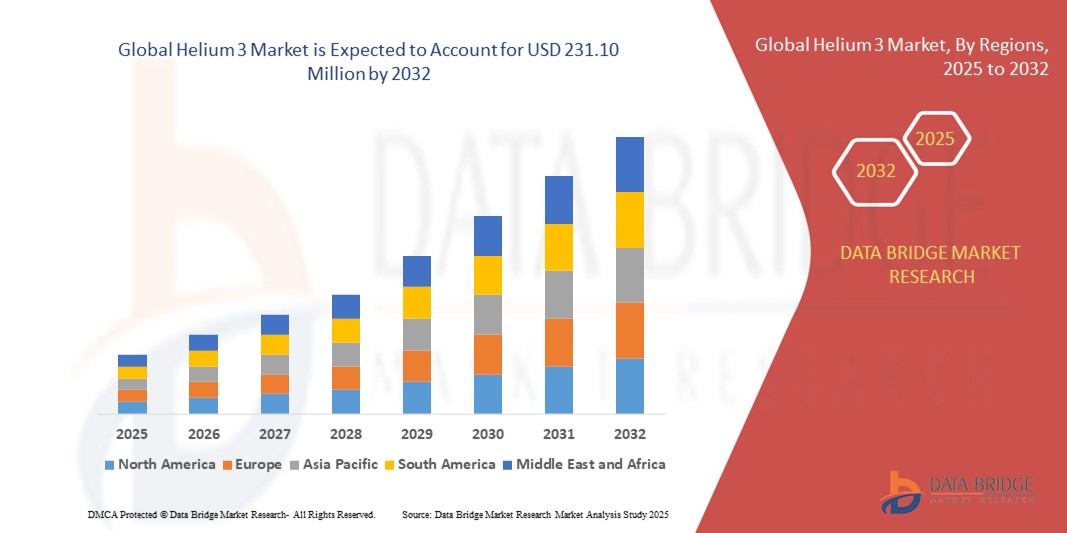
Helium 3 Market Size
- The global helium 3 market size was valued at USD 183.86 million in 2024 and is expected to reach USD 231.10 million by 2032, at a CAGR of 2.90% during the forecast period
- The market growth is primarily driven by increasing demand in scientific research, cryogenics, and emerging quantum technologies, particularly in nuclear fusion and low-temperature physics applications
- Moreover, growing utilization in neutron detection, medical imaging, and national security due to its unique isotopic properties is positioning helium-3 as a critical strategic resource. These expanding use cases are accelerating demand and investments, thereby significantly boosting the industry's growth
Helium 3 Market Analysis
- Helium-3, offering unique properties such as low boiling point, low neutron absorption, and high thermal conductivity, is becoming an essential component in advanced technologies across defense, energy, and medical sectors due to its effectiveness in neutron detection, cryogenics, and nuclear research applications
- The growing demand for helium-3 is largely driven by its increasing utilization in homeland security, quantum computing, and medical imaging, as well as intensifying global interest in nuclear fusion as a sustainable energy source
- North America dominated the helium-3 market with the largest revenue share of 39.4% in 2024, owing to substantial government investments in nuclear research, advanced defense systems, and technological innovation, particularly in the U.S., which leads in helium-3 production and application development
- Asia-Pacific is expected to be the fastest growing region in the helium-3 market during the forecast period due to expanding research initiatives in quantum technologies, nuclear fusion, and increasing medical isotope applications
- The gas segment dominated the helium-3 market with a market share of 63.6% in 2024, driven by its broad applicability in portable neutron detectors and advanced imaging systems where gaseous form enables efficient handling and integration
Report Scope and Helium 3 Market Segmentation
|
Attributes |
Helium 3 Key Market Insights |
|
Segments Covered |
|
|
Countries Covered |
North America
Europe
Asia-Pacific
Middle East and Africa
South America
|
|
Key Market Players |
|
|
Market Opportunities |
|
|
Value Added Data Infosets |
In addition to the insights on market scenarios such as market value, growth rate, segmentation, geographical coverage, and major players, the market reports curated by the Data Bridge Market Research also include in-depth expert analysis, pricing analysis, brand share analysis, consumer survey, demography analysis, supply chain analysis, value chain analysis, raw material/consumables overview, vendor selection criteria, PESTLE Analysis, Porter Analysis, and regulatory framework. |
Helium 3 Market Trends
Rising Demand in Quantum and Fusion Research
- A major and rapidly growing trend in the global helium-3 market is its increasing demand in quantum computing and nuclear fusion research, driven by its unique cryogenic and nuclear properties. Helium-3 is essential for cooling quantum bits (qubits) in superconducting systems and for use in low-temperature experiments across advanced physics laboratories
- For instance, global institutions such as ITER and private companies such as Helion Energy are exploring helium-3's role in next-generation nuclear fusion reactors, where it can enable aneutronic fusion reactions with minimal radioactive byproducts
- In quantum technology, helium-3 is used in dilution refrigerators critical for maintaining the near-zero temperatures needed in quantum processors, with institutions such as Google and IBM relying on it in experimental setups
- Moreover, helium-3’s application in neutron detection systems for security scanning at borders and ports is being expanded due to its exceptional efficiency and sensitivity. Governments are also investing in alternatives and recycling techniques due to its scarcity, further fueling R&D initiatives
- This trend toward strategic use of helium-3 in cutting-edge applications is redefining its market dynamics. Companies and research bodies are increasingly securing helium-3 supply through collaborative agreements with space agencies and nuclear facilities, reflecting its evolving role as a critical resource for the future of energy and computing
- The rising intersection of helium-3 with advanced scientific domains is expected to intensify in the coming years, with growing commercialization potential across security, healthcare, and energy industries
Helium 3 Market Dynamics
Driver
Strategic Importance in Defense and Advanced Technologies
- The growing recognition of helium-3 as a critical material for national security, medical diagnostics, and clean energy is significantly driving its demand across global markets. Its non-radioactive nature and high neutron absorption efficiency make it irreplaceable for neutron detection, cryogenic applications, and nuclear fusion research
- For instance, helium-3 is extensively used in radiation portal monitors for detecting nuclear threats at border checkpoints. Programs funded by the U.S. Department of Energy and Department of Homeland Security have prioritized helium-3 supply for security infrastructure upgrades
- In the medical field, helium-3 MRI imaging is emerging as a non-invasive method for detailed lung analysis, offering better diagnostics than traditional X-rays or CT scans, especially for diseases such as COPD
- Helium-3’s growing use in cryogenics, particularly in superconducting magnets and low-temperature physics, further emphasizes its importance in both public and private sector research. This cross-industry applicability is driving investments in helium-3 recovery from tritium decay and alternative production methods, especially in countries with space or nuclear programs
- The material’s role in enabling future technologies, coupled with rising global tensions and increasing healthcare innovation, continues to position helium-3 as a strategic asset with expanding commercial value
Restraint/Challenge
Scarcity, High Cost, and Supply Chain Dependency
- The extremely limited natural availability of helium-3 poses a significant challenge to the growth of the global market. Most helium-3 is produced as a byproduct of tritium decay in nuclear weapons programs, making its supply highly restricted and geopolitically sensitive
- With few global producers and no widespread commercial mining methods, the cost of helium-3 remains high—often exceeding thousands of dollars per liter—making it inaccessible for many institutions and industries
- For instance, the shutdown of tritium production facilities in the U.S. in past decades significantly reduced helium-3 supply, causing shortages and price spikes that affected national security and scientific research programs
- In addition, the logistical complexities of extracting, transporting, and storing helium-3 under strict safety and regulatory guidelines add to operational costs and hinder market scalability
- While some initiatives aim to generate helium-3 through tritium breeding or extraction from the Moon’s regolith in long-term space exploration plans, these solutions remain technically and economically unfeasible at present
- Overcoming these barriers will require sustained international cooperation, government-backed helium-3 recovery programs, and technological breakthroughs in alternative isotope production and recycling to ensure stable and affordable supply in the future
Helium 3 Market Scope
The market is segmented on the basis of type, product type, application, and end-use.
- By Type
On the basis of type, the helium-3 market is segmented into ultra high purity grade helium and high purity grade Helium. The Ultra High Purity Grade Helium segment dominated the market with the largest revenue share of 57.4% in 2024, driven by its critical use in quantum computing, low-temperature physics, and precision instrumentation. Its exceptionally low impurity level ensures accurate results in sensitive applications such as nuclear fusion experiments and cryogenics.
The high purity grade helium segment, is expected to witness fastest growth during forecast period, due to its usage in industrial applications where extremely high isotopic purity is not essential, such as leak detection or basic neutron monitoring.
- By Product Type
On the basis of product type, the helium-3 market is segmented into liquid and gas. The Gas segment held the largest revenue share of 63.6% in 2024, due to its ease of storage, transportation, and wide usage in neutron detection systems for defense and border security. Helium-3 gas is highly preferred in radiation portal monitors and portable detectors due to its efficiency and reusability.
The liquid segment is expected to witness fastest growth during forecast period, as it is used in specialized scientific applications, particularly in cryogenics for achieving ultra-low temperatures. Though niche, the demand for liquid helium-3 is growing in advanced research institutions and laboratories.
- By Application
On the basis of application, the helium-3 market is segmented into oil and gas, defence, power plant, medical, and others. The Defence segment dominated the market with the largest revenue share of 35.6% in 2024, owing to increasing global demand for advanced neutron detection systems and national security monitoring technologies. Helium-3 plays a vital role in nuclear threat detection and border surveillance.
The Medical segment is witnessing rising growth during forecast period, especially in the use of hyperpolarized helium-3 for MRI lung imaging, offering safer, non-invasive diagnostics.
- By End-Use
On the basis of end-use, the helium-3 market is segmented into NMR, border security, fusion research labs, and others. Border Security held the largest market revenue share of 38.2% in 2024, driven by extensive global investments in radiation detection infrastructure to monitor nuclear materials and contraband at ports and borders. The efficiency of helium-3 in neutron absorption makes it irreplaceable in these systems.
Fusion Research Labs are emerging as one of the fastest-growing segments during forecast period, due to increasing public and private investments in clean and sustainable energy sources such as aneutronic nuclear fusion, where helium-3 serves as a potential fuel.
Helium 3 Market Regional Analysis
- North America dominated the helium-3 market with the largest revenue share of 39.4% in 2024, owing to substantial government investments in nuclear research, advanced defense systems, and technological innovation, particularly in the U.S., which leads in helium-3 production and application development
- The region leads in helium-3 utilization for neutron detection systems, fusion research initiatives, and cryogenic applications, particularly through support from institutions such as the U.S. Department of Energy and national laboratories
- This dominance is further reinforced by a strong technological infrastructure, high demand for strategic isotopes, and ongoing advancements in quantum computing and homeland security, positioning helium-3 as a critical component in North America’s scientific and defense sectors
U.S. Helium 3 Market Insight
The U.S. helium-3 market captured the largest revenue share of 79% in 2024 within North America, driven by robust federal support for nuclear research, homeland security, and quantum technology development. Significant demand originates from government-backed neutron detection programs, fusion energy projects, and cryogenic applications. The country’s advanced infrastructure, coupled with major national laboratories and defense agencies, positions the U.S. as the global leader in helium-3 consumption and innovation. Moreover, collaborations with space and nuclear sectors further contribute to stable demand and ongoing R&D initiatives.
Europe Helium-3 Market Insight
The Europe helium-3 market is projected to expand at a strong CAGR throughout the forecast period, fueled by increasing investments in clean energy research, quantum computing, and medical imaging technologies. The region’s focus on scientific innovation, combined with EU-led security initiatives, supports helium-3 demand for border monitoring and nuclear research. Helium-3 is also gaining traction in European fusion energy programs such as EUROfusion. In addition, stringent regulatory frameworks and sustainability goals are encouraging the development of alternative sources and recycling methods.
U.K. Helium-3 Market Insight
The U.K. helium-3 market is anticipated to grow at a noteworthy CAGR during the forecast period, supported by the country’s strong research ecosystem and expanding quantum technology initiatives. Government-backed programs and university-led nuclear fusion projects are driving demand for ultra-pure helium-3 in precision applications. The U.K.’s emphasis on homeland security and technological innovation, particularly in border control systems and medical diagnostics, is expected to sustain steady market growth.
Germany Helium-3 Market Insight
The Germany helium-3 market is expected to expand at a considerable CAGR during the forecast period, backed by the country’s leadership in industrial research, cryogenics, and advanced imaging systems. Germany’s strategic focus on sustainability, coupled with its commitment to developing next-generation energy solutions such as fusion, supports increased helium-3 utilization. Research institutes and tech firms are exploring helium-3 applications across diverse fields including low-temperature physics, MRI advancements, and quantum technologies.
Asia-Pacific Helium-3 Market Insight
The Asia-Pacific helium-3 market is poised to grow at the fastest CAGR of 25% during 2025 to 2032, propelled by expanding scientific research capabilities, rapid industrialization, and government investment in nuclear and quantum sectors. Countries such as China, Japan, and India are actively developing fusion energy programs and advancing neutron detection technologies. The region's growing focus on innovation, coupled with rising security needs and increasing interest in medical applications, is accelerating helium-3 demand across both public and private sectors.
Japan Helium-3 Market Insight
The Japan helium-3 market is gaining momentum due to its strong presence in fusion energy research, cryogenics, and quantum computing development. The country’s high-tech environment and government-funded R&D initiatives are fostering significant adoption in scientific and industrial sectors. Helium-3 is used in ultra-low temperature experiments and neutron detection systems, aligning with Japan’s focus on innovation, security, and technological self-reliance.
India Helium-3 Market Insight
The India helium-3 market accounted for the largest market revenue share in Asia Pacific in 2024, driven by the nation's advancing nuclear energy initiatives, expanding medical imaging infrastructure, and increasing participation in global scientific research. The government's push for indigenous technology development, combined with strong demand in border security and academic sectors, is strengthening helium-3 utilization. In addition, India’s growing network of fusion research collaborations and scientific institutes is positioning it as a key emerging market for helium-3.
Helium 3 Market Share
The Helium 3 industry is primarily led by well-established companies, including:
- Air Products & Chemicals, Inc. (U.S.)
- Linde Plc (U.K.)
- Air Liquide (France)
- Messer Group (Germany)
- TAIYO NIPPON SANSO CORPORATION (Japan)
- MESA Specialty Gases & Equipment (U.A.E.)
- Matheson Tri, (Gas Inc. (U.S.)
- Iwatani Corp. (Japan)
- Gazprom PJSC (Russia)
- Gulf Cryo SAL (Lebanon)
- IACX Energy (U.S.)
- ISOFLEX (U.S.)
- LND, INC. (U.S.)
- Chemgas (Belgium)
- Laurentis Energy Partners Inc. (U.S.)
- Savannah River Site (U.S.)
- NIT (Russia)
What are the Recent Developments in Global Helium 3 Market?
- In May 2024, Helion Energy, a U.S.-based fusion energy company, announced a significant breakthrough in aneutronic fusion research using helium-3 as a core fuel component. The company's successful test results demonstrated the viability of helium-3 in clean, radiation-free fusion processes, reinforcing its strategic importance in future energy solutions. This milestone marks a major step toward commercializing fusion power and solidifies Helion's position as a global innovator in advanced energy technologies
- In April 2024, China National Nuclear Corporation (CNNC) initiated a pilot project to recover helium-3 from tritium decay byproducts generated in nuclear reactors. The program aims to establish a sustainable domestic supply chain for helium-3, reducing reliance on international sources. This move reflects China's increasing investment in quantum and nuclear research capabilities and highlights the country's strategic focus on securing critical scientific resources
- In March 2024, the European Organization for Nuclear Research (CERN) collaborated with leading cryogenics firms to advance the use of ultra-pure helium-3 in low-temperature physics and particle detector cooling systems. This joint initiative supports multiple ongoing research experiments and underscores helium-3's critical role in enabling precision science applications across European research institutes
- In February 2024, QphoX, a Netherlands-based quantum technology startup, secured funding to expand the use of helium-3 in quantum transducer development, which is crucial for connecting quantum processors via photons. This development emphasizes helium-3’s growing importance in next-generation computing and strengthens Europe's role in advancing quantum communication infrastructure
- In January 2024, Rosatom, Russia’s state nuclear corporation, announced the expansion of its helium-3 extraction facility from spent nuclear fuel as part of its broader nuclear innovation program. The move aims to increase helium-3 availability for strategic uses in medical imaging, radiation detection, and quantum research, reinforcing Russia’s capabilities in isotopic resource development and export potential

- Interactive Data Analysis Dashboard
- Company Analysis Dashboard for high growth potential opportunities
- Research Analyst Access for customization & queries
- Competitor Analysis with Interactive dashboard
- Latest News, Updates & Trend analysis
- Harness the Power of Benchmark Analysis for Comprehensive Competitor Tracking
Global Helium 3 Market, Supply Chain Analysis and Ecosystem Framework
To support market growth and help clients navigate the impact of geopolitical shifts, DBMR has integrated in-depth supply chain analysis into its Global Helium 3 Market research reports. This addition empowers clients to respond effectively to global changes affecting their industries. The supply chain analysis section includes detailed insights such as Global Helium 3 Market consumption and production by country, price trend analysis, the impact of tariffs and geopolitical developments, and import and export trends by country and HSN code. It also highlights major suppliers with data on production capacity and company profiles, as well as key importers and exporters. In addition to research, DBMR offers specialized supply chain consulting services backed by over a decade of experience, providing solutions like supplier discovery, supplier risk assessment, price trend analysis, impact evaluation of inflation and trade route changes, and comprehensive market trend analysis.
Data collection and base year analysis are done using data collection modules with large sample sizes. The stage includes obtaining market information or related data through various sources and strategies. It includes examining and planning all the data acquired from the past in advance. It likewise envelops the examination of information inconsistencies seen across different information sources. The market data is analysed and estimated using market statistical and coherent models. Also, market share analysis and key trend analysis are the major success factors in the market report. To know more, please request an analyst call or drop down your inquiry.
The key research methodology used by DBMR research team is data triangulation which involves data mining, analysis of the impact of data variables on the market and primary (industry expert) validation. Data models include Vendor Positioning Grid, Market Time Line Analysis, Market Overview and Guide, Company Positioning Grid, Patent Analysis, Pricing Analysis, Company Market Share Analysis, Standards of Measurement, Global versus Regional and Vendor Share Analysis. To know more about the research methodology, drop in an inquiry to speak to our industry experts.
Data Bridge Market Research is a leader in advanced formative research. We take pride in servicing our existing and new customers with data and analysis that match and suits their goal. The report can be customized to include price trend analysis of target brands understanding the market for additional countries (ask for the list of countries), clinical trial results data, literature review, refurbished market and product base analysis. Market analysis of target competitors can be analyzed from technology-based analysis to market portfolio strategies. We can add as many competitors that you require data about in the format and data style you are looking for. Our team of analysts can also provide you data in crude raw excel files pivot tables (Fact book) or can assist you in creating presentations from the data sets available in the report.













