


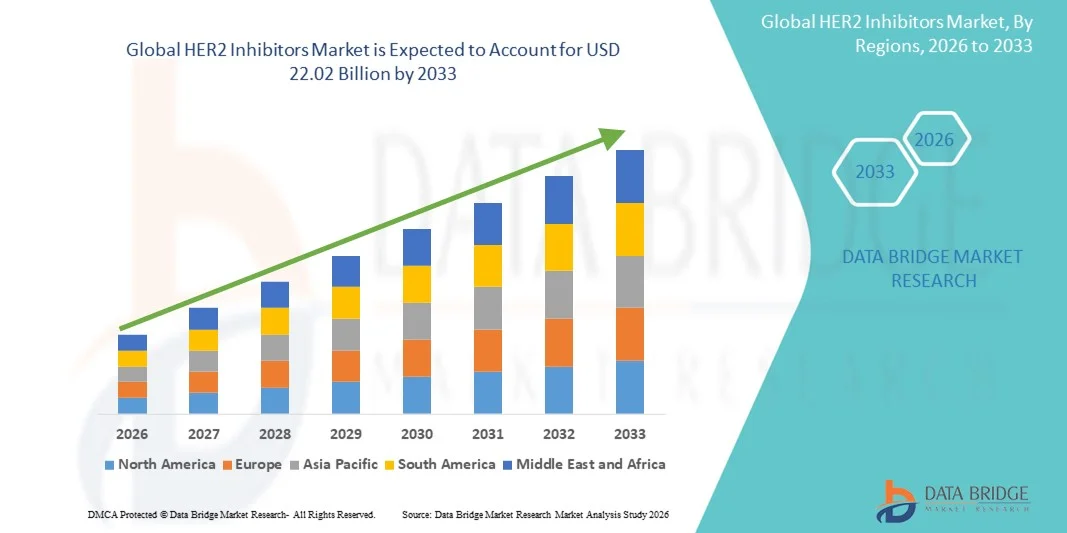
HER2 Inhibitors Market Size
- The global HER2 inhibitors market size was valued at USD 11.05 billion in 2025 and is expected to reach USD 22.02 billion by 2033, at a CAGR of 9.00% during the forecast period
- The market growth is largely fueled by increasing adoption of targeted cancer therapies, especially for HER2-positive and HER2-low breast cancer, along with technological progress in biotechnological R&D and precision oncology
- Furthermore, expansion of treatment indications across gastric and other solid tumors, rising patient-centric care, and widespread HER2 testing are driving demand, positioning HER2 inhibitors as a preferred therapy option and significantly boosting industry growth
HER2 Inhibitors Market Analysis
- HER2 inhibitors, providing targeted therapy for HER2-positive cancers, are becoming essential components of modern oncology treatment regimens due to their ability to selectively target cancer cells, improve patient outcomes, and integrate with combination therapies in both breast and gastric cancers
- The escalating demand for HER2 inhibitors is primarily driven by the increasing prevalence of HER2-positive breast cancer, growing awareness of targeted cancer therapies, and advances in biologics and antibody-drug conjugates that enhance efficacy and reduce side effects
- North America dominated the HER2 inhibitors market with the largest revenue share of 42.8% in 2025, characterized by high adoption of advanced oncology treatments, robust healthcare infrastructure, and strong presence of key pharmaceutical players, with the U.S. witnessing substantial uptake due to early approval of novel HER2-targeted drugs and widespread HER2 testing programs
- Asia-Pacific is expected to be the fastest-growing region in the HER2 inhibitors market during the forecast period due to rising cancer prevalence, increasing healthcare expenditure, and expanding access to innovative targeted therapies
- Combination therapy segment dominated the HER2 inhibitors market with a market share of 54.8% in 2025, driven by improved clinical efficacy, adoption in multiple cancer types including breast and gastric cancers, and integration into standard treatment regimens for enhanced patient outcomes
Report Scope and HER2 Inhibitors Market Segmentation
|
Attributes |
HER2 Inhibitors Key Market Insights |
|
Segments Covered |
|
|
Countries Covered |
North America
Europe
Asia-Pacific
Middle East and Africa
South America
|
|
Key Market Players |
|
|
Market Opportunities |
|
|
Value Added Data Infosets |
In addition to the insights on market scenarios such as market value, growth rate, segmentation, geographical coverage, and major players, the market reports curated by the Data Bridge Market Research also include in-depth expert analysis, patient epidemiology, pipeline analysis, pricing analysis, and regulatory framework |
HER2 Inhibitors Market Trends
Expansion of Targeted Therapy and Personalized Oncology
- A significant and accelerating trend in the global HER2 inhibitors market is the increasing adoption of targeted therapies and personalized treatment plans based on HER2 expression levels, improving clinical outcomes and minimizing side effects
- For instance, trastuzumab deruxtecan has been utilized in HER2-low breast cancer patients, expanding the eligible patient population and demonstrating efficacy where conventional therapies were limited
- Advances in combination therapies, including HER2 inhibitors with immune checkpoint inhibitors or chemotherapy, are enabling more precise, patient-specific treatment regimens, increasing response rates and survival outcomes
- The integration of diagnostic testing, such as companion HER2 assays, with therapy selection allows oncologists to tailor treatments more effectively and monitor therapy response in real time
- Growing investment in R&D for next-generation HER2-targeted drugs, including novel ADCs and bispecific antibodies, is accelerating innovation and expanding treatment options
- Strategic collaborations between biotech and pharmaceutical companies are enhancing global reach, facilitating faster clinical development, and enabling wider patient access to advanced HER2 inhibitors
- This trend towards more precise, patient-centered therapies is reshaping treatment protocols and expectations, with companies such as Roche developing HER2-targeted therapies that incorporate biomarker-driven patient selection
- The demand for HER2 inhibitors with improved specificity and safety profiles is growing rapidly across both developed and emerging oncology markets, as healthcare systems prioritize personalized and targeted cancer care
HER2 Inhibitors Market Dynamics
Driver
Rising Prevalence of HER2-Positive Cancers and Adoption of Targeted Therapies
- The increasing incidence of HER2-positive breast and gastric cancers, coupled with growing awareness of targeted treatment benefits, is a major driver for the escalating demand for HER2 inhibitors
- For instance, in 2025, Roche expanded access to trastuzumab biosimilars globally, enhancing availability of targeted therapy in key markets and supporting patient access programs
- As healthcare providers recognize the superior efficacy of HER2-targeted therapies, their adoption over conventional chemotherapy regimens is accelerating, boosting market growth
- In addition, supportive healthcare policies and reimbursement frameworks in developed regions are encouraging early adoption and broader patient access to HER2 inhibitors
- Increasing integration of HER2 testing in standard oncology diagnostics enables earlier detection and timely initiation of therapy, further driving demand and treatment adoption
- Rising awareness campaigns and advocacy by cancer organizations are improving patient education and encouraging early screening for HER2-positive cancers, indirectly increasing therapy uptake
- Expansion of telemedicine and digital health platforms is enabling better patient monitoring and adherence to HER2-targeted treatment regimens, contributing to market growth
Restraint/Challenge
High Treatment Costs and Limited Accessibility in Emerging Markets
- The high cost of HER2 inhibitors and associated combination therapies presents a significant barrier to broader adoption, particularly in price-sensitive and emerging markets
- For instance, limited availability of trastuzumab and pertuzumab in low-income regions restricts patient access to standard-of-care HER2-targeted treatments
- Manufacturing complexity and regulatory hurdles for novel HER2-targeted therapies, including ADCs, can delay approvals and market entry, slowing adoption
- In addition, disparities in diagnostic infrastructure, such as limited HER2 testing facilities, constrain patient identification and timely initiation of therapy in under-resourced regions
- Addressing affordability through biosimilars, patient assistance programs, and infrastructure expansion is crucial for overcoming these challenges and sustaining global market growth
- Potential side effects and adverse reactions associated with HER2 inhibitors may limit patient adherence and require careful monitoring, posing challenges for widespread use
- Intense competition among existing and emerging HER2-targeted therapies can pressure pricing strategies and slow adoption of newer products in highly regulated markets
HER2 Inhibitors Market Scope
The market is segmented on the basis of treatment, application, end-users, and distribution channel.
- By Treatment
On the basis of treatment, the HER2 inhibitors market is segmented into monotherapy and combination therapy. The combination therapy segment dominated the market with the largest market revenue share of 54.8% in 2025, driven by its superior clinical efficacy and adoption across multiple cancer types including breast and gastric cancers. Combination therapy regimens, often pairing HER2 inhibitors with chemotherapy, immune checkpoint inhibitors, or other targeted agents, provide improved response rates and prolonged progression-free survival. Oncologists prefer combination therapy for high-risk patients due to the ability to target cancer through multiple mechanisms simultaneously. The segment also benefits from growing clinical trial evidence supporting combination regimens and inclusion in standard treatment guidelines. Rising patient awareness and physician recommendation for combination approaches further reinforce its market dominance.
The monotherapy segment is expected to witness the fastest growth rate from 2026 to 2033, driven by the increasing prevalence of HER2-positive cancers and the approval of next-generation HER2 inhibitors that offer potent efficacy with reduced side effects. Monotherapy is particularly appealing for patients who cannot tolerate aggressive combination treatments. Advancements in precision medicine and companion diagnostics allow oncologists to identify suitable candidates for monotherapy, boosting adoption. This segment is also supported by the development of oral HER2-targeted agents, increasing convenience and patient compliance.
- By Application
On the basis of application, the HER2 inhibitors market is segmented into squamous cell carcinoma, gastric cancer, adenocarcinoma, breast cancer, large cell carcinoma, and others. The breast cancer segment dominated the market with the largest revenue share in 2025, owing to the high prevalence of HER2-positive breast cancer globally and the extensive clinical validation of HER2-targeted therapies. Breast cancer treatment guidelines strongly recommend HER2 inhibitors for early-stage, metastatic, and adjuvant settings, reinforcing their widespread use. The segment benefits from robust awareness programs, screening initiatives, and patient access schemes. The high demand for combination therapies and monoclonal antibodies further strengthens its market leadership. Clinical outcomes demonstrating improved survival and quality of life continue to drive growth in this application segment.
The gastric cancer segment is expected to witness the fastest growth during the forecast period, supported by increasing adoption of HER2 testing in gastric tumors and expanding approval of HER2-targeted drugs in multiple regions. Rising incidence of gastric cancer in Asia-Pacific and Latin America contributes to the segment’s growth. Ongoing clinical trials and research into HER2-targeted combination therapies for gastric cancer enhance treatment options. Expansion of healthcare infrastructure and increased patient access in emerging markets also accelerate adoption.
- By End-Users
On the basis of end-users, the market is segmented into clinics, hospitals, and others. The hospital segment dominated the market in 2025 due to the availability of advanced oncology treatment facilities, experienced oncologists, and comprehensive diagnostic capabilities required for administering HER2 inhibitors. Hospitals also benefit from higher patient volumes, structured treatment protocols, and inclusion in clinical trials, which reinforce adoption of targeted therapies. The segment is supported by strong reimbursement frameworks and established supply chains for biologics. Patients often prefer hospital-based treatment for combination therapy due to intensive monitoring requirements.
The clinic segment is anticipated to witness the fastest growth rate during the forecast period, driven by the increasing shift towards outpatient oncology care and decentralized treatment models. Clinics offer easier access for patients in suburban and semi-urban areas and can deliver monotherapy regimens or follow-up treatments conveniently. Growth in specialized oncology clinics, coupled with point-of-care HER2 testing, enhances adoption. Telemedicine integration in clinics further supports patient monitoring and treatment adherence.
- By Distribution Channel
On the basis of distribution channel, the market is segmented into hospital pharmacy, retail pharmacy, and online pharmacy. The hospital pharmacy segment dominated the market in 2025 owing to the direct link with inpatient and outpatient oncology treatment programs, ensuring consistent availability of HER2 inhibitors. Hospitals manage the storage, dosing, and administration of biologics, making this channel the preferred option for high-cost targeted therapies. Strong relationships between pharmaceutical companies and hospital procurement systems enhance supply reliability. The channel also benefits from reimbursement coverage and patient assistance programs that facilitate affordability.
The online pharmacy segment is expected to witness the fastest growth during the forecast period due to increasing digital adoption, improved logistics, and the rise of home delivery services for specialty medications. Patients in remote areas can access HER2 inhibitors conveniently, supporting treatment continuity. Online platforms also provide education, reminders, and adherence tracking, improving patient outcomes. Expansion of telemedicine and e-prescription services further supports the growth of online pharmacies in this segment.
HER2 Inhibitors Market Regional Analysis
- North America dominated the HER2 inhibitors market with the largest revenue share of 42.8% in 2025, characterized by high adoption of advanced oncology treatments, robust healthcare infrastructure, and strong presence of key pharmaceutical players
- Patients and healthcare providers in the region highly value the clinical efficacy, improved survival rates, and safety profiles offered by HER2-targeted treatments, along with the availability of advanced diagnostic tools for accurate HER2 testing
- This widespread adoption is further supported by strong reimbursement policies, robust research and development activities, and the presence of leading pharmaceutical companies, establishing HER2 inhibitors as a preferred treatment option for breast, gastric, and other HER2-positive cancers
U.S. HER2 Inhibitors Market Insight
The U.S. HER2 inhibitors market captured the largest revenue share of 79% in 2025 within North America, fueled by the high prevalence of HER2-positive breast and gastric cancers and early adoption of advanced oncology treatments. Patients and healthcare providers increasingly prioritize targeted therapies due to their proven efficacy, safety, and ability to improve survival outcomes. The growing availability of companion diagnostic tests for HER2 expression further drives treatment uptake. Moreover, the integration of HER2 inhibitors into standard treatment guidelines, combined with strong insurance coverage and patient assistance programs, significantly contributes to market expansion.
Europe HER2 Inhibitors Market Insight
The Europe HER2 inhibitors market is projected to expand at a substantial CAGR throughout the forecast period, primarily driven by the rising incidence of HER2-positive cancers and growing adoption of personalized oncology therapies. Increased awareness of targeted treatment benefits, coupled with stringent healthcare regulations and reimbursement policies, supports widespread usage. The demand for HER2 inhibitors is growing across hospitals, oncology clinics, and specialized cancer centers, with adoption in both early-stage and advanced cancer treatments.
U.K. HER2 Inhibitors Market Insight
The U.K. HER2 inhibitors market is anticipated to grow at a noteworthy CAGR during the forecast period, driven by increasing awareness of targeted therapy benefits and a strong emphasis on early cancer detection. Rising adoption of combination therapy regimens and patient access programs encourages uptake among both hospitals and outpatient clinics. The country’s well-developed healthcare system, coupled with ongoing clinical trials and support for innovative therapies, is expected to continue fueling market growth.
Germany HER2 Inhibitors Market Insight
The Germany HER2 inhibitors market is expected to expand at a considerable CAGR during the forecast period, fueled by the country’s advanced healthcare infrastructure and emphasis on precision medicine. Growing awareness of HER2 testing and availability of state-of-the-art treatment centers support adoption in both residential and commercial healthcare settings. German oncologists increasingly prefer HER2-targeted therapies due to their high efficacy, safety profile, and alignment with local clinical guidelines.
Asia-Pacific HER2 Inhibitors Market Insight
The Asia-Pacific HER2 inhibitors market is poised to grow at the fastest CAGR of 23% during the forecast period of 2026 to 2033, driven by rising cancer prevalence, increasing healthcare expenditure, and expanding access to advanced targeted therapies in countries such as China, Japan, and India. Government initiatives promoting early cancer detection, coupled with rising awareness of HER2 testing and treatment benefits, are supporting market growth. Furthermore, expanding hospital infrastructure and increased availability of HER2 inhibitors at affordable prices are enabling broader patient access.
Japan HER2 Inhibitors Market Insight
The Japan HER2 inhibitors market is gaining momentum due to the country’s high healthcare standards, aging population, and emphasis on precision oncology. Adoption is driven by increasing awareness of HER2-positive cancers, integration of HER2-targeted therapies into treatment protocols, and widespread availability of companion diagnostics. Japanese hospitals and oncology clinics are leveraging targeted therapies to improve patient outcomes, particularly in breast and gastric cancers.
India HER2 Inhibitors Market Insight
The India HER2 inhibitors market accounted for the largest market revenue share in Asia-Pacific in 2025, attributed to rising cancer incidence, expanding healthcare infrastructure, and increasing awareness of targeted therapies. The market benefits from growing adoption in both urban and semi-urban oncology centers. Initiatives promoting early diagnosis, availability of biosimilars, and expanding patient access programs are key factors propelling market growth. Increasing affordability and presence of domestic and international pharmaceutical players further support the market in India.
HER2 Inhibitors Market Share
The HER2 Inhibitors industry is primarily led by well-established companies, including:
- F. Hoffmann La Roche Ltd (Switzerland)
- Daiichi Sankyo Company, Limited (Japan)
- AstraZeneca (U.K.)
- Novartis AG (Switzerland)
- Pfizer Inc. (U.S.)
- Seagen Inc. (U.S.)
- Zymeworks Inc. (Canada)
- Puma Biotechnology, Inc. (U.S.)
- MacroGenics, Inc. (U.S.)
- Mersana Therapeutics, Inc. (U.S.)
- Biocon Biopharmaceuticals Pvt. Ltd. (India)
- Innovent Biologics, Inc. (China)
- Halozyme, Inc. (U.S.)
- Ipsen SA (France)
- Takeda Pharmaceutical Company Limited (Japan)
- Eli Lilly and Company (U.S.)
- Sanofi (France)
- Johnson & Johnson Services, Inc. (U.S.)
- Merck & Co., Inc. (U.S.)
What are the Recent Developments in Global HER2 Inhibitors Market?
- In September 2025, the U.S. FDA granted Priority Review to the sBLA for ENHERTU combined with pertuzumab as first-line therapy for unresectable or metastatic HER2-positive breast cancer, based on the compelling data from the DESTINY-Breast09 trial
- In April 2025, the European Union approved ENHERTU® (trastuzumab deruxtecan) as a monotherapy for adult patients with unresectable or metastatic, hormone receptor–positive HER2‑low (IHC 1+ or 2+) or HER2‑ultralow breast cancer, who have already received at least one line of endocrine therapy
- In January 2025, the U.S. Food and Drug Administration granted approval to datopotamab deruxtecan-dlnk (Datroway), a TROP‑2–directed antibody‑drug conjugate developed by Daiichi Sankyo and AstraZeneca, for adult patients with unresectable or metastatic, hormone receptor (HR)–positive, HER2-negative breast cancer who had already undergone endocrine therapy and chemotherapy
- In November 2024, the FDA granted accelerated approval to zanidatamab-hrii (Ziihera), a bispecific HER2-targeted antibody, for adults with previously treated, unresectable or metastatic HER2-positive biliary tract cancer. This marks a milestone: Ziihera is the first bispecific HER2 antibody approved in this indication, representing a novel mechanism of action
- In April 2024, the U.S. FDA granted accelerated approval for Enhertu (trastuzumab deruxtecan) from Daiichi Sankyo and AstraZeneca to treat a broad range of HER2‑positive solid tumors, not limited to breast cancer, making it a more universally applicable HER2-targeted therapy

- Interactive Data Analysis Dashboard
- Company Analysis Dashboard for high growth potential opportunities
- Research Analyst Access for customization & queries
- Competitor Analysis with Interactive dashboard
- Latest News, Updates & Trend analysis
- Harness the Power of Benchmark Analysis for Comprehensive Competitor Tracking
Data collection and base year analysis are done using data collection modules with large sample sizes. The stage includes obtaining market information or related data through various sources and strategies. It includes examining and planning all the data acquired from the past in advance. It likewise envelops the examination of information inconsistencies seen across different information sources. The market data is analysed and estimated using market statistical and coherent models. Also, market share analysis and key trend analysis are the major success factors in the market report. To know more, please request an analyst call or drop down your inquiry.
The key research methodology used by DBMR research team is data triangulation which involves data mining, analysis of the impact of data variables on the market and primary (industry expert) validation. Data models include Vendor Positioning Grid, Market Time Line Analysis, Market Overview and Guide, Company Positioning Grid, Patent Analysis, Pricing Analysis, Company Market Share Analysis, Standards of Measurement, Global versus Regional and Vendor Share Analysis. To know more about the research methodology, drop in an inquiry to speak to our industry experts.
Data Bridge Market Research is a leader in advanced formative research. We take pride in servicing our existing and new customers with data and analysis that match and suits their goal. The report can be customized to include price trend analysis of target brands understanding the market for additional countries (ask for the list of countries), clinical trial results data, literature review, refurbished market and product base analysis. Market analysis of target competitors can be analyzed from technology-based analysis to market portfolio strategies. We can add as many competitors that you require data about in the format and data style you are looking for. Our team of analysts can also provide you data in crude raw excel files pivot tables (Fact book) or can assist you in creating presentations from the data sets available in the report.












