


Hereditary Hemorrhagic Telangiectasia Disease (HHT) Market Size
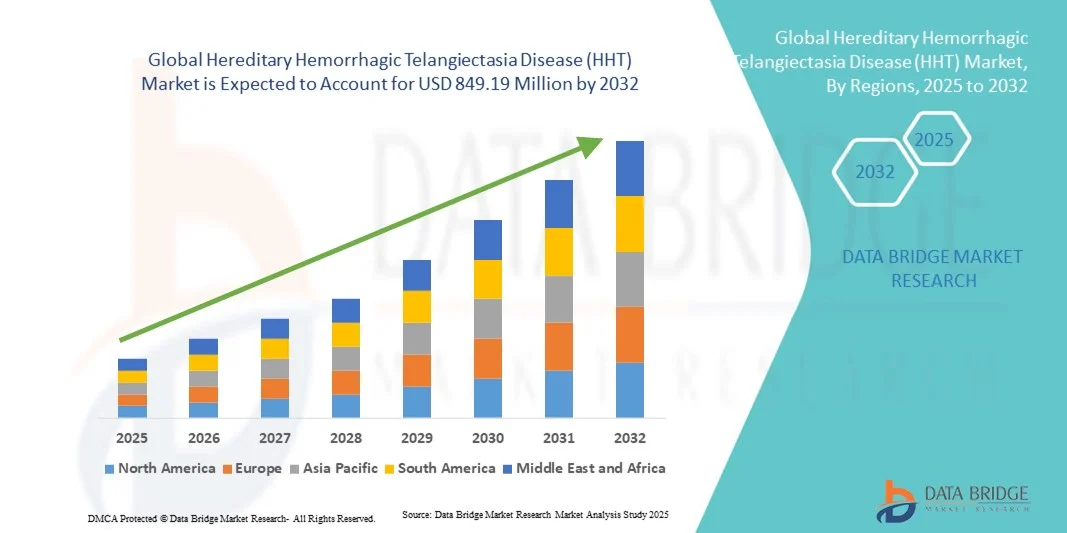
- The global Hereditary Hemorrhagic Telangiectasia Disease (HHT) market size was valued at USD 620.50 million in 2024 and is expected to reach USD 849.19 million by 2032, at a CAGR of 4.00% during the forecast period
- The market growth is primarily driven by increasing awareness and advancements in genetic testing and diagnostic technologies, enabling earlier and more accurate detection of HHT across diverse populations
- Furthermore, rising research initiatives, novel therapeutic developments, and supportive government programs aimed at managing rare genetic disorders are strengthening the market landscape. These combined factors are accelerating the adoption of targeted treatments and improving patient outcomes, thereby significantly propelling the industry’s growth
Hereditary Hemorrhagic Telangiectasia Disease (HHT) Market Analysis
- Hereditary Hemorrhagic Telangiectasia (HHT), a rare genetic vascular disorder characterized by abnormal blood vessel formation, is witnessing growing clinical and research attention as awareness and diagnostic precision improve across global healthcare systems. The market is evolving with advancements in molecular genetics and increased focus on multidisciplinary treatment approaches
- The rising prevalence of HHT, coupled with enhanced understanding of its genetic causes and symptomatic diversity, is fueling demand for effective diagnostic and therapeutic solutions. Increased healthcare spending on rare diseases and the introduction of advanced treatment modalities such as laser therapy and sclerotherapy are further driving market expansion
- North America dominated the HHT market with the largest revenue share of 41.2% in 2024, driven by strong research initiatives, early diagnosis through genetic testing, and the presence of specialized treatment centers. The U.S. remains a key growth contributor, supported by ongoing clinical studies and patient advocacy efforts promoting early intervention
- Asia-Pacific is expected to be the fastest-growing region during the forecast period, owing to improving healthcare infrastructure, rising awareness of genetic disorders, and expanding accessibility to advanced diagnostic tools
- The frequent nosebleeds symptom segment dominated the HHT market with a market share of 38.9% in 2024, as it remains the most prevalent and early clinical manifestation of the disease, often leading patients to seek diagnosis and treatment, thereby contributing significantly to overall market demand
Report Scope and Hereditary Hemorrhagic Telangiectasia Disease (HHT) Market Segmentation
|
Attributes |
Hereditary Hemorrhagic Telangiectasia Disease (HHT) Key Market Insights |
|
Segments Covered |
|
|
Countries Covered |
North America
Europe
Asia-Pacific
Middle East and Africa
South America
|
|
Key Market Players |
|
|
Market Opportunities |
|
|
Value Added Data Infosets |
In addition to the insights on market scenarios such as market value, growth rate, segmentation, geographical coverage, and major players, the market reports curated by the Data Bridge Market Research also include in-depth expert analysis, patient epidemiology, pipeline analysis, pricing analysis, and regulatory framework |
Hereditary Hemorrhagic Telangiectasia Disease (HHT) Market Trends
Advancement in Genetic Diagnostics and Targeted Therapies
- A significant and accelerating trend in the global HHT market is the growing emphasis on genetic diagnostics and precision medicine, enabling early identification of causative gene mutations such as ENG, ACVRL1, and SMAD4. This advancement is reshaping clinical management and treatment outcomes for patients
- For instance, Invitae and Blueprint Genetics offer next-generation sequencing panels that detect pathogenic variants linked to HHT, improving diagnostic accuracy and family screening efficiency. Similarly, ARUP Laboratories has expanded its molecular diagnostic services for hereditary vascular disorders
- Integration of genomic data analytics in HHT management allows for patient-specific therapeutic planning and facilitates more effective clinical decision-making. For instance, studies on anti-angiogenic agents such as bevacizumab have shown promising results in reducing recurrent epistaxis and improving quality of life
- This trend toward precision-based care is fundamentally transforming expectations for rare disease management. Consequently, companies and research organizations are focusing on developing molecularly targeted and biologic therapies designed specifically for vascular malformations in HHT patients
- The demand for accurate genetic testing and gene-targeted therapies is rapidly increasing across developed and emerging healthcare systems, as clinicians and patients seek early detection and individualized treatment strategies for improved disease control
Hereditary Hemorrhagic Telangiectasia Disease (HHT) Market Dynamics
Driver
Rising Disease Awareness and Advances in Therapeutic Approaches
- The growing global awareness of hereditary vascular disorders, coupled with increased availability of advanced genetic testing, is a significant driver behind the expanding HHT market
- For instance, in May 2024, the HHT Foundation International collaborated with NIH researchers to enhance patient registry databases and promote early diagnosis initiatives. Such collaborations are expected to strengthen clinical management and accelerate research progress during the forecast period
- As healthcare providers recognize the chronic complications associated with HHT, such as recurrent nosebleeds and organ arteriovenous malformations, the demand for specialized care centers and targeted treatments is rising rapidly worldwide
- Furthermore, the growing pipeline of clinical trials exploring anti-angiogenic therapies and the adoption of multidisciplinary management frameworks are propelling the market toward more standardized and effective care
- The availability of treatment options such as laser therapy, sclerotherapy, and surgical interventions, combined with improved patient education, is driving higher diagnosis and treatment rates across both hospital and research settings. The increasing investment in rare disease programs by public and private entities further contributes to market expansion
Restraint/Challenge
Limited Treatment Options and Diagnostic Accessibility in Developing Regions
- The absence of approved curative treatments and limited accessibility to specialized diagnostic infrastructure pose a significant challenge to the global HHT market’s growth
- For instance, the scarcity of trained medical professionals familiar with HHT symptoms and the lack of genetic testing facilities in low- and middle-income countries result in frequent underdiagnosis and delayed intervention
- Addressing these gaps through expanded genetic screening programs, international research collaboration, and funding for rare disease infrastructure is critical for improving patient outcomes. Organizations such as Cure HHT emphasize the importance of global clinical networks and telemedicine support to reduce diagnostic disparities
- In addition, the high cost associated with advanced genetic tests and therapies limits adoption in resource-constrained healthcare systems, hindering equitable access
- While awareness campaigns and non-profit initiatives are expanding, sustained investment in healthcare capacity building and affordable diagnostic technologies is essential to overcome these barriers and support long-term market development
Hereditary Hemorrhagic Telangiectasia Disease (HHT) Market Scope
The market is segmented on the basis of symptoms, treatment, and causes.
- By Symptoms
On the basis of symptoms, the HHT market is segmented into frequent nosebleeds, red or dark black blood in stools, shortness of breath, seizures, small strokes, port-wine stain birthmark, and others. The frequent nosebleeds segment dominated the market with the largest revenue share of 38.9% in 2024, as it represents the most common and earliest symptom of HHT, often appearing before other complications. Over 90% of patients experience recurrent epistaxis, making it a critical driver of diagnosis and treatment demand. Hospitals and ENT specialists increasingly rely on endoscopic and laser-based procedures to manage chronic nosebleeds effectively. In addition, pharmaceutical interventions such as anti-angiogenic sprays and topical agents are being developed to address vascular fragility. Rising patient awareness and the availability of minimally invasive solutions further enhance this segment’s prominence. The high prevalence and impact on patient quality of life continue to make it the key focus area within the HHT treatment landscape.
The shortness of breath segment is projected to record the fastest growth rate from 2025 to 2032, primarily due to the growing recognition of pulmonary arteriovenous malformations (PAVMs) as a major cause. These malformations lead to oxygen desaturation and severe respiratory complications, driving demand for screening and interventional treatments. Advancements in imaging technologies, such as contrast echocardiography and CT angiography, are improving early detection rates. In addition, the increased adoption of embolization therapy and post-procedural monitoring is contributing to improved clinical outcomes. Growing patient awareness of respiratory symptoms linked to HHT and the establishment of multidisciplinary HHT centers are also fueling growth. This segment’s expansion reflects the shift toward proactive diagnosis and personalized management in HHT care.
- By Treatment
On the basis of treatment, the HHT market is segmented into laser therapy, surgery, and sclerotherapy. The laser therapy segment dominated the market with the largest revenue share of 42.1% in 2024, as it remains the most preferred intervention for treating epistaxis and skin telangiectasias. Its minimally invasive nature, precision targeting, and quick recovery time make it highly suitable for repeated use in chronic cases. The adoption of advanced laser systems such as Nd:YAG, diode, and KTP lasers has enhanced procedural effectiveness and patient satisfaction. Hospitals and specialty clinics increasingly invest in modern laser devices to improve outcomes and minimize complications. Furthermore, favorable reimbursement policies in developed markets and the growing number of trained professionals have boosted this treatment’s utilization. The continued innovation in laser technology is expected to sustain this segment’s dominance throughout the forecast period.
The sclerotherapy segment is anticipated to witness the fastest CAGR during the forecast period, owing to its effectiveness in treating gastrointestinal and mucosal bleeding associated with HHT. It involves the injection of sclerosants to collapse abnormal vessels, providing long-term symptom relief. The procedure’s affordability, low invasiveness, and suitability for outpatient care have made it increasingly popular among patients and clinicians. Advancements in sclerosant formulations and image-guided techniques are enhancing precision and safety. In addition, ongoing clinical trials exploring optimized sclerotherapy protocols are broadening its therapeutic scope. The growing shift toward less invasive treatment options and the rising prevalence of recurrent telangiectasias are major factors supporting this segment’s growth trajectory.
- By Causes
On the basis of causes, the HHT market is segmented into alcoholism, habitual corticosteroid use, scleroderma, and dermatomyositis. The scleroderma segment dominated the market with a revenue share of 36.8% in 2024, driven by its close association with vascular abnormalities and endothelial dysfunction observed in HHT patients. Both conditions share overlapping angiogenic pathways, prompting increased research into their molecular correlations. Patients with scleroderma often exhibit telangiectasias and chronic vascular fragility, making them more susceptible to HHT-related complications. The rising number of collaborative genetic and clinical studies between autoimmune and vascular research institutes is strengthening diagnostic precision. Hospitals are increasingly adopting combined screening protocols to identify comorbid cases early and improve disease management outcomes. The segment’s growth is further supported by increasing global awareness of connective tissue disorders linked with rare vascular diseases.
The dermatomyositis segment is expected to witness the fastest growth from 2025 to 2032, due to rising recognition of its potential connection to vascular malformations. Patients with dermatomyositis frequently present with telangiectasias and inflammatory damage that can mimic or coexist with HHT features. Advances in immunogenetics and molecular pathology are deepening understanding of shared angiogenic and inflammatory mechanisms. Clinical collaborations between rheumatology and genetic departments are enhancing diagnostic accuracy and patient care integration. In addition, growing investment in rare autoimmune disease research and availability of advanced imaging tools are facilitating early detection. The segment’s expansion is supported by multidisciplinary approaches aimed at understanding the vascular overlap between autoimmune and hereditary conditions.
Hereditary Hemorrhagic Telangiectasia Disease (HHT) Market Regional Analysis
- North America dominated the HHT market with the largest revenue share of 41.2% in 2024, driven by strong research initiatives, early diagnosis through genetic testing, and the presence of specialized treatment centers
- The region benefits from advanced genetic testing infrastructure, active government and non-profit initiatives, and robust research collaborations focusing on novel diagnostic and therapeutic approaches for HHT management
- This widespread progress is further supported by high healthcare expenditure, favorable reimbursement policies, and a growing patient registry network that enhances early detection and treatment accessibility, establishing North America as the leading hub for innovation and patient care in the global HHT market
U.S. Hereditary Hemorrhagic Telangiectasia Disease (HHT) Market Insight
The U.S. hereditary hemorrhagic telangiectasia (HHT) market captured the largest revenue share of 82% in 2024 within North America, fueled by the presence of leading research institutions, advanced diagnostic infrastructure, and strong government support for rare disease management. The growing adoption of genetic testing and molecular diagnostics is accelerating early detection and personalized treatment approaches. Increasing collaborations between universities, biotech firms, and organizations such as Cure HHT are further enhancing clinical research and patient care. Moreover, the U.S. healthcare system’s emphasis on precision medicine and patient registries is significantly contributing to the market’s overall expansion.
Europe Hereditary Hemorrhagic Telangiectasia Disease (HHT) Market Insight
The Europe HHT market is projected to expand at a substantial CAGR throughout the forecast period, driven by increasing awareness of rare genetic disorders and the availability of specialized HHT treatment centers across the region. Governments and healthcare agencies are actively supporting initiatives for early diagnosis and management of hereditary vascular diseases. Growing access to advanced imaging and genetic testing technologies is fostering improved detection and clinical outcomes. The region also benefits from collaborative efforts under the European Reference Networks (ERNs), promoting research and patient data sharing. Expanding diagnostic coverage and supportive healthcare policies are expected to strengthen Europe’s HHT market further.
U.K. Hereditary Hemorrhagic Telangiectasia Disease (HHT) Market Insight
The U.K. HHT market is anticipated to grow at a noteworthy CAGR during the forecast period, driven by the presence of dedicated rare disease frameworks and improved patient awareness. Increasing government funding for genomic medicine and the expansion of genetic testing programs under the NHS are accelerating early diagnosis rates. For instance, the Genomic Medicine Service integrates genetic data into healthcare planning, benefiting HHT patients. Furthermore, partnerships between academic institutions and patient advocacy groups are promoting clinical trials and awareness campaigns. The U.K.’s proactive stance on rare disease management positions it as a key regional contributor.
Germany Hereditary Hemorrhagic Telangiectasia Disease (HHT) Market Insight
The Germany HHT market is expected to expand at a considerable CAGR during the forecast period, supported by advanced healthcare infrastructure, strong genetic research capabilities, and high adoption of diagnostic innovations. Germany’s emphasis on precision medicine and its collaboration with European research networks are driving advancements in HHT detection and treatment. The availability of specialized vascular clinics and nationwide patient registries ensures improved disease management and long-term monitoring. Moreover, the country’s focus on healthcare digitalization and multidisciplinary care models is encouraging early intervention, positioning Germany as a leading hub for HHT innovation in Europe.
Asia-Pacific Hereditary Hemorrhagic Telangiectasia Disease (HHT) Market Insight
The Asia-Pacific HHT market is poised to grow at the fastest CAGR of 23.5% from 2025 to 2032, driven by rising awareness of hereditary disorders, expanding healthcare infrastructure, and increasing adoption of genetic testing in countries such as China, Japan, and India. Government-led initiatives promoting rare disease research and screening programs are improving diagnosis rates across the region. The growing presence of research collaborations with Western institutions and rising healthcare spending further enhance market opportunities. As APAC’s diagnostic capabilities advance and patient advocacy groups expand, access to HHT testing and treatment is expected to increase significantly.
Japan Hereditary Hemorrhagic Telangiectasia Disease (HHT) Market Insight
The Japan HHT market is gaining momentum due to the country’s focus on precision healthcare, strong research infrastructure, and an aging population increasingly susceptible to vascular conditions. The integration of next-generation sequencing technologies into clinical practice supports early genetic diagnosis and familial screening. Japan’s healthcare system emphasizes multidisciplinary management, combining genetic counseling, imaging, and interventional therapy. Research collaborations between hospitals and universities are advancing novel treatment methods, including anti-angiogenic therapies. Moreover, the government’s initiatives to improve rare disease care accessibility are reinforcing Japan’s leadership in the APAC HHT landscape.
India Hereditary Hemorrhagic Telangiectasia Disease (HHT) Market Insight
The India HHT market accounted for the largest revenue share in Asia-Pacific in 2024, attributed to expanding diagnostic networks, improving healthcare accessibility, and a rapidly developing biotechnology sector. The rising number of genetic testing laboratories and increased participation in international rare disease research programs are driving awareness and early detection. The government’s focus on healthcare digitalization and initiatives such as the National Rare Disease Policy are supporting patient care and treatment funding. Moreover, the growth of domestic biotech companies and collaborations with global institutions are expected to enhance diagnostic accuracy and treatment availability, positioning India as a key emerging market in the HHT landscape.
Hereditary Hemorrhagic Telangiectasia Disease (HHT) Market Share
The Hereditary Hemorrhagic Telangiectasia Disease (HHT) industry is primarily led by well-established companies, including:
- Vaderis (Switzerland)
- Diagonal Therapeutics, Inc. (U.S.)
- Blueprint Genetics Oy. (Finland)
- ARUP Laboratories (U.S.)
- Natera, Inc. (U.S.)
- Lumenis Be Ltd. (Israel)
- Cook (U.S.)
- Genentech (U.S.)
- Labcorp (U.S.)
- Terumo Corporation (Japan)
- Cure HHT (U.S.)
- Cincinnati Children’s Hospital Medical Center (U.S.)
- Stanford Health Care (U.S.)
- Mayo Foundation for Medical Education and Research (U.S.)
- CSL Behring LLC (U.S.)
- Takeda Pharmaceutical Company Limited (Japan)
- F. Hoffmann-La Roche Ltd (Switzerland)
- Bayer AG (Germany)
- Pfizer Inc. (U.S.)
- Ionis Pharmaceuticals, Inc. (U.S.)
What are the Recent Developments in Global Hereditary Hemorrhagic Telangiectasia Disease (HHT) Market?
- In March 2025, Diagonal Therapeutics initiated a natural history observational study in collaboration with Cure HHT, aimed at building a comprehensive understanding of disease progression, clinical burden, and quality-of-life outcomes among adults living with HHT. The study is designed to collect longitudinal data on symptoms such as recurrent nosebleeds, anemia, and arteriovenous malformations
- In December 2024, Diagonal Therapeutics announced that it would present a Health-Economics and Outcomes Research (HEOR) study on HHT at the American Society of Hematology (ASH) Annual Meeting. The study quantified both the clinical and economic burden associated with HHT, revealing significant healthcare costs, transfusion dependencies, and productivity losses among patients
- In November 2024, Vaderis Therapeutics received Fast Track designation from the U.S. Food and Drug Administration (FDA) for VAD044, its first-in-class oral allosteric AKT inhibitor, developed for treating HHT. This designation accelerates the drug’s clinical review and facilitates closer FDA guidance, recognizing its potential to fulfill a major unmet medical need. VAD044 aims to reduce abnormal blood vessel formation and bleeding events characteristic of HHT
- In August 2024, Vaderis Therapeutics announced positive clinical proof-of-concept results for VAD044 in HHT patients, showing significant reductions in epistaxis (nosebleeds) frequency and improvements in quality of life. Conducted in collaboration with leading European clinical centers, the study demonstrated the therapeutic potential of targeting AKT signaling pathways involved in vascular malformations. These promising results support advancement toward larger pivotal trials
- In April 2024, Diagonal Therapeutics launched with US USD 128 million in Series A financing, backed by prominent investors to pioneer agonist antibody therapies for genetic vascular disorders, including HHT. The company’s platform focuses on restoring signaling balance in pathways disrupted by mutations in HHT genes (ENG, ACVRL1, SMAD4). Its lead candidate targets activin receptor-such as kinase modulation, potentially reversing abnormal vessel formation and chronic bleeding

- Interactive Data Analysis Dashboard
- Company Analysis Dashboard for high growth potential opportunities
- Research Analyst Access for customization & queries
- Competitor Analysis with Interactive dashboard
- Latest News, Updates & Trend analysis
- Harness the Power of Benchmark Analysis for Comprehensive Competitor Tracking
Data collection and base year analysis are done using data collection modules with large sample sizes. The stage includes obtaining market information or related data through various sources and strategies. It includes examining and planning all the data acquired from the past in advance. It likewise envelops the examination of information inconsistencies seen across different information sources. The market data is analysed and estimated using market statistical and coherent models. Also, market share analysis and key trend analysis are the major success factors in the market report. To know more, please request an analyst call or drop down your inquiry.
The key research methodology used by DBMR research team is data triangulation which involves data mining, analysis of the impact of data variables on the market and primary (industry expert) validation. Data models include Vendor Positioning Grid, Market Time Line Analysis, Market Overview and Guide, Company Positioning Grid, Patent Analysis, Pricing Analysis, Company Market Share Analysis, Standards of Measurement, Global versus Regional and Vendor Share Analysis. To know more about the research methodology, drop in an inquiry to speak to our industry experts.
Data Bridge Market Research is a leader in advanced formative research. We take pride in servicing our existing and new customers with data and analysis that match and suits their goal. The report can be customized to include price trend analysis of target brands understanding the market for additional countries (ask for the list of countries), clinical trial results data, literature review, refurbished market and product base analysis. Market analysis of target competitors can be analyzed from technology-based analysis to market portfolio strategies. We can add as many competitors that you require data about in the format and data style you are looking for. Our team of analysts can also provide you data in crude raw excel files pivot tables (Fact book) or can assist you in creating presentations from the data sets available in the report.












