


What is the Global Home Office Spending Market Size and Growth Rate?
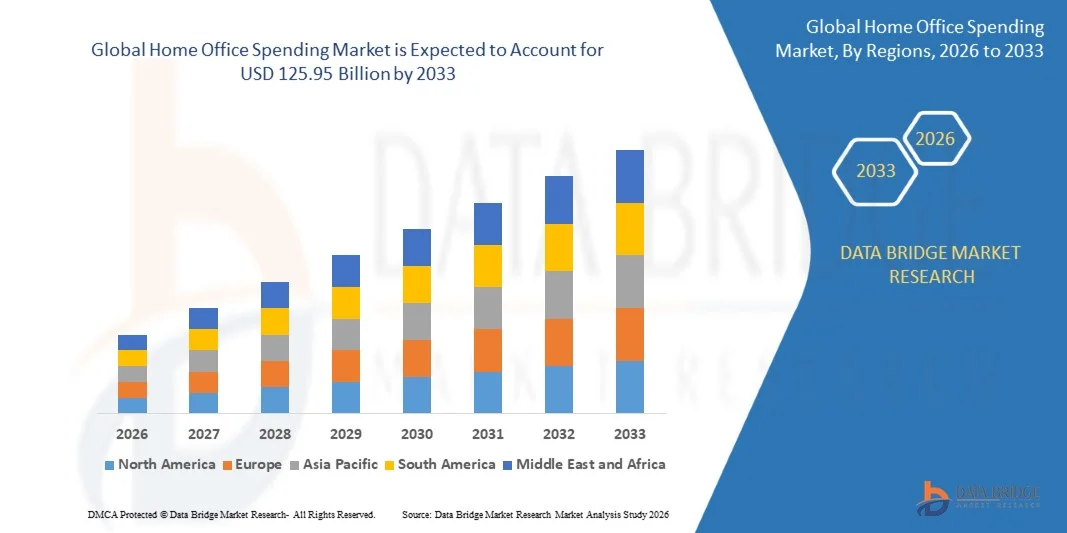
- As per Data Bridge Market Research Analysis the global home office spending market size was valued at USD 39.22 billion in 2025 and is expected to reach USD 125.95 billion by 2033, at a CAGR of 15.70% during the forecast period
- Major factors that are expected to boost the growth of the home office spending market in the forecast period are the rise in the convergence of data with the accuracy and high speed
- Furthermore, the increase in the need for efficient computing is further anticipated to propel the growth of the home office spending market. On the other hand, the rise in the cost and the concerns regarding the data security is further projected to impede the growth of the home office spending market in the timeline period
Market Size & Forecast
- Global Market Value (2025): USD 39.22 billion
- Expected Market Value (2033): USD 125.95 billion
- Forecast CAGR (2026–2033): 15.70%
What are the Major Takeaways of Home Office Spending Market?
- The cloud models are exhibiting to be highly favourable platforms for the remote working schemes will further provide potential opportunities for the growth of the home office spending market in the coming years
- However, the dearth of communication infrastructure might further challenge the growth of the home office spending market in the near future
- North America dominated the home office spending market with a 39.64% revenue share in 2025, driven by the strong presence of remote-first enterprises, advanced broadband infrastructure, and high purchasing power across the U.S. and Canada
- Asia-Pacific is projected to register the fastest CAGR of 9.47% from 2026 to 2033, driven by rapid urban digitalization, expanding freelance economies, rising startup culture, and improving broadband penetration across China, Japan, India, South Korea, and Southeast Asia
- The Tools segment dominated the market with a 62.4% share in 2025, driven by strong consumer and enterprise spending on laptops, external monitors, ergonomic chairs, standing desks, headsets, webcams, routers, and licensed productivity software
Report Scope and Home Office Spending Market Segmentation
|
Attributes |
Home Office Spending Key Market Insights |
|
Segments Covered |
|
|
Countries Covered |
North America
Europe
Asia-Pacific
Middle East and Africa
South America
|
|
Key Market Players |
|
|
Market Opportunities |
|
|
Value Added Data Infosets |
|
What is the Key Trend in the Home Office Spending Market?
“Rising Adoption of Integrated Digital Work Ecosystems for Hybrid Professionals”
- The home office spending market is experiencing strong growth in all-in-one digital ecosystems that combine computing devices, collaboration software, ergonomic furniture, and smart peripherals to create seamless remote work environments
- Manufacturers are launching AI-powered productivity tools, smart lighting systems, ultra-wide monitors, and advanced video conferencing equipment to enhance workflow efficiency and virtual engagement quality
- Increasing preference for minimalist, modular, and tech-enabled workspace designs is influencing purchasing behavior among urban professionals and remote employees
- For instance, companies such as Microsoft Corporation, Dell Technologies, HP Inc., and Cisco Systems are expanding integrated device and collaboration portfolios tailored for hybrid workforces
- Growing emphasis on digital wellness, cybersecurity, and uninterrupted connectivity is accelerating spending on optimized home office ecosystems
- As hybrid work models stabilize globally, home office investments will remain essential for sustaining productivity, flexibility, and enterprise-grade remote operations
What are the Key Drivers of Home Office Spending Market?
- Expanding implementation of remote and hybrid workplace strategies across enterprises is significantly increasing investments in home office infrastructure and collaboration technologies
- For instance, in 2025, providers such as Amazon Web Services and Google LLC enhanced cloud productivity and collaboration ecosystems to support distributed teams worldwide
- Rising penetration of high-speed broadband, cloud storage, and SaaS-based workflow platforms is enabling efficient remote operations across the U.S., Europe, and Asia-Pacific
- Growing awareness of ergonomic health risks and employee well-being is driving purchases of adjustable desks, ergonomic chairs, and optimized lighting systems
- Increasing number of freelancers, remote consultants, and digital startups is sustaining long-term demand for scalable and affordable home office setups
- Backed by enterprise reimbursements, digital transformation initiatives, and expanding online retail channels, the Home Office Spending market is projected to maintain steady long-term growth
Which Factor is Challenging the Growth of the Home Office Spending Market?
- High initial costs of premium ergonomic furniture, advanced computing devices, and enterprise-grade collaboration tools limit affordability among budget-conscious consumers
- For instance, during 2024–2025, volatility in semiconductor supply chains and rising logistics expenses increased prices of laptops, monitors, and networking hardware globally
- Space constraints in compact urban housing reduce feasibility of dedicated office installations, especially in densely populated metropolitan regions
- Rapid innovation cycles and compatibility concerns among hardware and software systems create purchasing uncertainty and shorter replacement timelines
- Partial return-to-office policies in certain industries may slow incremental spending growth in specific developed markets
- To mitigate these barriers, companies are emphasizing bundled pricing models, subscription-based device access, compact modular furniture, and direct-to-consumer online distribution strategies, strengthening global adoption of home office solutions
How is the Home Office Spending Market Segmented?
The market is segmented on the basis of solution, deployment, and vertical.
• By Solution
On the basis of solution, the home office spending market is segmented into Tools and Services. The Tools segment dominated the market with a 62.4% share in 2025, driven by strong consumer and enterprise spending on laptops, external monitors, ergonomic chairs, standing desks, headsets, webcams, routers, and licensed productivity software. Remote professionals prioritize reliable hardware and collaboration tools to maintain seamless communication, workflow efficiency, and digital task management. Corporate reimbursement programs, bundled hardware-software packages, and e-commerce availability further strengthen segment growth across SMEs and large enterprises.
The Services segment is expected to grow at the fastest CAGR from 2026 to 2033, supported by increasing demand for managed IT services, remote device monitoring, cybersecurity support, cloud migration consulting, and virtual workspace optimization. As home office environments become more security-sensitive and digitally complex, subscription-based and managed service offerings are gaining rapid traction.
• By Deployment
On the basis of deployment, the home office spending market is segmented into Cloud and On-Premises. The Cloud segment dominated the market with a 68.7% share in 2025, attributed to rising adoption of SaaS-based collaboration tools, cloud storage platforms, unified communication systems, and workflow automation software. Cloud deployment enables real-time access to files, remote synchronization, automatic updates, and enterprise-grade data security without heavy infrastructure investments. Organizations prefer cloud models for scalability, flexibility, and cost efficiency in supporting distributed teams.
The Cloud segment is also projected to grow at the fastest CAGR from 2026 to 2033, driven by increasing integration of AI-powered productivity tools, advanced cybersecurity layers, and cross-device accessibility. Rapid enterprise digital transformation and expansion of remote-first strategies are expected to sustain strong cloud-based adoption globally.
• By Vertical
On the basis of vertical, the home office spending market is segmented into Business Productivity, Information Security, Enterprise Communication, and Others. The Business Productivity segment dominated the market with a 38.9% share in 2025, fueled by widespread use of project management platforms, office suites, workflow automation software, and document collaboration tools. Enterprises continue to invest heavily in productivity-enhancing technologies to maintain efficiency across remote and hybrid workforces.
The Information Security segment is expected to grow at the fastest CAGR from 2026 to 2033, propelled by rising cyber threats, increased remote network vulnerabilities, and stricter data protection regulations. Adoption of VPNs, endpoint security solutions, encrypted communication tools, and identity access management systems is accelerating rapidly. As remote work ecosystems expand, secure digital infrastructure will remain critical for sustainable market growth.
Which Region Holds the Largest Share of the Home Office Spending Market?
- North America dominated the home office spending market with a 39.64% revenue share in 2025, driven by the strong presence of remote-first enterprises, advanced broadband infrastructure, and high purchasing power across the U.S. and Canada. Widespread adoption of hybrid work policies continues to fuel spending on laptops, ergonomic furniture, enterprise collaboration software, cybersecurity tools, and smart office accessories across residential workspaces
- Major technology providers in the region are consistently launching AI-enabled productivity platforms, secure cloud collaboration suites, and integrated communication ecosystems, strengthening North America’s leadership in digital workplace innovation. Continuous investments in SaaS, endpoint security, and remote IT management solutions further support long-term market growth
- High digital literacy, corporate reimbursement programs, and a well-established e-commerce distribution network further reinforce the region’s dominance in home office equipment and services
U.S. Home Office Spending Market Insight
The U.S. represents the largest share within North America, supported by enterprise-wide digital transformation initiatives and strong remote workforce penetration across IT, finance, healthcare, consulting, and education sectors. Increasing demand for secure cloud storage, VPN solutions, AI-powered collaboration tools, and premium ergonomic furniture continues to drive sustained investment and innovation.
Canada Home Office Spending Market Insight
Canada contributes significantly due to growing hybrid work adoption, government-backed digital initiatives, and expansion of tech startups. Rising focus on cybersecurity solutions, digital communication platforms, and optimized home workspace design strengthens national market expansion.
Asia-Pacific Home Office Spending Market
Asia-Pacific is projected to register the fastest CAGR of 9.47% from 2026 to 2033, driven by rapid urban digitalization, expanding freelance economies, rising startup culture, and improving broadband penetration across China, Japan, India, South Korea, and Southeast Asia. Increasing adoption of cloud-based productivity tools and affordable computing devices accelerates regional demand.
China Home Office Spending Market Insight
China leads regional growth due to strong consumer electronics production, expanding remote workforce adoption, and robust e-commerce ecosystems supporting widespread access to home office products.
Japan Home Office Spending Market Insight
Japan demonstrates steady growth supported by advanced digital infrastructure, enterprise modernization strategies, and increasing demand for secure collaboration tools and compact ergonomic solutions.
India Home Office Spending Market Insight
India is emerging rapidly due to expanding IT services, startup ecosystems, freelance professionals, and affordable internet access, boosting purchases of computing devices and collaboration software.
South Korea Home Office Spending Market Insight
South Korea contributes significantly through strong broadband networks, high digital adoption rates, and rising demand for premium computing devices and secure communication platforms, sustaining long-term market growth.
Which are the Top Companies in Home Office Spending Market?
The home office spending industry is primarily led by well-established companies, including:
- Oracle (U.S.)
- Google LLC (U.S.)
- Cisco Systems Inc. (U.S.)
- Avaya Inc. (U.S.)
- Microsoft Corporation (U.S.)
- Amazon Web Services, Inc. (U.S.)
- Panasonic Corporation (Japan)
- Plantronics, Inc. (U.S.)
- Tech Mahindra Limited (India)
- Huawei Technologies Co., Ltd. (China)
- Motorola Solutions, Inc. (U.S.)
- SAP (Germany)
- Cognizant (U.S.)
- Dell (U.S.)
- IBM (U.S.)
- Marlabs Inc. (U.S.)
- Broadcom Inc. (U.S.)
- Hewlett Packard Enterprise Development LP (U.S.)
- Alcor (U.S.)
- Happiest Minds (India)
What are the Recent Developments in Global Home Office Spending Market?
- In Dec 2023, Oracle was recognized as a Leader in Gartner’s Magic Quadrant for Strategic Cloud Platform Services, reflecting its strong momentum in cloud infrastructure, platform capabilities, and digital transformation offerings, with Oracle Cloud Infrastructure providing secure, high-performance, and flexible solutions across IaaS, PaaS, and SaaS environments to meet diverse enterprise and regulatory demands, thereby reinforcing its competitive positioning in the global cloud ecosystem
- In Jan 2023, Amazon Web Services announced that Zurich Insurance Group would migrate its enterprise IT infrastructure to AWS, enabling the insurer to utilize AWS’s scalable global cloud network along with advanced analytics and machine learning capabilities to enhance digital customer engagement and operational automation, ultimately strengthening its long-term digital transformation strategy and service innovation roadmap

- Interactive Data Analysis Dashboard
- Company Analysis Dashboard for high growth potential opportunities
- Research Analyst Access for customization & queries
- Competitor Analysis with Interactive dashboard
- Latest News, Updates & Trend analysis
- Harness the Power of Benchmark Analysis for Comprehensive Competitor Tracking
Data collection and base year analysis are done using data collection modules with large sample sizes. The stage includes obtaining market information or related data through various sources and strategies. It includes examining and planning all the data acquired from the past in advance. It likewise envelops the examination of information inconsistencies seen across different information sources. The market data is analysed and estimated using market statistical and coherent models. Also, market share analysis and key trend analysis are the major success factors in the market report. To know more, please request an analyst call or drop down your inquiry.
The key research methodology used by DBMR research team is data triangulation which involves data mining, analysis of the impact of data variables on the market and primary (industry expert) validation. Data models include Vendor Positioning Grid, Market Time Line Analysis, Market Overview and Guide, Company Positioning Grid, Patent Analysis, Pricing Analysis, Company Market Share Analysis, Standards of Measurement, Global versus Regional and Vendor Share Analysis. To know more about the research methodology, drop in an inquiry to speak to our industry experts.
Data Bridge Market Research is a leader in advanced formative research. We take pride in servicing our existing and new customers with data and analysis that match and suits their goal. The report can be customized to include price trend analysis of target brands understanding the market for additional countries (ask for the list of countries), clinical trial results data, literature review, refurbished market and product base analysis. Market analysis of target competitors can be analyzed from technology-based analysis to market portfolio strategies. We can add as many competitors that you require data about in the format and data style you are looking for. Our team of analysts can also provide you data in crude raw excel files pivot tables (Fact book) or can assist you in creating presentations from the data sets available in the report.













