


What is the Imaging Infrared Light Emitting Diode (LED) Market Size and Growth Rate?
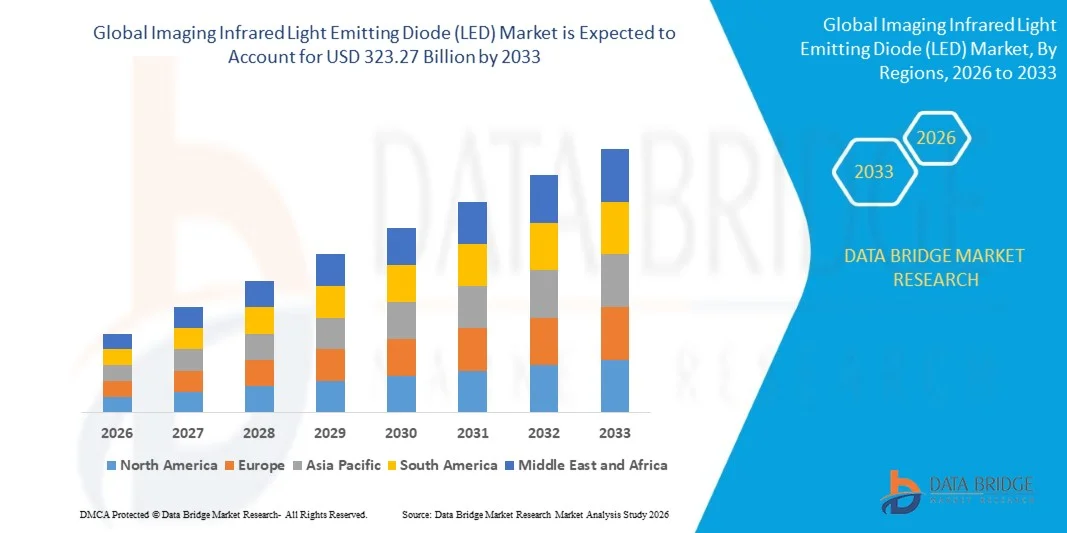
- As per Data Bridge Market Research analysis, the imaging infrared light emitting diode (LED) market was valued at USD 97.93 billion in 2025 and is projected to reach USD 323.27 billion by 2033, growing at a CAGR of 16.10% from 2026 to 2033.
- The market is experiencing strong growth driven by rising demand for infrared imaging and sensing technologies, expanding applications in consumer electronics and automotive systems, and continued advancements in infrared LED efficiency, wavelength precision, and compact device designs.
- The increasing adoption of night vision, surveillance, biometric identification, driver monitoring, and industrial imaging systems, combined with the growing integration of infrared LEDs into advanced sensing platforms, is compelling automotive, defense, healthcare, consumer electronics, and industrial organizations to adopt imaging infrared LED technologies. Improvements in high-power LEDs, miniaturization, and energy-efficient infrared illumination are further expanding their use across imaging and sensing applications.
Market Size & Forecast
- Global Market Value (2025): USD 97.93 Billion
- Expected Market Value (2033): USD 323.27 Billion
- Forecast CAGR (2026–2033): 16.10%
- Leading Region in 2025: North America
- Fastest Growing Region: Asia Pacific
What are the Major Takeaways of the Imaging Infrared Light Emitting Diode (LED) Market?
- North America dominated the imaging infrared light emitting diode (LED) market with the largest revenue share of 30.4% in 2025, supported by strong adoption across automotive, aerospace and defense, healthcare, surveillance, and consumer electronics applications.
- Asia-Pacific is expected to be the fastest-growing region at a CAGR of 17.2% from 2026 to 2033, fueled by expanding electronics manufacturing, semiconductor production, automotive applications, industrial automation, and increasing adoption of infrared sensing and imaging technologies
- The 850nm–940nm segment led the market with a 34% share in 2025, driven by strong sensor responsivity and extensive use in object detection, biometric monitoring, and machine vision.
- 1020nm–1720nm are the fastest-growing spectral range type, projected to register a CAGR of 18%, reflecting the surge in adoption of specialized short-wave infrared imaging.
- The medium segment dominated the power type category with a 40% revenue share in 2025, led by its balance between optical output, energy efficiency, and thermal requirements.
- Emitters accounted for 38% of the market share in 2025, preferred by manufacturers and system integrators for their high optical output, compact design, fast response, and suitability for infrared illumination applications
- The infrared LED chip segment is the fastest-growing technology category, with a CAGR of 18.4%, driven by continuing semiconductor innovation and miniaturization.
Report Scope and Imaging Infrared Light Emitting Diode (LED) Market Segmentation
|
Attributes |
Imaging Infrared Light Emitting Diode (LED) Key Market Insights |
|
Segments Covered |
|
|
Countries Covered |
North America
Europe
Asia-Pacific
Middle East and Africa
South America
|
|
Key Market Players |
|
|
Market Opportunities |
|
|
Value Added Data Infosets |
In addition to the insights on market scenarios such as market value, growth rate, segmentation, geographical coverage, and major players, the market reports curated by the Data Bridge Market Research also include in-depth expert analysis, geographically represented company-wise production and capacity, network layouts of distributors and partners, detailed and updated price trend analysis and deficit analysis of supply chain and demand. |
What is the Key Trend in the Imaging Infrared Light Emitting Diode (LED) Market?
- Automotive in-cabin sensing is increasingly driving demand for high-power infrared LEDs, particularly for driver monitoring, occupant monitoring, child-presence detection, and night-time vision applications where reliable illumination is required under low-light conditions.
- For instance, in October 2025, ams OSRAM introduced new infrared emitters for earbuds that combine vital-sign monitoring with proximity detection. The 850 nm and 940 nm emitters use IR:6 technology to reduce power consumption and extend battery life, demonstrating the growing integration of infrared illumination into compact wearable imaging and sensing devices.
- 940 nm infrared LEDs are gaining greater adoption because they provide effective near-infrared illumination while producing reduced visible red glow, making them suitable for discreet automotive and consumer sensing applications.
- Miniaturization and higher optical efficiency are becoming important product-development priorities, as manufacturers seek to integrate infrared emitters into compact cameras, wearable devices, biometric systems, and other space-constrained imaging platforms.
- AI-enabled biometric and three-dimensional imaging applications are expanding infrared LED utilization, particularly as facial recognition, eye tracking, and depth sensing require controlled infrared illumination for accurate image capture.
- For instance, in January 2025, ams OSRAM showcased infrared illumination technology for AR glasses at CES 2025, highlighting IR-based eye tracking as an important technology for lightweight augmented-reality devices while incorporating measures to control IR exposure and maintain eye safety.
- Automotive sensing manufacturers are also developing increasingly integrated infrared illumination systems, combining high-current LED drivers, thermal management, diagnostics, and precise pulse control to improve imaging performance while meeting vehicle safety requirements.
What are the Key Drivers of the Imaging Infrared Light Emitting Diode (LED) Market?
- The rapid expansion of advanced driver-assistance systems (ADAS), driver monitoring systems (DMS), and occupant monitoring systems (OMS) is increasing demand for high-performance infrared LEDs capable of providing consistent illumination to in-cabin cameras under daytime and nighttime conditions.
- For instance, in May 2023, ams OSRAM announced its TARA2000-AUT-SAFE 940 nm infrared emitter family for automotive in-cabin sensing, with versions optimized for driver monitoring and cabin monitoring using 2D near-infrared and 3D time-of-flight cameras. The company stated that a top-10 global car manufacturer had selected the technology for a new vehicle design, with mass production
- Increasing vehicle automation and stricter safety requirements are encouraging automakers to deploy infrared-based sensing for driver attention, drowsiness detection, occupant classification, child-presence detection, and night-time perception, expanding the addressable market for infrared LED components.
- Consumer electronics is another important growth driver, as facial recognition, eye tracking, biometric authentication, and health-monitoring devices increasingly depend on infrared emitters and cameras to collect reliable optical information without relying on visible illumination.
- For instance, in January 2024, ams OSRAM demonstrated infrared LED and VCSEL technologies for automotive in-cabin sensing at CES 2024, including hands-on detection systems that use infrared illumination to determine whether a driver's hands are on the steering wheel, supporting safety requirements in semi-autonomous vehicles.
- The automotive electronics ecosystem is simultaneously increasing investment in high-current, compact, thermally controlled IR LED drivers, allowing infrared emitters to deliver higher optical output while satisfying stringent automotive reliability and safety requirements.
Which Factors are Challenging the Growth of the Imaging Infrared Light Emitting Diode (LED) Market?
- High-performance infrared LEDs require careful thermal and electrical management, particularly in imaging systems using high-current pulsed illumination, increasing component complexity and system-design requirements.
- For instance, in March 2025, ams OSRAM stated that high-power infrared emitters operating at DC currents of at least 1 A and pulsed currents of 2 A or more require careful thermal management, as heat dissipation becomes an important design consideration in high-output IR illumination systems.
- The need for precise wavelength, optical power, beam angle, and current control can increase development and qualification costs, particularly for automotive applications requiring consistent performance across wide temperature ranges.
- Photobiological safety requirements can also complicate product development because infrared LED systems must be evaluated for exposure risks when used close to human eyes, particularly in automotive and wearable applications.
- For instance, in May 2025, ams OSRAM highlighted multiple potential fault conditions—including excessive current or voltage, incorrect pulse duration, mechanical damage, overheating, and cold-temperature effects that can increase infrared output beyond safe exposure limits, demonstrating the additional safety and control requirements for high-power IR systems
- High-power infrared illumination can also require additional protection and thermal-control circuitry, increasing system cost and limiting the design flexibility of compact imaging devices where available space and heat dissipation are constrained.
How is the Imaging Infrared Light Emitting Diode (LED) Market Segmented?
The imaging infrared light emitting diode (LED) market is segmented on the basis of spectral range, power, function, technology, and end-use.
- By Spectral Range
On the basis of spectral range, the imaging infrared LED market is segmented into 700nm–850nm, 850nm–940nm, 940nm–1020nm, and 1020nm–1720nm. The 850nm–940nm segment dominated the market with 34% share in 2025, owing to strong sensor responsivity and extensive use in object detection, biometric monitoring, and machine vision. These wavelengths are widely compatible with imaging sensors used in industrial automation and security applications. The segment also provides effective infrared illumination for low-light imaging systems. Its broad applicability across automotive and consumer electronics further strengthens demand. The established ecosystem of compatible cameras and sensors supports its leading position.
The 1020nm–1720nm segment is expected to be the fastest-growing at CAGR of 18% during forecast period, driven by increasing adoption of specialized short-wave infrared imaging. These wavelengths are increasingly relevant for material inspection and sorting applications. They can provide information that is difficult to obtain through conventional visible imaging. Industrial users are adopting SWIR-based systems for applications requiring improved material discrimination. Healthcare and advanced biomedical imaging are also creating additional opportunities. Growing demand for high-fidelity imaging is expected to support the segment's rapid expansion.
- By Power
On the basis of power, the imaging infrared LED market is segmented into low, medium, and high. The medium-power segment dominated the market with 40% share in 2025, supported by its balance between optical output, energy efficiency, and thermal requirements. Medium-power LEDs are suitable for a broad range of imaging and sensing applications. They are widely deployed in automotive, security, industrial, and consumer electronics systems. Their moderate operating requirements make them easier to integrate into compact devices. They also provide sufficient illumination for many short- and medium-range imaging applications. These characteristics support their leading position across the market.
The high-power segment is expected to be the fastest-growing at CAGR of 18.2% during forecast period, driven by increasing demand for high-intensity infrared illumination. High-power devices are particularly useful for long-range imaging and challenging low-light environments. They support applications requiring greater illumination intensity and improved image quality. Increasing deployment of advanced surveillance and automotive sensing systems is creating additional demand. Aerospace and defense applications also benefit from high-output infrared illumination. Improvements in thermal management and LED efficiency are further supporting adoption of high-power technologies.
- By Function
On the basis of function, the imaging infrared LED market is segmented into emitters, receivers, transceivers, and detectors. The emitters segment dominated the market with 38% share in 2025, as infrared emitters provide the illumination required by many imaging systems. They are extensively used in surveillance cameras, biometric systems, automotive sensing, and machine vision. Emitters enable cameras to capture images under low-light and nighttime conditions. Their broad compatibility with imaging architectures supports widespread adoption. Growing demand for infrared-based sensing is further strengthening their position. The segment therefore remains the primary functional component within many imaging infrared systems.
The receivers segment is expected to be the fastest-growing at CAGR of 17.5% during forecast period, supported by increasing demand for accurate infrared signal acquisition. Receivers are important for systems that capture reflected infrared radiation for imaging and sensing. Growth in biometric identification and machine vision is increasing their application potential. Automotive sensing systems are also creating demand for improved infrared signal reception. Healthcare applications requiring optical measurement provide another area of opportunity. Increasing requirements for accurate image and sensor data are expected to support continued receiver adoption.
- By Technology
On the basis of technology, the market is segmented into infrared light emitting diode (LED) chip and infrared light emitting diode (LED) package. The infrared LED package segment dominated the market with 55% share in 2025, supported by its ease of integration into complete imaging and sensing systems. Packaged LEDs provide physical protection and facilitate optical and thermal management. They are widely incorporated into automotive modules, cameras, industrial sensors, and consumer devices. Packaging also enables manufacturers to optimize beam characteristics for specific imaging applications. Increasing demand for compact and reliable components is supporting packaged solutions. Their integration advantages continue to sustain their market leadership.
The infrared LED chip segment is expected to be the fastest-growing at CAGR of 18.4% during forecast period, driven by continuing semiconductor innovation and miniaturization. Chip-level development enables manufacturers to improve optical efficiency and wavelength characteristics. Smaller chips can support increasingly compact imaging architectures. Demand for high-performance components is increasing across automotive and industrial applications. Advanced imaging systems also require greater control over infrared emission characteristics. Continued improvements in semiconductor manufacturing are therefore expected to accelerate adoption of infrared LED chips.
- By End-Use
On the basis of end-use, the market is segmented into aerospace and defense, automotive, banking, financial services and insurance (BFSI), consumer electronics, education, healthcare, retail, and industrial. The automotive segment dominated the market with 32% share in 2025, driven by growing integration of infrared illumination into vehicle sensing systems. Infrared LEDs support driver monitoring, occupant detection, night vision, and other imaging functions. Increasing deployment of advanced driver-assistance technologies is expanding their application. Autonomous and semi-autonomous vehicle development is also increasing demand for infrared sensing. Automotive manufacturers are increasingly incorporating cameras and sensors into vehicle platforms. These developments are supporting the segment's leading market position.
The industrial segment is expected to be the fastest-growing at CAGR of 18% during forecast period, supported by increasing adoption of machine vision and automated inspection. Infrared illumination can improve imaging performance for applications involving material identification and quality inspection. Industrial robots are increasingly incorporating optical sensing technologies for automated operations. The expansion of smart manufacturing is further increasing demand for advanced imaging components. Infrared systems are also being adopted for automated sorting and process monitoring. Growing investment in industrial automation is therefore expected to accelerate infrared LED adoption across manufacturing environments.
Which Region Holds the Largest Share of the Imaging Infrared Light Emitting Diode (LED) Market?
- North America dominated the imaging infrared light emitting diode (LED) market with the largest revenue share of 30.4% in 2025, supported by strong adoption across automotive, aerospace and defense, healthcare, surveillance, and consumer electronics applications.
- The region also benefits from the presence of established semiconductor and technology companies, high adoption of infrared-based surveillance and biometric systems, and growing demand for advanced driver and occupant monitoring solutions. Increasing investments in machine vision, healthcare imaging, autonomous vehicles, and industrial automation further strengthen North America's leading position in the global market.
U.S. Imaging Infrared Light Emitting Diode (LED) Market Insight
The U.S. imaging infrared light emitting diode (LED) market is witnessing strong growth due to rising investments in advanced imaging, surveillance, and infrared sensing technologies. The country’s mature semiconductor and technology ecosystem, along with increasing adoption of infrared LEDs in automotive sensing, biometric authentication, and machine vision systems, is driving demand across defense, healthcare, automotive, and industrial applications. In addition, growing emphasis on autonomous vehicles, security systems, and advanced imaging solutions is accelerating infrared LED adoption across technology and manufacturing sectors.
Asia-Pacific Imaging Infrared Light Emitting Diode (LED) Market Insight
The Asia-Pacific imaging infrared light emitting diode (LED) market is expected to witness rapid growth, driven by expanding electronics manufacturing, rising automotive production, and increasing investments in infrared imaging and sensing technologies across countries such as China, India, and Japan. Growing demand for consumer electronics, surveillance systems, biometric authentication, and industrial automation is supporting regional market expansion. In addition, the growing presence of semiconductor manufacturing facilities and increasing adoption of smart devices are accelerating infrared LED deployment across automotive, healthcare, and industrial applications.
Japan Imaging Infrared Light Emitting Diode (LED) Market Insight
The Japan imaging infrared light emitting diode (LED) market is witnessing consistent growth due to rising investments in advanced sensing technologies, automotive electronics, and industrial imaging solutions. Automotive manufacturers, electronics companies, and industrial organizations are increasingly adopting infrared LEDs for vehicle sensing, machine vision, surveillance, and biometric applications. Moreover, increasing integration of infrared technologies into smart devices and Japan’s focus on advanced manufacturing and automation are further contributing to market growth.
China Imaging Infrared Light Emitting Diode (LED) Market Insight
The China imaging infrared light emitting diode (LED) market is growing rapidly, driven by expanding electronics manufacturing, increasing automotive production, and rising demand for advanced imaging and sensing systems. Growing adoption of infrared LED technologies across consumer electronics, surveillance, automotive, and industrial applications is significantly boosting market demand. In addition, rising investments in semiconductor manufacturing, smart infrastructure, machine vision, and autonomous technologies are positioning China as one of the fastest-growing markets for imaging infrared LEDs globally.
U.K. Imaging Infrared Light Emitting Diode (LED) Market Insight
The U.K. imaging infrared light emitting diode (LED) market is experiencing steady growth, supported by rising adoption of infrared sensing and imaging technologies in automotive, healthcare, defense, and industrial applications. Increasing investments in advanced surveillance systems, biometric technologies, and machine vision solutions are contributing to market growth. Furthermore, integration of infrared LEDs with smart sensing, autonomous systems, and advanced imaging platforms is improving application capabilities, positioning the U.K. as a key market for infrared LED technologies.
Germany Imaging Infrared Light Emitting Diode (LED) Market Insight
The Germany imaging infrared light emitting diode (LED) market is expanding steadily due to the country’s strong automotive manufacturing base, advanced industrial capabilities, and increasing adoption of next-generation sensing technologies. Automotive companies, industrial manufacturers, and technology providers are increasingly utilizing infrared LEDs for vehicle sensing, machine vision, surveillance, and automation applications. Continuous advancements in automotive electronics, industrial imaging, and infrared sensing technologies, along with strong focus on manufacturing innovation and automation, are further driving market growth in Germany.
Which are the Top Companies in Imaging Infrared Light Emitting Diode (LED) Market?
The imaging infrared light emitting diode (LED) industry is primarily led by well-established companies, including:
- ams OSRAM (Austria)
- Vishay Intertechnology, Inc. (U.S.)
- EVERLIGHT ELECTRONICS CO., LTD. (Taiwan)
- ROHM Co., Ltd. (Japan)
- STANLEY ELECTRIC CO., LTD. (Japan)
- LITE-ON Technology Corporation (Taiwan)
- Lumileds Holding B.V. (Netherlands)
- Kingbright America, LLC (U.S.)
- Marktech Optoelectronics Inc. (U.S.)
- Hamamatsu Photonics K.K. (Japan)
- Opto Diode Corporation (U.S.)
- Excelitas Technologies Corp. (U.S.)
- USHIO INC. (Japan)
- Nichia Corporation (Japan)
- Seoul Semiconductor Co., Ltd. (South Korea)
- Toshiba Electronic Devices & Storage Corporation (Japan)
- Semiconductor Components Industries, LLC (U.S.)
- Broadcom Inc. (U.S.)
- SHARP CORPORATION (Japan)
- Unity Opto Technology Co., Ltd. (Taiwan)
What are Latest Developments in Imaging Infrared Light Emitting Diode (LED) Market?
- In November 2025, ams OSRAM launched two new FIREFLY infrared LEDs, SFH 4030B and SFH 4060B, designed for next-generation AR and VR headsets and smart glasses. The new IREDs use the company’s IR:6 thin-film chip technology to provide brighter infrared illumination and higher efficiency while supporting compact device designs. The products also introduced a 930 nm wavelength option for eye-tracking applications, helping improve camera sensitivity while reducing visible red glow. The launch strengthens the use of infrared LED illumination in eye tracking, iris scanning, wearable devices, and biometric applications.
- In October 2024, ams OSRAM introduced its new IR:6 infrared LED chip technology to improve performance in security, biometrics, and medical applications. The technology was incorporated into the OSLON P1616 and OSLON Black infrared LED families, providing higher brightness and efficiency than the previous generation. The new technology supports 850 nm, 920 nm, and 940 nm wavelength options and is designed for applications including security cameras, biometric authentication systems, medical equipment, and infrared imaging. This development highlights the increasing demand for high-performance infrared illumination in imaging and sensing systems.
- In November 2023, ams OSRAM announced a collaboration with ZLG and Enabot involving its infrared-enabled sensing technology for the AI-based EBO X companion robot. The robot incorporated ams OSRAM’s TMF8821 sensing technology to support automatic obstacle avoidance, fall prevention, and assisted mapping. The development demonstrates the expanding use of infrared-based sensing technologies in intelligent robotics and automated systems. It also highlights the growing integration of optical sensing with artificial intelligence to enable real-time environmental perception and navigation.
- In November 2022, ams OSRAM introduced the OSLON P1616 family of small, high-power infrared LEDs optimized for infrared camera applications. The newly launched emitters were designed to produce illumination fields matching the square or rectangular fields of view of IR cameras. Their compact package enables greater flexibility for space-constrained imaging and sensing systems. The development supports applications requiring efficient infrared illumination for cameras, surveillance, machine vision, and other imaging technologies.
- In February 2021, ams launched the TMD2636, a compact infrared-based proximity sensor module designed for true wireless stereo earbuds. The device integrated a 940 nm infrared emitter with IR-sensing photodiodes and control circuitry in an ultra-small package. Its infrared sensing capability enabled earbuds to automatically detect when they were inserted or removed, helping improve power management and user experience. The development demonstrated the growing integration of miniature infrared emitters and sensors into compact consumer electronics and wearable devices

- Interactive Data Analysis Dashboard
- Company Analysis Dashboard for high growth potential opportunities
- Research Analyst Access for customization & queries
- Competitor Analysis with Interactive dashboard
- Latest News, Updates & Trend analysis
- Harness the Power of Benchmark Analysis for Comprehensive Competitor Tracking
Global Imaging Infrared Led Market, Supply Chain Analysis and Ecosystem Framework
To support market growth and help clients navigate the impact of geopolitical shifts, DBMR has integrated in-depth supply chain analysis into its Global Imaging Infrared Led Market research reports. This addition empowers clients to respond effectively to global changes affecting their industries. The supply chain analysis section includes detailed insights such as Global Imaging Infrared Led Market consumption and production by country, price trend analysis, the impact of tariffs and geopolitical developments, and import and export trends by country and HSN code. It also highlights major suppliers with data on production capacity and company profiles, as well as key importers and exporters. In addition to research, DBMR offers specialized supply chain consulting services backed by over a decade of experience, providing solutions like supplier discovery, supplier risk assessment, price trend analysis, impact evaluation of inflation and trade route changes, and comprehensive market trend analysis.
Data collection and base year analysis are done using data collection modules with large sample sizes. The stage includes obtaining market information or related data through various sources and strategies. It includes examining and planning all the data acquired from the past in advance. It likewise envelops the examination of information inconsistencies seen across different information sources. The market data is analysed and estimated using market statistical and coherent models. Also, market share analysis and key trend analysis are the major success factors in the market report. To know more, please request an analyst call or drop down your inquiry.
The key research methodology used by DBMR research team is data triangulation which involves data mining, analysis of the impact of data variables on the market and primary (industry expert) validation. Data models include Vendor Positioning Grid, Market Time Line Analysis, Market Overview and Guide, Company Positioning Grid, Patent Analysis, Pricing Analysis, Company Market Share Analysis, Standards of Measurement, Global versus Regional and Vendor Share Analysis. To know more about the research methodology, drop in an inquiry to speak to our industry experts.
Data Bridge Market Research is a leader in advanced formative research. We take pride in servicing our existing and new customers with data and analysis that match and suits their goal. The report can be customized to include price trend analysis of target brands understanding the market for additional countries (ask for the list of countries), clinical trial results data, literature review, refurbished market and product base analysis. Market analysis of target competitors can be analyzed from technology-based analysis to market portfolio strategies. We can add as many competitors that you require data about in the format and data style you are looking for. Our team of analysts can also provide you data in crude raw excel files pivot tables (Fact book) or can assist you in creating presentations from the data sets available in the report.













