


What is the Inotropic Agents Market Size and Growth Rate?
- As per Data Bridge Market Research Analysis the global inotropic agents market size was valued at USD 1.96 billion in 2025 and is expected to reach USD 4.85 billion by 2033, at a CAGR of 12.00% during the forecast period
- The market growth is primarily driven by the increasing prevalence of cardiovascular diseases, especially heart failure, cardiogenic shock, and other serious cardiac conditions requiring inotropic therapy, along with continued advancements in drug efficacy, delivery technologies, and treatment protocols
- Furthermore, the aging global population, rising healthcare expenditure, and increasing awareness of cardiovascular health are boosting demand for effective inotropic agents across hospitals, clinics, and care centers. These converging factors are accelerating the uptake of inotropic therapies, thereby significantly boosting the industry’s growth outlook
Market Size & Forecast
- Global Market Value (2025): USD 1.96 billion in 2025
- Expected Market Value (2033): USD 4.85 billion by 2033
- Forecast CAGR (2026–2033): 12.00%
Inotropic Agents Market Analysis
- Inotropic agents, which modulate the strength of heart muscle contractions, are critical in managing cardiovascular conditions such as heart failure, heart attack, angina, and arrhythmia, helping improve cardiac output and overall patient outcomes
- The rising demand for inotropic agents is primarily driven by the increasing prevalence of cardiovascular diseases, growing geriatric population, and advancements in drug formulations that improve efficacy, safety, and patient compliance
- North America dominated the inotropic agents market with the largest revenue share of 38.5% in 2025, attributed to a high incidence of heart-related disorders, advanced healthcare infrastructure, strong R&D presence of key pharmaceutical players, and widespread adoption of both positive and negative inotropic therapies in hospitals and critical care centers
- Asia-Pacific is expected to be the fastest-growing region in the inotropic agents market during the forecast period, supported by rising healthcare access, increasing awareness of cardiovascular treatments, growing hospital networks, and a rapidly expanding elderly population requiring effective cardiac care
- Positive inotropic drugs dominated the market in 2025, accounting for the largest share of 54.3%, driven by their proven efficacy in improving cardiac contractility in patients with heart failure and acute cardiac events
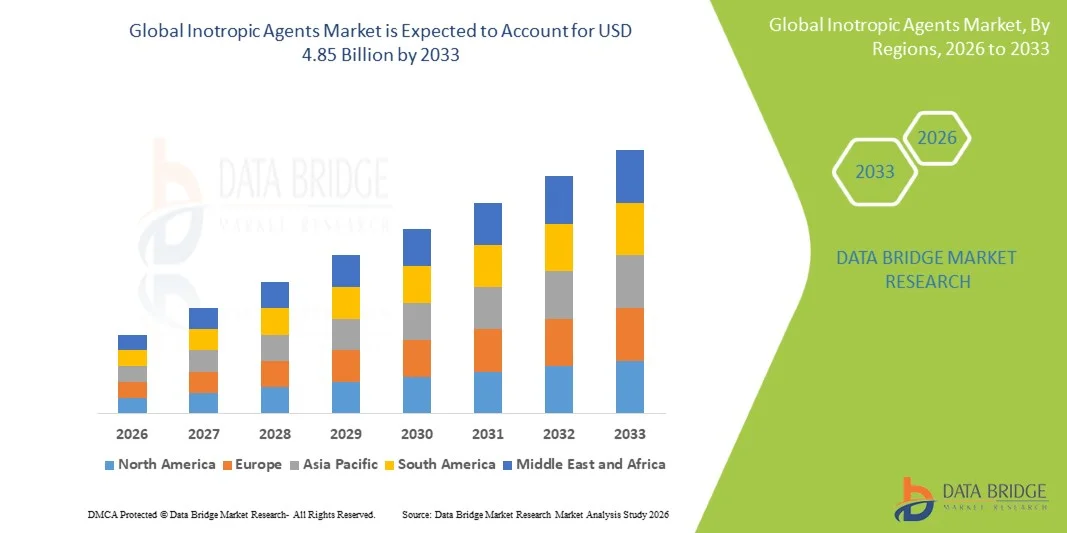
Report Scope and Inotropic Agents Market Segmentation
|
Attributes |
Inotropic Agents Key Market Insights |
|
Segments Covered |
|
|
Countries Covered |
North America
Europe
Asia-Pacific
Middle East and Africa
South America
|
|
Key Market Players |
|
|
Market Opportunities |
|
|
Value Added Data Infosets |
In addition to the insights on market scenarios such as market value, growth rate, segmentation, geographical coverage, and major players, the market reports curated by the Data Bridge Market Research also include in-depth expert analysis, patient epidemiology, pipeline analysis, pricing analysis, and regulatory framework |
What is the Key Trend in the Inotropic Agents Market?
“Advancements in Drug Formulations and Targeted Therapy”
- A major and accelerating trend in the global inotropic agents market is the development of advanced drug formulations that improve efficacy, reduce side effects, and allow more precise cardiac output management
- For instance, newer levosimendan formulations provide both inotropic and vasodilatory effects, improving patient outcomes in acute heart failure compared to traditional agents
- Targeted therapy integration enables personalized dosing based on patient hemodynamics, genetic markers, or real-time cardiac monitoring, optimizing treatment efficacy and safety
- Furthermore, combination therapies with inotropes and other cardiac drugs allow comprehensive management of complex cardiovascular conditions, reducing hospital stays and enhancing patient recovery
- Increasing research into oral inotropic agents is enabling outpatient management of chronic heart failure, reducing dependence on hospital-based IV treatments
- Integration with digital cardiac monitoring devices is helping clinicians track patient response in real time, optimizing therapy adjustments and improving long-term outcomes
- This trend towards safer, more effective, and patient-specific inotropic therapies is fundamentally reshaping clinician expectations for cardiovascular care
- The demand for advanced, targeted inotropic agents is growing rapidly across hospitals and critical care settings, as physicians prioritize treatments that maximize therapeutic benefit while minimizing adverse effects
Inotropic Agents Market Dynamics
Driver
“Rising Prevalence of Cardiovascular Diseases and Critical Care Demand”
- The increasing incidence of heart failure, cardiogenic shock, and acute myocardial infarction is a significant driver for the heightened demand for inotropic agents
- For instance, in March 2025, a leading pharmaceutical company launched a new intravenous positive inotrope targeting acute decompensated heart failure to improve hospital treatment outcomes
- As the global population ages and cardiovascular conditions become more prevalent, hospitals increasingly rely on inotropic therapies for critically ill patients requiring rapid stabilization
- Furthermore, expanding critical care infrastructure and increasing ICU admissions worldwide are driving demand for injectable inotropic agents as standard-of-care in acute settings
- High awareness among cardiologists about the efficacy of inotropes in improving patient hemodynamics and survival rates is propelling adoption in both developed and emerging healthcare markets
- The rising prevalence of comorbidities such as diabetes and hypertension further increases demand for inotropic support, as these patients are at higher risk of cardiac complications
- Increasing government initiatives to improve cardiovascular care access, particularly in Asia-Pacific and Latin America, are driving adoption of inotropic therapies in hospitals and specialty care centers
Restraint/Challenge
“Side Effects and Regulatory Compliance Hurdles”
- Concerns regarding adverse effects such as arrhythmias, hypotension, and long-term mortality risks pose a significant challenge to broader market adoption
- For instance, reports of ventricular arrhythmias linked to high-dose dobutamine have made some clinicians cautious in prescribing certain inotropic therapies
- Addressing safety concerns through improved dosing protocols, risk management strategies, and regulatory approvals is crucial for gaining clinician and patient trust
- Furthermore, stringent regulatory requirements and clinical trial obligations for new inotropic drugs increase development timelines and costs, potentially delaying market entry
- While generics and novel formulations are expanding access, the perceived risk of side effects and complex monitoring requirements can hinder widespread adoption, especially in emerging markets
- The high cost of newer inotropic agents compared to older therapies may limit adoption in price-sensitive regions, impacting overall market growth
- Limited awareness and training among healthcare providers on optimal inotrope administration and monitoring can also restrict the safe and effective use of these therapies in certain regions
Inotropic Agents Market Scope
The market is segmented on the basis of type, indication, route of administration, end-users, and distribution channel.
- By Type
On the basis of type, the inotropic agents market is segmented into positive inotropic drugs, negative inotropic drugs, and others. The Positive Inotropic Drugs segment dominated the market with the largest revenue share of 54.3% in 2025, driven by their proven efficacy in improving cardiac contractility in patients with heart failure and acute cardiac events. Hospitals and critical care centers often prioritize positive inotropes such as dobutamine and milrinone for rapid hemodynamic stabilization in acute cases. The segment also benefits from high clinician familiarity, strong presence in treatment guidelines, and established safety profiles when administered under supervision. Positive inotropic drugs are widely used across ICU settings, emergency care, and cardiology wards, enhancing patient survival rates and recovery.
The Negative Inotropic Drugs segment is anticipated to witness the fastest growth rate of 9.5% from 2026 to 2033, fueled by increasing adoption for chronic cardiovascular management and arrhythmia control. Negative inotropes, including beta-blockers, are gaining traction for long-term therapy to reduce myocardial oxygen demand, prevent cardiac remodeling, and manage chronic heart conditions. Their integration into combination therapy regimens is expanding usage in outpatient care, specialty centers, and telemedicine-guided cardiac management. Rising awareness among cardiologists about risk reduction and guideline-driven therapy also supports faster adoption of negative inotropes globally.
- By Indication
On the basis of indication, the market is segmented into heart attack, heart failure, angina, arrhythmia, and others. The Heart Failure segment dominated the market with a share of 42.5% in 2025, owing to the high prevalence of acute and chronic heart failure worldwide. Positive inotropic drugs are critical in stabilizing patients with reduced ejection fraction or decompensated heart failure, particularly in ICUs and emergency settings. Hospitals prefer inotropes to manage low cardiac output and prevent multi-organ failure. The segment is supported by clinical guidelines emphasizing early inotrope intervention in severe cases, as well as growing awareness of cardiovascular risk management in aging populations.
The Arrhythmia segment is expected to witness the fastest CAGR of 10.2% from 2026 to 2033, driven by the rising prevalence of atrial fibrillation and ventricular arrhythmias. Inotropic agents with negative or modulatory effects on heart rate are increasingly used alongside standard anti-arrhythmic therapy. Advancements in personalized dosing and integration with cardiac monitoring devices allow safer management of arrhythmic patients, particularly in specialty centers. Telemedicine and remote monitoring solutions also enhance access and adherence, fueling growth in this segment.
- By Route of Administration
On the basis of route of administration, the market is segmented into oral, parenteral, and others. The Parenteral segment dominated the market with 61.7% share in 2025, due to rapid therapeutic action in critical care settings. Intravenous inotropes are essential in ICU, emergency, and perioperative cardiac management where immediate hemodynamic support is required. Hospitals and specialty centers prefer parenteral administration for precise titration and real-time monitoring of patient response. This segment also benefits from established protocols, clinician expertise, and availability of key injectable drugs such as dobutamine, milrinone, and levosimendan.
The Oral segment is anticipated to witness the fastest growth rate of 11.3% from 2026 to 2033, fueled by the rising prevalence of chronic heart failure and outpatient management needs. Oral inotropes enable long-term therapy outside hospital settings, reducing dependence on IV administration and ICU resources. The growing trend of homecare-based cardiac monitoring and telemedicine programs further supports the adoption of oral therapies. Patients increasingly prefer oral options due to convenience, adherence, and integration into routine cardiovascular management plans.
- By End-Users
On the basis of end-users, the market is segmented into hospitals, homecare, specialty centers, and others. The Hospitals segment dominated the market with the largest share of 58.4% in 2025, owing to the high prevalence of acute cardiac conditions requiring intensive care. Hospitals are the primary site for administration of parenteral inotropes, with trained staff and monitoring equipment ensuring patient safety. Critical care, cardiology, and emergency wards drive demand for both positive and negative inotropic agents. Hospitals also benefit from established supply chains, bulk procurement, and integration of inotropes into standard treatment protocols.
The Homecare segment is expected to witness the fastest CAGR of 12.1% from 2026 to 2033, driven by increasing availability of oral inotropes, telemedicine cardiac monitoring, and rising preference for outpatient management of chronic heart failure. Homecare adoption is fueled by cost savings, reduced hospital stays, and convenience for elderly patients. Growth is also supported by remote patient monitoring, education programs for caregivers, and integration with wearable cardiac devices.
- By Distribution Channel
On the basis of distribution channel, the market is segmented into hospital pharmacy, online pharmacy, and retail pharmacy. The Hospital Pharmacy segment dominated the market with 65.2% share in 2025, due to direct supply of parenteral inotropes for critical care and emergency settings. Hospitals rely on dedicated pharmacies to ensure timely availability, proper storage, and compliance with safety regulations. Bulk procurement and integration with hospital formulary systems also contribute to dominance.
The Online Pharmacy segment is anticipated to witness the fastest CAGR of 14.5% from 2026 to 2033, driven by growing e-pharmacy adoption, homecare demand for oral inotropes, and digital prescription services. Online channels allow patients to conveniently access medications for chronic cardiovascular conditions, particularly in regions with strong internet penetration. Rising consumer awareness, secure payment options, and integration with telehealth platforms further accelerate adoption of online pharmacies.
Inotropic Agents Market Regional Analysis
- North America dominated the inotropic agents market with the largest revenue share of 38.5% in 2025, attributed to a high incidence of heart-related disorders, advanced healthcare infrastructure, strong R&D presence of key pharmaceutical players
- Hospitals and critical care centers in the region prioritize the use of both positive and negative inotropic agents for acute and chronic cardiac conditions, supported by established clinical guidelines and well-trained cardiology specialists
- This widespread adoption is further supported by high healthcare expenditure, an aging population with increasing cardiac risk, and growing awareness among clinicians and patients about the benefits of inotropic therapies, establishing the region as a major market hub for both hospital-based and specialty care treatments
U.S. Inotropic Agents Market Insight
The U.S. inotropic agents market captured the largest revenue share of 82% in 2025 within North America, driven by the high prevalence of cardiovascular diseases and well-established critical care infrastructure. Hospitals and specialty cardiac centers are rapidly adopting both positive and negative inotropic therapies for acute heart failure, cardiogenic shock, and arrhythmia management. The strong presence of leading pharmaceutical companies developing advanced formulations and the integration of digital cardiac monitoring systems further propel market growth. In addition, increasing awareness among clinicians and patients regarding optimized cardiac care is encouraging wider adoption of inotropic therapies.
Europe Inotropic Agents Market Insight
The Europe inotropic agents market is projected to expand at a substantial CAGR during the forecast period, primarily driven by stringent healthcare regulations and a rising burden of cardiovascular diseases. Advanced hospital networks and critical care units across countries such as Germany, France, and Italy are facilitating the adoption of inotropic drugs in acute and chronic cardiac care. Increased awareness about heart failure management, coupled with the integration of digital monitoring and telemedicine, is supporting the growth of oral and parenteral inotropic therapies. The region is witnessing significant adoption across hospitals, specialty centers, and homecare services.
U.K. Inotropic Agents Market Insight
The U.K. inotropic agents market is anticipated to grow at a noteworthy CAGR during the forecast period, driven by the rising prevalence of heart failure and acute cardiac conditions. Hospitals and specialty cardiac care facilities are increasingly relying on both positive and negative inotropes to stabilize patients in ICU and emergency settings. Government initiatives promoting cardiovascular health, coupled with advanced healthcare infrastructure and high physician awareness, are further stimulating market growth. Chronic care management and telemedicine adoption are also encouraging the use of oral inotropic drugs in homecare settings.
Germany Inotropic Agents Market Insight
The Germany inotropic agents market is expected to expand at a considerable CAGR during the forecast period, fueled by increasing awareness of cardiovascular diseases and demand for advanced therapies. Germany’s strong healthcare system and emphasis on research and innovation facilitate the adoption of novel inotropic formulations in hospitals and specialty centers. Integration of digital cardiac monitoring and combination therapy protocols enhances clinical efficacy, while hospitals prefer parenteral administration for acute care. Growing patient awareness and focus on outcome-driven therapies further boost market adoption.
Asia-Pacific Inotropic Agents Market Insight
The Asia-Pacific inotropic agents market is poised to grow at the fastest CAGR of 8.7% during 2026–2033, driven by rising cardiovascular disease prevalence, expanding critical care infrastructure, and increasing healthcare access in countries such as China, India, and Japan. Governments are promoting cardiovascular health initiatives and improving hospital networks, fueling adoption of both intravenous and oral inotropic therapies. In addition, growing awareness among clinicians, the rising geriatric population, and increasing insurance coverage are boosting the market. Emerging economies are also benefiting from improved affordability and accessibility of inotropic agents.
Japan Inotropic Agents Market Insight
The Japan inotropic agents market is gaining momentum due to the country’s aging population, high incidence of heart failure, and technologically advanced healthcare system. Hospitals and specialty centers are increasingly utilizing parenteral inotropes in ICUs for acute care, while oral therapies are being adopted for chronic heart failure management at home. Integration with digital cardiac monitoring devices enables precise dosing and improved patient outcomes. The focus on patient-centric care, early intervention, and advanced treatment protocols is further driving market growth.
India Inotropic Agents Market Insight
The India inotropic agents market accounted for the largest market revenue share in Asia-Pacific in 2025, attributed to increasing cardiovascular disease prevalence, expanding hospital and specialty care infrastructure, and rising awareness of advanced therapies. Both acute care hospitals and homecare providers are adopting inotropic therapies for improved patient outcomes. The government’s push towards digital healthcare, growing telemedicine initiatives, and increasing insurance penetration support the use of oral and parenteral inotropic drugs. In addition, domestic pharmaceutical manufacturers are contributing to affordability and accessibility, further propelling market growth in India.
Which are the Top Companies in Inotropic Agents Market?
The Inotropic Agents industry is primarily led by well-established companies, including:
- Pfizer Inc. (U.S.)
- Novartis AG (Switzerland)
- Boehringer Ingelheim International GmbH (Germany)
- Bristol-Myers Squibb Company (U.S.)
- Merck & Co., Inc. (U.S.)
- GSK plc (U.K.)
- Sanofi (France)
- Eli Lilly and Company (U.S.)
- AstraZeneca (U.K.)
- Johnson & Johnson Services, Inc. (U.S.)
- Bayer AG (Germany)
- AbbVie Inc. (U.S.)
- Amgen Inc. (U.S.)
- Teva Pharmaceutical Industries Ltd. (Israel)
- Takeda Pharmaceutical Company Limited (Japan)
- Daiichi Sankyo Company, Limited (Japan)
- Otsuka Pharmaceutical Co., Ltd. (Japan)
- Sun Pharmaceutical Industries Ltd. (India)
- Boehringer Ingelheim Pharma KG (Germany)
What are the Recent Developments in Global Inotropic Agents Market?
- In August 2025, a randomized controlled study reported that adding levosimendan to dobutamine significantly improved the success of weaning patients from inotropic support and was associated with lower 30‑day mortality in cardiogenic shock patients compared to dobutamine alone, reflecting practical advances in combined inotrope strategies
- In December 2024, Cytokinetics announced the initiation of COMET‑HF (Confirmation of Omecamtiv Mecarbil Efficacy Trial in Heart Failure), a global Phase 3 clinical trial enrolling patients with symptomatic heart failure and severely reduced ejection fraction to assess whether omecamtiv mecarbil provides meaningful cardiac benefit in high‑risk patients, marking a key step in inotropic agent development
- In October 2024, clinical research reported that adding levosimendan to dobutamine therapy in patients with cardiogenic shock refractory to conventional inotrope withdrawal improved likelihood of successful inotrope discontinuation and was associated with lower 30‑day mortality, indicating real‑world therapeutic interest in combined inotrope strategies
- In August 2024, a pooled analysis of clinical data suggested that intermittent levosimendan therapy may improve cardiovascular outcomes and reduce mortality markers in patients with advanced heart failure, highlighting renewed clinical interest in calcium‑sensitizing inotropes beyond traditional agents
- In February 2023, Cytokinetics received a Complete Response Letter (CRL) from the U.S. Food and Drug Administration (FDA) for its New Drug Application for Omecamtiv Mecarbil for treating heart failure with reduced ejection fraction (HFrEF), after regulators concluded that the evidence submitted did not sufficiently demonstrate effectiveness, highlighting regulatory challenges for this novel myosin activator inotropic therapy

- Interactive Data Analysis Dashboard
- Company Analysis Dashboard for high growth potential opportunities
- Research Analyst Access for customization & queries
- Competitor Analysis with Interactive dashboard
- Latest News, Updates & Trend analysis
- Harness the Power of Benchmark Analysis for Comprehensive Competitor Tracking
Data collection and base year analysis are done using data collection modules with large sample sizes. The stage includes obtaining market information or related data through various sources and strategies. It includes examining and planning all the data acquired from the past in advance. It likewise envelops the examination of information inconsistencies seen across different information sources. The market data is analysed and estimated using market statistical and coherent models. Also, market share analysis and key trend analysis are the major success factors in the market report. To know more, please request an analyst call or drop down your inquiry.
The key research methodology used by DBMR research team is data triangulation which involves data mining, analysis of the impact of data variables on the market and primary (industry expert) validation. Data models include Vendor Positioning Grid, Market Time Line Analysis, Market Overview and Guide, Company Positioning Grid, Patent Analysis, Pricing Analysis, Company Market Share Analysis, Standards of Measurement, Global versus Regional and Vendor Share Analysis. To know more about the research methodology, drop in an inquiry to speak to our industry experts.
Data Bridge Market Research is a leader in advanced formative research. We take pride in servicing our existing and new customers with data and analysis that match and suits their goal. The report can be customized to include price trend analysis of target brands understanding the market for additional countries (ask for the list of countries), clinical trial results data, literature review, refurbished market and product base analysis. Market analysis of target competitors can be analyzed from technology-based analysis to market portfolio strategies. We can add as many competitors that you require data about in the format and data style you are looking for. Our team of analysts can also provide you data in crude raw excel files pivot tables (Fact book) or can assist you in creating presentations from the data sets available in the report.












