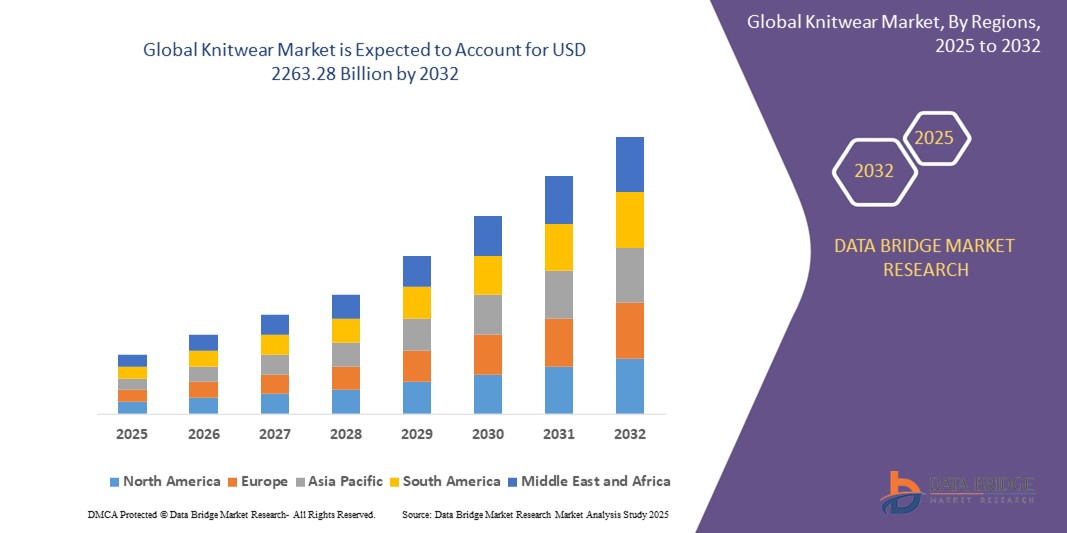
Knitwear Market Size
- The global knitwear market was valued at USD 907.60 billion in 2024 and is expected to reach USD 2263.28 billion by 2032
- During the forecast period of 2025 to 2032 the market is likely to grow at a CAGR of 12.10%, primarily driven by sustainable and ethical fashion movement
- This growth is driven by factors such as ethical manufacturing, eco-friendly materials and low-waste production
Knitwear Market Analysis
- Knitwear refers to garments produced using various knitting techniques, typically made from yarns such as wool, cotton, or synthetics. Known for their flexibility, comfort, and thermal properties, knitwear products include sweaters, cardigans, dresses, and activewear. These garments are widely used across casual, formal, and athleisure categories, appealing to consumers of all age groups while supporting fashion versatility and seasonal adaptability
- The knitwear market is witnessing strong growth due to increasing consumer preference for comfortable and stylish apparel, rising demand for sustainable clothing, and the influence of casual fashion trends. Brands are increasingly adopting eco-friendly materials and ethical production practices to align with evolving consumer values and regulatory shifts toward sustainable fashion
- The market is evolving with a focus on material innovation, sustainable manufacturing, and circular fashion models. As consumers and brands aim to reduce environmental footprints, manufacturers are investing in organic fibers, biodegradable dyes, and zero-waste knitting technologies. In addition, second-hand markets and recycling initiatives are helping extend the lifecycle of knit garments
- For instance, companies such as Patagonia and Stella McCartney are incorporating recycled yarns and ethical supply chain practices to develop knitwear collections that blend performance, comfort, and sustainability
- The knitwear market is projected to maintain a steady growth trajectory, fueled by rising demand in both mature and emerging markets, continued innovation in eco-conscious textiles, and increased penetration through e-commerce and direct-to-consumer platforms. With growing awareness of ethical fashion and sustained interest in casual and functional wear, knitwear is expected to remain a key segment within the global apparel industry
Report Scope and Knitwear Market Segmentation
|
Attributes |
Knitwear Key Market Insights |
|
Segments Covered |
|
|
Countries Covered |
North America
Europe
Asia-Pacific
Middle East and Africa
South America
|
|
Key Market Players |
|
|
Market Opportunities |
|
|
Value Added Data Infosets |
In addition to the insights on market scenarios such as market value, growth rate, segmentation, geographical coverage, and major players, the market reports curated by the Data Bridge Market Research also include in-depth expert analysis, pricing analysis, brand share analysis, consumer survey, demography analysis, supply chain analysis, value chain analysis, raw material/consumables overview, vendor selection criteria, PESTLE Analysis, Porter Analysis, and regulatory framework. |
Knitwear Market Trends
Rising Demand for Comfortable and Casual Wear
- One prominent trend in the global knitwear market is the rising demand for comfortable and casual wear
- This trend is driven by the lifestyle shifts such as remote work, increased focus on wellness, and a growing preference for versatile clothing that balances comfort with style. As a result, knitwear items such as hoodies, joggers, oversized sweaters, and knit co-ords have gained widespread popularity across all age groups
- For instance, brands such as Uniqlo and Lululemon are expanding their knitwear lines to include cozy, stretchable, and breathable fabrics that align with everyday wear and athleisure aesthetics
- The demand for multifunctional and easy-to-maintain garments is further driving the use of lightweight, performance-enhancing knit fabrics in both casual and semi-formal segments
- As consumer fashion preferences continue to evolve, knitwear manufacturers are focusing on innovation in texture, fit, and fabric blends to meet growing expectations for comfort, functionality, and day-to-night versatility. This rising emphasis on lifestyle-friendly fashion is expected to remain a major influence in shaping knitwear product development and market growth
Knitwear Market Dynamics
Driver
Increased Fashion Awareness and Knitwear Requirements
- Rising fashion consciousness and evolving consumer preferences are key drivers of growth in the knitwear market. As global consumers become more style-aware, there is growing demand for knitwear that blends aesthetics with comfort, offering fashionable alternatives for various occasions
- This shift is especially evident across urban populations and younger demographics, where knitwear is being embraced not just for functionality, but also as a style statement in streetwear, office wear, and luxury fashion. The versatility of knitted garments allows them to be adapted to seasonal styles, patterns, and silhouettes
- With fashion cycles accelerating and social media shaping consumer tastes, knitwear brands are increasingly focusing on trend-driven collections, rapid design turnaround, and custom-fit options
- Innovations in yarn dyeing, digital knitting, and eco-conscious embellishments are supporting the creation of high-impact, fashion-forward knitwear
- Features such as enhanced texture variety, stretchability, layering potential, and mix-and-match versatility are driving the integration of knitwear into both casual and premium segments. This has led to increased demand for knit tops, dresses, and accessories that reflect contemporary fashion trends
For instance
- Brands such as Zara, H&M, and Mango are frequently updating their knitwear offerings to reflect seasonal palettes and influencer-inspired designs, while high-end labels such as Acne Studios and The Row are elevating knitwear with minimalist luxury appeal
- Sustainable fashion brands such as Reformation and Everlane are emphasizing responsibly-sourced knitwear with modern aesthetics to appeal to conscious consumers
- As consumer interest in expressive, comfortable, and sustainable fashion continues to grow, fashion-forward knitwear is expected to remain a critical growth engine for the global apparel market, prompting investments in design innovation, material development, and market expansion
Opportunity
Awareness Towards Use of Biodegradable Products
- The rising global awareness of environmental sustainability presents a major opportunity for growth in the knitwear market. As consumers and regulators prioritize eco-conscious living, the demand for biodegradable and responsibly produced clothing is steadily increasing
- Biodegradable knitwear, made from natural fibers such as organic cotton, wool, bamboo, and hemp, offers a sustainable alternative to synthetic, petroleum-based textiles. These materials decompose naturally, leaving minimal environmental impact, and are being embraced by both mass-market and premium fashion brands
- The growing preference for eco-friendly apparel aligns closely with circular fashion goals—encouraging compostable garments, reduced textile waste, and recyclable product design in knitwear manufacturing. This trend is reshaping product development and sourcing strategies across the apparel industry
For instance
- PANGAIA has introduced bio-based knitwear lines made with seaweed fiber and natural dyes, designed for minimal waste and full end-of-life compostability
- Eileen Fisher is exploring regenerative wool and take-back programs to support biodegradable product use within a closed-loop system
- As governments tighten environmental regulations and consumers demand greater transparency, investment in biodegradable materials, sustainable design innovation, and end-of-life solutions is expected to rise. These developments are positioning biodegradable knitwear as a key growth opportunity within the broader shift toward greener fashion practices
Restraint/Challenge
Highly Fragmented Market
- The highly fragmented nature of the global knitwear market presents a significant challenge to sustained growth and brand consolidation. The presence of numerous small- to mid-sized players, alongside large apparel conglomerates, creates intense competition and limits pricing power, especially in developing markets
- Market fragmentation leads to inconsistencies in product quality, supply chain coordination, and innovation capabilities. Many regional manufacturers operate with limited resources, outdated technologies, or minimal focus on sustainability, making it difficult to standardize offerings or meet rising global expectations for quality and environmental compliance
- In addition, the lack of centralized production and distribution infrastructure hinders scalability and disrupts supply chains, particularly in sourcing raw materials, maintaining lead times, and managing costs across diverse geographic regions. Smaller brands often struggle to compete with fast fashion giants in terms of marketing reach, economies of scale, and trend responsiveness
For instance
- Local knitwear producers in South Asia and Eastern Europe often face challenges in meeting international sustainability standards and certification requirements
- As global fashion consumers increasingly seek transparency, quality assurance, and sustainable production, the fragmented nature of the knitwear industry poses structural limitations. Without greater industry collaboration, technological upgrades, and investment in streamlined operations, overcoming these challenges remains difficult, particularly for smaller or emerging brands seeking global relevance
Knitwear Market Scope
The market is segmented on the basis of product type, material type, application, consumer group, and distribution channel.
|
Segmentation |
Sub-Segmentation |
|
By Product Type |
|
|
By Material Type |
|
|
By Application |
|
|
By Consumer Group
|
|
|
By Distribution Channel |
|
Knitwear Market Regional Analysis
Asia-Pacific is the Dominant Region in the Knitwear Market
- Asia-Pacific dominates the knitwear market, driven by the strong presence of major manufacturers and well-established textile supply chains across leading economies such as China, India, Bangladesh, and South Korea
- The China holds a significant share due to its expansive textile manufacturing base, investment in automation and circular knitting technologies, and active export networks. India also contributes substantially, driven by its rich textile heritage, growing demand for natural fiber knitwear, and rising consumption in tier-1 and tier-2 cities
- South Korea and Japan play important roles through high-quality knitwear production, fashion-forward design innovation, and strong regional brand presence, particularly in premium and trend-based categories. These countries are also investing in eco-friendly knitwear made from organic and recycled yarns
- With increasing adoption of e-commerce, rising fashion awareness, and government support for sustainable textile manufacturing, the Asia-Pacific knitwear market is expected to retain its dominance throughout the forecast period 2025–2032. The region is also witnessing growing demand for winter and transitional clothing in response to changing weather patterns and evolving consumer lifestyles
North America is Projected to Register the Highest Growth Rate
- The North America region is expected to witness the highest growth rate in the knitwear market, driven by increasing fashion consciousness, growing preference for seasonal and functional apparel, and a rising shift toward health-focused lifestyles. Knitwear products such as hoodies, cardigans, and thermals are gaining popularity across demographics due to their comfort and versatility
- The U.S. leads the regional market owing to high consumer spending on fashion, well-developed retail infrastructure, and the presence of influential athleisure and lifestyle brands promoting casual knitwear. In addition, consumer interest in locally made, sustainable knitwear is on the rise, creating opportunities for ethical and eco-friendly labels
- Canada is also contributing to market growth, particularly in the premium and winterwear knitwear segments, driven by cold weather conditions and demand for durable, high-quality garments
- With strong demand for ethically produced, biodegradable fashion and a growing appetite for comfort-driven styles, North America is expected to emerge as the fastest-growing region in the global knitwear market over the forecast period 2025–2032. Increased adoption of digital fashion retail and direct-to-consumer models will further support regional market expansion
Knitwear Market Share
The market competitive landscape provides details by competitor. Details included are company overview, company financials, revenue generated, market potential, investment in research and development, new market initiatives, global presence, production sites and facilities, production capacities, company strengths and weaknesses, product launch, product width and breadth, application dominance. The above data points provided are only related to the companies' focus related to market.
The Major Market Leaders Operating in the Market Are:
- Adidas AG (Germany)
- Gildan Activewear (Canada)
- Loro Piana S.p.A. (Italy)
- Puma SE (Germany)
- Ralph Lauren (U.S.)
- The Nautical Company (UK) Ltd (U.K.)
- Victoria's Secret & Co. (U.S.)
- Maglificio Ripa SRL (Italy)
- Lenzing AG (Austria)
- Ecowool (New Zealand)
- Sana Hastakala Pvt. Ltd. (Nepal)
- Gap Inc. (U.S.)
- The Hackett Group, Inc. (U.S.)
- Marks and Spencer Group plc (U.K.)
- Nike, Inc. (U.S.)
Latest Developments in Global Knitwear Market
- In May 2023, Pailung introduced its innovative AlterKnit technology at ITMA Milan 2023, marking a significant step toward redefining efficiency and design flexibility in the knitwear manufacturing market. This launch is expected to enhance the company’s competitive edge by addressing growing industry demands for sustainable, high-performance knitting solutions

- Interactive Data Analysis Dashboard
- Company Analysis Dashboard for high growth potential opportunities
- Research Analyst Access for customization & queries
- Competitor Analysis with Interactive dashboard
- Latest News, Updates & Trend analysis
- Harness the Power of Benchmark Analysis for Comprehensive Competitor Tracking
Data collection and base year analysis are done using data collection modules with large sample sizes. The stage includes obtaining market information or related data through various sources and strategies. It includes examining and planning all the data acquired from the past in advance. It likewise envelops the examination of information inconsistencies seen across different information sources. The market data is analysed and estimated using market statistical and coherent models. Also, market share analysis and key trend analysis are the major success factors in the market report. To know more, please request an analyst call or drop down your inquiry.
The key research methodology used by DBMR research team is data triangulation which involves data mining, analysis of the impact of data variables on the market and primary (industry expert) validation. Data models include Vendor Positioning Grid, Market Time Line Analysis, Market Overview and Guide, Company Positioning Grid, Patent Analysis, Pricing Analysis, Company Market Share Analysis, Standards of Measurement, Global versus Regional and Vendor Share Analysis. To know more about the research methodology, drop in an inquiry to speak to our industry experts.
Data Bridge Market Research is a leader in advanced formative research. We take pride in servicing our existing and new customers with data and analysis that match and suits their goal. The report can be customized to include price trend analysis of target brands understanding the market for additional countries (ask for the list of countries), clinical trial results data, literature review, refurbished market and product base analysis. Market analysis of target competitors can be analyzed from technology-based analysis to market portfolio strategies. We can add as many competitors that you require data about in the format and data style you are looking for. Our team of analysts can also provide you data in crude raw excel files pivot tables (Fact book) or can assist you in creating presentations from the data sets available in the report.