


Ligases Enzyme Market Size
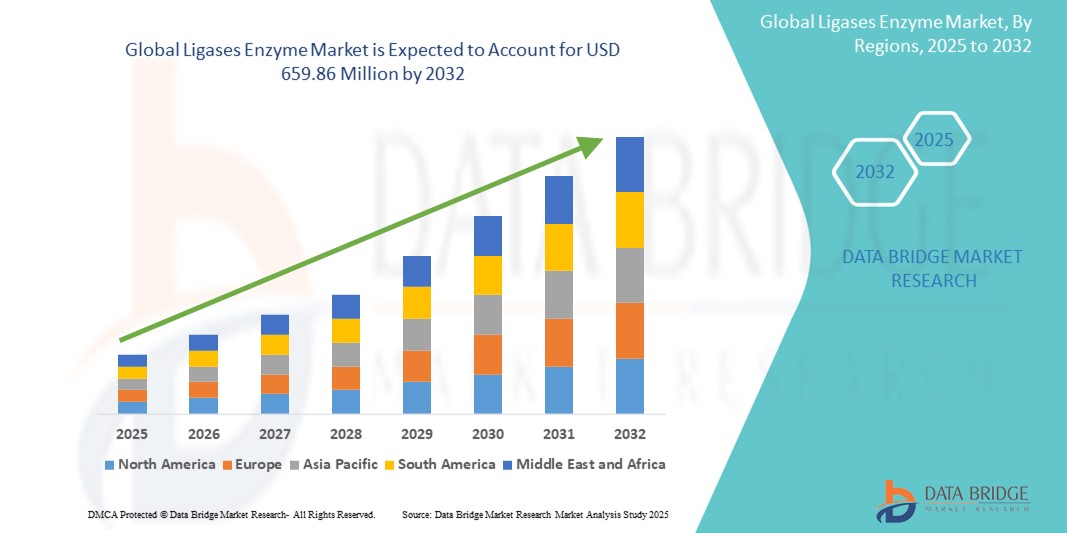
- The global ligases enzyme market size was valued at USD 389.25 million in 2024 and is expected to reach USD 659.86 million by 2032, at a CAGR of 6.82% during the forecast period
- This growth is driven by factors such as rising demand for genetic research and diagnostic applications and advancements in enzyme engineering and biotechnology
Ligases Enzyme Market Analysis
- Ligases are a class of enzymes that catalyze the joining of two molecules by forming a new chemical bond, typically with the hydrolysis of a diphosphate bond in ATP or a similar energy donor. In biotechnology and molecular biology, ligases are crucial for DNA replication and repair, where DNA ligases help seal nicks in the DNA backbone. These enzymes are fundamental in gene cloning, genetic engineering, and next-generation sequencing (NGS) workflows
- The global ligases enzyme market is experiencing steady growth due to increased applications in genomics, personalized medicine, forensic analysis, and diagnostics. With the surge in biopharmaceutical R&D, CRISPR gene editing, and synthetic biology, the demand for high-purity, high-efficiency ligases is rising
- North America is expected to dominate the global ligases enzyme market with a market share of approximately 42.8% in 2025, driven by advanced research infrastructure, a high demand for biotechnology solutions, and a strong presence of leading enzyme producers in the region
- Asia-Pacific is expected to be the fastest growing region in the global ligases enzyme market, with a projected market share of approximately 26.7% in 2025, driven by rapid advancements in biotechnology research, increased adoption of genetic engineering techniques, and growing investments in life sciences and molecular biology
- Bacterial segment segment is expected to dominate the market with a market share of 34.6% due to its widespread application in molecular biology procedures such as DNA cloning, ligation, and gene expression studies
Report Scope and Ligases Enzyme Market Segmentation
|
Attributes |
Ligases Enzyme Key Market Insights |
|
Segments Covered |
|
|
Countries Covered |
North America
Europe
Asia-Pacific
Middle East and Africa
South America
|
|
Key Market Players |
|
|
Market Opportunities |
|
|
Value Added Data Infosets |
In addition to the insights on market scenarios such as market value, growth rate, segmentation, geographical coverage, and major players, the market reports curated by the Data Bridge Market Research also include import export analysis, production capacity overview, production consumption analysis, price trend analysis, climate change scenario, supply chain analysis, value chain analysis, raw material/consumables overview, vendor selection criteria, PESTLE Analysis, Porter Analysis, and regulatory framework. |
Ligases Enzyme Market Trends
“Advancements in Ligase Enzyme Technology & Applications in Molecular Biology”
- One prominent trend in the global ligases enzyme market is the increasing integration of high-fidelity ligase enzymes in advanced molecular diagnostics and next-generation sequencing (NGS) applications
- These enzymes are being engineered for enhanced stability, faster reaction times, and improved specificity, enabling more accurate and efficient DNA ligation in complex genetic workflows
- For instance, recent developments in thermostable DNA ligases have expanded their use in ligation-based amplification techniques such as Ligase Chain Reaction (LCR) and padlock probe assays, which are instrumental in point-of-care diagnostics and mutation detection
- These innovations are transforming the fields of genomics, personalized medicine, and synthetic biology, driving demand for specialized ligase enzymes with improved performance and broader application scope
Ligases Enzyme Market Dynamics
Driver
“Rising Demand for Genetic Research and Diagnostic Applications”
- The growing demand for genetic research and molecular diagnostics is significantly contributing to the expansion of the global ligases enzyme market
- Ligases play a critical role in DNA replication and repair, and are essential in advanced techniques such as next-generation sequencing (NGS), cloning, and polymerase chain reactions (PCR)
- With increasing global investments in genomics, personalized medicine, and disease diagnosis, the need for high-performance ligase enzymes has surged to support accurate and efficient nucleic acid manipulation
For instance,
- According to the Global Genes Report 2023, rare genetic diseases affect over 400 million people globally, prompting increased R&D funding and demand for diagnostic tools leveraging ligase enzymes for precise genetic testing
- As a result of the rising focus on genetic diagnostics and research, there is significant growth in the adoption of ligase enzymes across biotechnology firms, academic institutions, and clinical laboratories
Opportunity
“Integration of AI and Automation in Enzyme-based Molecular Diagnostics”
- AI-driven platforms are increasingly being integrated into molecular biology workflows, including those involving ligases enzymes, to improve diagnostic accuracy, accelerate data analysis, and automate complex laboratory procedures
- Machine learning algorithms can streamline the interpretation of large-scale genomic data generated using ligase-dependent techniques such as next-generation sequencing (NGS) and DNA ligation assays
- In addition, automated systems can optimize ligation reactions, reduce human error, and enhance the efficiency of high-throughput diagnostics in clinical and research settings
For instance,
- In March 2024, a study published in the journal Nature Biotechnology highlighted how AI-powered diagnostics combined with ligase-dependent assays significantly improved the detection rate of rare genetic mutations in oncology research, allowing earlier and more personalized treatments
- The adoption of AI and automation in conjunction with ligase enzymes presents a significant opportunity to enhance diagnostic capabilities, streamline R&D processes, and support precision medicine initiatives
Restraint/Challenge
“High Cost and Technical Complexity of Enzyme-based Applications”
- The global ligases enzyme market faces a major challenge due to the high cost of enzyme production, purification, and stabilization, especially for applications requiring high purity and activity
- Ligases, particularly DNA ligases used in advanced biotechnological and therapeutic processes, demand sophisticated manufacturing infrastructure and rigorous quality control measures, which increases the final product cost
- Furthermore, the technical complexity associated with optimizing ligase reactions for specific applications (for instance, gene therapy, synthetic biology, and molecular diagnostics) limits their adoption in resource-constrained laboratories and developing regions
For instance,
- According to a 2023 report by the European Federation of Biotechnology, the average production cost of high-purity ligase enzymes used in NGS workflows remains 2–3 times higher than traditional polymerases, creating a financial barrier for smaller biotech firms and academic institutions
- This cost and complexity can hinder widespread adoption and limit the potential growth of the ligases enzyme market, especially in emerging economies with limited access to advanced molecular biology infrastructure
Ligases Enzyme Market Scope
The market is segmented on the basis of product type, source, application and end user.
|
Segmentation |
Sub-Segmentation |
|
By Product Type |
|
|
By Source |
|
|
By Application |
|
|
By End Use |
|
In 2025, the bacterial is projected to dominate the market with a largest share in source segment
The bacterial segment is expected to dominate the global ligases enzyme market with the largest share of 34.6% in 2025 due to its widespread application in molecular biology procedures such as DNA cloning, ligation, and gene expression studies. As the most commonly utilized source for ligase enzymes—particularly T4 DNA Ligase derived from bacteriophage T4—bacterial enzymes offer high efficiency, cost-effectiveness, and ease of recombinant production. The increasing demand for advanced genetic engineering techniques and biotechnology research further contributes to the dominance of this segment across academic, diagnostic, and pharmaceutical sectors.
The T4 DNA ligase is expected to account for the largest share during the forecast period in product type market
In 2025, the T4 DNA ligase segment is expected to dominate the global ligases enzyme market with the largest market share of 29.9% due to its high usage in molecular biology and genetic engineering applications. As a widely adopted enzyme for DNA cloning, repair, and ligation processes, T4 DNA Ligase is essential in next-generation sequencing, plasmid construction, and synthetic biology.
Ligases Enzyme Market Regional Analysis
“North America Holds the Largest Share in the Ligases Enzyme Market”
- North America is expected to dominate the global ligases enzyme market with a market share of approximately 42.8% in 2025, driven by advanced research infrastructure, a high demand for biotechnology solutions, and a strong presence of leading enzyme producers in the region
- U.S. holds a significant share primarily due to its well-established biotechnology and pharmaceutical industries, which utilize ligases enzymes in various applications including gene therapy, molecular diagnostics, and synthetic biology
- The region benefits from a strong research and development ecosystem, robust funding for biotech companies, and extensive application of ligases enzymes in academic, pharmaceutical, and industrial research
- Moreover, the rapid adoption of molecular biology techniques, such as CRISPR gene editing, which relies heavily on ligases enzymes, further strengthens North America's position as a leader in the global market
“Asia-Pacific is Projected to Register the Highest CAGR in the Ligases Enzyme Market”
- Asia-Pacific is expected to witness the highest growth rate in the global ligases enzyme market, driven by rapid advancements in biotechnology research, increased adoption of genetic engineering techniques, and growing investments in life sciences and molecular biology
- Countries such as China, India, and Japan are emerging as key markets for ligases enzymes due to their expanding biotechnology sectors, increasing government funding for life sciences research, and rising demand for enzymes in pharmaceuticals, diagnostics, and agricultural applications
- Japan remains a significant market, with its highly developed biotechnology ecosystem, strong emphasis on genomics and gene therapy research, and advanced healthcare infrastructure. Japan’s regulatory environment supports the development and commercialization of innovative enzyme technologies, driving ligases enzyme demand in research and clinical applications
- India is expected to register the highest CAGR in the ligases enzyme market with a projected market share of approximately 6.3% in 2025, with rising investments in biotechnology startups, an expanding focus on gene therapies, and a growing number of life sciences research projects. Government initiatives aimed at improving healthcare infrastructure and biotech research further support market growth across the region
Ligases Enzyme Market Share
The market competitive landscape provides details by competitor. Details included are company overview, company financials, revenue generated, market potential, investment in research and development, new market initiatives, global presence, production sites and facilities, production capacities, company strengths and weaknesses, product launch, product width and breadth, application dominance. The above data points provided are only related to the companies' focus related to market.
The Major Market Leaders Operating in the Market Are:
- Agilent Technologies, Inc. (U.S.)
- Bio-Rad Laboratories, Inc. (U.S.)
- Bio-Techne (U.S.)
- Biosynth (U.K.)
- Codexis, Inc. (U.S.)
- Cayman Chemical (U.S.)
- Enzo Biochem Inc. (U.S.)
- F. Hoffmann-La Roche Ltd (Switzerland)
- Jena Bioscience GmbH (Germany)
- Merck & Co., Inc. (U.S.)
- New England Biolabs (U.S.)
- Promega Corporation (U.S.)
- QIAGEN (Netherlands)
- Santa Cruz Biotechnology Inc. (U.S.)
- Thermo Fisher Scientific Inc. (U.S.)
- Takara Bio Inc. (Japan)
- Zymo Research Corporation (U.S.)
Latest Developments in Global Ligases Enzyme Market
- In May 2024, Biocatalysts Ltd announced the successful large-scale production of a specialized ligase enzyme for a leading pharmaceutical company. The enzyme was purified using a state-of-the-art chromatography system, which was recently installed at the company’s Cardiff facility to enhance post-fermentation processing capabilities
- In February 2024, Codexis, Inc. announced a new agreement with Roche, granting Roche an exclusive global license for its newly engineered double-stranded DNA (dsDNA) ligase, specifically designed for next-generation sequencing (NGS) library preparation, along with the Company’s EvoT4 DNA ligase. As part of the agreement, Codexis will receive upfront payments and technical milestone-based compensation. This new deal replaces the previous exclusive license agreement for the EvoT4 DNA ligase
- In February 2023, Ajinomoto Bio-Pharma Services announced the successful development of a novel enzyme for efficient double-stranded oligonucleotide formation. Collaborating with researchers from the University of Shizuoka, the company engineered a highly functional artificial RNA ligase using an ancestral design approach. This newly developed ligase demonstrated significantly enhanced thermostability and superior ligation activity, particularly for RNA fragments containing xenonucleic acids, outperforming natural RNA ligases in both efficiency and stability

- Interactive Data Analysis Dashboard
- Company Analysis Dashboard for high growth potential opportunities
- Research Analyst Access for customization & queries
- Competitor Analysis with Interactive dashboard
- Latest News, Updates & Trend analysis
- Harness the Power of Benchmark Analysis for Comprehensive Competitor Tracking
Data collection and base year analysis are done using data collection modules with large sample sizes. The stage includes obtaining market information or related data through various sources and strategies. It includes examining and planning all the data acquired from the past in advance. It likewise envelops the examination of information inconsistencies seen across different information sources. The market data is analysed and estimated using market statistical and coherent models. Also, market share analysis and key trend analysis are the major success factors in the market report. To know more, please request an analyst call or drop down your inquiry.
The key research methodology used by DBMR research team is data triangulation which involves data mining, analysis of the impact of data variables on the market and primary (industry expert) validation. Data models include Vendor Positioning Grid, Market Time Line Analysis, Market Overview and Guide, Company Positioning Grid, Patent Analysis, Pricing Analysis, Company Market Share Analysis, Standards of Measurement, Global versus Regional and Vendor Share Analysis. To know more about the research methodology, drop in an inquiry to speak to our industry experts.
Data Bridge Market Research is a leader in advanced formative research. We take pride in servicing our existing and new customers with data and analysis that match and suits their goal. The report can be customized to include price trend analysis of target brands understanding the market for additional countries (ask for the list of countries), clinical trial results data, literature review, refurbished market and product base analysis. Market analysis of target competitors can be analyzed from technology-based analysis to market portfolio strategies. We can add as many competitors that you require data about in the format and data style you are looking for. Our team of analysts can also provide you data in crude raw excel files pivot tables (Fact book) or can assist you in creating presentations from the data sets available in the report.













