What is the Liquefied Natural Gas Market Size and Growth Rate?
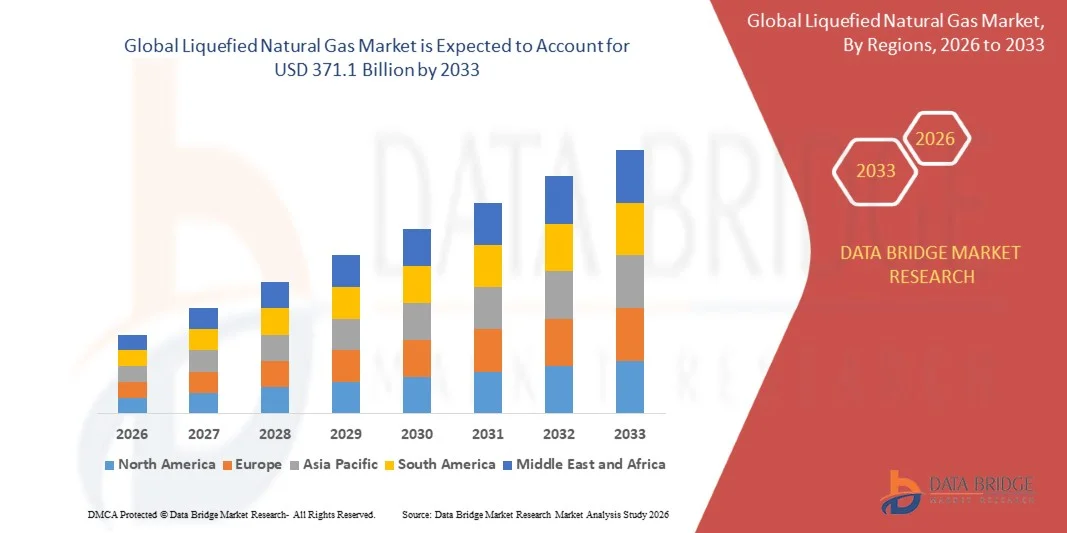
- As per Data Bridge Market Research analysis, the liquefied natural gas market was valued at USD 131.1 billion in 2025 and is projected to reach USD 371.1 billion by 2033, growing at a CAGR of 14.70% from 2026 to 2033.
- The market is expanding due to the rising demand for cleaner-burning energy sources, increasing electricity consumption, growing natural gas demand across power generation and industrial applications, energy security concerns, and the transition from coal and oil toward lower-emission fuels.
- Liquefied natural gas (LNG) is increasingly adopted across power generation, transportation, industrial, mining, and other applications because of its lower emissions compared with conventional coal and oil-based fuels, improving energy efficiency, flexibility in global energy supply, and expanding liquefaction, storage, transportation, and regasification infrastructure.
Market Size & Forecast
- Global Market Value (2025): USD 131.1 billion
- Expected Market Value (2033): USD 371.1 billion
- Forecast CAGR (2026–2033): 14.70%
- Leading Region in 2025: Asia-Pacific
- Fastest Growing Region: Asia-Pacific
What are the Major Takeaways of the Liquefied Natural Gas Market?
- Asia Pacific dominated the global liquefied natural gas market with a revenue share of 81.4% in 2025, driven by rising energy demand, rapid industrialization, increasing LNG consumption, expanding regasification infrastructure, and the transition toward cleaner-burning fuels.
- Asia Pacific is expected to register the fastest CAGR of 15.1% from 2026 to 2033, driven by rising energy demand, rapid industrialization, increasing LNG consumption, expanding regasification infrastructure, and the transition toward cleaner-burning fuels
- The Power generation segment dominated the application category with a market share of 48.1% in 2025. Growth is supported by rising electricity demand, increasing gas-based power generation, coal-to-gas switching, and the ability of LNG-based power plants to provide flexible generation.
- LNG liquefaction represents the leading infrastructure segment in another current LNG market dataset, accounting for 42.60% of 2025 revenue. Therefore, these figures should be presented separately rather than combined.
- LNG regasification infrastructure is expanding as LNG-importing countries diversify natural gas supplies and strengthen energy security. A separate infrastructure dataset reports 26.5% market share in 2025 because these figures come from different datasets.
- LNG shipping is benefiting from increasing international LNG trade and expansion of the global LNG carrier fleet. A current LNG infrastructure dataset reports 22.1% market share in 2025. The growth is supported by increasing long-distance LNG trade, fleet expansion, vessel replacement, and development of LNG bunkering infrastructure.
Report Scope and Liquefied Natural Gas Market Segmentation
|
Attributes |
Liquefied Natural Gas Key Market Insights |
|
Segments Covered |
|
|
Countries Covered |
North America
Europe
Asia-Pacific
Middle East and Africa
South America
|
|
Key Market Players |
|
|
Market Opportunities |
|
|
Value Added Data Infosets |
In addition to the market insights such as market value, growth rate, market segments, geographical coverage, market players, and market scenario, the market report curated by the Data Bridge Market Research team includes in-depth expert analysis, import/export analysis, pricing analysis, production consumption analysis, and pestle analysis. |
What is the Key Trend in the Liquefied Natural Gas Market?
- The increasing adoption of advanced digitalization, emissions-reduction technologies, floating LNG infrastructure, and flexible LNG supply solutions is becoming a major trend in the global liquefied natural gas market. LNG producers, terminal operators, and shipping companies are increasingly integrating digital monitoring, automation, methane-emission detection, process optimization, and advanced analytics across the LNG value chain to improve operational efficiency, enhance supply reliability, and reduce environmental impact.
- The integration of digital technologies, automation, artificial intelligence, and advanced monitoring systems with LNG liquefaction, transportation, storage, and regasification is gaining importance as industry participants seek to optimize energy consumption, improve asset utilization, predict equipment failures, and strengthen operational safety. At the same time, floating LNG (FLNG) and floating storage and regasification units (FSRUs) are gaining attention because they provide greater flexibility for developing LNG supply and import infrastructure in markets where conventional onshore facilities may require higher investment or longer development periods.
- For instance, in September 2026, the International Energy Agency (IEA) highlighted methane abatement, process-efficiency improvements, electrification using low-emissions electricity, reductions in flaring, and carbon capture, utilization and storage (CCUS) as key measures for reducing emissions across the LNG supply chain. The IEA reported that LNG supply emissions encompass upstream production, processing, transmission, liquefaction, shipping, and regasification, increasing the importance of technologies that improve emissions monitoring and mitigation throughout the value chain.
- Overall, the global liquefied natural gas market is increasingly shaped by digitalization, AI-enabled operations, methane-emission monitoring, CCUS, energy-efficient liquefaction, FLNG and FSRU deployment, LNG bunkering, and flexible global LNG trading. LNG companies are therefore moving toward integrated and technology-driven value chains that combine automation, real-time monitoring, advanced analytics, emissions management, and flexible infrastructure to improve efficiency, energy security, and environmental performance.
What are the Key Drivers of the Liquefied Natural Gas Market?
- Increasing demand for cleaner-burning energy sources is becoming a major driver in the global liquefied natural gas market, as countries and industries increasingly shift away from coal and oil toward natural gas to reduce emissions and improve energy efficiency. LNG enables natural gas to be transported over long distances and supports energy supply diversification across regions. The growing need for reliable and flexible energy supplies is further supporting LNG adoption across power generation, industrial, and transportation applications.
- Growing electricity demand and the expansion of gas-based power generation are gaining importance as major growth drivers for the LNG market. LNG provides a flexible source of electricity generation that can support base-load and peak-load requirements while complementing intermittent renewable energy sources.
- For instance, In March 2026, Syama Prasad Mookerjee Port, Kolkata signed a license agreement with East Horizon Pvt. Limited for establishing a Floating Storage and Regasification Unit (FSRU) at Haldia Dock Complex. The ₹260 crore project is intended to strengthen LNG import, storage, and regasification infrastructure in eastern India and support greater adoption of natural gas across industrial and energy applications.
- Overall, the global liquefied natural gas market is increasingly shaped by rising electricity consumption, the transition from coal and oil to lower-emission fuels, energy security requirements, industrialization, supply diversification, and expansion of LNG infrastructure. Increasing investments in liquefaction, transportation, storage, and regasification infrastructure are improving the availability and flexibility of LNG supplies, while technological advancements are supporting greater efficiency across the LNG value chain.
What Factors are Challenging the Growth of the Liquefied Natural Gas Market?
- High capital requirements for LNG infrastructure remain a major challenge in the global LNG market, as liquefaction plants, LNG carriers, storage terminals, regasification facilities, and associated pipeline infrastructure require substantial upfront investment. Project development can also be affected by permitting requirements, construction delays, cost inflation, and difficulties in securing long-term financing.
- Price volatility and supply-demand uncertainty continue to create challenges for LNG producers, traders, and importers. LNG prices are influenced by weather conditions, seasonal demand, geopolitical developments, production disruptions, shipping constraints, and competition for flexible cargoes. The IEA reported that geopolitical disruptions in 2026 caused significant volatility in Asian and European gas prices and highlighted the vulnerability of global LNG supply chains.
- Geopolitical risks and concentration of LNG supply routes represent another significant challenge. LNG trade depends heavily on major producing regions and strategic maritime routes. Disruptions to important shipping corridors can rapidly affect global supply availability, transportation costs, and regional gas prices. The IEA reported that disruption to shipping through the Strait of Hormuz temporarily affected almost 20% of global LNG supply.
- Environmental concerns and methane emissions are increasingly challenging the long-term positioning of LNG as a transition fuel. Emissions occur across the LNG value chain, including natural gas production, processing, pipeline transmission, liquefaction, shipping, and regasification. The IEA estimates that the global average emissions intensity of LNG from production through regasification was 18.6 g CO₂-eq/MJ of LNG delivered in 2025, increasing pressure on producers to improve methane management, reduce flaring, improve energy efficiency, and adopt CCUS technologies.
- For instance, in January 2026, Reuters reported that global LNG supply was expected to increase by up to 10% in 2026, with at least 35 million tonnes of new capacity expected from the U.S., Qatar, Canada, and West Africa. The resulting increase in supply was expected to place downward pressure on LNG prices while encouraging demand growth in price-sensitive markets such as China and India.
- Overall, the Global LNG Market is challenged by high infrastructure costs, price volatility, geopolitical risks, environmental and methane-emission concerns, supply-chain vulnerabilities, renewable-energy competition, and changing regulatory requirements. Market participants are therefore focusing on diversified supply portfolios, resilient infrastructure, emissions-reduction technologies, flexible LNG contracts, and more efficient operations to strengthen the long-term sustainability and security of the LNG value chain.
How is the Liquefied Natural Gas Market Segmented?
The global liquefied natural gas market is segmented on the basis of LNG Infrastructure.
- By LNG Infrastructure
On the basis of LNG infrastructure, the global liquefied natural gas market is segmented into LNG liquefaction, LNG regasification facilities, and LNG shipping. The LNG Liquefaction segment represents the highest dominating segment with market share of 43.12% in a critical component of the LNG value chain, supported by increasing investments in LNG export capacity, new liquefaction projects, and growing international demand for natural gas.
The LNG regasification facilities segment is projected to register the fastest CAGR of 8.0% from 2026 to 2033 supported by increasing LNG imports, expansion of receiving terminals, and growing investments in regasification infrastructure across Asia Pacific and Europe. The LNG Shipping segment is driven by increasing international LNG trade, rising demand for specialized LNG carriers, and expansion of global LNG transportation networks.
- By LNG Trade
On the basis of LNG trade, the global liquefied natural gas market is segmented into import and export. The export segment is representing the highest dominating segment with market share of 39.11% supported by increasing liquefaction capacity and growing international demand for LNG, particularly from major producing countries.
The import segment is projected to register the fastest CAGR of 7.2% from 2026 to 2033supported by increasing energy consumption, limited domestic natural gas production in several countries, and investments in LNG receiving and regasification infrastructure.
- By Application
On the basis of application, the global liquefied natural gas market is segmented into transportation fuel, power generation, and others. The power generation segment dominated the market with a 48.1% share in 2025. The growth is attributed to rising electricity demand, increasing industrialization and urbanization, coal-to-gas switching, and the need for flexible power generation to complement renewable energy sources.
The transportation fuel segment is projected to register the fastest CAGR of 15.0% from 2026 to 2033 supported by increasing LNG adoption in heavy-duty road transportation and marine applications, along with the development of LNG refueling and bunkering infrastructure.
Which Region Holds the Largest Share of the Liquefied Natural Gas Market?
- Asia Pacific accounted for the largest share of the global liquefied natural gas market, with an 81.4% revenue share in 2025, supported by increasing natural gas consumption, rapid industrialization and urbanization, rising electricity demand, expansion of LNG import infrastructure, and growing adoption of LNG for power generation and industrial applications.
- The region benefits from increasing investments in LNG liquefaction, regasification terminals, storage infrastructure, LNG shipping, and associated gas distribution networks. China, Japan, South Korea, and India represent major contributors to regional LNG demand, supported by increasing energy requirements, efforts to diversify energy supplies, and the use of LNG in power generation and industrial applications.
U.S. Liquefied Natural Gas Market Insight
The U.S. liquefied natural gas market is expanding due to abundant natural gas production, increasing LNG export capacity, and strong international demand for U.S. LNG. The country benefits from extensive shale gas resources, established pipeline networks, liquefaction facilities, and access to major global markets. Growing LNG demand in Europe and Asia, coupled with efforts to strengthen energy security and diversify gas supplies, is supporting export growth. Continued investments in liquefaction terminals, LNG carriers, and supporting infrastructure are expected to strengthen the position of the U.S. in the global LNG market.
Canada Liquefied Natural Gas Market Insight
The Canada liquefied natural gas market is experiencing increasing opportunities due to the country’s growing LNG export capacity, abundant natural gas resources, and rising demand from international markets. Development of LNG export terminals on the Pacific coast is strengthening Canada’s access to Asian energy markets and supporting diversification of global LNG supply. Increasing investments in liquefaction infrastructure, LNG transportation, and associated pipeline networks are further supporting market development. The country’s focus on reducing emissions across natural gas operations and improving energy infrastructure is also encouraging the adoption of efficient LNG technologies and lower-carbon production practices.
Asia-Pacific Liquefied Natural Gas Market Insight
The Asia-Pacific liquefied natural gas market is experiencing strong growth, supported by rising energy demand, rapid industrialization, urbanization, and increasing electricity consumption across major economies. China, Japan, South Korea, and India remain important contributors to regional LNG demand, while investments in LNG import terminals, regasification facilities, storage infrastructure, and transportation networks continue to expand. Growing LNG adoption in power generation and industrial applications is further supporting market development.
China Liquefied Natural Gas Market Insight
China’s liquefied natural gas (LNG) market is expanding due to rising natural gas consumption, industrialization, urbanization, and increasing demand for cleaner energy sources. LNG is increasingly utilized in power generation, industrial applications, transportation, and residential energy consumption. China’s extensive LNG import infrastructure, including receiving terminals and regasification facilities, supports the country’s growing reliance on international LNG supplies. Increasing efforts to reduce coal consumption and improve air quality are further supporting natural gas adoption. Investments in LNG storage, transportation, and distribution infrastructure are expected to strengthen market development and improve energy security.
Japan Liquefied Natural Gas Market Insight
The Japan liquefied natural gas (LNG) market is supported by the country’s high dependence on LNG imports, limited domestic natural gas resources, and continued demand for reliable energy supply. LNG remains an important fuel for power generation, particularly as Japan balances energy security with its decarbonization objectives. Increasing investments in energy-efficient infrastructure, long-term LNG procurement, and diversified supply sources are supporting market development. Japan is also strengthening its LNG procurement strategies and overseas energy partnerships to improve supply security amid geopolitical uncertainties. Growing adoption of renewable energy is expected to influence the long-term structure of Japan’s LNG demand.
Germany Liquefied Natural Gas Market Insight
The Germany liquefied natural gas (LNG) Market is supported by the country’s efforts to diversify natural gas supplies, strengthen energy security, and reduce dependence on pipeline-based gas imports. The development and expansion of LNG import infrastructure, including floating and onshore regasification terminals, are supporting greater access to global LNG supplies. Growing demand from power generation, industrial facilities, and commercial consumers is further supporting market development. Germany’s energy transition and increasing integration of renewable energy are also creating demand for flexible natural gas-based power generation to complement intermittent renewable sources and maintain grid reliability.
U.K. Liquefied Natural Gas Market Insight
The U.K. liquefied natural gas market is supported by the country’s growing focus on energy security, diversification of natural gas supplies, and development of flexible gas infrastructure. LNG imports provide an important source of natural gas as domestic production declines and the energy system increasingly integrates renewable power generation. The U.K. benefits from established LNG receiving and regasification infrastructure, supported by terminals such as grain LNG. Increasing demand for flexible power generation, seasonal gas supply, and diversified international LNG sourcing is expected to support the market, while decarbonization policies and renewable energy expansion influence long-term demand.
Which are the Top Companies in Liquefied Natural Gas Market?
The liquefied natural gas industry is primarily led by well-established companies, including:
- British Petroleum (BP) p.l.c. (U.K.)
- Chevron Corporation (U.S.)
- China Petroleum & Chemical Corporation (China)
- Eni SpA (Italy)
- Equinor ASA (Norway)
- Exxon Mobil Corporation (U.S.)
- Gazprom (Russia)
- Shell PLC (U.K.)
- TotalEnergies (France)
- ENGIE SA (France)
What are Latest Developments in Liquefied Natural Gas Market?
- In September 2026, Canada announced the Final Investment Decision (FID) for Phase 2. The expansion is expected to add approximately 14 million tonnes per annum (mtpa) of LNG export capacity, strengthening Canada's position as a major global LNG supplier.
- In July 2026, The U.S. Energy Information Administration reported that global LNG trade increased 5.4% to a record 56.3 Bcf/d in 2025. U.S. LNG exports increased by 26% to 15.1 Bcf/d, accounting for approximately 26% of global LNG exports, while LNG Canada began exports in June 2025.
- In July 2026, Canada announced a binding agreement between Ksi Lisims LNG and Germany's Uniper for the supply of 2 mtpa of Canadian LNG for up to 20 years, with deliveries expected to begin in 2032. The agreement supports Canada's strategy of diversifying LNG exports beyond the U.S. market toward European customers.
- In May 2026, The Canadian federal government, British Columbia, and LNG Canada agreed on enhanced investment cooperation to advance the proposed Phase 2 expansion. LNG Canada's joint venture participants had approved additional funding to complete engineering, commercial, supply-chain, and other activities required for the potential FID.
- In April 2026, Golden Pass LNG, a joint venture between QatarEnergy and ExxonMobil, exported its first LNG cargo, following first LNG production from Train 1 in March 2026. The project represents a major addition to U.S. LNG export capacity and strengthens the country's role in global LNG supply.

- Interactive Data Analysis Dashboard
- Company Analysis Dashboard for high growth potential opportunities
- Research Analyst Access for customization & queries
- Competitor Analysis with Interactive dashboard
- Latest News, Updates & Trend analysis
- Harness the Power of Benchmark Analysis for Comprehensive Competitor Tracking
Data collection and base year analysis are done using data collection modules with large sample sizes. The stage includes obtaining market information or related data through various sources and strategies. It includes examining and planning all the data acquired from the past in advance. It likewise envelops the examination of information inconsistencies seen across different information sources. The market data is analysed and estimated using market statistical and coherent models. Also, market share analysis and key trend analysis are the major success factors in the market report. To know more, please request an analyst call or drop down your inquiry.
The key research methodology used by DBMR research team is data triangulation which involves data mining, analysis of the impact of data variables on the market and primary (industry expert) validation. Data models include Vendor Positioning Grid, Market Time Line Analysis, Market Overview and Guide, Company Positioning Grid, Patent Analysis, Pricing Analysis, Company Market Share Analysis, Standards of Measurement, Global versus Regional and Vendor Share Analysis. To know more about the research methodology, drop in an inquiry to speak to our industry experts.
Data Bridge Market Research is a leader in advanced formative research. We take pride in servicing our existing and new customers with data and analysis that match and suits their goal. The report can be customized to include price trend analysis of target brands understanding the market for additional countries (ask for the list of countries), clinical trial results data, literature review, refurbished market and product base analysis. Market analysis of target competitors can be analyzed from technology-based analysis to market portfolio strategies. We can add as many competitors that you require data about in the format and data style you are looking for. Our team of analysts can also provide you data in crude raw excel files pivot tables (Fact book) or can assist you in creating presentations from the data sets available in the report.