


What is the Mass Timber Market Size and Growth Rate?
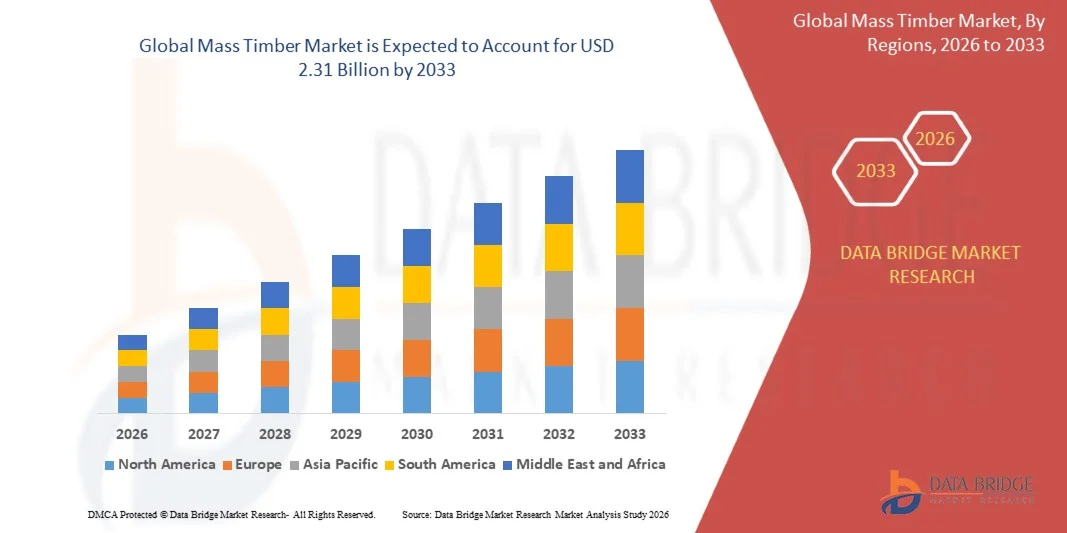
- As per Data Bridge Market Research analysis, the mass timber market was valued at USD 1.29 billion in 2025 and is projected to reach USD 2.31 billion by 2033, growing at a CAGR of 7.50% from 2026 to 2033.
- The market is experiencing robust growth driven by the increasing demand for sustainable construction solutions and the need to reduce the carbon footprint of the built environment. Mass timber products, such as Cross-Laminated Timber (CLT) and Glue-Laminated Timber (Glulam), offer a renewable and low-carbon alternative to traditional materials such as concrete and steel.
- Supportive government policies and updated building codes, particularly in North America and Europe, are playing a crucial role in promoting the use of mass timber in construction. In addition, advancements in manufacturing and digital design technologies, such as Building Information Modeling (BIM), are enhancing the precision, efficiency, and scalability of mass timber construction.
Market Size & Forecast
- Market Value (2025): USD 1.29 Billion
- Expected Market Value (2033): USD 2.31 Billion
- Forecast CAGR (2026–2033): 7.50%
- Leading Region in 2025: Europe
- Fastest Growing Region: Asia-Pacific
What are the Major Takeaways of the Mass Timber Market?
- Europe dominated the mass timber market and accounted for the largest revenue share in 2025, supported by a long-standing tradition of timber construction, robust forestry sectors, and progressive policies that actively promote sustainable building materials.
- Asia-Pacific region is expected to be the fastest-growing market for mass timber from 2026 to 2033. Rapid urbanization, particularly in China and India, is creating significant demand for sustainable construction materials and advanced building solutions.
- The cross-laminated timber (CLT) segment dominated the market with the largest revenue share in 2025, owing to its superior structural strength, excellent load-bearing capacity, fire resistance, and increasing adoption in sustainable mid-rise and high-rise construction projects. Growing investments in green buildings and prefabricated construction techniques further support the widespread use of CLT across residential and commercial developments.
- The dowel-laminated timber (DLT) segment is projected to register the fastest CAGR from 2026 to 2033, driven by rising demand for adhesive-free engineered wood products, increasing emphasis on environmentally friendly construction materials, and growing adoption of modular and prefabricated building systems. Its ease of installation and sustainability advantages are expected to accelerate market growth.
- The residential buildings segment led the market with the largest revenue share in 2025, supported by rising demand for sustainable housing, rapid urbanization, and increasing adoption of engineered wood in single-family and multi-family residential projects. Government initiatives promoting low-carbon construction and energy-efficient buildings further contribute to the segment's dominance.
- The institutional buildings segment is expected to witness the fastest CAGR from 2026 to 2033, driven by increasing construction of schools, universities, healthcare facilities, and public infrastructure using sustainable building materials. Growing government support for mass timber construction and stringent carbon reduction targets are further accelerating adoption across institutional projects.
Report Scope and Mass Timber Market Segmentation
|
Attributes |
Mass Timber Key Market Insights |
|
Segments Covered |
|
|
Countries Covered |
North America
Europe
Asia-Pacific
Middle East and Africa
South America
|
|
Key Market Players |
|
|
Market Opportunities |
|
|
Value Added Data Infosets |
In addition to the insights on market scenarios such as market value, growth rate, segmentation, geographical coverage, and major players, the market reports curated by the Data Bridge Market Research also include import export analysis, production capacity overview, production consumption analysis, price trend analysis, climate change scenario, supply chain analysis, value chain analysis, raw material/consumables overview, vendor selection criteria, PESTLE Analysis, Porter Analysis, and regulatory framework. |
What is the Key Trend in the Mass Timber Market?
- Governments, developers, and construction companies are increasingly adopting mass timber, including cross-laminated timber (CLT) and glued laminated timber (glulam), to reduce embodied carbon, accelerate project delivery, and meet stringent sustainability and net-zero building targets. Engineered wood products are gaining traction across commercial, residential, institutional, and infrastructure projects due to their lower environmental impact, prefabrication capabilities, and structural performance.
- For instance, in March 2025, Timberlab broke ground on a 190,000-square-foot cross-laminated timber (CLT) manufacturing facility in Millersburg, Oregon. The facility, one of the largest CLT production plants in the U.S., is designed to expand domestic mass timber production and support the growing demand for sustainable, prefabricated timber buildings across North America.
- Increasing investment in prefabricated and modular construction is further driving the use of mass timber, as factory-manufactured CLT and glulam components enable faster installation, reduced construction waste, and improved labor efficiency while lowering project timelines.
- Developers are also integrating circular economy principles into mass timber projects by utilizing reclaimed and salvaged wood to manufacture engineered timber products, helping reduce material waste and lifecycle carbon emissions.
- For instance, in March 2025, Sterling Structural, Cambium, RIOS Architecture, and Minimal Impact Engineering unveiled the "Campfire Coil" at the International Mass Timber Conference. The installation showcased cross-laminated timber manufactured from salvaged wood, demonstrating the potential of circular material supply chains and carbon-smart timber for future sustainable construction.
- As governments strengthen green building regulations and developers prioritize low-carbon construction materials, the adoption of mass timber is expected to accelerate globally, reinforcing engineered wood as a key solution for sustainable urban development and next-generation building construction.
What are the Key Drivers of the Mass Timber Market?
- Governments, developers, and construction companies are increasingly adopting mass timber as a sustainable alternative to concrete and steel to reduce embodied carbon emissions and achieve net-zero building goals. Engineered wood products such as cross-laminated timber (CLT), glued laminated timber (glulam), and nail-laminated timber (NLT) offer lower lifecycle emissions, renewable sourcing, and faster construction, making them highly attractive for commercial, residential, and institutional projects.
- For instance, in June 2026, Stora Enso partnered with Swedish construction company ByggPartner to supply Sylva cross-laminated timber (CLT) for ByggPartner's new headquarters in Sweden. The project combines mass timber construction with fully electric truck deliveries, demonstrating how developers are lowering embodied carbon emissions and supporting net-zero building goals through sustainable construction practices.
- Growing investments in green building certifications, prefabricated construction, and climate-resilient infrastructure are encouraging architects and developers to integrate mass timber into new building projects, reducing construction time, material waste, and environmental impact.
- As governments implement stricter carbon reduction policies and the construction industry prioritizes sustainable building materials, demand for mass timber is expected to grow rapidly, positioning engineered wood as a key component of the global transition toward low-carbon construction.
Which Factors are Challenging the Growth of the Mass Timber Market?
- Mass timber construction requires significant upfront investment due to specialized manufacturing facilities, advanced engineered wood production technologies, prefabrication equipment, transportation logistics, and skilled labor. The costs associated with establishing cross-laminated timber (CLT) and glued laminated timber (glulam) production facilities remain substantially higher than those of conventional construction material manufacturing.
- These high capital requirements, combined with limited regional manufacturing capacity and supply chain constraints, restrict the adoption of mass timber, particularly among small and medium-sized developers, contractors, and projects in emerging economies where conventional concrete and steel remain more cost-competitive.
- For instance, in February 2025, Timberlab announced plans to construct a new cross-laminated timber (CLT) manufacturing facility in Millersburg, Oregon. The company stated that the project represents a major capital investment aimed at expanding domestic CLT production capacity, highlighting the substantial upfront costs associated with establishing advanced mass timber manufacturing infrastructure and specialized production equipment.
- The high capital investment, limited number of certified manufacturing facilities, transportation costs for large engineered timber panels, and ongoing workforce training requirements continue to slow the adoption of mass timber. These factors constrain market penetration, particularly in cost-sensitive regions and countries with underdeveloped engineered wood supply chains, despite increasing demand for sustainable construction materials.
How is the Mass Timber Market Segmented?
The mass timber market is segmented on the basis of product type, application, and end use.
- By Product Type
On the basis of product type, the mass timber market is segmented into cross-laminated timber (CLT), glued-laminated timber (glulam), nail-laminated timber (NLT), dowel-laminated timber (DLT), laminated veneer lumber (LVL), and solid wood panels/boards. The cross-laminated timber (CLT) segment dominated the market with the largest revenue share in 2025, owing to its superior structural strength, excellent load-bearing capacity, fire resistance, and increasing adoption in sustainable mid-rise and high-rise construction projects. Growing investments in green buildings and prefabricated construction techniques further support the widespread use of CLT across residential and commercial developments.
The dowel-laminated timber (DLT) segment is projected to register the fastest CAGR from 2026 to 2033, driven by rising demand for adhesive-free engineered wood products, increasing emphasis on environmentally friendly construction materials, and growing adoption of modular and prefabricated building systems. Its ease of installation and sustainability advantages are expected to accelerate market growth.
- By Application
On the basis of application, the mass timber market is segmented into residential buildings, commercial buildings, industrial buildings, and institutional buildings. The residential buildings segment led the market with the largest revenue share in 2025, supported by rising demand for sustainable housing, rapid urbanization, and increasing adoption of engineered wood in single-family and multi-family residential projects. Government initiatives promoting low-carbon construction and energy-efficient buildings further contribute to the segment's dominance.
The institutional buildings segment is expected to witness the fastest CAGR from 2026 to 2033, driven by increasing construction of schools, universities, healthcare facilities, and public infrastructure using sustainable building materials. Growing government support for mass timber construction and stringent carbon reduction targets are further accelerating adoption across institutional projects.
- By End Use
On the basis of end use, the mass timber market is segmented into floor and roof systems, beams and columns, walls, and others. The floor and roof systems segment dominated the market with the largest revenue share in 2025 due to extensive utilization of mass timber panels in modern building construction, superior structural performance, reduced construction time, and improved design flexibility. Increasing adoption of prefabricated construction methods and demand for lightweight structural solutions continue to strengthen segment growth.
The walls segment is anticipated to witness the fastest CAGR from 2026 to 2033, driven by growing use of prefabricated wall panels in residential and commercial construction, increasing focus on energy-efficient building envelopes, and rising demand for sustainable, high-performance construction materials. Advances in engineered wood manufacturing technologies are further supporting rapid expansion of this segment
Which Region Holds the Largest Share of the Mass Timber Market?
- Europe dominated the mass timber market and accounted for the largest revenue share in 2025, supported by a long-standing tradition of timber construction, robust forestry sectors, and progressive policies that actively promote sustainable building materials.
- The region also benefits from stringent environmental regulations, high adoption of engineered wood products such as Cross-Laminated Timber (CLT) and Glulam, and growing use of mass timber across residential, commercial, and institutional construction applications. Increasing focus on carbon-neutral construction, green building certifications, and urban densification continues to strengthen Europe's leadership position in the global market. Countries such as Austria, Germany, and Sweden are at the forefront of innovation and adoption.
U.K. Mass Timber Market Insight
The U.K. mass timber market is expected to witness the fastest growth rate from 2026 to 2033, driven by increasing demand for sustainable buildings and the country's commitment to achieving net-zero carbon emissions. Growing investments in low-carbon residential developments, educational facilities, and commercial buildings are supporting market expansion. In addition, rising awareness of off-site construction techniques and the environmental advantages of engineered wood products is encouraging wider adoption of mass timber across new construction and renovation projects.
Germany Mass Timber Market Insight
The Germany dominated the mass timber market and accounted for the largest revenue share in 2025, fueled by strong government initiatives promoting sustainable construction and the country's advanced engineered wood manufacturing industry. Germany's focus on reducing embodied carbon in buildings, combined with continuous innovation in timber engineering and construction technologies, is accelerating the adoption of mass timber. Increasing demand for energy-efficient residential and commercial buildings is further supporting market growth.
North America Mass Timber Market Insight
North America is expected to be the fastest-growing market for mass timber from 2026 to 2033, supported by the increasing adoption of sustainable construction materials and growing investments in low-carbon building solutions. Rising awareness regarding the environmental benefits of engineered wood products, coupled with supportive building code revisions, is encouraging the use of mass timber across residential, commercial, and institutional projects. The region also benefits from abundant forest resources, advanced manufacturing capabilities, and increasing demand for prefabricated construction systems that reduce project timelines and carbon emissions.
U.S. Mass Timber Market Insight
The U.S. is expected to be the fastest-growing market for mass timber from 2026 to 2033, driven by the growing emphasis on sustainable construction and favorable updates to the International Building Code permitting taller mass timber buildings. Increasing investments in commercial offices, educational institutions, multifamily housing, and public infrastructure projects are accelerating product adoption. In addition, expanding domestic manufacturing capacity, strong government support for low-carbon construction, and increasing developer interest in prefabricated timber systems continue to strengthen market growth.
Asia-Pacific Mass Timber Market Insight
The Asia-Pacific region is expected to be the fastest-growing market for mass timber from 2026 to 2033. Rapid urbanization, particularly in China and India, is creating significant demand for sustainable construction materials and advanced building solutions. Governments across the region are increasingly promoting green building practices, carbon reduction initiatives, and the use of renewable materials in construction. China, Japan, Australia, and emerging economies are witnessing rising investments in sustainable infrastructure and low-carbon buildings. The growing adoption of engineered wood products in commercial, residential, and institutional construction is expected to accelerate regional market expansion.
China Mass Timber Market Insight
China is forecast to be a key driver of growth in the Asia-Pacific region, supported by rapid urban development, large-scale infrastructure projects, and increasing emphasis on sustainable construction technologies. The country’s focus on reducing carbon emissions from the building sector is encouraging the adoption of renewable materials such as mass timber. Growing investments in green buildings, prefabricated construction, and modern wood engineering technologies are creating new opportunities for mass timber applications. In addition, increasing awareness of energy-efficient and low-carbon construction methods is expected to support market growth in China.
Japan Mass Timber Market Insight
Japan is expected to be the fastest-growing market for mass timber from 2026 to 2033, fueled by its need for earthquake-resilient construction and sustainable building solutions. The country is exploring timber as a lightweight structural material that can meet strict seismic safety standards while reducing environmental impact. Increasing government support for timber utilization, advanced wood processing technologies, and demand for eco-friendly buildings are driving adoption across residential and commercial sectors. Furthermore, Japan’s long-standing forestry industry and focus on renewable resource utilization provide a strong foundation for the expansion of mass timber construction.
Which are the Top Companies in Mass Timber Market?
The mass timber industry is primarily led by well-established companies, including:
- Stora Enso (Finland)
- Binderholz GmbH (Austria)
- KLH Massivholz GmbH (Austria)
- Mayr-Melnhof Holz (Austria)
- Hasslacher Norica (Austria)
- Structurlam Mass Timber Corporation (Canada)
- Nordic Structures (Canada)
- Lignotrend (Germany)
- ZÜBLIN Timber Construction (Germany)
- XLam Dolomiti (Italy)
- SmartLam North America (U.S.)
- Mercer Mass Timber (U.S.)
- Element5 (Canada)
What are Latest Developments in Mass Timber Market?
- In February 2025, Timberlab announced plans to construct a new cross-laminated timber (CLT) manufacturing facility in Millersburg, Oregon. The company stated that the project represents a major capital investment aimed at expanding domestic CLT production capacity, highlighting the substantial upfront costs associated with establishing advanced mass timber manufacturing infrastructure and specialized production equipment.
- In March 2025, Sterling Structural, Cambium, RIOS Architecture, and Minimal Impact Engineering unveiled the "Campfire Coil" installation at the International Mass Timber Conference. The project showcased cross-laminated timber manufactured from salvaged wood, demonstrating how circular economy practices and reclaimed timber can reduce embodied carbon while expanding sustainable material sourcing for mass timber construction.
- In January 2025, Mercer Mass Timber highlighted major advancements expected across the industry, including improved manufacturing technologies, greater automation, and cost-efficient engineered wood production. These developments are expected to enhance construction productivity, improve affordability, and accelerate the replacement of carbon-intensive materials such as steel and concrete in commercial and residential buildings.

- Interactive Data Analysis Dashboard
- Company Analysis Dashboard for high growth potential opportunities
- Research Analyst Access for customization & queries
- Competitor Analysis with Interactive dashboard
- Latest News, Updates & Trend analysis
- Harness the Power of Benchmark Analysis for Comprehensive Competitor Tracking
Global Mass Timber Market, Supply Chain Analysis and Ecosystem Framework
To support market growth and help clients navigate the impact of geopolitical shifts, DBMR has integrated in-depth supply chain analysis into its Global Mass Timber Market research reports. This addition empowers clients to respond effectively to global changes affecting their industries. The supply chain analysis section includes detailed insights such as Global Mass Timber Market consumption and production by country, price trend analysis, the impact of tariffs and geopolitical developments, and import and export trends by country and HSN code. It also highlights major suppliers with data on production capacity and company profiles, as well as key importers and exporters. In addition to research, DBMR offers specialized supply chain consulting services backed by over a decade of experience, providing solutions like supplier discovery, supplier risk assessment, price trend analysis, impact evaluation of inflation and trade route changes, and comprehensive market trend analysis.
Data collection and base year analysis are done using data collection modules with large sample sizes. The stage includes obtaining market information or related data through various sources and strategies. It includes examining and planning all the data acquired from the past in advance. It likewise envelops the examination of information inconsistencies seen across different information sources. The market data is analysed and estimated using market statistical and coherent models. Also, market share analysis and key trend analysis are the major success factors in the market report. To know more, please request an analyst call or drop down your inquiry.
The key research methodology used by DBMR research team is data triangulation which involves data mining, analysis of the impact of data variables on the market and primary (industry expert) validation. Data models include Vendor Positioning Grid, Market Time Line Analysis, Market Overview and Guide, Company Positioning Grid, Patent Analysis, Pricing Analysis, Company Market Share Analysis, Standards of Measurement, Global versus Regional and Vendor Share Analysis. To know more about the research methodology, drop in an inquiry to speak to our industry experts.
Data Bridge Market Research is a leader in advanced formative research. We take pride in servicing our existing and new customers with data and analysis that match and suits their goal. The report can be customized to include price trend analysis of target brands understanding the market for additional countries (ask for the list of countries), clinical trial results data, literature review, refurbished market and product base analysis. Market analysis of target competitors can be analyzed from technology-based analysis to market portfolio strategies. We can add as many competitors that you require data about in the format and data style you are looking for. Our team of analysts can also provide you data in crude raw excel files pivot tables (Fact book) or can assist you in creating presentations from the data sets available in the report.













