


Mediastinitis Treatment Market Size
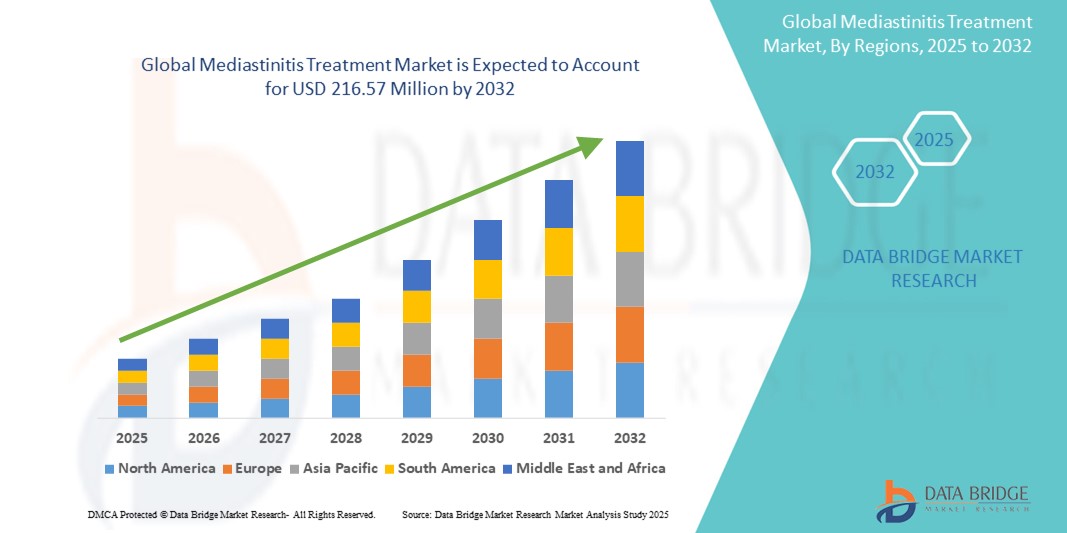
- The global mediastinitis treatment market size was valued at USD 126.99 million in 2024 and is expected to reach USD 216.57 million by 2032, at a CAGR of 6.90% during the forecast period
- The market growth is primarily driven by the increasing incidence of postoperative infections, especially following cardiac surgeries, and the growing awareness and early diagnosis of mediastinal infections
- Moreover, advancements in antimicrobial therapies, wound care management, and surgical interventions are improving treatment outcomes, prompting wider clinical adoption. These factors, combined with increasing healthcare expenditure and improved hospital infrastructure, are propelling the demand for effective mediastinitis treatment solutions globally, thereby contributing to substantial market expansion
Mediastinitis Treatment Market Analysis
- Mediastinitis treatment, involving antimicrobial therapy, surgical intervention, and advanced wound care, has become increasingly critical in managing deep-seated infections of the mediastinum, particularly in postoperative cardiac patients, with growing adoption in hospitals and specialty clinics due to advancements in diagnostic imaging and clinical management protocols
- The escalating demand for mediastinitis treatment is primarily driven by a rise in postoperative infections, an aging population undergoing complex surgeries, and increasing awareness of hospital-acquired infections requiring aggressive treatment approaches
- North America dominated the mediastinitis treatment market with the largest revenue share of 40.3% in 2024, supported by a well-established healthcare infrastructure, higher rates of cardiac surgeries, and early availability of novel antibiotics and diagnostic tools, particularly in the U.S. where multidisciplinary protocols are standard for infection control
- Asia-Pacific is expected to be the fastest growing region in the mediastinitis treatment market during the forecast period due to rising healthcare spending, rapid urbanization, and improving access to advanced diagnostic and treatment services in emerging economies such as India and China
- Antibiotic segment dominated the mediastinitis treatment market with a market share of 48.8% in 2024, attributed to its essential role in the immediate management of mediastinal infections, with increasing reliance on broad-spectrum and targeted therapies to improve patient outcomes
Report Scope and Mediastinitis Treatment Market Segmentation
|
Attributes |
Mediastinitis Treatment Key Market Insights |
|
Segments Covered |
|
|
Countries Covered |
North America
Europe
Asia-Pacific
Middle East and Africa
South America
|
|
Key Market Players |
|
|
Market Opportunities |
|
|
Value Added Data Infosets |
In addition to the insights on market scenarios such as market value, growth rate, segmentation, geographical coverage, and major players, the market reports curated by the Data Bridge Market Research also include in-depth expert analysis, pricing analysis, brand share analysis, consumer survey, demography analysis, supply chain analysis, value chain analysis, raw material/consumables overview, vendor selection criteria, PESTLE Analysis, Porter Analysis, and regulatory framework. |
Mediastinitis Treatment Market Trends
“Advancement in Diagnosis and Personalized Antimicrobial Therapy”
- A significant and accelerating trend in the global mediastinitis treatment market is the increasing integration of advanced diagnostic imaging and personalized antimicrobial therapy protocols. This evolution is significantly improving the early detection and effective management of mediastinitis, particularly in high-risk postoperative patients
- For instance, contrast-enhanced CT scans and high-resolution MRI are increasingly being used in clinical settings to precisely diagnose mediastinal infections, enabling timely surgical intervention and reducing mortality rates. Leading hospitals are combining these tools with culture-based microbial profiling to optimize treatment strategies
- Personalized antimicrobial therapy, which tailors antibiotic selection based on pathogen identification and sensitivity testing, is becoming more prevalent. For example, rapid diagnostic techniques such as PCR and next-generation sequencing allow clinicians to initiate targeted antibiotic therapy early, minimizing resistance risks and improving outcomes
- The adoption of adjunctive therapies, such as vacuum-assisted closure (VAC) systems, is also growing. These systems aid in wound healing post-surgery, reduce infection spread, and are particularly useful in deep sternal wound infections linked to mediastinitis
- These technological advancements, combined with data-driven treatment planning and real-time monitoring tools, are transforming clinical practice and elevating the standard of care for mediastinitis globally. Consequently, healthcare providers and medical technology companies are investing in integrated solutions for faster diagnosis, optimized drug delivery, and improved infection control
- The demand for precise, patient-centered treatment approaches is increasing across both developed and emerging healthcare markets, as clinicians and hospitals prioritize outcomes, cost-efficiency, and antimicrobial stewardship
Mediastinitis Treatment Market Dynamics
Driver
“Rising Surgical Volumes and Awareness of Postoperative Infections”
- The increasing number of cardiac and thoracic surgeries globally, along with growing awareness about postoperative complications, is a major driver fueling the demand for mediastinitis treatment solutions
- For instance, a significant portion of mediastinitis cases develop after coronary artery bypass graft (CABG) surgery, which remains one of the most frequently performed procedures worldwide. The rising prevalence of cardiovascular disease and obesity continues to drive the volume of these surgeries, thereby increasing associated infection risks
- Growing clinical awareness and institutional adoption of early screening protocols for mediastinitis are leading to faster diagnoses and better therapeutic outcomes. Hospitals in high-income regions are implementing evidence-based protocols to mitigate risk, including prophylactic antibiotic regimens and early imaging for suspected cases
- Furthermore, advancements in surgical techniques, intensive care infrastructure, and infection control protocols are enhancing the ability of healthcare systems to manage complex infections such as mediastinitis. These improvements are being mirrored in emerging markets as investments in healthcare infrastructure grow
- The increased availability of multidisciplinary care teams and standardized clinical pathways in tertiary care settings is also supporting faster recovery and reducing the burden of mediastinitis on healthcare systems. These combined factors are expected to propel sustained market growth during the forecast period
Restraint/Challenge
“Delayed Diagnosis and Antimicrobial Resistance”
- A key challenge facing the mediastinitis treatment market is the frequent delay in diagnosis, which can severely impact patient outcomes and increase treatment complexity. Early symptoms of mediastinitis are often vague, making it difficult to distinguish from other postoperative complications without advanced imaging or surgical exploration
- For instance, in resource-limited settings, access to CT or MRI imaging may be restricted, leading to underdiagnosis or delayed intervention. This can result in more severe infections, longer hospital stays, and increased healthcare costs
- In addition, rising antimicrobial resistance (AMR) is creating barriers to effective treatment. Infections caused by multidrug-resistant organisms are more difficult to treat and require more expensive or toxic antibiotic regimens, putting further strain on healthcare systems
- High reliance on empirical therapy in the absence of rapid microbial identification increases the risk of inappropriate treatment and worsens resistance trends. Inadequate implementation of antimicrobial stewardship programs exacerbates the issue in many hospitals globally
- The high cost of advanced therapies and diagnostics, particularly in low- and middle-income countries, can also hinder access to optimal care. Affordability and insurance coverage gaps remain significant barriers to the widespread adoption of best practices
- Addressing these challenges requires investment in early detection tools, broader access to imaging, enhanced global surveillance for resistance patterns, and continued innovation in both antimicrobial agents and delivery systems to ensure timely, effective, and accessible treatment
Mediastinitis Treatment Market Scope
The market is segmented on the basis of treatment, diagnosis, dosage form, route of administration, end-user, and distribution channel.
- By Treatment
On the basis of treatment, the mediastinitis treatment market is segmented into antibiotic, surgery, and others. The antibiotic segment dominated the market with the largest market revenue share of 48.8% in 2024, driven by its essential role as the frontline treatment for bacterial infections associated with mediastinitis. Antibiotics are typically administered immediately upon diagnosis to control infection, reduce inflammation, and prevent complications. This segment continues to grow with the development of advanced, broad-spectrum, and targeted antimicrobial therapies aimed at combating resistant bacterial strains and minimizing systemic toxicity.
The surgery segment is anticipated to witness the fastest growth rate from 2025 to 2032, fueled by rising incidences of deep sternal wound infections post-cardiac surgery and increasing adoption of minimally invasive techniques. Surgical debridement, drainage, and reconstruction procedures are becoming standard in severe cases where antibiotics alone are insufficient, with technologies such as VAC therapy further supporting post-surgical recovery.
- By Diagnosis
On the basis of diagnosis, the mediastinitis treatment market is segmented into CT scan, MRI, X-ray, ultrasound, and others. The CT scan segment held the largest market revenue share of 37.6% in 2024, driven by its superior imaging accuracy, rapid availability, and high diagnostic value in identifying mediastinal infections. CT scans are widely used in both emergency and postoperative care settings to confirm mediastinitis, guide surgical decisions, and monitor treatment response.
The MRI segment is expected to witness the fastest CAGR from 2025 to 2032, supported by its enhanced soft tissue visualization and lack of ionizing radiation, making it suitable for repeat imaging in sensitive populations. As access to MRI improves and protocols for mediastinal imaging evolve, this modality is gaining traction in hospitals with advanced diagnostic capabilities.
- By Dosage Form
On the basis of dosage form, the mediastinitis treatment market is segmented into tablet, injection, and others. The injection segment dominated the market with the largest market revenue share of 44.9% in 2024, owing to its use in critical and hospitalized cases that require rapid onset of action and precise dosing. Injectable antibiotics, especially intravenous formulations, are essential for managing acute mediastinitis due to their effectiveness in achieving high plasma concentrations quickly.
The tablet segment is expected to grow steadily through 2032, particularly in follow-up care and non-severe cases, where oral formulations are preferred for their ease of use, cost-effectiveness, and suitability for outpatient management. Advancements in oral drug formulations that maintain bioavailability are further supporting this segment's expansion
- By Route of Administration
On the basis of route of administration, the mediastinitis treatment market is segmented into oral, intramuscular, intravenous, and others. The intravenous segment held the largest market revenue share of 52.1% in 2024, primarily due to its critical role in hospital settings where immediate and controlled delivery of antibiotics is required. Intravenous administration ensures rapid drug distribution, particularly in life-threatening cases where early intervention is vital.
The oral route is projected to experience the fastest growth rate from 2025 to 2032, supported by the increasing use of oral medications in continuation and step-down therapy once the patient stabilizes. This route offers convenience, lower treatment costs, and better patient compliance, especially in long-term or home-based care.
- By End-User
On the basis of end-user, the mediastinitis treatment market is segmented into hospital, clinic, and others. The hospital segment dominated the market with the largest market revenue share of 61.4% in 2024, driven by the critical nature of mediastinitis requiring inpatient care, multidisciplinary treatment teams, surgical capability, and access to intensive care units. Hospitals are the primary centers for managing severe infections and are well-equipped with imaging, lab diagnostics, and surgery facilities.
The clinic segment is expected to grow at a moderate pace during forecast period, driven by increasing outpatient follow-up visits, wound care management, and postoperative consultations. As healthcare infrastructure expands and decentralizes, specialty clinics are playing a greater role in the continuum of care.
- By Distribution Channel
On the basis of distribution channel, the mediastinitis treatment market is segmented into hospital pharmacy, retail pharmacy, and online pharmacy. The hospital pharmacy segment held the largest market revenue share of 46.7% in 2024, attributed to its integration with inpatient care and the administration of high-potency injectable therapies, which are typically dispensed in hospital settings.
The online pharmacy segment is anticipated to witness the fastest growth from 2025 to 2032, fueled by growing digital health adoption, home-based treatment models, and the convenience of ordering oral medications and follow-up prescriptions online. Increased awareness, regulatory support, and telemedicine integration are further driving this trend, particularly in urban and semi-urban regions.
Mediastinitis Treatment Market Regional Analysis
- North America dominated the mediastinitis treatment market with the largest revenue share of 40.3% in 2024, supported by a well-established healthcare infrastructure, higher rates of cardiac surgeries, and early availability of novel antibiotics and diagnostic tools, particularly in the U.S. where multidisciplinary protocols are standard for infection control
- The region benefits from greater clinical awareness, well-established infection control protocols, and widespread access to high-end imaging and antimicrobial therapies, supporting faster diagnosis and effective treatment of mediastinitis
- In addition, the presence of leading healthcare institutions, favorable reimbursement policies, and a rising focus on managing postoperative complications contribute to the increasing demand for mediastinitis treatment solutions, reinforcing North America's position as the primary market for advanced infection management
U.S. Mediastinitis Treatment Market Insight
The U.S. mediastinitis treatment market captured the largest revenue share of 82.5% in 2024 within North America, driven by the high volume of cardiac surgeries and strong awareness of postoperative infection risks. Advanced healthcare infrastructure, early access to cutting-edge diagnostic tools such as CT and MRI, and the widespread implementation of antimicrobial stewardship programs support effective disease management. Furthermore, the presence of key pharmaceutical and medical device companies, alongside structured infection control protocols, reinforces the U.S. as a leader in mediastinitis treatment adoption and innovation.
Europe Mediastinitis Treatment Market Insight
The Europe mediastinitis treatment market is projected to grow at a steady CAGR throughout the forecast period, primarily fueled by a rising number of thoracic and cardiac surgeries and an aging population more vulnerable to post-surgical complications. Stringent regulatory frameworks and quality assurance standards across healthcare systems in countries such as Germany, France, and the U.K. support early diagnosis and optimal treatment. In addition, increasing investment in advanced imaging modalities and growing focus on hospital-acquired infection prevention are fostering wider adoption of effective mediastinitis management strategies.
U.K. Mediastinitis Treatment Market Insight
The U.K. mediastinitis treatment market is anticipated to grow at a noteworthy CAGR during the forecast period, supported by a strong public health system, rising awareness among healthcare providers, and centralized post-operative care systems. Hospitals in the U.K. are emphasizing early detection protocols and deploying high-resolution diagnostic imaging for faster clinical decisions. Increasing emphasis on antimicrobial resistance control and national healthcare policies promoting infection management are also contributing to the growing demand for mediastinitis treatments.
Germany Mediastinitis Treatment Market Insight
The Germany mediastinitis treatment market is expected to expand steadily during the forecast period, supported by the country’s advanced medical infrastructure and increasing emphasis on precision medicine and infection prevention. Germany’s healthcare system promotes early and accurate diagnostics through widespread use of CT and MRI imaging, while multidisciplinary teams enable comprehensive treatment involving antibiotics, surgical care, and wound management. Public health initiatives focused on reducing hospital-acquired infections also contribute to rising demand for structured mediastinitis care pathways.
Asia-Pacific Mediastinitis Treatment Market Insight
The Asia-Pacific mediastinitis treatment market is poised to grow at the fastest CAGR of 25.2% during the forecast period of 2025 to 2032, driven by improving healthcare access, rising surgical volumes, and growing awareness of post-operative infections in countries such as China, Japan, and India. Government-led investments in hospital infrastructure and digital health technologies are improving early diagnosis and treatment delivery. In addition, increasing medical tourism and the expansion of tertiary care facilities across the region are supporting the adoption of advanced mediastinitis treatment protocols.
Japan Mediastinitis Treatment Market Insight
The Japan mediastinitis treatment market is gaining momentum due to its aging population, high incidence of cardiac surgeries, and strong emphasis on infection control. The country’s technologically advanced healthcare system and focus on patient safety have led to the early adoption of antimicrobial stewardship and rapid diagnostic methods. Hospitals in Japan are increasingly incorporating imaging and AI-assisted decision tools to improve early detection, while rising demand for minimally invasive surgical care supports broader market growth.
India Mediastinitis Treatment Market Insight
The India mediastinitis treatment market accounted for the largest revenue share in Asia-Pacific in 2024, attributed to the country’s growing healthcare infrastructure, high surgical volume, and expanding access to diagnostic technologies. India’s rising middle-class population and increased health awareness are driving demand for timely and effective post-operative care. Government initiatives focused on affordable healthcare, along with public and private investments in tertiary care hospitals and infectious disease control, are contributing significantly to the country's market growth.
Mediastinitis Treatment Market Share
The mediastinitis treatment industry is primarily led by well-established companies, including:
- Merck & Co., Inc. (U.S.)
- Pfizer Inc. (U.S.)
- GSK plc (U.K.)
- Melinta Therapeutics (U.S.)
- Basilea Pharmaceutica Ltd. (Switzerland)
- Paratek Pharmaceuticals, Inc. (U.S.)
- Nabriva Therapeutics plc (Ireland)
- Spero Therapeutics (U.S.)
- Abbott (U.S.)
- F. Hoffmann-La Roche Ltd. (Switzerland)
- Viatris Inc. (U.S.)
- Teva Pharmaceutical Industries Ltd. (Israel)
- Sanofi (France)
- Novartis AG (Switzerland)
- Bayer AG (Germany)
- Sun Pharmaceutical Industries Ltd. (India)
- Lilly (U.S.)
- Aurobindo Pharma (India)
- Lupin (India)
- Shionogi & Co., Ltd. (Japan)
- AbbVie Inc. (U.S.)
- Cumberland Pharmaceuticals Inc. (U.S.)
What are the Recent Developments in Global Mediastinitis Treatment Market?
- In May 2024, Pfizer Inc. initiated a clinical collaboration with leading cardiovascular centers in North America to evaluate the efficacy of next-generation broad-spectrum antibiotics in the treatment of deep sternal wound infections, including mediastinitis. This initiative reflects Pfizer’s commitment to combatting post-surgical infections through innovation and precision antimicrobial therapies, aiming to reduce recovery times and hospital readmissions for cardiac surgery patients
- In April 2024, 3M Health Care expanded its wound care portfolio by launching a new range of antimicrobial incise drapes and negative pressure wound therapy (NPWT) systems, designed specifically to prevent and manage complex surgical infections such as mediastinitis. These products offer improved postoperative outcomes by reducing microbial contamination at incision sites, reinforcing 3M’s leadership in advanced surgical site infection (SSI) prevention technologies
- In March 2024, Abbott Laboratories announced the results of a multicenter study evaluating the use of rapid diagnostic testing for early detection of mediastinitis in high-risk cardiac surgery patients. The study showed significant improvement in early intervention outcomes, supporting the integration of point-of-care molecular diagnostics in postoperative care protocols. Abbott’s innovation aims to enhance clinical decision-making and minimize complications associated with delayed diagnosis
- In February 2024, Medtronic plc launched an awareness campaign in partnership with global cardiac surgery associations to educate healthcare professionals about best practices in mediastinitis prevention and management. The initiative emphasizes the role of surgical technique, glycemic control, and optimized antimicrobial use in reducing infection rates, showcasing Medtronic’s focus on holistic, patient-centered care strategies
- In January 2024, BD (Becton, Dickinson and Company) unveiled its new antimicrobial sternal closure system aimed at reducing infection risks in open-heart surgeries. Designed to inhibit microbial colonization while ensuring secure wound closure, this product highlights BD’s commitment to advancing infection control technologies and supporting improved outcomes for patients susceptible to mediastinitis

- Interactive Data Analysis Dashboard
- Company Analysis Dashboard for high growth potential opportunities
- Research Analyst Access for customization & queries
- Competitor Analysis with Interactive dashboard
- Latest News, Updates & Trend analysis
- Harness the Power of Benchmark Analysis for Comprehensive Competitor Tracking
Data collection and base year analysis are done using data collection modules with large sample sizes. The stage includes obtaining market information or related data through various sources and strategies. It includes examining and planning all the data acquired from the past in advance. It likewise envelops the examination of information inconsistencies seen across different information sources. The market data is analysed and estimated using market statistical and coherent models. Also, market share analysis and key trend analysis are the major success factors in the market report. To know more, please request an analyst call or drop down your inquiry.
The key research methodology used by DBMR research team is data triangulation which involves data mining, analysis of the impact of data variables on the market and primary (industry expert) validation. Data models include Vendor Positioning Grid, Market Time Line Analysis, Market Overview and Guide, Company Positioning Grid, Patent Analysis, Pricing Analysis, Company Market Share Analysis, Standards of Measurement, Global versus Regional and Vendor Share Analysis. To know more about the research methodology, drop in an inquiry to speak to our industry experts.
Data Bridge Market Research is a leader in advanced formative research. We take pride in servicing our existing and new customers with data and analysis that match and suits their goal. The report can be customized to include price trend analysis of target brands understanding the market for additional countries (ask for the list of countries), clinical trial results data, literature review, refurbished market and product base analysis. Market analysis of target competitors can be analyzed from technology-based analysis to market portfolio strategies. We can add as many competitors that you require data about in the format and data style you are looking for. Our team of analysts can also provide you data in crude raw excel files pivot tables (Fact book) or can assist you in creating presentations from the data sets available in the report.












