


What is the Melon Seeds Market Size and Growth Rate?
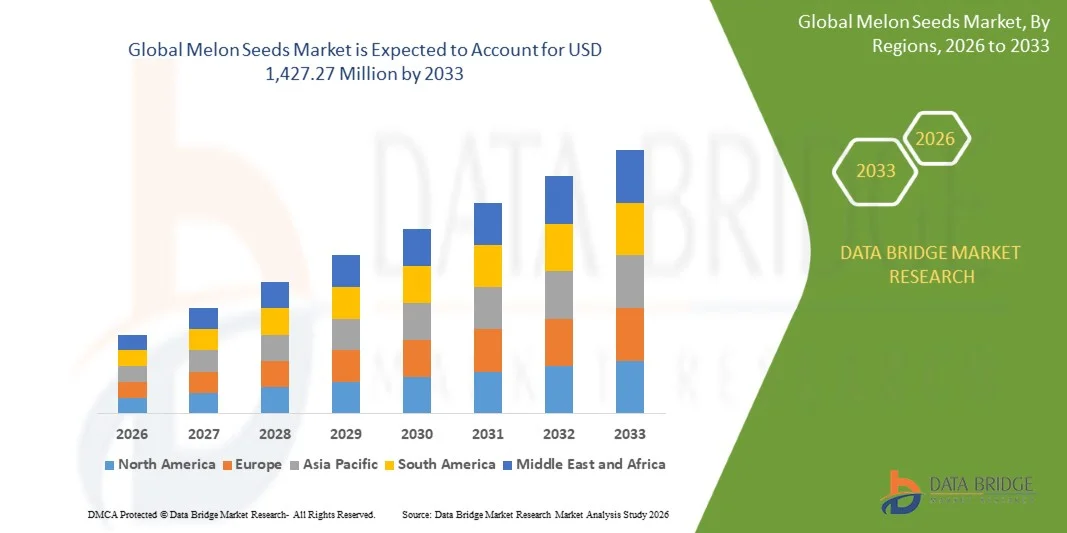
As per Data Bridge Market Research analysis, the melon seeds market was valued at USD 882.09 million in 2025 and is projected to reach USD 1,427.27 million by 2033, growing at a CAGR of 6.20% from 2026 to 2033. The market is experiencing consistent growth driven by rising consumer demand for nutrient-dense snack products, increasing awareness regarding the health benefits of seeds, and expanding applications of melon seeds in food, beverage, and functional nutrition industries.
The growing adoption of plant-based and protein-rich foods, combined with increasing consumer preference for natural and clean-label ingredients, is encouraging food manufacturers to incorporate melon seeds into snacks, bakery products, confectionery, and dietary formulations. Advancements in processing technologies, rising demand for organic seed products, and the expansion of health-focused food products are further supporting market growth by providing consumers with convenient and nutritious alternatives.
Market Size & Forecast
- Global Market Value (2025): USD 882.09 Million
- Expected Market Value (2033): USD 1,427.27 Million
- Forecast CAGR (2026–2033): 6.20%
- Leading Region in 2025: North America
- Fastest Growing Region: Asia-Pacific
What are the Major Takeaways of Melon Seeds Market?
- North America dominated the melon seeds market with the largest revenue share of 35.2% in 2025, supported by rising consumer preference for healthy snacking products, increasing demand for plant-based protein sources, and strong adoption of nutritious seed-based food products
- The conventional melon seeds segment led the market with a 70.4% share in 2025, driven by large-scale cultivation, wider availability, lower production costs, and established agricultural supply chains
- Asia-Pacific is expected to be the fastest-growing region at a CAGR of 7.0% from 2026 to 2033, fueled by increasing health awareness, growing consumption of nutrient-rich foods, expanding food processing industries, and rising demand in countries such as China and India
- Organic melon seeds are the fastest-growing nature type, projected to register a CAGR of 8.1%, reflecting the surge in consumer preference for organic, chemical-free, and sustainably sourced food products
- The watermelon seeds segment dominated the source category with a 45.2% revenue share in 2025, led by extensive watermelon cultivation, high global consumption, and increasing utilization of watermelon seeds in snacks and nutritional products
- Farmland accounted for 85.6% of the market, preferred by widespread adoption of traditional open-field cultivation and availability of suitable agricultural land
- The winter segment is the fastest-growing season category, with a CAGR of 7.9%, driven by increasing adoption of greenhouse and controlled-environment cultivation methods
Report Scope and Melon Seeds Market Segmentation
|
Attributes |
Melon Seeds Key Market Insights |
|
Segments Covered |
|
|
Countries Covered |
North America
Europe
Asia-Pacific
Middle East and Africa
South America
|
|
Key Market Players |
|
|
Market Opportunities |
|
|
Value Added Data Infosets |
In addition to the insights on market scenarios such as market value, growth rate, segmentation, geographical coverage, and major players, the market reports curated by the Data Bridge Market Research also include in-depth expert analysis, pricing analysis, brand share analysis, consumer survey, demography analysis, supply chain analysis, value chain analysis, raw material/consumables overview, vendor selection criteria, PESTLE Analysis, Porter Analysis, and regulatory framework. |
What is the Key Trend in the Melon Seeds Market?
Trend: Rising Demand for Plant-Based and Nutrient-Rich Snack Products
Consumers are increasingly shifting toward healthy, natural, and protein-rich snack alternatives, driving the adoption of melon seeds as a functional food ingredient due to their high nutritional value, including protein, fiber, healthy fats, vitamins, and minerals. Food manufacturers are incorporating melon seeds into snack bars, cereals, bakery products, and ready-to-eat formulations to meet growing demand for clean-label and wellness-oriented products. The increasing popularity of plant-based diets and functional foods is further encouraging product innovation, while organic and minimally processed melon seed products are gaining traction among health-conscious consumers seeking natural nutrition solutions. For instance, in August 2024, an article published in Sustainable Food Technology highlighted the increasing valorisation of melon seeds as a promising food ingredient due to their nutritional composition, including protein, healthy fats, and bioactive compounds, supporting their growing applications in functional foods and value-added food products
The growing preference for healthy snacking and plant-based nutrition is expected to strengthen melon seed consumption across global food and beverage applications.
Melon Seeds Market Dynamics
Key Market Driver: Increasing Awareness of Nutritional Benefits of Melon Seeds
The rising awareness regarding the health benefits of melon seeds is a major factor driving market growth, as consumers increasingly recognize their rich protein content, dietary fiber, antioxidants, and essential minerals. Health-focused consumers are incorporating melon seeds into daily diets to support wellness, weight management, and balanced nutrition, increasing demand for packaged and processed seed products. Food and beverage manufacturers are responding by launching innovative products such as roasted seeds, seed mixes, and fortified nutritional products, expanding the role of melon seeds beyond traditional consumption patterns into mainstream health food categories. For instance, in August 2024, a study published in Chemical and Biological Technologies in Agriculture evaluated melon seed oil processing by-products and found that defatted melon seeds contained high levels of protein (51.1–54.2%), dietary fiber (29.4–33.2%), minerals, and bioactive compounds, demonstrating their potential as functional food ingredients for food reformulation and nutritional product development.
Growing consumer understanding of nutritional advantages is expected to remain a key driver for the expansion of the global melon seeds market.
Key Restraint/Challenge: Limited Consumer Awareness and Supply Chain Constraints
A significant challenge in the melon seeds market is limited consumer awareness in several regions and inconsistent availability of high-quality seed products. Compared with other widely consumed seeds, melon seeds have lower global recognition, restricting their adoption among mainstream consumers. In addition, fluctuations in agricultural production, climate-related cultivation challenges, and limited processing infrastructure can affect supply consistency, pricing, and product availability. Small-scale producers often face difficulties in maintaining standardized quality, packaging, and distribution networks, creating barriers for wider market penetration in emerging economies. For instance, in August 2023, a research published in the Journal of Plant Physiology found that microplastic contamination in agricultural soils negatively affected melon (Cucumis melo L.) seed germination and seedling growth, highlighting the impact of environmental conditions and cultivation-related challenges on melon production quality.
Improving cultivation practices, processing infrastructure, and consumer education will be essential to overcome supply and awareness-related challenges in the melon seeds market.
Key Market Opportunity: Expansion of Functional Food and Organic Seed Applications
The increasing demand for functional foods, organic ingredients, and clean-label products presents a significant opportunity for melon seed manufacturers to develop value-added products targeting health-conscious consumers. Companies are exploring opportunities in organic melon seeds, premium snack products, plant-based protein formulations, and nutritional supplements to capitalize on changing dietary preferences. The expansion of e-commerce platforms and specialty health food channels is further improving consumer access to melon seed products, creating opportunities for market players to enter new geographic regions and develop innovative product offerings. For instance, in November 2023, research published in Food Chemistry demonstrated that melon seeds can be converted into value-added food products, with melon seed flour successfully incorporated into cake formulations as a source of protein, dietary fiber, and beneficial lipids, supporting opportunities for functional bakery and nutrition-focused product development.
Rising demand for functional nutrition and organic food products is expected to create new growth opportunities for melon seed producers and food manufacturers globally.
How is the Melon Seeds Market Segmented?
The melon seeds market is segmented on the basis of nature, source, farm type, season, distribution channel, and end-use.
- By Nature
On the basis of nature, the melon seeds market is segmented into organic melon seeds and conventional melon seeds. The conventional melon seeds segment dominated the market with an 70.4% share in 2025, owing to large-scale cultivation, wider availability, lower production costs, and established agricultural supply chains. Conventional melon seeds are extensively preferred by farmers due to their affordability and compatibility with traditional farming practices. These seeds are widely utilized for commercial cultivation because of their higher accessibility and consistent supply availability. Increasing demand from food processing industries for reliable raw materials is supporting segment dominance. The availability of conventional farming infrastructure across major melon-producing countries continues to strengthen market adoption. Their cost-effectiveness and large production volume are expected to maintain their leading position globally.
The organic melon seeds segment is projected to register the fastest growth at a CAGR of 8.1% from 2026 to 2033, driven by increasing consumer preference for organic, chemical-free, and sustainably sourced food products. Growing awareness regarding clean-label ingredients and healthy lifestyles is encouraging demand for organically produced melon seeds. Organic melon seeds are gaining popularity among premium snack manufacturers and wellness-focused consumers. Expansion of certified organic farming practices and increasing availability through online retail platforms are supporting market growth. Rising demand for sustainable agricultural products is further accelerating adoption. Increasing focus on environmentally responsible food production is expected to create significant growth opportunities for organic melon seeds.
- By Source
On the basis of source, the melon seeds market is segmented into cantaloupe, galia melons, watermelons, yellow melons, and others. The watermelon seeds segment dominated the market with an 45.2% share in 2025, supported by extensive watermelon cultivation, high global consumption, and increasing utilization of watermelon seeds in snacks and nutritional products. Watermelon seeds are widely consumed due to their protein, healthy fat, mineral, and antioxidant content. Large-scale production across Asia-Pacific and Africa provides strong raw material availability. Food manufacturers are increasingly incorporating watermelon seeds into roasted snacks, seed mixes, and functional food products. Their established consumer acceptance contributes to segment leadership. Growing demand for plant-based nutrition is further supporting market expansion.
The cantaloupe seeds segment is expected to witness the fastest growth at a CAGR of 7.5% from 2026 to 2033, driven by increasing research and commercialization of melon seed by-products for functional food applications. Cantaloupe seeds contain valuable nutritional components, including proteins, oils, minerals, and bioactive compounds. Growing interest in sustainable food production is encouraging the utilization of fruit processing by-products. Food manufacturers are exploring cantaloupe seeds as value-added ingredients in nutritional formulations. Increasing demand for innovative plant-based ingredients is supporting segment growth. Expansion of functional food applications is expected to accelerate adoption during the forecast period.
- By Farm Type
On the basis of farm type, the melon seeds market is segmented into farmland, greenhouse, and hydroponics. The farmland segment dominated the market with an 85.6% share in 2025, due to widespread adoption of traditional open-field cultivation and availability of suitable agricultural land. Farmland cultivation remains the primary production method for melon crops globally because of lower operational costs and established farming practices. Major melon-producing countries rely heavily on conventional agricultural systems for large-scale production. The segment benefits from extensive farming experience and existing supply chain infrastructure. Increasing demand for melon seeds from food processing industries continues to support farmland cultivation. Its scalability and cost efficiency maintain its dominant position in the market.
The hydroponics segment is projected to grow at the fastest CAGR of 10.1% from 2026 to 2033, driven by increasing adoption of controlled-environment agriculture and sustainable farming technologies. Hydroponic cultivation enables efficient resource utilization, controlled nutrient management, and production in regions with limited agricultural land. Rising concerns regarding climate change and water scarcity are encouraging alternative cultivation methods. Technological advancements in vertical farming are supporting hydroponic adoption. Increasing investments in sustainable agriculture are creating new opportunities. The growing need for year-round crop production is expected to accelerate segment growth.
- By Season
On the basis of season, the melon seeds market is segmented into summer, winter, autumn, and spring. The summer segment dominated the market with an 55.2% share in 2025, as melons are primarily warm-season crops requiring higher temperatures for optimal growth and seed development. Favorable climatic conditions during summer support higher cultivation volumes across major producing regions. Increased melon production during the summer season contributes to greater seed availability for processing applications. Farmers benefit from established cultivation practices during this period. Strong agricultural output supports supply consistency for food manufacturers. The dominance of summer cultivation is expected to continue due to favorable growing conditions.
the winter segment is expected to register the fastest growth at a CAGR of 7.9% from 2026 to 2033, supported by increasing adoption of greenhouse and controlled-environment cultivation methods. Modern farming technologies are enabling melon production beyond traditional growing periods. Protected cultivation helps maintain suitable temperature and humidity conditions. Rising demand for year-round availability of melon seed products is encouraging seasonal diversification. Greenhouse farming is expanding in regions facing climatic limitations. Increasing investment in advanced agricultural systems is expected to support winter cultivation growth.
- By Distribution Channel
On the basis of distribution channel, the melon seeds market is segmented into business to business, hypermarkets & supermarkets, convenience stores, specialty stores, and online channels. The business to business segment dominated the market with an 50.4% share in 2025, driven by bulk purchasing requirements from food processors, ingredient manufacturers, and commercial food producers. Industrial buyers require consistent supply, standardized quality, and large-volume procurement. B2B channels support applications across snacks, bakery products, nutritional foods, and ingredient manufacturing. Established supplier networks strengthen segment growth. Increasing demand for melon seed-based food products is expanding industrial sourcing activities. The segment remains essential for global melon seed distribution.
The online channel segment is projected to grow at the fastest CAGR of 12.0% from 2026 to 2033, driven by increasing e-commerce adoption and rising consumer preference for convenient purchasing options. Online platforms provide wider access to organic, premium, and specialty melon seed products. Digital marketplaces allow smaller brands to reach global consumers. Increasing internet penetration and online grocery adoption are supporting growth. Health-conscious consumers are increasingly purchasing functional foods through digital channels. Expansion of direct-to-consumer brands is expected to accelerate online sales.
- By End-Use
On the basis of end-use, the melon seeds market is segmented into food processing, pharmaceuticals, cosmetics and personal care, and others. The food processing segment dominated the market with an 65.9% share in 2025, supported by increasing utilization of melon seeds in snacks, bakery products, confectionery, cereals, and functional foods. Melon seeds are valued for their protein, fiber, healthy fats, and mineral content. Food manufacturers are incorporating melon seeds into nutritional and clean-label products. Rising demand for plant-based ingredients is strengthening food applications. Growth of healthy snack categories is further supporting adoption. The segment is expected to maintain its leading position throughout the forecast period.
The pharmaceuticals segment is expected to witness the fastest growth at a CAGR of 9.4% from 2026 to 2033, driven by increasing research into melon seed bioactive compounds and nutritional benefits. Melon seeds contain proteins, oils, antioxidants, and minerals with potential health applications. Growing demand for natural ingredients in nutraceutical formulations is creating opportunities. Pharmaceutical companies are exploring plant-derived compounds for wellness applications. Rising preventive healthcare awareness is supporting demand for natural nutritional ingredients. Continued scientific research is expected to accelerate pharmaceutical utilization of melon seeds.
Which Region Holds the Largest Share of the Melon Seeds Market?
North America dominated the melon seeds market with the largest revenue share of 35.2% in 2025, supported by rising consumer preference for healthy snacking products, increasing demand for plant-based protein sources, and strong adoption of nutritious seed-based food products. The region benefits from growing awareness regarding the nutritional benefits of melon seeds, including protein, fiber, and essential minerals. Increasing demand for organic and clean-label food products is accelerating market development. Expansion of online retail channels, premium snack categories, and health-focused food applications is further supporting regional growth. Growing preference for sustainable and nutrient-rich food alternatives continues to strengthen North America's leading position in the global market.
U.S. Melon Seeds Market Insight
The U.S. melon seeds market is witnessing steady growth due to rising consumer demand for healthy snacking products, increasing preference for plant-based protein sources, and expanding adoption of functional food ingredients. The country’s mature health food and organic food ecosystem, along with increasing availability of packaged melon seed products through retail and e-commerce channels, is driving demand across snack, nutrition, and food processing applications. In addition, growing consumer interest in clean-label and nutrient-rich foods is accelerating melon seed adoption among health-conscious consumers and food manufacturers. According to the Organic Trade Association’s 2023 Organic Industry Survey, U.S. organic sales reached a record USD 67.6 billion in 2022, reflecting increasing consumer demand for organic and naturally sourced food products and creating growth opportunities for organic melon seed applications
Europe Melon Seeds Market Insight
The Europe melon seeds market remains a significant contributor to global demand, driven by increasing consumption of healthy snacks, rising preference for organic food products, and strong adoption of functional ingredients in food formulations. The widespread availability of premium seed-based snacks, plant-based nutrition products, and clean-label ingredients is supporting market expansion across the region. Increasing investments in sustainable agriculture, organic farming practices, and innovative food applications continue to enhance melon seed adoption throughout Europe. According to Eurostat (European Commission), the area used for organic agricultural production in the European Union reached 16.9 million hectares in 2022, equivalent to 10.5% of the total utilised agricultural area, reflecting the increasing adoption of organic farming practices and supporting growth opportunities for organic food ingredients such as melon seeds.
U.K. Melon Seeds Market Insight
The U.K. melon seeds market is experiencing steady growth, supported by rising demand for nutritious snacks, increasing awareness of plant-based diets, and growing availability of functional food products. Increasing consumer focus on protein-rich ingredients and healthy lifestyle choices is encouraging retailers and food manufacturers to introduce seed-based products. Furthermore, expansion of online grocery platforms and specialty health food stores is improving accessibility of melon seed products, positioning the U.K. as an important market for premium and organic seed-based foods. According to the Food and Agriculture Organization (FAO), the global shift toward plant-based food consumption is increasing demand for nutrient-rich plant ingredients, supporting opportunities for seed-based food products in markets such as the U.K.
Germany Melon Seeds Market Insight
The Germany melon seeds market is expanding steadily due to increasing demand for sustainable food products, strong consumer preference for organic ingredients, and the country’s advanced food processing industry. Food manufacturers and retailers are increasingly incorporating nutrient-rich seeds into snacks, bakery products, and functional food formulations. Continuous growth of organic food consumption, along with strong sustainability initiatives, is further supporting market development in Germany. According to the German Organic Food Industry Federation (BÖLW), Germany’s organic food market reached approximately EUR 16.1 billion in sales in 2023, highlighting strong consumer demand for organic and naturally sourced food products and supporting opportunities for organic melon seed applications.
Asia-Pacific Melon Seeds Market Insight
The Asia-Pacific melon seeds market is expected to witness rapid growth, driven by increasing health awareness, rising consumption of nutritious snacks, expanding food processing industries, and growing demand for plant-based ingredients across countries such as China, India, and Japan. Growing urbanization and increasing disposable income are encouraging consumers to adopt healthier food choices and premium snack products. In addition, the region’s strong agricultural base and large-scale melon production are supporting raw material availability and market expansion. According to the Food and Agriculture Organization (FAO), Asia remains the largest producer of melons globally, with China accounting for a major share of global melon production, supporting regional availability of melon seed resources.
Japan Melon Seeds Market Insight
The Japan melon seeds market is witnessing consistent growth due to rising demand for functional foods, increasing interest in healthy snacking, and growing adoption of premium nutritional ingredients. Food manufacturers are increasingly focusing on innovative products containing seeds, grains, and plant-based ingredients to meet consumer wellness trends. Moreover, increasing demand for convenient nutrition products and clean-label foods is supporting melon seed applications in snacks and health-oriented formulations. According to the Ministry of Agriculture, Forestry and Fisheries (MAFF) Japan, consumer interest in food sustainability and healthier dietary patterns has increased, supporting demand for functional and plant-based food products.
China Melon Seeds Market Insight
The China melon seeds market is growing rapidly, driven by high consumption of seed-based snacks, expanding food processing industries, and increasing demand for nutritious food products. China’s large agricultural production base, strong snack culture, and growing health-conscious consumer base are significantly boosting melon seed demand. In addition, rising investments in food innovation, e-commerce distribution, and premium packaged food products are accelerating market development. According to FAOSTAT data from the Food and Agriculture Organization (FAO), China ranks among the world’s leading melon producers, with large-scale cultivation supporting raw material availability and processing opportunities for melon seed-based products.
Which are the Top Companies in Melon Seeds Market?
The melon seeds industry is primarily led by well-established companies, including:
- Syngenta (Switzerland)
- Bayer AG (Germany)
- BASF (Germany)
- Corteva (U.S.)
- SAKATA SEED CORPORATION (Japan)
- TAKII & CO., LTD. (Japan)
- Rijk Zwaan Zaadteelt en Zaadhandel B.V. (Netherlands)
- Enza Zaden (Netherlands)
- East-West Seed (Thailand)
- KNOWN-YOU SEED CO., LTD (Taiwan)
- Vilmorin & Cie (France)
- Bejo Zaden B.V. (Netherlands)
- HM.CLAUSE (France)
- Seedway, LLC (U.S.)
- Johnny's Selected Seeds (U.S.)
- Harris Seeds (U.S.)
- Territorial Seed Company (U.S.)
- Vitalis Organic Seeds (Netherlands)
- Organic Seeds Alliance (U.S.)
- Fedco Seeds, Inc. (U.S.)
What are Latest Developments in Melon Seeds Market?
- In November 2025, DKMUL (Dakshina Kannada Cooperative Milk Producers Union Ltd.) announced the launch of a new seed-based nutrition product, Nandini Seeds Delight, containing watermelon seeds along with other nutrient-rich ingredients. The product was developed as a health-focused offering containing seeds, nuts, milk, and other nutritional components. The launch reflects increasing commercialization of seed-based functional foods and growing consumer interest in protein- and fiber-rich snack products
- In September 2024, Smash Melon launched its Watermelon Seed Protein Powder as a plant-based protein product developed from a single ingredient watermelon seeds. The product was introduced to address increasing demand for alternative protein sources and clean-label nutrition products. The company positioned watermelon seed protein as an allergen-free and plant-based protein option with applications in smoothies, baking, and nutritional formulations. This launch highlights the commercialization of melon seed-derived ingredients beyond traditional snack applications and reflects growing interest in sustainable plant-based nutrition products
- In July 2024, Meloop Foods promoted its All Sow Great seed-based snack range, highlighting the commercialization of nutrient-rich seed snacks using ingredients sourced from farmers. The company focused on developing healthier snack alternatives using seeds as key ingredients, targeting consumers seeking nutritious and sustainable snack options. The product positioning reflects increasing consumer interest in seed-based foods and alternative protein-rich snacks. This development supports the expansion of seed ingredients, including melon and related edible seeds, into modern snack categories
- In December 2023, researchers developed watermelon seed protein-based chocolate formulations, demonstrating a new functional food application for melon seed ingredients. The study published in ACS Food Science & Technology evaluated the use of watermelon seed protein isolate as a partial replacement for skim milk powder in chocolate production. Researchers found that watermelon seed protein improved nutritional properties, including protein content, while maintaining quality characteristics of the chocolate product
- In September 2023, Milkish launched a watermelon seed-based plant milk product, expanding the application of melon seeds into alternative dairy beverages. The company developed a plant-based milk formulation using watermelon seeds as a key ingredient, targeting consumers seeking dairy alternatives and sustainable nutrition products. The launch reflects increasing innovation in seed-based beverages and the utilization of watermelon seeds as a functional ingredient beyond traditional snack applications

- Interactive Data Analysis Dashboard
- Company Analysis Dashboard for high growth potential opportunities
- Research Analyst Access for customization & queries
- Competitor Analysis with Interactive dashboard
- Latest News, Updates & Trend analysis
- Harness the Power of Benchmark Analysis for Comprehensive Competitor Tracking
Global Melon Seeds Market, Supply Chain Analysis and Ecosystem Framework
To support market growth and help clients navigate the impact of geopolitical shifts, DBMR has integrated in-depth supply chain analysis into its Global Melon Seeds Market research reports. This addition empowers clients to respond effectively to global changes affecting their industries. The supply chain analysis section includes detailed insights such as Global Melon Seeds Market consumption and production by country, price trend analysis, the impact of tariffs and geopolitical developments, and import and export trends by country and HSN code. It also highlights major suppliers with data on production capacity and company profiles, as well as key importers and exporters. In addition to research, DBMR offers specialized supply chain consulting services backed by over a decade of experience, providing solutions like supplier discovery, supplier risk assessment, price trend analysis, impact evaluation of inflation and trade route changes, and comprehensive market trend analysis.
Data collection and base year analysis are done using data collection modules with large sample sizes. The stage includes obtaining market information or related data through various sources and strategies. It includes examining and planning all the data acquired from the past in advance. It likewise envelops the examination of information inconsistencies seen across different information sources. The market data is analysed and estimated using market statistical and coherent models. Also, market share analysis and key trend analysis are the major success factors in the market report. To know more, please request an analyst call or drop down your inquiry.
The key research methodology used by DBMR research team is data triangulation which involves data mining, analysis of the impact of data variables on the market and primary (industry expert) validation. Data models include Vendor Positioning Grid, Market Time Line Analysis, Market Overview and Guide, Company Positioning Grid, Patent Analysis, Pricing Analysis, Company Market Share Analysis, Standards of Measurement, Global versus Regional and Vendor Share Analysis. To know more about the research methodology, drop in an inquiry to speak to our industry experts.
Data Bridge Market Research is a leader in advanced formative research. We take pride in servicing our existing and new customers with data and analysis that match and suits their goal. The report can be customized to include price trend analysis of target brands understanding the market for additional countries (ask for the list of countries), clinical trial results data, literature review, refurbished market and product base analysis. Market analysis of target competitors can be analyzed from technology-based analysis to market portfolio strategies. We can add as many competitors that you require data about in the format and data style you are looking for. Our team of analysts can also provide you data in crude raw excel files pivot tables (Fact book) or can assist you in creating presentations from the data sets available in the report.













