


What is the Mini Light-Emitting Diode (LED) Market Size and Growth Rate?
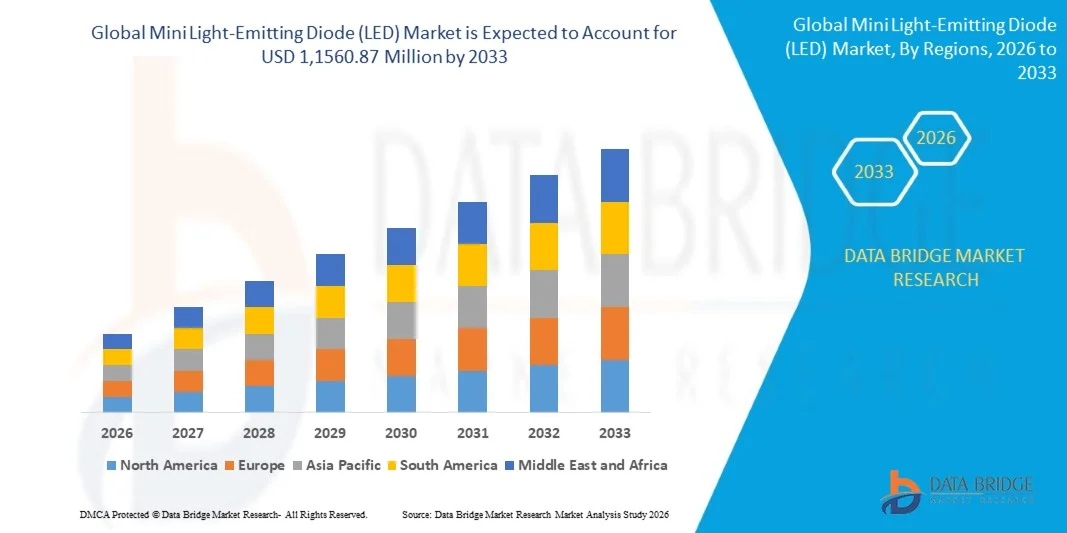
- As per Data Bridge Market Research analysis, the mini light-emitting diode (LED) market was valued at USD 572.40 million in 2025 and is projected to reach USD 1,1560.87 million by 2033, growing at a CAGR of 45.6% from 2026 to 2033.
- The market is experiencing rapid growth driven by the increasing utilization of mini light-emitting diodes in the electronics industry, rising investment in mini-LED technologies, and growing adoption of advanced display technologies. Mini LEDs offer improved local dimming characteristics and are expected to gain significant popularity during the forecast period.
- The increasing adoption of mini-LED technology across televisions, smartphones, laptops, and other electronic devices, supported by advancements in display performance such as higher brightness, improved contrast ratio, and energy efficiency, is supporting market growth. However, high costs and the requirement for a large number of ICs remain key challenges that could restrict market expansion.
Market Size & Forecast
- Global Market Value (2025): USD 572.40 Million
- Expected Market Value (2033): USD 1,1560.87 Million
- Forecast CAGR (2026–2033): 45.6%
- Leading Region in 2025: North America
- Fastest Growing Region: Asia-Pacific
What are the Major Takeaways of the Mini Light-Emitting Diode (LED) Market?
- North America dominated the mini light-emitting diode (LED) market with the largest revenue share of 41.82% in 2025, supported by rising demand for consumer electronics, growth in the automotive sector, technological advancements, and increasing adoption of LED lighting solutions.
- Asia-Pacific is expected to be the fastest-growing region at a CAGR of 21.4% from 2026 to 2033, fueled by concentrated mini-LED manufacturing, expanding consumer electronics markets, and increasing government support for advanced display technologies.
- The standard segment led the market with a 52.0% share in 2025, driven by its broad applicability across consumer electronics, displays, backlighting, automotive applications, and general illumination.
- Ultra-high output are the fastest-growing type, projected to register a CAGR of 9.0%, reflecting the surge in demand for high-performance illumination and display applications.
- The mini display segment dominated the technology type category with a 78.0% revenue share in 2025, led by rapid adoption of mini LED technology in televisions, computer monitors, tablets, laptops, and other advanced display devices.
- Consumer electronics accounted for 70.0% of the market share in 2025, preferred by extensive adoption of mini LED technology in televisions, monitors, laptops, tablets, and other display devices.
- The automotive segment is the fastest-growing sector category, with a CAGR of 10.0%, driven by increasing adoption of advanced displays and high-performance lighting systems in vehicles
Report Scope and Mini Light-Emitting Diode (LED) Market Segmentation
|
Attributes |
Mini Light-Emitting Diode (LED) Key Market Insights |
|
Segments Covered |
|
|
Countries Covered |
North America
Europe
Asia-Pacific
Middle East and Africa
South America
|
|
Key Market Players |
|
|
Market Opportunities |
|
|
Value Added Data Infosets |
In addition to the insights on market scenarios such as market value, growth rate, segmentation, geographical coverage, and major players, the market reports curated by the Data Bridge Market Research also include in-depth expert analysis, geographically represented company-wise production and capacity, network layouts of distributors and partners, detailed and updated price trend analysis and deficit analysis of supply chain and demand. |
What is the Key Trend in the Mini Light-Emitting Diode (LED) Market?
- Mini-LED displays are increasingly moving into automotive cockpits, driven by demand for HDR, local dimming, wide color gamut, curved screens, and sunlight-readable interfaces across premium vehicles and electric vehicles.
- For instance, in February 2025, TrendForce reported that Hisense, Samsung, and TCL were advancing RGB Mini LED backlighting, with Hisense planning to launch its RGB Mini LED TV in March 2025, highlighting the industry's shift toward RGB-based backlighting to deliver improved color reproduction, brightness, and power efficiency
- Premium televisions are increasingly adopting mini-LED backlighting to deliver higher brightness, precise local dimming, enhanced contrast, and HDR performance while competing directly with OLED in large-screen consumer electronics applications worldwide.
- Gaming monitors are increasingly integrating mini-LED backlighting because high brightness, deep contrast, HDR capability, and high refresh rates improve visual performance for competitive gaming, content creation, and immersive entertainment applications.
- Automotive manufacturers are exploring mini-LED technology for panoramic and holographic head-up displays, where improved contrast and brightness enhance information visibility while supporting increasingly sophisticated driver assistance interfaces and cockpit systems.
- For instance, in June 2025, Omdia projected Mini LED TV shipments to increase by 82.9% in 2025, driven by growing consumer and retailer demand for premium display features, including higher brightness, improved contrast, and enhanced picture quality, demonstrating the accelerating adoption of Mini LED technology in the television market.
- Mini-LED technology is gaining traction across premium televisions as manufacturers seek differentiated display performance, while falling backplane costs and expanding production capacity improve competitiveness against established OLED technologies globally.
What are the Key Drivers of the Mini Light-Emitting Diode (LED) Market?
- The rising demand for high-resolution displays is supporting mini-LED adoption across televisions, laptops, monitors, tablets, automotive displays, and other electronics requiring high brightness, precise backlight control, and enhanced contrast across markets.
- For instance, in September 2025, UBI Research reported that Mini LED display shipments for automotive applications were expected to increase from approximately 1.5 million units in 2023 to more than 16 million units by 2030, driven by automakers’ growing demand for brighter, more durable, and cost-efficient displays for digital cockpits and infotainment systems.
- Growing gaming and video-streaming activity is increasing demand for mini-LED displays because the technology provides stronger contrast, brightness, and HDR performance required by increasingly demanding entertainment and gaming applications worldwide.
- Automotive display demand is accelerating mini-LED adoption as electric vehicles and advanced cockpits require larger screens with improved sunlight readability, local dimming, high brightness, and sophisticated infotainment functionality across premium vehicles.
- Growing demand for high-performance gaming displays is accelerating Mini-LED adoption, as the technology supports HDR certification above 1,000 nits, high contrast, and wide color gamut performance for gaming monitors and laptops.
- For instance, in December 2025, UBI reported that automotive Mini LED display shipments were expected to increase from approximately 4.5 million units in 2024 to 6.75 million units in 2025, driven by growing requirements for high brightness, enhanced readability, and high contrast as automakers increasingly adopt larger center information displays, panoramic displays, and integrated screen configurations
- Increasing emphasis on energy-efficient and durable display technologies is supporting mini-LED adoption because precise local dimming can improve display efficiency while offering greater durability and lower burn-in risk than OLED technologies.
Which Factors are Challenging the Growth of the Mini Light-Emitting Diode (LED) Market?
- Advanced Mini Light-Emitting Diode (LED) require significant upfront investment due to the integration of high-fidelity graphics, motion platforms, realistic vehicle dynamics, and immersive visualization systems.
- For instance, in November 2023, TrendForce reported that declining consumer-electronics demand had affected Mini LED product shipments, while manufacturers continued reducing Mini LED product prices to stimulate demand, highlighting the pricing pressure and profitability challenges associated with Mini LED adoption.
- These high costs limit adoption among smaller driving schools, research institutions, and organizations in emerging economies.
- Complex manufacturing and lower production yields remain significant restraints because mini-LED requires precise placement of thousands of small LED chips, increasing quality-control requirements, production time, and manufacturing costs.
- Supply-chain dependence on specialized materials and components can increase production costs and create supply risks, particularly because mini-LED manufacturing requires specialized semiconductor materials, precision optical films, driver circuitry, and advanced assembly processes.
- For instance, in June 2023, TrendForce highlighted that low manufacturing yields remained a challenge for advanced LED display production, with complex manufacturing processes and yield limitations contributing to higher production costs and slowing the pace of cost reduction.
- The high capital investment and recurring operational costs associated with advanced mini Light-Emitting Diode (LED) continue to restrict adoption, particularly among small and medium-sized organizations, driving schools, and research institutions.
- This cost barrier slows market penetration in price-sensitive and emerging regions, limiting the widespread deployment of advanced simulation technologies despite growing demand.
How is the Mini Light-Emitting Diode (LED) Market Segmented?
The mini light-emitting diode (LED) market is segmented on the basis of type, technology type, and sector.
- By Type
On the basis of type, the mini light-emitting diode (LED) market is segmented into standard, low-current, and ultra-high output. The standard segment dominated the market with an estimated 52.0% share in 2025, owing to its broad applicability across consumer electronics, displays, backlighting, automotive applications, and general illumination. standard mini LEDs provide a balance between brightness, energy efficiency, reliability, and manufacturing cost, making them suitable for high-volume commercial applications. Their compatibility with established LED manufacturing and packaging processes also supports widespread adoption among display and lighting manufacturers. Growing demand for mini LED-backlit televisions, monitors, laptops, and tablets is further contributing to segment expansion. Standard Mini LEDs are increasingly being integrated into products requiring enhanced brightness and localized dimming without the higher costs associated with specialized high-output solutions.
The ultra-high output segment is projected to register the fastest growth at an estimated CAGR of 9.0% from 2026 to 2033, driven by increasing demand for high-performance illumination and display applications. Ultra-high-output mini LEDs can deliver greater luminous intensity within compact form factors, making them suitable for applications where brightness and visibility are critical. Increasing adoption of advanced automotive displays is creating additional opportunities for high-output mini LED technologies. These LEDs can support high-brightness displays used in vehicles, outdoor advertising, professional monitors, and specialized equipment. Growing consumer preference for brighter displays with improved HDR performance is also encouraging manufacturers to develop higher-output mini LED solutions. Technological improvements in thermal management and LED packaging are helping manufacturers achieve higher brightness while maintaining reliability.
- By Technology Type
On the basis of technology type, the mini light-emitting diode (LED) market is segmented into mini display and mini lighting. The mini display segment dominated the market with an estimated 78.0% share in 2025, supported by rapid adoption of mini LED technology in televisions, computer monitors, tablets, laptops, and other advanced display devices. Mini LED displays offer improved brightness, contrast, local dimming, and HDR performance compared with conventional LED-backlit displays. Leading consumer electronics manufacturers are increasingly incorporating mini LED backlighting into premium and high-performance products to improve visual quality. The technology also provides manufacturers with an alternative to OLED for applications requiring high brightness and reduced concerns regarding image retention. Growing demand for large-screen televisions, gaming monitors, professional displays, and high-end laptops is further strengthening this segment.
The mini lighting segment is projected to register the fastest growth at an estimated CAGR of 8.5% from 2026 to 2033, driven by increasing application of mini LED technology in specialized and high-performance lighting solutions. Mini LED lighting enables compact designs while providing high brightness, precise light distribution, and improved energy efficiency. The technology is gaining attention in automotive lighting, architectural lighting, smart lighting, and other applications requiring compact high-performance light sources. Increasing demand for advanced vehicle lighting systems is creating opportunities for mini LED manufacturers, particularly as automakers introduce sophisticated exterior and interior lighting designs. Improvements in LED packaging and thermal management are also enabling manufacturers to achieve higher output from smaller components. Growing investment in smart and connected lighting solutions is further supporting technological development. As manufacturers continue to improve efficiency and reduce production costs,
- By Sector
On the basis of sector, the mini light-emitting diode (LED) market is segmented into consumer electronics, automotive, advertisement, aerospace and defense, and others. The consumer electronics segment dominated the market with an estimated 70.0% share in 2025, primarily due to extensive adoption of mini LED technology in televisions, monitors, laptops, tablets, and other display devices. Consumer electronics manufacturers are increasingly using Mini LED backlighting to deliver higher brightness, improved contrast, better HDR performance, and more precise local dimming. Growing consumer preference for premium visual experiences is encouraging manufacturers to introduce mini LED products across high-end and increasingly mainstream product categories. The technology is particularly attractive for large-screen televisions and gaming monitors, where brightness and contrast are important purchasing factors. Increasing competition among display manufacturers is also encouraging the integration of mini LED technology into new product categories.
The automotive segment is projected to register the fastest growth at an estimated CAGR of 10.0% from 2026 to 2033, supported by increasing adoption of advanced displays and high-performance lighting systems in vehicles. Automakers are increasingly incorporating larger infotainment screens, digital instrument clusters, passenger displays, and head-up displays into modern vehicle interiors. mini LED technology can provide high brightness, strong contrast, and improved visibility, which are particularly valuable for automotive displays exposed to changing ambient lighting conditions. Growing adoption of electric vehicles and software-defined vehicles is further increasing demand for sophisticated digital cockpit technologies. Mini LED is also gaining opportunities in automotive lighting applications because of its compact form factor and ability to provide precise illumination. Rising investment in advanced driver assistance systems and connected vehicle interfaces is creating additional demand for high-quality displays.
Which Region Holds the Largest Share of the Mini Light-Emitting Diode (LED) Market?
- North America dominated the mini light-emitting diode (LED) market with the largest revenue share of 41.82% in 2025, supported by rising demand for consumer electronics, growth in the automotive sector, technological advancements, and increasing adoption of LED lighting solutions.
- The region also benefits from a technology-forward consumer base, growing demand for premium display quality, and increasing adoption of mini LED technology across gaming, home entertainment, professional content creation, and automotive applications. Strong demand for high-brightness and high-contrast displays, together with continued investments in advanced display technologies, continues to strengthen North America's leadership in the global market.
U.S. Mini Light-Emitting Diode (LED) Market Insight
The U.S. mini light-emitting diode (LED) market is witnessing strong growth due to rising demand for premium televisions, gaming monitors, laptops, and other high-performance display products. The country’s strong consumer electronics market and high purchasing power are supporting adoption of mini LED technology for enhanced brightness, contrast, HDR performance, and local dimming. Increasing demand for premium gaming and home-entertainment displays is further creating opportunities for mini LED manufacturers. In addition, the technology is gaining traction as manufacturers seek high-brightness display solutions that can compete with OLED while offering different performance characteristics. The broader North American market is identified as a major premium-display market, with demand particularly concentrated in televisions and gaming monitors.
Asia-Pacific Mini Light-Emitting Diode (LED) Market Insight
The Asia-Pacific mini light-emitting diode (LED) market is expected to witness rapid growth, driven by its strong display manufacturing ecosystem, vertically integrated supply chain, and presence of major manufacturers across China, South Korea, and Taiwan. China benefits from vertically integrated production involving companies such as BOE, TCL, CSOT, and Tianma, while government support and subsidies have further encouraged domestic mini LED adoption. South Korea’s Samsung Display and LG Display are also investing in mini LED technologies and reallocating capacity to strengthen their positions in advanced displays. Rising demand for high-performance consumer electronics and automotive displays is further supporting regional expansion.
Japan Mini Light-Emitting Diode (LED) Market Insight
The Japan mini light-emitting diode (LED) market is witnessing consistent growth due to strong demand for premium televisions, professional displays, gaming products, and advanced visual technologies. Japanese electronics brands are incorporating mini LED technology into high-end television portfolios to deliver improved brightness, contrast, HDR performance, and localized light control. In 2025, Japanese-market products included mini LED televisions from Sony, Panasonic, TVS REGZA, Sharp, and Hisense, demonstrating the expanding availability of the technology across the country’s premium television segment. Growing consumer preference for large-screen and high-quality displays is supporting further adoption. Japan’s established consumer electronics ecosystem and technological expertise provide additional opportunities for mini LED applications. Continued development of premium display products is expected to support the country’s mini LED market growth.
China Mini Light-Emitting Diode (LED) Market Insight
The China mini light-emitting diode (LED) market is growing rapidly, driven by the country’s vertically integrated display manufacturing ecosystem, government support, and increasing domestic adoption of mini LED products. China’s vertically integrated ecosystem includes BOE, TCL, CSOT, and Tianma, enabling coordination between LED-chip and panel production and supporting production efficiency and cost competitiveness. Government subsidies have also helped push mini LED television penetration toward approximately 10% of the domestic TV market, according to Research and Markets. BOE reported in its 2025 annual report that it continued to develop and mass-produce mini LED/MLED products for both domestic and overseas markets, while improving brightness, contrast, color gamut, and power consumption. These developments are strengthening China’s position as a major Mini LED production and innovation hub
U.K. Mini Light-Emitting Diode (LED) Market Insight
The U.K. mini light-emitting diode (LED) market is experiencing steady growth, supported by increasing availability of premium mini LED televisions and consumer demand for high-quality home entertainment displays. Samsung introduced its 2025 Neo QLED television range in the U.K., incorporating Quantum Mini LED technology with Quantum Matrix control to deliver improved contrast, brightness, and picture detail. The company’s U.K. portfolio includes Mini LED models ranging from mainstream large-screen televisions to premium models, demonstrating the broadening availability of the technology in the market. Growing interest in large-screen televisions, gaming, HDR content, and high-brightness displays is supporting demand. Mini LED’s ability to provide precise light control and strong contrast is also helping manufacturers position the technology as a premium alternative to conventional LED displays. Continued expansion of mini LED product portfolios is expected to support market growth in the U.K
Germany Mini Light-Emitting Diode (LED) Market Insight
The Germany mini light-emitting diode (LED) market is expanding steadily due to growing applications of mini LED technology in automotive displays and advanced vehicle communication systems. In September 2025, Valeo and Ennostar showcased an advanced mini LED high-definition automotive exterior display at IAA MOBILITY 2025 in Munich, integrating mini LED technology into Valeo’s exterior digital-signaling system. The system is designed to provide high brightness, contrast, and resolution while supporting vehicle-to-everything communication and improved road-user safety. This development demonstrates the increasing use of mini LED beyond consumer electronics and into next-generation automotive applications. Germany’s strong automotive manufacturing base and its importance as a center for automotive technology development provide a favorable environment for adoption. Increasing vehicle digitalization and demand for advanced human-machine interfaces are expected to create further opportunities for mini LED technology in the country.
Which are the Top Companies in Mini Light-Emitting Diode (LED) Market?
The mini light-emitting diode (LED) industry is primarily led by well-established companies, including:
- Apple Inc. (U.S.)
- Samsung Electronics Co., Ltd (U.S.)
- LG Electronics India Limited. (U.S.)
- Sony Group Corporation (U.S.)
- Panasonic Corporation (U.S.)
- TCL (China)
- Hisense Company Ltd. (China)
- BOE Technology Group Co., Ltd. (China)
- AUO Corporation (Taiwan)
- Innolux Corporation (Taiwan)
- Ennostar Corporation (Taiwan)
- PlayNitride Inc. (Taiwan)
- ams-OSRAM AG (Austria)
- Lumileds Holding B.V. (Netherlands)
- ViewSonic Corporation (U.S.)
- Dell Inc. (U.S.)
- Lenovo (Hong Kong)
- AOC Monitors (Taiwan)
- ASUSTeK COMPUTER INC. (Taiwan)
- Acer Incorporated (Taiwan)
What are Latest Developments in Mini Light-Emitting Diode (LED) Market?
- In January 2025, Samsung Electronics unveiled its new Vision AI-powered Neo QLED 8K QN990F at CES 2025, featuring advanced AI-driven picture and sound processing alongside its latest Neo QLED display technology. The launch expanded Samsung’s Mini LED-based Neo QLED portfolio and demonstrated the company’s continued development of intelligent, high-performance displays. Samsung highlighted features including 8K AI Upscaling Pro, Auto HDR Remastering Pro, Adaptive Sound Pro, and Color Booster Pro, reinforcing the integration of artificial intelligence with Mini LED display technology
- In May 2024, TCL launched its new premium QD-Mini LED television lineup in North America, introducing the QM7 and QM8 series with advanced Mini LED technology and up to more than 5,000 local dimming zones. The new lineup also included a 115-inch QD-Mini LED television, with peak brightness of up to 5,000 nits, more than 97% DCI-P3 color gamut, and 100% color volume. The launch demonstrated TCL’s continued advancement of Mini LED technology toward larger screens, higher brightness, greater contrast, and improved color performance for premium home entertainment applications
- In February 2024, LG Electronics announced the U.S. rollout of its 2024 QNED Mini LED television lineup, including the QNED90T series in 65-, 75-, and 86-inch screen sizes. The new Mini LED models incorporated LG’s Precision Dimming technology for enhanced contrast and backlight control, alongside AI-powered picture and sound processing. The QNED90T models were scheduled to become available in March 2024, with prices ranging from approximately USD 1,899 for the 65-inch model to USD 3,299 for the 86-inch model. The rollout expanded LG’s Mini LED television portfolio and demonstrated the company’s continued investment in premium large-screen display technology.
- In January 2022, ASUS and ROG unveiled the ROG Swift PG32UQXE, a 32-inch 4K Mini LED gaming monitor featuring a 160 Hz overclockable refresh rate, 10-bit color, 97% DCI-P3 coverage, and up to 1,000 nits peak brightness. The monitor incorporated Full Array Local Dimming across 576 zones to provide more precise control of highlights and shadows in HDR content. ASUS also integrated AUO AmLED technology, enabling real-time adjustment of brightness, contrast, color, refresh rate, and power consumption. The development highlighted the expanding adoption of Mini LED technology in high-performance gaming and creator displays.
- In April 2021, Apple introduced the 12.9-inch iPad Pro with its Liquid Retina XDR display, incorporating a new Mini LED backlighting architecture with more than 10,000 custom-designed Mini LEDs. The display delivered up to 1,000 nits of full-screen brightness, 1,600 nits of peak brightness, and a 1 million-to-1 contrast ratio. Apple designed the system with individually controlled local-dimming zones to reproduce bright highlights and subtle details in dark images for professional HDR workflows. The launch marked a significant expansion of Mini LED technology into high-end tablet and portable professional-display applications

- Interactive Data Analysis Dashboard
- Company Analysis Dashboard for high growth potential opportunities
- Research Analyst Access for customization & queries
- Competitor Analysis with Interactive dashboard
- Latest News, Updates & Trend analysis
- Harness the Power of Benchmark Analysis for Comprehensive Competitor Tracking
Global Mini Led Market, Supply Chain Analysis and Ecosystem Framework
To support market growth and help clients navigate the impact of geopolitical shifts, DBMR has integrated in-depth supply chain analysis into its Global Mini Led Market research reports. This addition empowers clients to respond effectively to global changes affecting their industries. The supply chain analysis section includes detailed insights such as Global Mini Led Market consumption and production by country, price trend analysis, the impact of tariffs and geopolitical developments, and import and export trends by country and HSN code. It also highlights major suppliers with data on production capacity and company profiles, as well as key importers and exporters. In addition to research, DBMR offers specialized supply chain consulting services backed by over a decade of experience, providing solutions like supplier discovery, supplier risk assessment, price trend analysis, impact evaluation of inflation and trade route changes, and comprehensive market trend analysis.
Data collection and base year analysis are done using data collection modules with large sample sizes. The stage includes obtaining market information or related data through various sources and strategies. It includes examining and planning all the data acquired from the past in advance. It likewise envelops the examination of information inconsistencies seen across different information sources. The market data is analysed and estimated using market statistical and coherent models. Also, market share analysis and key trend analysis are the major success factors in the market report. To know more, please request an analyst call or drop down your inquiry.
The key research methodology used by DBMR research team is data triangulation which involves data mining, analysis of the impact of data variables on the market and primary (industry expert) validation. Data models include Vendor Positioning Grid, Market Time Line Analysis, Market Overview and Guide, Company Positioning Grid, Patent Analysis, Pricing Analysis, Company Market Share Analysis, Standards of Measurement, Global versus Regional and Vendor Share Analysis. To know more about the research methodology, drop in an inquiry to speak to our industry experts.
Data Bridge Market Research is a leader in advanced formative research. We take pride in servicing our existing and new customers with data and analysis that match and suits their goal. The report can be customized to include price trend analysis of target brands understanding the market for additional countries (ask for the list of countries), clinical trial results data, literature review, refurbished market and product base analysis. Market analysis of target competitors can be analyzed from technology-based analysis to market portfolio strategies. We can add as many competitors that you require data about in the format and data style you are looking for. Our team of analysts can also provide you data in crude raw excel files pivot tables (Fact book) or can assist you in creating presentations from the data sets available in the report.













