


What is the Molecular Biology Kits and Reagent Market Size and Growth Rate?
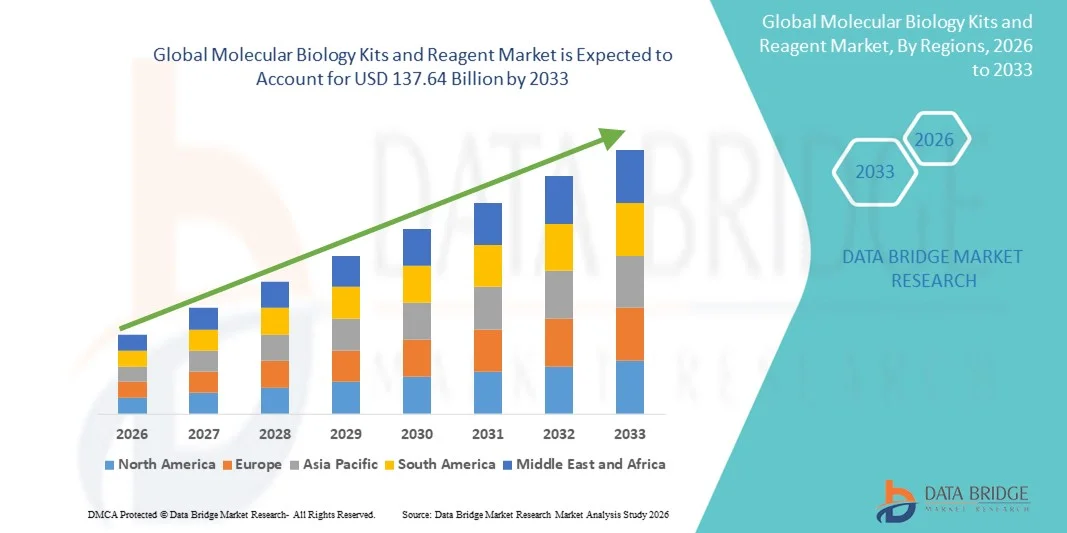
- As per Data Bridge Market Research Analysis the global molecular biology kits and reagent market size was valued at USD 25.90 billion in 2025 and is expected to reach USD 137.64 billion by 2033, at a CAGR of 23.22% during the forecast period
- The market growth is largely fueled by the growing adoption and technological progress within molecular diagnostics, genomics, and life sciences research technologies, leading to increased utilization of standardized molecular workflows across academic, clinical, and industrial settings
- Furthermore, rising demand for accurate, reproducible, and time-efficient laboratory solutions is establishing molecular biology kits and reagents as essential tools for modern research and diagnostic applications. These converging factors are accelerating the uptake of Molecular Biology Kits and Reagents solutions, thereby significantly boosting the industry’s growth
Market Size and Forecast:
- Global Market Value (2025): USD 25.90 Billion
- Expected Market Value (2033): USD 137.64 Billion
- Forecast CAGR (2026–2033): 23.22%
What are the Major Takeaways of Molecular Biology Kits and Reagent Market?
- Molecular biology kits and reagents, offering ready-to-use and standardized solutions for DNA, RNA, and protein analysis, are increasingly vital components of modern life sciences research and clinical diagnostics across academic, pharmaceutical, and biotechnology settings due to their accuracy, reproducibility, and time efficiency
- The escalating demand for molecular biology kits and reagents is primarily fueled by the widespread adoption of genomics and proteomics research, increasing prevalence of infectious and genetic diseases, and rising investments in drug discovery, precision medicine, and molecular diagnostics
- North America dominated the molecular biology kits and reagents market, accounting for approximately 41.8% of the global revenue share in 2025. This dominance is supported by strong federal and private funding for life sciences research, a well-established biotechnology and pharmaceutical industry, and high adoption of advanced molecular techniques across research institutes, CROs, and diagnostic laboratories in the U.S. and Canada
- Asia-Pacific is expected to be the fastest-growing region in the molecular biology kits and reagents market during the forecast period, registering an estimated CAGR of 8.6%. Growth is driven by expanding biotechnology research, rising healthcare expenditure, increasing government initiatives to support genomics research, and rapid growth of pharmaceutical manufacturing in countries such as China, India, and South Korea
- The kits and reagents segment dominated the largest market revenue share of 64.8% in 2025, driven by their extensive use across routine molecular biology workflows such as PCR, sequencing, cloning, and sample preparation
Report Scope and Molecular Biology Kits and Reagent Market Segmentation
|
Attributes |
Molecular Biology Kits and Reagent Key Market Insights |
|
Segments Covered |
|
|
Countries Covered |
North America
Europe
Asia-Pacific
Middle East and Africa
South America
|
|
Key Market Players |
• Thermo Fisher Scientific (U.S.) |
|
Market Opportunities |
|
|
Value Added Data Infosets |
In addition to the insights on market scenarios such as market value, growth rate, segmentation, geographical coverage, and major players, the market reports curated by the Data Bridge Market Research also include in-depth expert analysis, patient epidemiology, pipeline analysis, pricing analysis, and regulatory framework. |
What is the Key Trend in the Molecular Biology Kits and Reagent Market?
Increasing Adoption of Advanced Molecular Research Techniques
- A significant and accelerating trend in the global molecular biology kits and reagents market is the growing adoption of advanced molecular research techniques such as PCR, next-generation sequencing (NGS), gene editing, and synthetic biology across research and clinical laboratories. These techniques require highly standardized, reliable, and ready-to-use kits and reagents to ensure accuracy and reproducibility of results
- For instance, the expanding use of real-time PCR and digital PCR in genetic testing and infectious disease diagnostics has increased demand for high-quality enzymes, primers, probes, and master mixes, supporting consistent experimental outcomes
- The rising focus on genomics, proteomics, and transcriptomics research is further driving the demand for specialized molecular biology kits designed for high-throughput and sensitive applications
- Academic institutions and biotechnology companies are increasingly shifting toward pre-validated kits to reduce experimental variability and shorten research timelines
- In addition, advancements in reagent stability, shelf life, and ease of use are improving laboratory efficiency and workflow optimization
- This trend reflects the growing preference for standardized molecular biology solutions that support complex research applications while minimizing technical errors and operational complexity
Molecular Biology Kits and Reagent Market Dynamics
Driver
Rising Demand from Pharmaceutical, Biotechnology, and Diagnostic Applications
- The increasing demand for molecular biology kits and reagents from pharmaceutical and biotechnology companies is a major driver of market growth, fueled by rising investments in drug discovery, biologics development, and precision medicine
- For instance, the growing pipeline of biologics and gene-based therapies has significantly increased the use of molecular biology reagents in target validation, biomarker discovery, and preclinical research
- The expanding application of molecular diagnostics for infectious diseases, oncology, and genetic disorders is further accelerating demand for PCR kits, sequencing reagents, and sample preparation solutions
- Hospitals and diagnostic laboratories are increasingly adopting molecular testing due to its high sensitivity, specificity, and faster turnaround times compared to conventional methods
- Government funding and public–private collaborations supporting genomics research and disease surveillance programs are also contributing to market expansion
- Together, these factors are driving sustained demand for reliable and high-performance molecular biology kits and reagents across both research and clinical settings
Restraint/Challenge
High Costs and Technical Complexity of Molecular Biology Reagents
- The relatively high cost of advanced molecular biology kits and reagents remains a key restraint, particularly for small laboratories, academic institutes, and research facilities in developing regions
- For instance, high-fidelity PCR enzymes and next-generation sequencing (NGS) library preparation kits from leading suppliers such as Thermo Fisher Scientific and QIAGEN are often priced at a premium, limiting routine use in budget-constrained academic and diagnostic laboratories
- Specialized reagents such as high-fidelity enzymes, sequencing kits, and contamination-free reagents increase overall research and operational expenses
- In addition, the technical complexity associated with molecular biology workflows demands skilled personnel, which can restrict adoption in laboratories lacking trained molecular biologists
- Variability in reagent performance due to improper storage, handling, or batch differences can impact experimental reproducibility and data reliability
- Regulatory and quality compliance requirements for clinical and diagnostic applications further add to development, validation, and procurement costs for end users
How is the Molecular Biology Kits and Reagent Market Segmented?
The market is segmented on the basis of product type, application, and end user.
- By Product Type
On the basis of product type, the Molecular Biology Kits and Reagents market is segmented into kits and reagents, and enzymes. The kits and reagents segment dominated the largest market revenue share of 64.8% in 2025, driven by their extensive use across routine molecular biology workflows such as PCR, sequencing, cloning, and sample preparation. These products offer standardized, ready-to-use solutions that reduce experimental variability and save laboratory time. Academic and research institutes widely adopt kits due to their ease of use and reproducibility. Increasing investments in genomics and proteomics research further strengthen demand. Diagnostic laboratories also prefer kits for consistent and validated performance. The rising adoption of molecular diagnostics in infectious disease testing supports sustained consumption. Additionally, frequent product launches and upgrades by key manufacturers enhance market penetration. Regulatory approvals for clinical-use kits further boost adoption. The growing preference for bundled solutions over individual reagents contributes to revenue dominance. Expansion of biotech startups globally continues to fuel demand. The segment benefits from recurring purchases due to consumable nature. Together, these factors reinforce its leading position in the market.
The enzymes segment is expected to witness the fastest CAGR of 10.9% from 2026 to 2033, owing to increasing demand for high-fidelity and specialty enzymes in advanced applications. Enzymes such as polymerases, ligases, nucleases, and reverse transcriptases are essential for next-generation sequencing and synthetic biology. Rising adoption of precision medicine and gene editing technologies accelerates enzyme usage. Pharmaceutical and biotechnology companies increasingly rely on customized enzymes for R&D pipelines. Technological advancements have improved enzyme stability, specificity, and performance. Growing research in epigenetics and transcriptomics further expands demand. Increased funding for life sciences research globally supports market growth. Enzymes are also witnessing higher uptake in automation-based workflows. Expansion of CRO activities adds to consumption. Emerging applications in cell and gene therapy further boost growth prospects. Continuous innovation in recombinant enzyme production strengthens adoption. These factors collectively drive rapid CAGR growth.
- By Application
On the basis of application, the Molecular Biology Kits and Reagents market is segmented into polymerase chain reaction, sequencing, cloning, epigenetics, restriction digestion, synthetic biology, and other applications. The polymerase chain reaction (PCR) segment dominated the market with a revenue share of 38.5% in 2025, driven by its widespread use in research, diagnostics, and forensic science. PCR remains a foundational technique for DNA amplification across multiple disciplines. Its extensive use in infectious disease detection significantly supports demand. Clinical laboratories heavily rely on PCR-based kits for routine testing. Academic research continues to utilize PCR for gene expression and mutation analysis. Advances such as real-time and digital PCR enhance adoption. Availability of cost-effective and high-sensitivity PCR kits boosts market penetration. PCR is also integral to downstream sequencing workflows. Government initiatives supporting molecular diagnostics strengthen usage. Rapid turnaround time further increases preference. PCR applications span oncology, genetics, and microbiology research. Its versatility ensures sustained dominance in the market.
The sequencing segment is projected to register the fastest CAGR of 12.6% from 2026 to 2033, fueled by rapid advancements in next-generation sequencing technologies. Declining sequencing costs have broadened adoption across research and clinical settings. Growing use of sequencing in oncology and rare disease diagnosis accelerates growth. Pharmaceutical companies increasingly use sequencing for biomarker discovery and drug development. Expansion of population genomics initiatives supports demand. Sequencing also plays a crucial role in infectious disease surveillance. Increased funding for precision medicine drives adoption. Technological improvements in library preparation kits enhance efficiency. Integration of sequencing with AI-based data analysis boosts utilization. Rising collaborations between sequencing companies and healthcare providers support growth. Expansion of personalized medicine further fuels demand. These factors contribute to the segment’s strong growth trajectory.
- By End User
On the basis of end user, the Molecular Biology Kits and Reagents market is segmented into academic and research institutes, pharmaceutical and biotechnology companies, hospitals and diagnostic centers, and other end users. The academic and research institutes segment accounted for the largest market revenue share of 41.9% in 2025, driven by continuous research activities in genomics, proteomics, and molecular biology. Universities and public research organizations are major consumers of kits and reagents. Government funding for life sciences research supports sustained demand. These institutions extensively use PCR, cloning, and sequencing reagents. Academic collaborations with biotech companies increase reagent consumption. Availability of grants encourages adoption of advanced molecular techniques. High frequency of experimental workflows leads to recurring purchases. Research institutes are early adopters of novel reagents. Increasing number of molecular biology research programs globally strengthens dominance. Training and education activities further drive usage. The consumable nature of products supports consistent demand. Together, these factors maintain segment leadership.
The pharmaceutical and biotechnology companies segment is expected to grow at the fastest CAGR of 11.8% from 2026 to 2033, supported by rising R&D investments. These companies extensively use molecular biology kits in drug discovery and development. Growth of biologics and biosimilars increases reagent demand. Cell and gene therapy research strongly relies on molecular biology tools. Increased outsourcing to CROs supports indirect consumption. Adoption of high-throughput screening accelerates usage. Precision medicine initiatives boost demand for sequencing and PCR reagents. Strategic collaborations with reagent manufacturers enhance innovation. Automation in pharmaceutical labs increases kit utilization. Regulatory approvals for advanced therapies support growth. Expansion of biotech startups globally adds momentum. These factors collectively drive rapid growth in this segment.
Which Region Holds the Largest Share of the Molecular Biology Kits and Reagent Market?
- North America dominated the molecular biology kits and reagents market with the largest revenue share of approximately 41.8% in 2025, driven by strong federal and private funding for life sciences research, a well-established biotechnology and pharmaceutical industry, and widespread adoption of advanced molecular techniques
- Research institutes, pharmaceutical companies, CROs, and diagnostic laboratories in the region highly value the reliability, accuracy, and high throughput of advanced molecular biology kits and reagents, including PCR, qPCR, NGS, and cloning solutions
- The strong market position is further supported by advanced research infrastructure, a technologically skilled workforce, and continuous innovation by leading manufacturers, establishing molecular biology kits and reagents as essential tools across academic, clinical, and industrial research applications
U.S. Molecular Biology Kits and Reagents Market Insight
The U.S. molecular biology kits and reagents market captured the largest revenue share within North America in 2025, supported by substantial NIH funding, strong pharmaceutical and biotechnology pipelines, and early adoption of next-generation molecular technologies. The country’s leadership in genomics, personalized medicine, and infectious disease research continues to drive demand for high-quality PCR, sequencing, and sample preparation kits. In addition, the presence of major industry players and contract research organizations further accelerates market growth.
Europe Molecular Biology Kits and Reagents Market Insight
The Europe molecular biology kits and reagents market is projected to expand at a steady CAGR during the forecast period, driven by increasing investments in biomedical research, expanding genomics programs, and growing adoption of molecular diagnostics. Strong regulatory frameworks supporting clinical research, along with rising funding from public and private research bodies, are fostering consistent demand across academic, pharmaceutical, and diagnostic laboratories.
U.K. Molecular Biology Kits and Reagents Market Insight
The U.K. molecular biology kits and reagents market is expected to grow at a noteworthy CAGR, supported by government-backed genomics initiatives, strong academic research institutions, and increasing focus on precision medicine. The growing use of molecular techniques in disease research, drug discovery, and diagnostics continues to stimulate demand for advanced reagents and assay kits.
Germany Molecular Biology Kits and Reagents Market Insight
The Germany molecular biology kits and reagents market is anticipated to expand at a considerable CAGR, driven by the country’s strong biotechnology sector, emphasis on research innovation, and increasing adoption of molecular tools in pharmaceutical manufacturing and clinical diagnostics. Germany’s well-developed research infrastructure and focus on quality and reproducibility support sustained market growth.
Asia-Pacific Molecular Biology Kits and Reagents Market Insight
The Asia-Pacific molecular biology kits and reagents market is expected to grow at the fastest CAGR of approximately 8.6% during the forecast period, driven by expanding biotechnology research, rising healthcare expenditure, and increasing government initiatives supporting genomics and life sciences research. Rapid growth of pharmaceutical manufacturing and academic research activities is significantly boosting demand across the region.
Japan Molecular Biology Kits and Reagents Market Insight
The Japan molecular biology kits and reagents market is gaining momentum due to strong investment in biomedical research, advanced healthcare infrastructure, and growing adoption of molecular diagnostics. The country’s focus on regenerative medicine, oncology research, and infectious disease studies continues to drive steady demand for high-precision molecular biology reagents.
China Molecular Biology Kits and Reagents Market Insight
The China molecular biology kits and reagents market accounted for the largest revenue share in Asia-Pacific in 2025, supported by rapid expansion of biotechnology research, increasing government funding for genomics initiatives, and growth in pharmaceutical and diagnostic manufacturing. The presence of strong domestic manufacturers and rising demand from academic and clinical laboratories are key factors propelling market growth in China.
Which are the Top Companies in Molecular Biology Kits and Reagent Market?
The Molecular Biology Kits and Reagent industry is primarily led by well-established companies, including:
• Thermo Fisher Scientific (U.S.)
• Merck KGaA (Germany)
• Agilent Technologies (U.S.)
• Roche Diagnostics (Switzerland)
• Bio-Rad Laboratories (U.S.)
• Illumina (U.S.)
• Takara Bio Inc. (Japan)
• New England Biolabs (U.S.)
• Promega Corporation (U.S.)
• Danaher Corporation (U.S.)
• Becton, Dickinson and Company (U.S.)
• GenScript Biotech (China)
• Eurofins Scientific (Luxembourg)
• LGC Limited (U.K.)
• PerkinElmer (U.S.)
• Oxford Nanopore Technologies (U.K.)
• Fujifilm Wako Chemicals (Japan)
• Abcam (U.K.)
• Sartorius AG (Germany)
What are Latest Developments in Global Molecular Biology Kits and Reagent Market?
- In May 2022, Thermo Fisher Scientific launched the Gibco CTS TrueCut Cas9 Protein for genome editing workflows, expanding its molecular biology enzyme and reagent portfolio to support cell therapy manufacturing and CRISPR-based research
- In April 2024, Beckman Coulter Life Sciences announced a collaborative partnership with Watchmaker Genomics to deliver automated liquid-handling solutions for next-generation sequencing (NGS) library preparation — a workflow requiring high-quality kits and reagents optimized for automation

- Interactive Data Analysis Dashboard
- Company Analysis Dashboard for high growth potential opportunities
- Research Analyst Access for customization & queries
- Competitor Analysis with Interactive dashboard
- Latest News, Updates & Trend analysis
- Harness the Power of Benchmark Analysis for Comprehensive Competitor Tracking
Data collection and base year analysis are done using data collection modules with large sample sizes. The stage includes obtaining market information or related data through various sources and strategies. It includes examining and planning all the data acquired from the past in advance. It likewise envelops the examination of information inconsistencies seen across different information sources. The market data is analysed and estimated using market statistical and coherent models. Also, market share analysis and key trend analysis are the major success factors in the market report. To know more, please request an analyst call or drop down your inquiry.
The key research methodology used by DBMR research team is data triangulation which involves data mining, analysis of the impact of data variables on the market and primary (industry expert) validation. Data models include Vendor Positioning Grid, Market Time Line Analysis, Market Overview and Guide, Company Positioning Grid, Patent Analysis, Pricing Analysis, Company Market Share Analysis, Standards of Measurement, Global versus Regional and Vendor Share Analysis. To know more about the research methodology, drop in an inquiry to speak to our industry experts.
Data Bridge Market Research is a leader in advanced formative research. We take pride in servicing our existing and new customers with data and analysis that match and suits their goal. The report can be customized to include price trend analysis of target brands understanding the market for additional countries (ask for the list of countries), clinical trial results data, literature review, refurbished market and product base analysis. Market analysis of target competitors can be analyzed from technology-based analysis to market portfolio strategies. We can add as many competitors that you require data about in the format and data style you are looking for. Our team of analysts can also provide you data in crude raw excel files pivot tables (Fact book) or can assist you in creating presentations from the data sets available in the report.













