


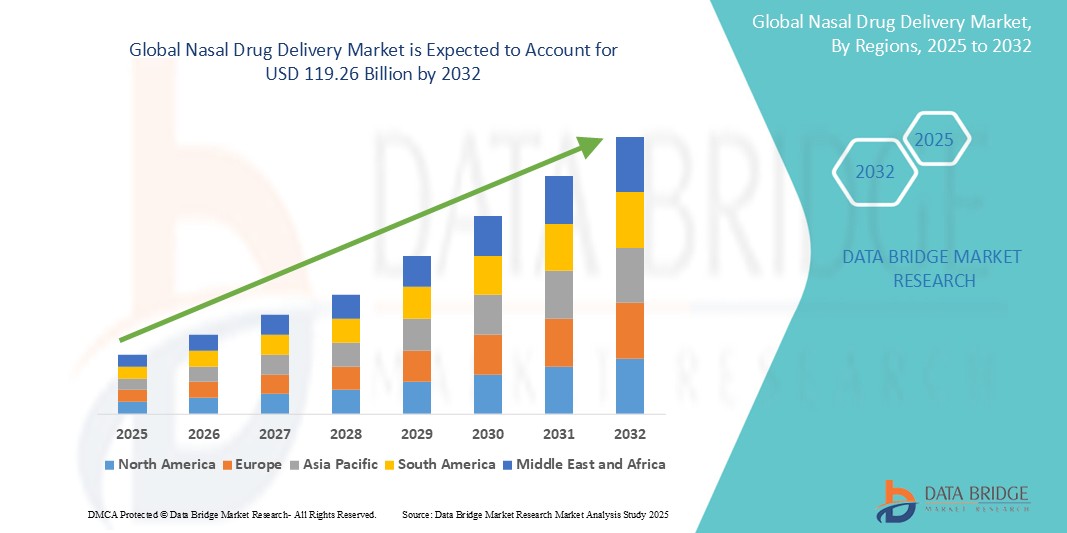
Nasal Drug Delivery Market Size
- The global nasal drug delivery market size was valued at USD 69.93 billion in 2024 and is expected to reach USD 119.26 billion by 2032, at a CAGR of 6.90% during the forecast period
- The market growth is largely fuelled by the rising prevalence of chronic respiratory diseases and neurological disorders, along with increasing demand for non-invasive and rapid drug administration methods
- Technological advancements in formulation and device design are enhancing drug absorption efficiency and patient compliance, further supporting market expansion
Nasal Drug Delivery Market Analysis
- The nasal drug delivery market is experiencing strong momentum due to its fast-acting nature and convenience for patients across various therapeutic areas
- Continuous innovation in nasal spray devices and formulation technologies is reshaping how medications are delivered
- North America dominates the nasal drug delivery market with the largest revenue share of 35.5% in 2025, driven by advanced healthcare infrastructure, high adoption of innovative drug delivery systems, and strong presence of key pharmaceutical players
- Asia-Pacific is expected to be the fastest growing region in the nasal drug delivery market during the forecast period due to rising healthcare expenditure, increasing awareness of non-invasive therapies, and expanding access to medical treatments across emerging economies
- The pain relief drugs segment dominates the largest market revenue share in 2025, driven by the rapid onset of action and improved bioavailability offered by nasal administration for pain management. Patients often prefer nasal sprays for their non-invasive nature and ease of use, leading to increased adoption in both acute and chronic pain scenarios. The market also sees strong demand for pain relief drugs due to the rising prevalence of chronic pain conditions and the need for effective alternatives to oral medications
Report Scope and Nasal Drug Delivery Market Segmentation
|
Attributes |
Nasal Drug Delivery Key Market Insights |
|
Segments Covered |
|
|
Countries Covered |
North America
Europe
Asia-Pacific
Middle East and Africa
South America
|
|
Key Market Players |
|
|
Market Opportunities |
|
|
Value Added Data Infosets |
In addition to the insights on market scenarios such as market value, growth rate, segmentation, geographical coverage, and major players, the market reports curated by the Data Bridge Market Research also include depth expert analysis, patient epidemiology, pipeline analysis, pricing analysis, and regulatory framework. |
Nasal Drug Delivery Market Trends
“Growing Popularity of Nasal Route for Systemic Drug Delivery”
- The nasal route is increasingly being adopted for systemic therapies such as pain relief, hormone delivery, and neurological treatments, beyond its traditional use in allergy or cold remedies
- Its efficiency lies in the nasal cavity's vascular structure, which enables rapid drug absorption and avoids first-pass metabolism, improving the overall effectiveness of medications
- For instance, intranasal naloxone is widely used for emergency opioid overdose reversal, offering fast action when seconds matter
- For instance, esketamine nasal spray has been approved for patients with treatment-resistant depression, offering a non-invasive and rapid-acting alternative to traditional antidepressants
- Pharmaceutical companies are exploring nasal delivery for vaccines and biologics, and for instance, intranasal COVID-19 vaccines developed in India and China show how the route is expanding into preventive healthcare
Nasal Drug Delivery Market Dynamics
Driver
“Rising Demand for Non-Invasive and Rapid Drug Delivery Methods”
- Nasal drug delivery is gaining popularity due to its non-invasive nature and rapid onset of action, offering a practical alternative for individuals who avoid injections or have trouble swallowing oral medications
- The nasal cavity's highly vascularized structure allows drugs to enter the bloodstream quickly, bypassing digestive enzymes and liver metabolism, enhancing bioavailability and treatment speed
- For instance, intranasal naloxone is widely used to reverse opioid overdoses in emergency situations, providing life-saving treatment within minutes
- For instance, nasal sumatriptan is employed for rapid migraine relief, allowing patients to manage symptoms quickly without the need for oral intake
- Post-COVID-19, there has been a spike in demand for self-administered treatments, prompting pharmaceutical companies to invest in nasal formulations for chronic conditions and immunizations—such as intranasal flu vaccines and research into nasal insulin for diabetes management
Restraint/Challenge
“Mucosal Irritation and Limited Drug Suitability”
- One of the major challenges in nasal drug delivery is the risk of mucosal irritation, as repeated use of certain drugs or preservatives can cause discomfort, inflammation, or even long-term damage to the nasal lining
- Some drugs, especially large-molecule biologics and peptides, face difficulties being effectively absorbed through the nasal route due to limitations in molecular size, solubility, or stability
- For instance, biologics used for treating autoimmune diseases often struggle with poor nasal absorption, limiting their delivery through this method
- For instance, overuse of nasal decongestants has led to regulatory actions and consumer caution, which negatively impacts the perception and trust in nasal treatments
- External variables such as humidity, temperature, nasal congestion, or anatomical differences can significantly alter drug absorption, while the need for specialized formulations and devices raises costs and deters smaller companies from entering the market
Nasal Drug Delivery Market Scope
The market is segmented on the basis of drug type, dosage form, container type, system type, therapeutic application, distribution channel, and end user.
- By Drug Type
On the basis of drug type, the nasal drug delivery market is segmented into anesthetics, antibiotics, pain relief drugs, calcium supplements, vasoconstrictors, antihistamines, and others. The pain relief drugs segment dominates the largest market revenue share in 2025, driven by the rapid onset of action and improved bioavailability offered by nasal administration for pain management. Patients often prefer nasal sprays for their non-invasive nature and ease of use, leading to increased adoption in both acute and chronic pain scenarios. The market also sees strong demand for pain relief drugs due to the rising prevalence of chronic pain conditions and the need for effective alternatives to oral medications.
The anesthetics segment is anticipated to witness the fastest growth rate from 2025 to 2032, fueled by increasing advancements in nasal spray formulations for local anesthesia. Nasal delivery offers a needle-free and convenient option for delivering anesthetics, making it particularly valuable in pediatric and outpatient settings. The improved patient comfort and reduced procedural time associated with nasal anesthetics contribute to their growing popularity in the medical field.
- By Dosage Form
On the basis of dosage form, the nasal drug delivery market is segmented into nasal spray, nasal drops, nasal gels and ointments, nasal powders, and others. The nasal spray segment held the largest market revenue share in 2025, driven by its ease of use, accurate dosing, and wide applicability across various therapeutic areas. Nasal sprays provide a fine mist that can be easily inhaled, ensuring effective drug delivery and patient compliance. Their non-invasive nature makes them ideal for self-administration, especially in emergency scenarios such as allergic reactions or opioid overdose. The segment continues to grow with increasing applications in respiratory, neurological, and hormonal therapies. For instance, intranasal naloxone and esketamine highlight how nasal sprays are transforming treatment approaches. In addition, advancements in spray technology are enhancing drug stability and delivery precision, boosting product adoption.
The nasal gels and ointments segment is expected to witness the fastest CAGR from 2025 to 2032, driven by their ability to provide localized and sustained drug release, reducing the frequency of administration. These formulations are particularly beneficial for treating conditions such as nasal dryness, irritation, and chronic inflammation, offering improved patient comfort and therapeutic outcomes. Their thicker consistency ensures longer mucosal contact time, leading to enhanced drug retention and absorption. For instance, nasal gels used for hormone therapy or antihistamines provide relief without frequent reapplication. The growing interest in extended-release nasal formulations is also encouraging innovation in this segment, especially for chronic and pediatric care applications.
- By Container Type
On the basis of container type, the nasal drug delivery market is segmented into non-pressurized containers and pressurized containers. The non-pressurized containers segment accounted for the largest market revenue share in 2025, driven by their cost-effectiveness and versatility in delivering various nasal formulations. These containers are widely used for nasal sprays and drops, offering ease of use and compatibility with different drug types. Their simple design makes them accessible for both over-the-counter and prescription products, catering to a broad patient base. Non-pressurized systems also allow for easier recycling and are often preferred for single-use and unit-dose packaging. Their adaptability across formulations such as decongestants, antihistamines, and corticosteroids continue to support strong market demand.
The pressurized containers segment is expected to witness a steady CAGR from 2025 to 2032, favored for their ability to deliver a consistent and fine mist, ensuring effective drug atomization and delivery. Pressurized containers are commonly used for medications requiring precise and controlled administration. Their sealed systems protect formulations from contamination and degradation, extending shelf life. These containers are especially effective in chronic respiratory therapies where uniform dosing is critical. Moreover, advancements in metered-dose and propellant-free technologies are making pressurized systems more eco-friendly and user-centric, supporting their continued growth in specialized applications.
- By System Type
On the basis of system type, the nasal drug delivery market is segmented into multi-dose, bi-dose, and unit dose. The multi-dose segment held the largest market revenue share in 2025, driven by its cost-effectiveness and convenience for chronic conditions requiring repeated administration. Multi-dose systems allow patients to administer multiple doses from a single container, improving adherence and reducing packaging waste. These containers are ideal for long-term treatments such as nasal corticosteroids and antihistamines, providing greater value and less frequent refills. Innovations in valve and closure technologies have also improved dose accuracy and shelf life, further increasing their appeal across therapeutic categories.
The unit dose segment is expected to witness the fastest CAGR from 2025 to 2032, favored for its safety and hygiene, particularly in applications such as vaccines and potent medications. Unit dose systems minimize the risk of contamination and ensure accurate dosing, enhancing patient safety and therapeutic efficacy. They are especially suitable for hospital and clinical settings where sterility and precision are crucial. Growing use in emergency care and sensitive formulations is also contributing to the segment's accelerated adoption, particularly in pediatric and geriatric patient groups.
- By Therapeutic Application
On the basis of therapeutic application, the nasal drug delivery market is segmented into allergic and non-allergic rhinitis, nasal congestion, asthma, vaccination, and others. The allergic and non-allergic rhinitis segment accounted for the largest market revenue share in 2024, driven by the high prevalence of these conditions and the effectiveness of nasal drug delivery in providing rapid relief. Nasal sprays are commonly used to alleviate symptoms such as congestion, sneezing, and itching, driving market growth. These treatments offer localized action with minimal systemic side effects, making them a preferred choice among patients. The increasing availability of over-the-counter nasal formulations has also made it easier for individuals to manage symptoms, further boosting segment demand.
The vaccination segment is expected to witness the fastest CAGR from 2025 to 2032, driven by the increasing research and development of nasal vaccines. Nasal vaccine delivery offers a non-invasive and needle-free alternative to traditional injections, improving patient compliance and potentially enhancing immune response. This method is especially beneficial for mass immunization campaigns, particularly in pediatric and geriatric populations. The success of intranasal influenza vaccines and ongoing clinical trials for nasal COVID-19 vaccines underscore the potential of this delivery route in revolutionizing vaccine administration.
- By Distribution Channel
On the basis of distribution channel, the nasal drug delivery market is segmented into hospital pharmacies, retail pharmacies, and online pharmacies. The hospital pharmacies segment accounted for the largest market revenue share in 2024, driven by the critical role of hospitals in administering nasal drugs, particularly for acute conditions and specialized treatments. Hospital pharmacies ensure the availability of a wide range of nasal drug formulations and provide expert guidance to patients. These settings are often the first point of care for emergency medications such as intranasal naloxone and midazolam, reinforcing their significance. Moreover, the presence of trained medical personnel supports accurate dosing and monitoring, improving patient outcomes and safety.
The online pharmacies segment is expected to witness the fastest CAGR from 2025 to 2032, driven by the increasing convenience and accessibility of online platforms for purchasing medications. Online pharmacies offer a wide selection of nasal drug products, competitive pricing, and the convenience of home delivery, fueling market growth. The rise in digital health adoption, particularly post-pandemic, has accelerated e-commerce penetration in the pharmaceutical sector. In addition, user-friendly interfaces, digital prescriptions, and subscription-based refills are making online pharmacies an increasingly preferred channel for chronic condition management.
- By End User
On the basis of end user, the nasal drug delivery market is segmented into hospitals, clinics, and home care settings. The hospitals segment accounted for the largest market revenue in 2024. The segment's growth is driven by the crucial role hospitals play in treating various acute and chronic conditions. Hospitals are the primary settings for administering complex nasal drug therapies, including emergency treatments such as intranasal benzodiazepines for seizures. Their access to advanced medical infrastructure and trained professionals ensures accurate diagnosis, dosage, and monitoring, contributing to higher treatment success rates and driving demand for nasal drug delivery solutions.
The home care settings segment is expected to witness the fastest CAGR from 2025 to 2032. The increasing preference for self-administration and home-based treatment, especially for chronic diseases, is driving the growth of this segment. Patients are opting for nasal sprays for conditions such as migraines and hormone imbalances due to ease of use and reduced need for clinical visits. Technological advancements in user-friendly nasal devices and growing awareness of at-home care benefits are further supporting this trend, enhancing both comfort and compliance.
Nasal Drug Delivery Market Regional Analysis
- North America dominates the nasal drug delivery market with the largest revenue share of 35.5% in 2024, driven by a growing prevalence of chronic diseases, high healthcare expenditure, and the increasing adoption of advanced drug delivery technologies
- Consumers in the region highly value the convenience, non-invasiveness, and rapid onset of action offered by nasal drug delivery
- This widespread adoption is further supported by the strong presence of key pharmaceutical companies, a well-established healthcare infrastructure, and favorable regulatory policies, establishing nasal drug delivery as a preferred solution for both acute and chronic conditions
U.S. Nasal Drug Delivery Market Insight
The U.S. nasal drug delivery market captured the largest revenue share of 70% within North America in 2025, fueled by the rising incidence of allergic rhinitis, asthma, and other respiratory ailments, coupled with a growing preference for patient-friendly drug administration routes. Consumers are increasingly prioritizing the enhancement of drug efficacy and patient compliance through innovative, non-invasive delivery systems. The growing preference for self-administration and home healthcare, combined with robust demand for over-the-counter nasal spray products, further propels the nasal drug delivery industry. Moreover, the increasing focus on developing nasal vaccines and biologics is significantly contributing to the market's expansion.
Europe Nasal Drug Delivery Market Insight
The European nasal drug delivery market is projected to expand at a substantial CAGR throughout the forecast period, primarily driven by the increasing prevalence of respiratory diseases, advancements in drug formulations, and the rising demand for non-invasive drug delivery methods. The increase in healthcare expenditure, coupled with stringent regulatory standards, is fostering the adoption of nasal drug delivery. European consumers are also drawn to the improved bioavailability and reduced side effects offered by this route of administration. The region is experiencing significant growth across various therapeutic areas, with nasal drug delivery being incorporated into both novel drug formulations and generic medications.
U.K. Nasal Drug Delivery Market Insight
The U.K. nasal drug delivery market is anticipated to grow at a noteworthy CAGR during the forecast period, driven by the escalating trend of self-administration and a desire for enhanced drug efficacy and patient convenience. In addition, concerns regarding the side effects of oral medications and the invasiveness of injections are encouraging both healthcare providers and patients to choose nasal drug delivery solutions. The UK's embrace of innovative drug delivery technologies, alongside its robust pharmaceutical industry and healthcare infrastructure, is expected to continue to stimulate market growth.
Germany Nasal Drug Delivery Market Insight
The German nasal drug delivery market is expected to expand at a considerable CAGR during the forecast period, fueled by increasing awareness of the benefits of nasal administration and the demand for technologically advanced, patient-centric drug delivery solutions. Germany's well-developed healthcare infrastructure, combined with its emphasis on research and development, promotes the adoption of nasal drug delivery, particularly in the treatment of respiratory diseases and pain management. The integration of nasal drug delivery with novel drug formulations, such as biologics and vaccines, is also becoming increasingly prevalent, with a strong preference for safe and effective drug delivery methods aligning with local patient expectations.
Asia-Pacific Nasal Drug Delivery Market Insight
The Asia-Pacific nasal drug delivery market is poised to grow at the fastest CAGR of over 28% in 2025, driven by increasing prevalence of respiratory diseases, rising healthcare expenditure, and improving healthcare access in countries such as China, Japan, and India. The region's growing population, supported by increasing urbanization and changing lifestyles, is driving the demand for effective and convenient drug delivery systems. Furthermore, as APAC emerges as a manufacturing hub for pharmaceuticals and drug delivery devices, the affordability and accessibility of nasal drug delivery products are expanding to a wider patient base.
Japan Nasal Drug Delivery Market Insight
The Japan nasal drug delivery market is gaining momentum due to the country’s high prevalence of allergic rhinitis and the increasing adoption of advanced drug delivery technologies. The Japanese market places a significant emphasis on patient comfort and safety, and the adoption of nasal drug delivery is driven by the increasing number of elderly patients and the demand for non-invasive drug administration. The integration of nasal drug delivery with novel drug formulations, such as nasal vaccines and biologics, is fueling growth. Moreover, Japan's focus on technological innovation and quality healthcare is likely to spur demand for advanced nasal drug delivery systems in both the pharmaceutical and biotechnology sectors.
China Nasal Drug Delivery Market Insight
The China nasal drug delivery market accounted for the largest market revenue share in Asia Pacific in 2025, attributed to the country's large population base, rapid urbanization, and increasing prevalence of respiratory diseases. China stands as one of the largest markets for pharmaceuticals, and nasal drug delivery is becoming increasingly popular in the treatment of allergic rhinitis, asthma, and other respiratory conditions. The push towards modern healthcare practices and the availability of affordable nasal drug delivery options, alongside strong domestic manufacturers, are key factors propelling the market in China.
Nasal Drug Delivery Market Share
The Nasal Drug Delivery industry is primarily led by well-established companies, including:
- Merck & Co., Inc. (U.S.)
- GSK plc (U.K.)
- AstraZeneca (U.K.)
- Johnson & Johnson Services, Inc. (U.S.)
- Mystic Pharmaceuticals Limited (U.S.)
- Bausch Health Companies Inc. (Canada)
- BD (U.S.)
- 3M (U.S.)
- AptarGroup, Inc. (U.S.)
- OptiNose US, Inc. (U.S.)
- Dr. Reddy’s Laboratories Ltd (India)
- Aspen Group, Inc. (Australia)
- Cadila Pharmaceuticals (India)
- Pendopharm (Canada)
- Neurelis, Inc. (U.S.)
Latest Developments in Global Nasal Drug Delivery Market
- In November 2023, Hovione announced the expansion of its nasal drug delivery portfolio through the launch of innovative nasal powder delivery devices, developed in collaboration with IDC. This development aims to offer a more effective and patient-friendly alternative to conventional drug delivery methods. By enabling rapid and safe administration for both local and systemic therapies, it enhances treatment outcomes and supports broader adoption of nasal drug delivery technologies in the pharmaceutical market
- In July 2021, GSK plc received approval from the U.S. Food and Drug Administration for Nucala (mepolizumab), a monoclonal antibody designed to treat chronic rhinosinusitis with nasal polyps. This approval introduces a targeted biologic therapy that addresses a significant unmet medical need. The development enhances treatment options, potentially improving quality of life for patients while strengthening GSK’s position in the specialty respiratory treatment segment

- Interactive Data Analysis Dashboard
- Company Analysis Dashboard for high growth potential opportunities
- Research Analyst Access for customization & queries
- Competitor Analysis with Interactive dashboard
- Latest News, Updates & Trend analysis
- Harness the Power of Benchmark Analysis for Comprehensive Competitor Tracking
Data collection and base year analysis are done using data collection modules with large sample sizes. The stage includes obtaining market information or related data through various sources and strategies. It includes examining and planning all the data acquired from the past in advance. It likewise envelops the examination of information inconsistencies seen across different information sources. The market data is analysed and estimated using market statistical and coherent models. Also, market share analysis and key trend analysis are the major success factors in the market report. To know more, please request an analyst call or drop down your inquiry.
The key research methodology used by DBMR research team is data triangulation which involves data mining, analysis of the impact of data variables on the market and primary (industry expert) validation. Data models include Vendor Positioning Grid, Market Time Line Analysis, Market Overview and Guide, Company Positioning Grid, Patent Analysis, Pricing Analysis, Company Market Share Analysis, Standards of Measurement, Global versus Regional and Vendor Share Analysis. To know more about the research methodology, drop in an inquiry to speak to our industry experts.
Data Bridge Market Research is a leader in advanced formative research. We take pride in servicing our existing and new customers with data and analysis that match and suits their goal. The report can be customized to include price trend analysis of target brands understanding the market for additional countries (ask for the list of countries), clinical trial results data, literature review, refurbished market and product base analysis. Market analysis of target competitors can be analyzed from technology-based analysis to market portfolio strategies. We can add as many competitors that you require data about in the format and data style you are looking for. Our team of analysts can also provide you data in crude raw excel files pivot tables (Fact book) or can assist you in creating presentations from the data sets available in the report.













