


Non Thermal Pasteurization Market Size
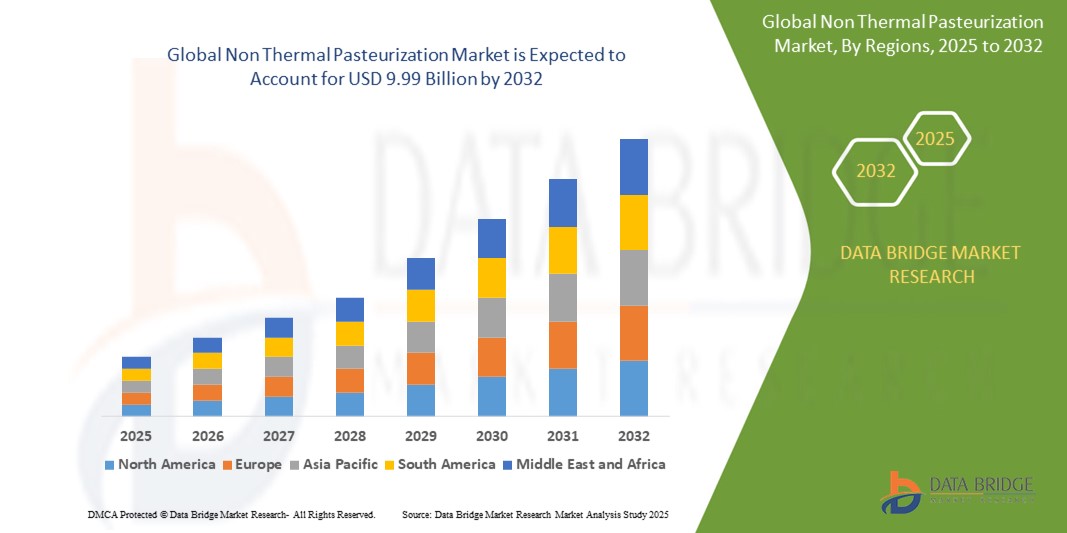
- The global non thermal pasteurization market size was valued at USD 2.43 billion in 2024 and is expected to reach USD 9.99 billion by 2032, at a CAGR of 19.30% during the forecast period
- The market growth is primarily driven by increasing consumer demand for minimally processed, fresh-such as food products with extended shelf life, alongside advancements in non-thermal pasteurization technologies
- Rising awareness of food safety, coupled with growing preferences for clean-label and natural products, is accelerating the adoption of non thermal pasteurization techniques in food, beverage, pharmaceutical, and cosmetic industries
Non Thermal Pasteurization Market Analysis
- Non thermal pasteurization techniques, such as High Pressure Processing (HPP) and Pulse Electric Field (PEF), are increasingly vital for preserving food quality, nutritional value, and safety without the use of high temperatures, making them ideal for heat-sensitive products
- The surge in demand is fueled by growing consumer preference for healthy, minimally processed foods, stringent food safety regulations, and the need for sustainable processing methods that reduce energy consumption
- North America dominated the non thermal pasteurization market with the largest revenue share of 42.5% in 2024, driven by advanced food processing infrastructure, high consumer awareness, and the presence of key industry players
- Europe is expected to be the fastest-growing region during the forecast period, propelled by increasing demand for premium, organic, and clean-label products, along with supportive regulatory frameworks for food safety
- The high pressure processing (HPP) segment dominated the largest market revenue share of 38.5% in 2024, driven by its widespread adoption in the food and beverage industry for its ability to inactivate pathogens and extend shelf life while preserving nutritional quality and flavor
Report Scope and Non Thermal Pasteurization Market Segmentation
|
Attributes |
Non Thermal Pasteurization Key Market Insights |
|
Segments Covered |
|
|
Countries Covered |
North America
Europe
Asia-Pacific
Middle East and Africa
South America
|
|
Key Market Players |
|
|
Market Opportunities |
|
|
Value Added Data Infosets |
In addition to the insights on market scenarios such as market value, growth rate, segmentation, geographical coverage, and major players, the market reports curated by the Data Bridge Market Research also include in-depth expert analysis, pricing analysis, brand share analysis, consumer survey, demography analysis, supply chain analysis, value chain analysis, raw material/consumables overview, vendor selection criteria, PESTLE Analysis, Porter Analysis, and regulatory framework. |
Non Thermal Pasteurization Market Trends
“Increasing Adoption of Advanced Non-Thermal Technologies”
- The global non-thermal pasteurization market is experiencing a significant trend toward the integration of advanced technologies such as High-Pressure Processing (HPP), Pulsed Electric Field (PEF), Microwave Volumetric Heating (MVH), Ultrasonic, and Irradiation
- These technologies enable efficient microbial inactivation while preserving the nutritional quality, flavor, and texture of food, beverages, pharmaceuticals, and cosmetics
- HPP and PEF are particularly gaining traction for their ability to extend shelf life without compromising sensory attributes, meeting consumer demand for minimally processed products
- For instance, companies are developing PEF systems to process fruits, vegetables, and juices, ensuring freshness without preservatives, while HPP is widely used for cold-pressed juices and meat products to maintain quality and safety
- This trend is enhancing the appeal of non-thermal pasteurization systems for food manufacturers, pharmaceutical companies, and cosmetic producers aiming to deliver high-quality, safe, and sustainable products
- Advanced analytics and automation are also being integrated to optimize processing parameters, improving efficiency and scalability across applications
Non Thermal Pasteurization Market Dynamics
Driver
“Rising Demand for Minimally Processed and Safe Products”
- Increasing consumer preference for fresh, natural, and minimally processed food and beverage products is a major driver for the global non-thermal pasteurization market
- Non-thermal pasteurization technologies, such as HPP and PEF, enhance product safety by eliminating pathogens and extending shelf life without the use of heat or chemical preservatives
- Stringent food safety regulations, particularly in North America, which dominates the market, are pushing manufacturers to adopt these technologies to meet compliance standards
- The rise of clean-label products and growing health consciousness among consumers are further fueling the demand for non-thermal pasteurization in food, beverages, pharmaceuticals, and cosmetics
- Advancements in IoT and automation are enabling real-time monitoring and control, supporting the scalability of these technologies for diverse applications
Restraint/Challenge
“High Capital Investment and Regulatory Complexities”
- The high initial costs associated with acquiring and installing non-thermal pasteurization equipment, such as HPP and PEF systems, pose a significant barrier, particularly for small and medium-sized enterprises (SMEs) in emerging markets
- The complexity of integrating these technologies into existing production lines adds to the cost and operational challenges
- In addition, concerns about regulatory compliance and labeling requirements, especially for irradiated food, create challenges. The fragmented regulatory landscape across regions, including stringent guidelines in North America and Europe, complicates market expansion
- Misconceptions about non-thermal technologies, such as irradiation, may lead to consumer skepticism and additional regulatory hurdles for labeling and transparency
- These factors can limit market growth, particularly in regions with high cost sensitivity or where awareness of non-thermal pasteurization benefits is low
Non Thermal Pasteurization market Scope
The market is segmented on the basis of techniques, application, and food form.
- By Techniques
On the basis of techniques, the global non-thermal pasteurization market is segmented into high pressure processing (HPP), pulse electric field (PEF), microwave volumetric heating (MVH), ultrasonic, and irradiation. The high pressure processing (HPP) segment dominated the largest market revenue share of 38.5% in 2024, driven by its widespread adoption in the food and beverage industry for its ability to inactivate pathogens and extend shelf life while preserving nutritional quality and flavor.
The pulse electric field (PEF) segment is expected to witness the fastest growth rate from 2025 to 2032, driven by increasing demand for minimally processed, preservative-free foods. PEF technology uses high-voltage electrical pulses to inactivate microorganisms, retaining the sensory and nutritional attributes of products such as fruits, vegetables, and juices, which aligns with consumer preferences for fresh and natural foods.
- By Application
On the basis of application, the global non-thermal pasteurization market is segmented into food and beverages, pharmaceuticals, and cosmetics. The food and beverages segment dominated the market with a revenue share of 65.7% in 2024, propelled by the rising demand for safe, high-quality, and minimally processed food products, such as meats, fruits, vegetables, and juices. Non-thermal pasteurization techniques, particularly HPP and PEF, are widely used to meet stringent food safety regulations and consumer preferences for clean-label products.
The pharmaceuticals segment is anticipated to experience the fastest growth from 2025 to 2032, driven by the increasing use of non-thermal pasteurization for the disaggregation and controlled re-naturalization of therapeutic proteins and pathogen inactivation in vaccines. These techniques ensure product safety and integrity without compromising efficacy, aligning with the growing demand for advanced pharmaceutical processing solutions.
- By Food Form
On the basis of food form, the global non-thermal pasteurization market is segmented into solid form and liquid form. The solid form segment held the largest market revenue share of 57.2% in 2024, driven by its extensive use in processed foods such as meat products, cheese, fruits, vegetables, and ready-to-eat meals, which are prone to contamination and spoilage. Non-thermal pasteurization techniques such as HPP and PEF effectively eliminate microorganisms and extend shelf life while maintaining texture and nutritional value.
The liquid form segment is expected to witness the fastest growth rate of 21.3% from 2025 to 2032, fueled by the rising popularity of non-thermal pasteurization in beverages such as juices, dairy, and non-alcoholic drinks. Techniques such as HPP and PEF preserve the flavor, color, and nutrients of liquid products, meeting consumer demand for fresh, shelf-stable beverages with no added preservatives.
Non Thermal Pasteurization Market Regional Analysis
- North America dominated the non thermal pasteurization market with the largest revenue share of 42.5% in 2024, driven by advanced food processing infrastructure, high consumer awareness, and the presence of key industry players
- Consumers prioritize non thermal pasteurization techniques for extending shelf life, preserving nutritional quality, and enhancing food safety, particularly in regions with stringent regulatory standards
- Growth is supported by advancements in technologies such as High Pressure Processing (HPP), Pulse Electric Field (PEF), and Ultrasonic methods, alongside rising adoption in food, beverage, pharmaceutical, and cosmetic applications
U.S. Non Thermal Pasteurization Market Insight
The U.S. non thermal pasteurization market captured the largest revenue share of 88.3% in 2024 within North America, fueled by strong demand for clean-label and minimally processed foods. Increasing consumer awareness of health benefits and food safety drives adoption of techniques such as HPP and PEF. Regulatory support for innovative food processing technologies and the growing use of non thermal methods in both food and pharmaceutical industries further boost market expansion.
Europe Non Thermal Pasteurization Market Insight
The Europe non thermal pasteurization market is expected to witness the fastest growth rate, supported by stringent food safety regulations and consumer demand for high-quality, nutrient-rich products. Techniques such as HPP and Ultrasonic processing are gaining traction for their ability to maintain product freshness while meeting safety standards. Growth is prominent in both food and beverage processing and pharmaceutical applications, with countries such as Germany and France leading due to advanced food processing industries.
U.K. Non Thermal Pasteurization Market Insight
The U.K. market for non thermal pasteurization is expected to witness rapid growth, driven by increasing demand for premium, minimally processed foods and beverages. Consumer focus on health, sustainability, and food safety encourages adoption of technologies such as PEF and MVH. Evolving regulations promoting clean-label products and the growing use of non thermal methods in cosmetics further support market growth.
Germany Non Thermal Pasteurization Market Insight
Germany is expected to witness the fastest growth rate in the non thermal pasteurization market, attributed to its advanced food processing sector and high consumer demand for safe, high-quality products. German industries prioritize techniques such as HPP and Ultrasonic processing for their efficiency in preserving nutritional content and extending shelf life. The integration of these technologies in premium food and beverage products and pharmaceutical applications supports sustained market growth.
Asia-Pacific Non Thermal Pasteurization Market Insight
The Asia-Pacific region is expected to witness significant growth, driven by expanding food and beverage production and rising consumer awareness in countries such as China, India, and Japan. Increasing demand for safe, high-quality food products and growing disposable incomes boost the adoption of non thermal pasteurization techniques. Government initiatives promoting food safety and sustainability further encourage the use of advanced methods such as HPP and PEF.
Japan Non Thermal Pasteurization Market Insight
Japan’s non thermal pasteurization market is expected to witness rapid growth due to strong consumer preference for high-quality, minimally processed foods and beverages. The presence of major food manufacturers and the integration of technologies such as HPP and Ultrasonic processing in both solid and liquid food forms accelerate market penetration. Rising interest in pharmaceutical and cosmetic applications also contributes to growth.
China Non Thermal Pasteurization Market Insight
China holds the largest share of the Asia-Pacific non thermal pasteurization market, propelled by rapid urbanization, increasing food and beverage consumption, and growing demand for safe, nutrient-rich products. The country’s expanding middle class and focus on food safety support the adoption of advanced techniques such as HPP and PEF. Strong domestic manufacturing capabilities and competitive pricing enhance market accessibility.
Non Thermal Pasteurization Market Share
The non thermal pasteurization industry is primarily led by well-established companies, including:
- Marel (Iceland)
- GEA Group Aktiengesellschaft (Germany)
- Bühler AG (Switzerland)
- JBT (U.S.)
- The Middleby Corporation (U.S.)
- Heat and Control, Inc. (U.S.)
- ALFA LAVAL (Sweden)
- TNA Australia Pty Limited (Australia)
- Equipamientos Cárnicos, S.L. (Spain)
- Clextral (France)
- Bigtem Makine A.S. (Turkey)
- Krones AG (Germany)
- Finis-Eillert (Netherlands)
- Heat and Control, Inc. (U.S.)
- Baader Global SE (Germany)
- Dover Corporation (U.S.)
What are the Recent Developments in Global Non Thermal Pasteurization Market?
- In June 2024, Ventolini, a Colombia-based food company, launched a new line of High-Pressure Processed (HPP) ready-to-eat (RTE) meals, becoming the first Colombian producer to offer such products. These meals are made exclusively with natural ingredients, require no freezing, and boast a shelf life of up to 60 days. The initiative reflects Ventolini’s commitment to clean-label innovation, food safety, and convenience. The company uses Hiperbaric HPP technology, which applies cold water pressure to eliminate pathogens while preserving nutritional quality and flavor—meeting the rising demand for healthy, preservative-free food options in Latin America
- In April 2024, Hormel Foods, one of the largest food companies in the U.S., expanded its use of High-Pressure Processing (HPP) technology to include its ready-to-eat (RTE) deli meats and protein snacks. This move responds to the growing consumer demand for clean-label, preservative-free products that maintain freshness and safety without compromising flavor. HPP is a cold pasteurization method that uses high pressure to eliminate pathogens after packaging, extending shelf life and ensuring food safety. By broadening its HPP application, Hormel reinforces its commitment to innovation, quality, and consumer health in the evolving food landscape
- In March 2024, Good Foods Group, a U.S.-based manufacturer known for its guacamole, dips, and fresh sauces, expanded its High-Pressure Processing (HPP) capacity at its Wisconsin facility. This strategic investment was made to meet the growing consumer demand for preservative-free, fresh-tasting foods that align with clean-label trends. HPP technology uses cold water and high pressure to eliminate pathogens while preserving flavor, texture, and nutrients—extending shelf life without the need for artificial preservatives. By increasing its in-house HPP capabilities, Good Foods reinforces its commitment to food safety, innovation, and sustainability in the fresh food sector
- In February 2024, Suja Juice, a leading U.S.-based premium beverage company, expanded its use of High-Pressure Processing (HPP) across its lines of cold-pressed juices. This move was driven by the growing consumer demand for clean-label, preservative-free beverages that retain natural flavor and nutrients. HPP, a non-thermal pasteurization method, uses high pressure to eliminate harmful pathogens while preserving the juice’s freshness, color, and nutritional value. By increasing its reliance on HPP, Suja reinforces its commitment to transparency, quality, and functional wellness, aligning with evolving health-conscious consumer preferences in the natural beverage market
- In October 2023, IDD Process & Packaging, a U.S.-based leader in keg processing equipment, unveiled the RP-1 Rotary Pasteurizer, a compact and efficient pasteurization solution specifically designed for small brewers and craft beverage producers. The RP-1 addresses a key challenge in the production of non-alcoholic and low-alcohol beers—ensuring microbiological stability without compromising flavor or quality. Operating at 40 cans per minute, the RP-1 delivers up to 100 Pasteurization Units (PU), making it ideal for small-scale operations. Its space-saving design and energy efficiency bring industrial-grade safety and shelf-life assurance to the craft brewing segment

- Interactive Data Analysis Dashboard
- Company Analysis Dashboard for high growth potential opportunities
- Research Analyst Access for customization & queries
- Competitor Analysis with Interactive dashboard
- Latest News, Updates & Trend analysis
- Harness the Power of Benchmark Analysis for Comprehensive Competitor Tracking
Global Non Thermal Pasteurization Market, Supply Chain Analysis and Ecosystem Framework
To support market growth and help clients navigate the impact of geopolitical shifts, DBMR has integrated in-depth supply chain analysis into its Global Non Thermal Pasteurization Market research reports. This addition empowers clients to respond effectively to global changes affecting their industries. The supply chain analysis section includes detailed insights such as Global Non Thermal Pasteurization Market consumption and production by country, price trend analysis, the impact of tariffs and geopolitical developments, and import and export trends by country and HSN code. It also highlights major suppliers with data on production capacity and company profiles, as well as key importers and exporters. In addition to research, DBMR offers specialized supply chain consulting services backed by over a decade of experience, providing solutions like supplier discovery, supplier risk assessment, price trend analysis, impact evaluation of inflation and trade route changes, and comprehensive market trend analysis.
Data collection and base year analysis are done using data collection modules with large sample sizes. The stage includes obtaining market information or related data through various sources and strategies. It includes examining and planning all the data acquired from the past in advance. It likewise envelops the examination of information inconsistencies seen across different information sources. The market data is analysed and estimated using market statistical and coherent models. Also, market share analysis and key trend analysis are the major success factors in the market report. To know more, please request an analyst call or drop down your inquiry.
The key research methodology used by DBMR research team is data triangulation which involves data mining, analysis of the impact of data variables on the market and primary (industry expert) validation. Data models include Vendor Positioning Grid, Market Time Line Analysis, Market Overview and Guide, Company Positioning Grid, Patent Analysis, Pricing Analysis, Company Market Share Analysis, Standards of Measurement, Global versus Regional and Vendor Share Analysis. To know more about the research methodology, drop in an inquiry to speak to our industry experts.
Data Bridge Market Research is a leader in advanced formative research. We take pride in servicing our existing and new customers with data and analysis that match and suits their goal. The report can be customized to include price trend analysis of target brands understanding the market for additional countries (ask for the list of countries), clinical trial results data, literature review, refurbished market and product base analysis. Market analysis of target competitors can be analyzed from technology-based analysis to market portfolio strategies. We can add as many competitors that you require data about in the format and data style you are looking for. Our team of analysts can also provide you data in crude raw excel files pivot tables (Fact book) or can assist you in creating presentations from the data sets available in the report.













