


Oculodentodigital Syndrome Market Size
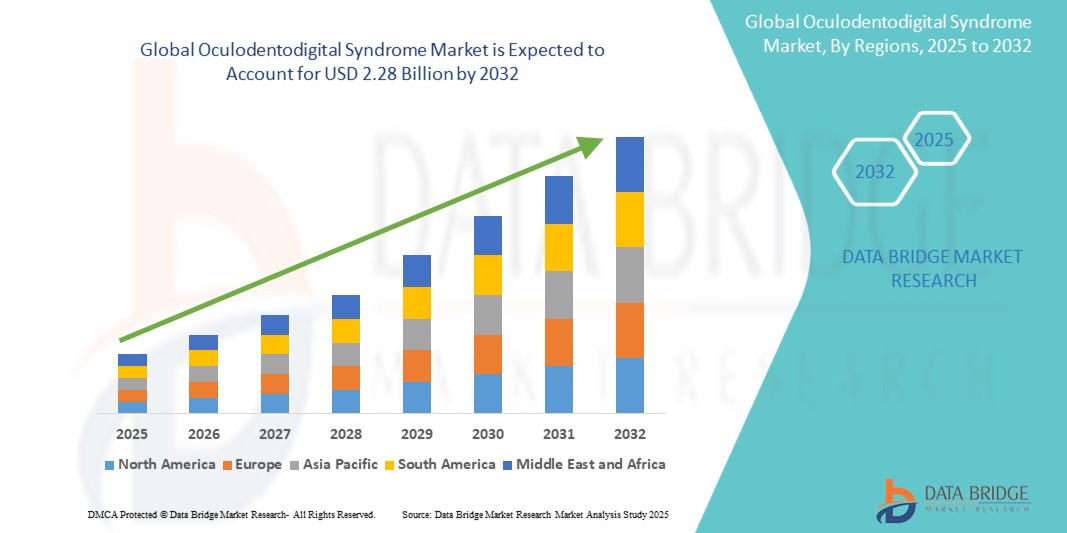
- The global oculodentodigital syndrome market size was valued at USD 1.32 billion in 2024 and is expected to reach USD 2.28 billion by 2032, at a CAGR of 7.10% during the forecast period
- This growth is driven by factors such as the by increased awareness and improved diagnosis of rare genetic disorders, advancements in gene therapy and treatment options, and growing investments in rare disease research
Oculodentodigital Syndrome Market Analysis
- Oculodentodigital Syndrome (ODD) is a rare genetic disorder affecting the eyes, teeth, and fingers, often caused by mutations in the GJA1 gene. Diagnosis typically involves genetic testing and symptom-based clinical evaluations
- The market is driven by increased awareness and early diagnosis of rare genetic conditions, along with advancements in genomic research and personalized medicine
- North America is expected to dominate the oculodentodigital syndrome market due to strong healthcare infrastructure, higher diagnostic capabilities, and increased investment in rare disease research
- Asia-Pacific is expected to be the fastest growing region in the oculodentodigital syndrome market during the forecast period due to increasing healthcare expenditure, improved access to genetic testing, and rising awareness of rare disease
- Dental anomalies segment is expected to dominate the market with a market share of 41% due to its the high prevalence of dental defects among patients with ODDS. These anomalies, such as defective enamel and malformed teeth, are one of the most noticeable and impactful symptoms of the syndrome, leading to an increased demand for dental treatments and restorative procedures
Report Scope and Oculodentodigital Syndrome Market Segmentation
|
Attributes |
Oculodentodigital Syndrome Key Market Insights |
|
Segments Covered |
|
|
Countries Covered |
North America
Europe
Asia-Pacific
Middle East and Africa
South America
|
|
Key Market Players |
|
|
Market Opportunities |
|
|
Value Added Data Infosets |
In addition to the insights on market scenarios such as market value, growth rate, segmentation, geographical coverage, and major players, the market reports curated by the Data Bridge Market Research also include import export analysis, production capacity overview, production consumption analysis, price trend analysis, climate change scenario, supply chain analysis, value chain analysis, raw material/consumables overview, vendor selection criteria, PESTLE Analysis, Porter Analysis, and regulatory framework. |
Oculodentodigital Syndrome Market Trends
“Rising Adoption of Genetic Testing & Personalized Treatment Approaches for Rare Disorders”
- One key trend in the global oculodentodigital syndrome market is the increasing adoption of advanced genetic testing techniques, enabling early and accurate diagnosis of this rare congenital disorder
- Genetic testing helps identify mutations in the GJA1 gene, which is crucial for confirming ODDS and guiding tailored treatment strategies for affected individuals
- For instance, next-generation sequencing (NGS) and whole exome sequencing are increasingly utilized in clinical settings, significantly enhancing diagnostic accuracy and facilitating personalized care planning
- These advancements are accelerating early intervention, improving quality of life for patients, and fueling demand for precision diagnostics and individualized therapeutic approaches in the rare disease market
Oculodentodigital Syndrome Market Dynamics
Driver
“Rising Awareness and Diagnosis of Rare Genetic Disorders”
- The increasing awareness and recognition of rare genetic disorders, including Oculodentodigital Syndrome (ODDS), is a major factor driving the market’s growth. This is supported by the growing availability of genetic testing and rare disease registries globally
- Advancements in diagnostic technologies, particularly genetic sequencing tools, have led to earlier and more accurate detection of ODDS, enabling timely medical intervention and targeted treatments
- As more healthcare professionals become aware of the symptoms and genetic markers associated with ODDS, diagnostic rates are expected to rise, facilitating broader patient identification and inclusion in specialized care programs
For instance,
- According to a 2023 report by the Global Genes Foundation, over 70% of rare genetic disorders are now diagnosable with modern genetic testing, and global initiatives such as Rare Disease Day are significantly increasing awareness across both medical communities and the general public
- As a result, the rising awareness and improved diagnostic capabilities for rare genetic conditions such as ODDS are contributing to a steady increase in demand for specialized treatment and care solutions
Opportunity
“Emergence of Gene Therapy and Targeted Treatments for Rare Genetic Disorders”
- The development of gene therapies and targeted molecular treatments presents a significant opportunity in the oculodentodigital syndrome market, aiming to address the root cause of the disorder at the genetic level
- With advancements in CRISPR and other gene-editing technologies, there is growing potential to correct mutations in the GJA1 gene—responsible for ODDS—offering hope for more effective and long-term treatment options
- In addition, the rising focus on orphan drug development and supportive regulatory frameworks (e.g., FDA’s Orphan Drug Act) are encouraging pharmaceutical companies to invest in research and development for ultra-rare conditions such as ODDS
For instance,
- In February 2024, according to a report by Global Genes and Evaluate Pharma, over 600 gene therapies are currently under development for rare diseases, with a notable increase in funding and regulatory support. These therapies are designed to modify or replace faulty genes, opening new avenues for the treatment of inherited conditions such as ODDS
- The emergence of gene therapies not only offers transformative potential for managing ODDS but also aligns with the broader trend of personalized medicine, enhancing long-term patient outcomes and offering a significant growth opportunity for the market
Restraint/Challenge
“Limited Awareness and Delayed Diagnosis in Underdeveloped Regions”
- One of the primary challenges in the Oculodentodigital Syndrome (ODDS) market is the limited awareness and understanding of the condition among healthcare professionals and the general public, particularly in low- and middle-income countries
- ODDS being an ultra-rare genetic disorder often leads to misdiagnosis or underdiagnosis, delaying appropriate treatment and management. Lack of access to advanced diagnostic tools, such as genetic testing, further exacerbates this issue in resource-constrained settings
- This Inadequate training and minimal clinical exposure to rare genetic syndromes hinder early recognition and comprehensive care, resulting in unmet medical needs and poor patient outcomes
For instance,
- According to a 2023 report by Rare Disease International, nearly 95% of rare diseases, including ODDS, lack approved treatments, and over 50% of patients face diagnostic delays of five years or more, especially in regions with limited healthcare infrastructure
- Consequently, the limited awareness, diagnostic challenges, and infrastructure gaps significantly restrict early detection and intervention for ODDS, posing a major restraint to market growth and access to optimal care
Oculodentodigital Syndrome Market Scope
The market is segmented on the basis of symptoms, treatment, Mode of administration, Distribution Channel, and End User
|
Segmentation |
Sub-Segmentation |
|
By Symptoms |
|
|
By Treatment |
|
|
By Mode of administration |
|
|
By Distribution Channel
|
|
|
By End User |
|
In 2025, the dental anomalies is projected to dominate the market with a largest share in symptoms segment
The dental anomalies segment is expected to dominate the oculodentodigital syndrome market with the largest share of 41% in 2025 due to due to the high prevalence of dental defects among patients with ODDS. These anomalies, such as defective enamel and malformed teeth, are one of the most noticeable and impactful symptoms of the syndrome, leading to an increased demand for dental treatments and restorative procedures. In addition, dental issues are often prioritized in early diagnosis and treatment, further boosting the market share of this segment
The surgery segment is expected to account for the largest share during the forecast period in treatment market
In 2025, the surgery segment is expected to dominate the market with the largest market share of 50.05% due to its crucial role in managing structural abnormalities caused by the syndrome. Surgical interventions are often necessary to correct physical deformities such as syndactyly (fused fingers) and craniofacial defects. These procedures significantly improve functionality and quality of life for patients, making them a cornerstone of ODDS treatment strategies
Oculodentodigital Syndrome Market Regional Analysis
“North America Holds the Largest Share in the Oculodentodigital Syndrome Market”
- North America dominates the global oculodentodigital syndrome market, driven by well-established healthcare systems, high awareness of rare genetic disorders, and widespread availability of advanced diagnostic and therapeutic tools, including genetic testing
- U.S. holds a substantial market share due to strong government support for rare disease research, robust funding for orphan drug development, and comprehensive insurance coverage for specialized treatments
- In addition, the presence of leading biopharmaceutical companies and academic institutions conducting research on rare genetic conditions accelerates innovation and drives market growth in the region.
“Asia-Pacific is Projected to Register the Highest CAGR in the Oculodentodigital Syndrome Market”
- Asia-Pacific is expected to witness the highest growth rate in the oculodentodigital syndrome market, fueled by rising healthcare investments, improving genetic testing infrastructure, and growing awareness about rare diseases
- Countries such as India, China, and Japan are key contributors to this growth due to increasing diagnosis rates, expanding rare disease registries, and supportive healthcare reforms aimed at improving access to specialized care
- Japan, with its advanced biomedical research and active participation in global rare disease networks, plays a significant role in the development of treatment options for rare conditions such as ODDS
- India and China are experiencing a surge in rare disease diagnostics due to increased funding, public health initiatives, and collaborative efforts between the government and private healthcare sectors to improve early detection and management of genetic disorders
Oculodentodigital Syndrome Market Share
The market competitive landscape provides details by competitor. Details included are company overview, company financials, revenue generated, market potential, investment in research and development, new market initiatives, global presence, production sites and facilities, production capacities, company strengths and weaknesses, product launch, product width and breadth, application dominance. The above data points provided are only related to the companies' focus related to market.

- Interactive Data Analysis Dashboard
- Company Analysis Dashboard for high growth potential opportunities
- Research Analyst Access for customization & queries
- Competitor Analysis with Interactive dashboard
- Latest News, Updates & Trend analysis
- Harness the Power of Benchmark Analysis for Comprehensive Competitor Tracking
Data collection and base year analysis are done using data collection modules with large sample sizes. The stage includes obtaining market information or related data through various sources and strategies. It includes examining and planning all the data acquired from the past in advance. It likewise envelops the examination of information inconsistencies seen across different information sources. The market data is analysed and estimated using market statistical and coherent models. Also, market share analysis and key trend analysis are the major success factors in the market report. To know more, please request an analyst call or drop down your inquiry.
The key research methodology used by DBMR research team is data triangulation which involves data mining, analysis of the impact of data variables on the market and primary (industry expert) validation. Data models include Vendor Positioning Grid, Market Time Line Analysis, Market Overview and Guide, Company Positioning Grid, Patent Analysis, Pricing Analysis, Company Market Share Analysis, Standards of Measurement, Global versus Regional and Vendor Share Analysis. To know more about the research methodology, drop in an inquiry to speak to our industry experts.
Data Bridge Market Research is a leader in advanced formative research. We take pride in servicing our existing and new customers with data and analysis that match and suits their goal. The report can be customized to include price trend analysis of target brands understanding the market for additional countries (ask for the list of countries), clinical trial results data, literature review, refurbished market and product base analysis. Market analysis of target competitors can be analyzed from technology-based analysis to market portfolio strategies. We can add as many competitors that you require data about in the format and data style you are looking for. Our team of analysts can also provide you data in crude raw excel files pivot tables (Fact book) or can assist you in creating presentations from the data sets available in the report.












