


What is the Odor Sensors Market Size and Growth Rate?
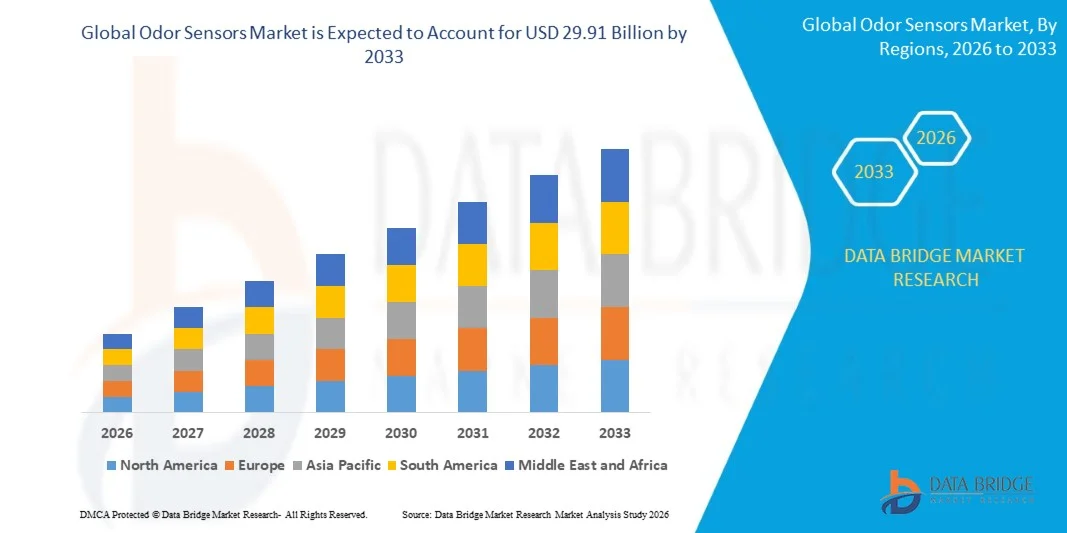
- As per Data Bridge Market Research analysis, the odor sensors market was valued at USD 3.60 billion in 2025 and is projected to reach USD 29.91 billion by 2033, growing at a CAGR of 30.30% from 2026 to 2033.
- The market is experiencing consistent growth driven by rising demand for real-time odor detection and analysis, rapid advancements in biosensor and chemical sensor technologies, and expanding applications across food quality control, healthcare, environmental monitoring, agriculture, and industrial operations.
- The increasing focus on air-quality monitoring, food safety, disease detection, and automated odor assessment, combined with the integration of artificial intelligence, IoT, and sensor-array technologies, is compelling industries to adopt advanced odor-sensing solutions. Biosensors and chemical sensors are being increasingly deployed to provide faster, more sensitive, and automated detection of volatile compounds across diverse applications.
Market Size & Forecast
- Global Market Value (2025): USD 3.60 Billion
- Expected Market Value (2033): USD 29.91 Billion
- Forecast CAGR (2026–2033): 30.30%
- Leading Region in 2025: North America
- Fastest Growing Region: Asia Pacific
What are the Major Takeaways of the Odor Sensors Market?
- North America dominated the odor sensors market with the largest revenue share of 37% in 2025, supported by advanced sensor technologies, strong industrial infrastructure, and increasing adoption of odor monitoring across healthcare, food, and environmental applications
- Asia-Pacific is expected to be the fastest-growing region at a CAGR of 22% from 2026 to 2033, fueled by advanced sensor technologies, strong industrial infrastructure, and increasing adoption of odor monitoring across healthcare, food, and environmental applications
- The chemical sensors segment led the market with a 35% share in 2025, driven by their broad applicability in detecting and identifying odor-causing gases and volatile organic compounds.
- Biosensors are the fastest-growing sensor type, projected to register a CAGR of 20.92%, reflecting the surge in demand for highly sensitive and selective detection technologies
- The multi-odor sensors segment dominated the instrument type category with a 67% revenue share in 2025, led by their ability to detect and differentiate multiple odor compounds simultaneously.
- Medical diagnosis accounted for 33% of the market share in 2025, preferred by growing interest in odor-based detection of volatile biomarkers and non-invasive diagnostic techniques.
- The air control and environmental monitoring segment is the fastest-growing software category, with a CAGR of 21.15%, driven by increasing concerns regarding air pollution, industrial emissions, and odor pollution.
Report Scope and Odor Sensors Market Segmentation
|
Attributes |
Odor Sensors Key Market Insights |
|
Segments Covered |
|
|
Countries Covered |
North America
Europe
Asia-Pacific
Middle East and Africa
South America
|
|
Key Market Players |
|
|
Market Opportunities |
|
|
Value Added Data Infosets |
In addition to the insights on market scenarios such as market value, growth rate, segmentation, geographical coverage, and major players, the market reports curated by the Data Bridge Market Research also include in-depth expert analysis, geographically represented company-wise production and capacity, network layouts of distributors and partners, detailed and updated price trend analysis and deficit analysis of supply chain and demand. |
What is the Key Trend in the Odor Sensors Market?
- Odor sensors are increasingly integrating artificial intelligence, machine learning, and multi-sensor arrays to improve odor classification, enable real-time analysis, and distinguish complex mixtures of volatile organic compounds (VOCs) across environmental, food, healthcare, and industrial applications.
- For instance, in June 2025, researchers published a multi-scenario adaptive electronic nose capable of monitoring four key odor pollutants across landfills, wastewater treatment plants, and livestock farms, with its random-forest classification model achieving 100% accuracy and reducing quantitative RMSE by more than 15%.
- Real-time sensor-array processing enables odor-monitoring systems to analyze changing VOC concentrations continuously, supporting faster identification of pollution sources and improving environmental odor-management decisions.
- Environmental agencies, waste-management operators, and industrial facilities are increasingly adopting networked electronic noses and mobile sensing platforms to monitor odor concentrations across multiple locations rather than relying solely on periodic manual measurements.
- For instance, in May 2025, the European Commission's SENSODOR project reported a nanotechnology-based electronic nose using CuO, SnO₂, and WO₃ sensors that achieved detection limits as low as 5 ppb for hydrogen sulfide, while integrating stationary networks, mobile systems, AI analysis, and drone-based odor mapping.
- As sensor arrays, AI-based recognition, nanomaterials, and connected monitoring platforms continue to improve odor identification and spatial analysis, the adoption of intelligent odor sensors is expected to accelerate across environmental monitoring, industrial emissions control, food quality assessment, and healthcare applications.
What are the Key Drivers of the Odor Sensors Market?
- The increasing requirement for real-time environmental monitoring and odor pollution control is significantly increasing demand for odor sensors capable of continuously detecting and classifying VOCs from landfills, wastewater facilities, livestock operations, and industrial sources.
- For instance, in June 2025, researchers demonstrated a multi-scenario electronic nose that simultaneously addressed odor monitoring across three pollution environments—landfills, wastewater treatment plants, and livestock farms demonstrating the growing need for adaptable real-time odor-monitoring technologies.
- Food manufacturers, healthcare organizations, environmental operators, and industrial companies are integrating electronic noses into quality-control and diagnostic processes to obtain rapid, non-invasive, and automated analysis of complex VOC profiles.
- For instance, in October 2025, researchers developed an electronic-nose device that tested 53 broad-spectrum odors without sample pretreatment and classified them within 7 seconds with 95.0% accuracy, demonstrating the potential for rapid automated odor analysis.
- With growing demand for faster VOC detection, automated quality assessment, environmental compliance, and non-invasive analysis, odor sensors will remain increasingly important for real-time monitoring and intelligent odor-recognition applications across diverse industries.
Which Factors are Challenging the Growth of the Odor Sensors Market?
- Odor sensors face significant technical challenges related to sensor drift, cross-sensitivity, humidity, temperature fluctuations, and inconsistent environmental conditions, which can reduce detection accuracy when sensors are deployed outside controlled laboratory environments.
- For instance, in September 2024, researchers developed a humidity-compensation system for electronic noses because humidity drift negatively affected sensor performance; the compensation approach improved average classification resolution from 87.7% to 99.3%, demonstrating the magnitude of environmental interference.
- These limitations can require frequent calibration, environmental compensation, and sophisticated data-processing algorithms, increasing system complexity and maintenance requirements for organizations deploying electronic noses at scale.
- For instance, in October 2024, researchers published an adversarial-network approach specifically to address sensor drift, describing drift as a serious problem limiting the development and practical deployment of electronic noses.
- The continuing challenges associated with sensor selectivity, environmental interference, calibration, long-term stability, and standardized data processing can restrict the widespread deployment of odor sensors, particularly in complex outdoor environments where temperature, humidity, airflow, and mixed odor sources continuously change.
How is the Odor Sensors Market Segmented?
The odor sensors market is segmented on the basis of sensor type, instrument type, application, and end user.
- By Sensor Type
On the basis of sensor type, the odor sensors market is segmented into chemical sensors, biosensors, mass spectrometry sensors, differential optical absorption spectrometers, and others. The chemical sensors segment dominated the market with 35% share in 2025, owing to their broad applicability in detecting and identifying odor-causing gases and volatile organic compounds. Chemical sensors offer rapid response and can be integrated into electronic-nose systems for continuous odor monitoring. Their utilization across environmental monitoring, food quality control, healthcare, and industrial applications supports their widespread deployment. Advances in sensing materials and miniaturized sensor architectures are improving sensitivity and selectivity. Growing demand for real-time gas detection is further supporting the adoption of chemical-based odor sensors.
The biosensors segment is projected to register the fastest growth at a CAGR of 20.92% from 2026 to 2033, driven by increasing demand for highly sensitive and selective detection technologies. Biosensors combine biological recognition elements with transducers to identify specific chemical and biological compounds. Their potential in non-invasive disease detection is increasing interest from healthcare and research organizations. The technology is also being investigated for food-quality assessment and biological-process monitoring. Advances in nanotechnology, bioreceptor materials, and signal-processing technologies are improving biosensor performance. Increasing demand for rapid and automated analysis is further expanding their potential applications.
- By Instrument Type
On the basis of instrument type, the odor sensors market is segmented into one-element odor sensors and multi-odor sensors. The multi-odor sensors segment dominated the market with share of 67% in 2025, supported by their ability to detect and differentiate multiple odor compounds simultaneously. These systems are particularly suitable for complex odor profiles containing several volatile compounds. Multi-sensor arrays can generate distinctive odor fingerprints that are subsequently interpreted through pattern-recognition technologies. Their application across food quality assessment, environmental monitoring, healthcare, and industrial processes supports broad adoption. Integration with artificial intelligence and machine-learning algorithms is further improving the interpretation of complex odor signatures.
The one-element odor sensors segment is projected to register the fastest growth at a CAGR of 20.3% from 2026 to 2033, supported by increasing demand for compact and application-specific odor detection solutions. These sensors are suitable for applications where monitoring of a particular odor-producing compound is required. Their relatively straightforward architecture can support integration into portable and embedded sensing devices. Increasing deployment of low-power sensors in environmental and industrial monitoring is creating additional demand. Advances in sensor materials are improving sensitivity and selectivity for targeted compounds. Their potential integration with connected monitoring systems is further expanding application opportunities.
- By Application
On the basis of application, the odor sensors market is segmented into smell visualization and standardization, food quality control, medical diagnosis, air control and environmental monitoring, and others. The medical diagnosis segment dominated the market with a share of 33% in 2025, supported by growing interest in odor-based detection of volatile biomarkers and non-invasive diagnostic techniques. Electronic-nose systems can identify characteristic chemical signatures associated with biological conditions. Their potential use in breath analysis and disease screening is increasing research activity in healthcare. Advances in biosensors and artificial intelligence are improving the classification of complex biological odor patterns. The technology can provide rapid analysis compared with conventional laboratory procedures in selected applications.
The air control and environmental monitoring segment is projected to register the fastest growth at a CAGR of 21.15% from 2026 to 2033, driven by increasing concerns regarding air pollution, industrial emissions, and odor pollution. Odor sensors can continuously monitor and differentiate multiple gases using sensor arrays and electronic-nose technologies. Their deployment across landfills, wastewater-treatment facilities, livestock operations, and industrial locations is expanding. Connected sensors can transmit odor data in real time for remote monitoring and analysis. Integration with IoT and artificial intelligence is further improving source identification and predictive odor management. Increasing environmental awareness and regulatory requirements are creating additional demand for continuous odor-monitoring solutions.
- By End User
On the basis of end user, the odor sensors market is segmented into military and defense, agriculture, healthcare, HoReCa, entertainment, food and beverages, cosmetics, and others. The healthcare segment dominated the market with share of 35% in 2025, supported by increasing use of odor-sensing technologies for medical diagnosis, breath analysis, and biological research. Healthcare organizations are investigating electronic noses as tools for rapid and non-invasive detection of volatile biomarkers. Odor sensors can provide chemical fingerprints that may assist in differentiating biological conditions. Improvements in biosensors, sensor arrays, and artificial intelligence are enhancing analytical capabilities. Growing interest in point-of-care and automated diagnostic technologies is creating additional opportunities for odor-sensing systems.
The renewable energy generation and waste management segment is projected to witness the fastest growth at a CAGR of 22.27% from 2026 to 2033, driven by increasing requirements for odor monitoring around waste-treatment and waste-management facilities. Odor sensors can continuously detect compounds generated by decomposition, wastewater treatment, and other waste-processing activities. Real-time monitoring enables operators to identify changes in odor intensity and potential emission sources. Integration with IoT platforms can support remote monitoring across large waste-management facilities. Increasing environmental regulations and community concerns regarding odor pollution are encouraging operators to adopt automated monitoring technologies. Advances in electronic-nose systems and AI-based odor classification are further improving monitoring capabilities.
Which Region Holds the Largest Share of the Odor Sensors Market?
- North America dominated the odor sensors market with the largest revenue share of 37% in 2025, supported by advanced sensor technologies, strong industrial infrastructure, and increasing adoption of odor monitoring across healthcare, food, and environmental applications
- The region also benefits from increasing adoption of IoT-enabled environmental monitoring, growing demand for non-invasive healthcare diagnostics, and established sensor-manufacturing capabilities. Strong regulatory emphasis on air quality and industrial emissions, together with expanding smart-city and industrial automation initiatives, continues to strengthen North America's position in the global odor sensors market.
U.S. Odor Sensors Market Insight
The U.S. odor sensors market is witnessing strong growth due to rising investments in advanced environmental monitoring, healthcare diagnostics, food quality control, and industrial odor-management technologies. The country's mature sensor technology ecosystem, along with increasing adoption of AI-powered electronic noses, connected monitoring systems, and portable sensing platforms, is driving demand across commercial, healthcare, and research applications. In addition, growing emphasis on air-quality monitoring, industrial emissions control, and non-invasive diagnostic technologies is accelerating odor sensor adoption across end-use industries.
Asia-Pacific Odor Sensors Market Insight
The Asia-Pacific odor sensors market is expected to witness rapid growth, driven by increasing industrialization, expanding food and beverage production, and rising investments in environmental monitoring infrastructure across countries such as China, India, and Japan. Growing concerns regarding air pollution, industrial odors, and food safety, together with increasing adoption of smart sensing technologies, are supporting regional market expansion. In addition, the growing presence of electronics manufacturers, healthcare research facilities, and industrial automation initiatives is accelerating odor sensor adoption across commercial and industrial sectors.
Japan Odor Sensors Market Insight
The Japan odor sensors market is witnessing consistent growth due to rising investments in advanced sensing technologies, environmental monitoring, food quality assessment, and healthcare research. Manufacturers, research institutes, and environmental organizations are increasingly adopting electronic noses and high-sensitivity odor sensors for quality control, odor identification, and analytical applications. Moreover, increasing integration of artificial intelligence, miniaturized sensor arrays, and IoT technologies, together with the country's focus on advanced manufacturing and environmental quality, is further contributing to market growth.
China Odor Sensors Market Insight
The China odor sensors market is growing rapidly, driven by increasing industrialization, expanding manufacturing activity, and rising government focus on environmental protection and air-quality monitoring. Growing adoption of AI-enabled electronic noses and advanced sensor arrays across industrial, food and beverage, healthcare, and environmental applications is significantly boosting market demand. In addition, rising investments in sensor technology, increasing awareness regarding odor pollution, and rapid development of smart monitoring systems are positioning China as one of the fastest-growing markets for odor sensors globally.
U.K. Odor Sensors Market Insight
The U.K. odor sensors market is experiencing steady growth, supported by rising adoption of sensing technologies in environmental monitoring, food quality control, healthcare research, and industrial odor management. Increasing investments in advanced sensor infrastructure and growing demand for continuous, automated odor-monitoring solutions are contributing to market growth. Furthermore, integration of AI, IoT, and data analytics technologies is improving odor classification and monitoring efficiency, positioning the U.K. as an important innovation market in the global odor sensors industry.
Germany Odor Sensors Market Insight
The Germany odor sensors market is expanding steadily due to the country's strong industrial base, advanced research capabilities, and increasing adoption of next-generation sensing technologies. Industrial companies, food manufacturers, environmental organizations, and research institutes are increasingly utilizing odor sensors for emissions monitoring, quality assessment, process control, and analytical applications. Continuous advancements in electronic-nose systems, AI-based odor recognition, and connected sensor technologies, along with strong environmental focus and industrial automation, are further driving market growth in Germany.
Which are the Top Companies in Odor Sensors Market?
The odor sensors industry is primarily led by well-established companies, including:
- Alpha MOS (France)
- AIRSENSE Analytics GmbH (Germany)
- Electronic Sensor Technology, Inc. (U.S.)
- The eNose Company (Netherlands)
- RoboScientific Ltd. (U.K.)
- Plasmion GmbH (Germany)
- Common Invent B.V. (Netherlands)
- Sensigent, LLC (U.S.)
- Scentroid Inc. (Canada)
- Oizom Instruments Pvt. Ltd. (India)
- Owlstone Medical Limited (U.K.)
- ScentifAI, Inc. (Japan)
- MUI Robotics Co., Ltd. (Japan)
- VOCIFY AB (Sweden)
- FIGARO ENGINEERING INC. (Japan)
- Sensirion AG (Switzerland)
- Bosch Sensortec GmbH (Germany)
- ScioSense B.V. (Netherlands)
- SGX Sensortech Limited (U.K.)
- SACMI Cooperativa Meccanici Imola S.C. (Italy)
What are Latest Developments in Odor Sensors Market?
- In August 2025, Ainos launched its first commercial AI Nose module at Automation Taipei 2025, introducing an AI-powered digital olfaction platform for industrial and healthcare applications. The AI Nose combines multi-sensor arrays with proprietary artificial-intelligence technology to detect, analyze, and quantify scents, with applications including semiconductor process monitoring, smart manufacturing, hospital infection control, environmental monitoring, and food-quality assurance. The launch represents the commercialization of AI-enabled electronic-nose technology for continuous scent monitoring and machine-readable odor analysis.
- In January 2025, Interlink Electronics introduced its 110-37x family of electrochemical odor sensors at CES 2025, adding automated detection of Tert-Butyl Mercaptan (TBM) and Tetra-Hydrothiophene (THT) to its gas-sensing portfolio. These compounds are intentionally added to natural gas to provide a detectable odor, and the new sensors are designed to provide automated and reliable detection for domestic, commercial, and industrial natural-gas safety applications. The launch expanded the use of odor-sensitive gas sensing for leak detection and safety monitoring.
- In June 2024, Aroma Bit announced the successful development of a highly integrated CMOS semiconductor-based e-Nose odor imaging sensor chip. The prototype incorporates a compact sensor area and multiple odor-receptor membranes to generate digital odor patterns, enabling electronic discrimination of different smells. Aroma Bit stated that the technology is intended to support easier sensor integration into various devices and accelerate applications requiring compact, lower-cost, high-volume odor sensing.
- In January 2023, Aryballe launched its Digital Olfaction Hub, a cloud-based software product designed to simplify and accelerate odor analysis. The platform complements Aryballe’s electronic-nose technology by enabling users to manage and analyze digital odor data through cloud-based tools. The launch expanded the company’s digital olfaction offering beyond physical sensing hardware toward connected odor-data analysis and industrial applications.
- In January 2021, Aroma Bit launched its 5C-SSM-H1 silicon CMOS odor-sensor module development kit, providing an odor-sensing platform based on a compact silicon chip with multiple odor-sensitive elements. The development kit was introduced to support the expansion of compact odor-sensor applications, particularly in high-volume consumer areas such as mobile devices, mobility, and home electronics. The launch marked a step toward commercializing smaller CMOS-based odor-sensing technologies for integration into consumer and connected devices.

- Interactive Data Analysis Dashboard
- Company Analysis Dashboard for high growth potential opportunities
- Research Analyst Access for customization & queries
- Competitor Analysis with Interactive dashboard
- Latest News, Updates & Trend analysis
- Harness the Power of Benchmark Analysis for Comprehensive Competitor Tracking
Global Odor Sensors Market, Supply Chain Analysis and Ecosystem Framework
To support market growth and help clients navigate the impact of geopolitical shifts, DBMR has integrated in-depth supply chain analysis into its Global Odor Sensors Market research reports. This addition empowers clients to respond effectively to global changes affecting their industries. The supply chain analysis section includes detailed insights such as Global Odor Sensors Market consumption and production by country, price trend analysis, the impact of tariffs and geopolitical developments, and import and export trends by country and HSN code. It also highlights major suppliers with data on production capacity and company profiles, as well as key importers and exporters. In addition to research, DBMR offers specialized supply chain consulting services backed by over a decade of experience, providing solutions like supplier discovery, supplier risk assessment, price trend analysis, impact evaluation of inflation and trade route changes, and comprehensive market trend analysis.
Data collection and base year analysis are done using data collection modules with large sample sizes. The stage includes obtaining market information or related data through various sources and strategies. It includes examining and planning all the data acquired from the past in advance. It likewise envelops the examination of information inconsistencies seen across different information sources. The market data is analysed and estimated using market statistical and coherent models. Also, market share analysis and key trend analysis are the major success factors in the market report. To know more, please request an analyst call or drop down your inquiry.
The key research methodology used by DBMR research team is data triangulation which involves data mining, analysis of the impact of data variables on the market and primary (industry expert) validation. Data models include Vendor Positioning Grid, Market Time Line Analysis, Market Overview and Guide, Company Positioning Grid, Patent Analysis, Pricing Analysis, Company Market Share Analysis, Standards of Measurement, Global versus Regional and Vendor Share Analysis. To know more about the research methodology, drop in an inquiry to speak to our industry experts.
Data Bridge Market Research is a leader in advanced formative research. We take pride in servicing our existing and new customers with data and analysis that match and suits their goal. The report can be customized to include price trend analysis of target brands understanding the market for additional countries (ask for the list of countries), clinical trial results data, literature review, refurbished market and product base analysis. Market analysis of target competitors can be analyzed from technology-based analysis to market portfolio strategies. We can add as many competitors that you require data about in the format and data style you are looking for. Our team of analysts can also provide you data in crude raw excel files pivot tables (Fact book) or can assist you in creating presentations from the data sets available in the report.













