What is the Oil & Gas Asset Performance Management Market Size and Growth Rate?
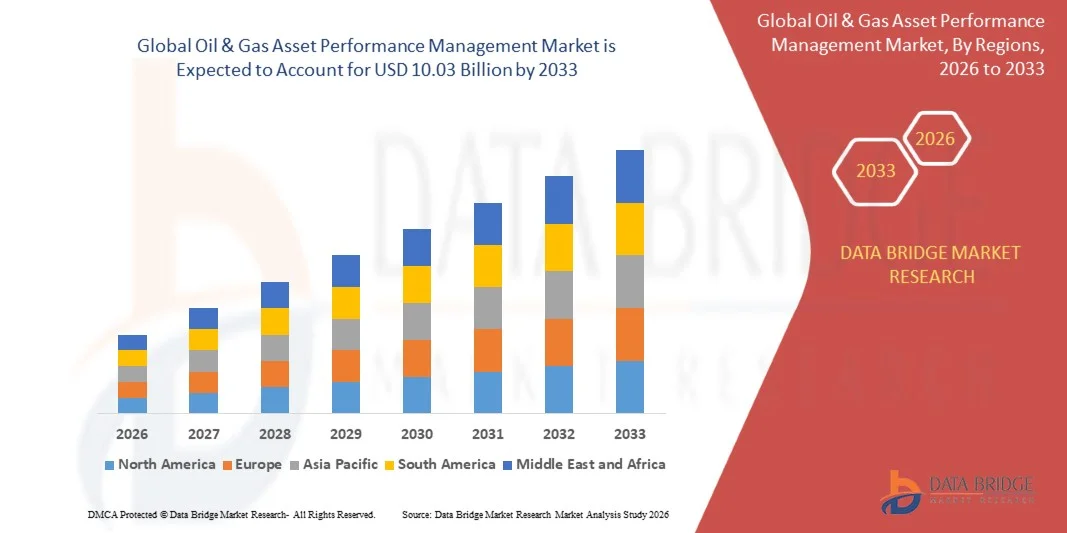
- As per Data Bridge Market Research analysis, the oil & gas asset performance management market was valued at USD 3.75 billion in 2025 and is projected to reach USD 10.03 billion by 2033, growing at a CAGR of 13.10% from 2026 to 2033.
- The market is experiencing consistent growth driven by digital transformation, predictive maintenance adoption, regulatory compliance pressure, and aging infrastructure, while falling sensor costs, improved cloud infrastructure, and the maturation of edge computing are making advanced asset performance management solutions more accessible to oil and gas operators.
- The increasing complexity and aging of oilfields, refineries, and pipeline networks, combined with the need to reduce unplanned downtime and improve operational efficiency, are compelling operators to adopt advanced asset performance management solutions. These solutions provide advanced analytics and real-time monitoring, enabling operators to proactively identify potential failures, optimize maintenance schedules, improve asset reliability, and maximize asset lifecycles.
Market Size & Forecast
- Global Market Value (2025): USD 3.75 Billion
- Expected Market Value (2033): USD 10.03 Billion
- Forecast CAGR (2026–2033): 13.10%
- Leading Region in 2025: North America
- Fastest Growing Region: Asia Pacific
What are the Major Takeaways of the Oil & Gas Asset Performance Management Market?
- North America dominated the oil & gas asset performance management market with the largest revenue share of 35.2% in 2025, supported by the concentration of major oil and gas operators, stringent regulatory requirements, mature IT infrastructure, and substantial technology investments.
- Asia-Pacific is expected to be the fastest-growing region at a CAGR of 12.4% from 2026 to 2033, fueled by expanding oil and gas exploration activities, increasing investments in digital infrastructure, and growing adoption of IIoT and cloud-based asset performance management platforms.
- The software segment led the market with a 58.3% share in 2025, driven by increasing adoption of digital platforms for asset monitoring, predictive analytics, and intelligent decision-making across oil and gas operations.
- Services are the fastest-growing component type, projected to register a CAGR of 8.1%, reflecting the surge in demand for implementation, consulting, maintenance, training, and managed services associated with increasingly complex APM deployments.
- The asset reliability management segment dominated the application category with a 35.0% revenue share in 2025, led by the growing need to improve equipment reliability and reduce unplanned downtime.
- On-Premise deployment accounted for 45.8% of the market share in 2025, preferred by large integrated oil and gas operators for greater control over system architecture, customization, data management, and sensitive production information.
- The predictive asset analytics segment is the fastest-growing application category, with a CAGR of 12.3%, driven by increasing adoption of artificial intelligence and machine learning for forecasting equipment degradation and failure probability
Report Scope and Oil & Gas Asset Performance Management Market Segmentation
|
Attributes |
Oil & Gas Asset Performance Management Key Market Insights |
|
Segments Covered |
|
|
Countries Covered |
North America
Europe
Asia-Pacific
Middle East and Africa
South America
|
|
Key Market Players |
|
|
Market Opportunities |
|
|
Value Added Data Infosets |
In addition to the insights on market scenarios such as market value, growth rate, segmentation, geographical coverage, and major players, the market reports curated by the Data Bridge Market Research also include in-depth expert analysis, geographically represented company-wise production and capacity, network layouts of distributors and partners, detailed and updated price trend analysis and deficit analysis of supply chain and demand. |
What is the Key Trend in the Oil & Gas Asset Performance Management Market?
- Oil and gas operators are increasingly integrating digital twins, artificial intelligence, predictive analytics, and real-time monitoring into asset performance management to improve reliability, optimize operations, and support data-driven maintenance decisions.
- For instance, in August 2024, ADNOC deployed Neuron 5, an AI-enabled process optimization technology that uses advanced AI models and deep-learning algorithms to predict maintenance needs and monitor critical equipment performance using pressure, temperature, and vibration data from sensors.
- Digital twin technology is gaining traction because virtual representations of pipelines, rigs, wells, and refineries enable operators to monitor asset conditions, simulate operating scenarios, predict failures, and optimize performance throughout asset lifecycles.
- Asset performance management platforms are increasingly combining AI and machine learning with physics-based models to detect early warning signs, prioritize interventions, reduce unplanned downtime, and improve maintenance strategies across complex oil and gas operations.
- Operators are also moving toward integrated APM platforms that connect asset health, maintenance strategies, operational data, and execution workflows, enabling organizations to transition from reactive maintenance toward proactive and predictive asset management.
- For instance, in September 2025, Baker Hughes enhanced its Cordant industrial software with integrated AI capabilities for asset performance management and process optimization, reflecting the increasing integration of AI-driven analytics into oil and gas asset monitoring and maintenance.
- As oil and gas companies increasingly prioritize operational resilience, cost efficiency, sustainability, and asset reliability, APM is evolving from a maintenance-focused solution into an enterprise capability spanning upstream, midstream, and downstream operations.
What are the Key Drivers of the Oil & Gas Asset Performance Management Market?
- The growing need to manage aging oilfields, pipelines, compressors, processing facilities, and other capital-intensive assets is increasing demand for predictive maintenance and continuous asset health monitoring to prevent costly failures.
- For instance, in March 2023, Baker Hughes and bp announced a collaboration to further develop Cordant, an integrated asset performance management and process optimization solution designed to improve asset availability, manage risk, and lower emissions across key operations.
- Increasing adoption of industrial IoT, cloud computing, artificial intelligence, and advanced analytics is enabling operators to collect and analyze real-time asset data, identify anomalies, and improve operational decision-making across geographically distributed facilities.
- Oil and gas companies are integrating APM into digital transformation strategies to reduce unplanned downtime, optimize maintenance costs, improve equipment reliability, extend asset lifecycles, and strengthen operational resilience across production environments.
- For instance, in January 2023, Baker Hughes introduced Cordant as an integrated suite of asset performance management and process optimization solutions for energy and industrial customers, alongside digital solutions designed to improve efficiency, performance, and emissions reduction in oilfield and gas operations.
- Regulatory requirements, safety priorities, and sustainability objectives are encouraging operators to adopt technologies capable of continuous monitoring, risk management, energy-efficiency optimization, and proactive identification of equipment performance degradation.
Which Factors are Challenging the Growth of the Oil & Gas Asset Performance Management Market?
- Legacy infrastructure and fragmented operational data create integration challenges because many oil and gas facilities continue using disparate systems, making it difficult to establish unified asset views and deploy advanced analytics effectively.
- For instance, in December 2024, a study published in Energies by MDPI identified technical complexities, security concerns, insufficient strategies, organizational resistance to change, and the significant time required to validate new technologies as key barriers to digital transformation in the oil and gas sector. The findings directly support the challenge of integrating advanced APM and digital technologies into existing oil and gas operations.
- Cybersecurity concerns represent a significant challenge as increasing connectivity of industrial control systems, sensors, cloud platforms, and operational technologies expands potential exposure to cyber threats across critical oil and gas infrastructure.
- Poor data quality and inconsistent datasets can limit the accuracy and reliability of predictive asset management models, particularly when equipment data are incomplete, noisy, or collected from heterogeneous sources.
- For instance, in July 2025, a research article published in Computers & Industrial Engineering by Elsevier identified high initial investment costs, workforce skill gaps, cybersecurity risks, and complexity in integrating new technologies with legacy systems as major challenges to Industry 4.0 adoption in the oil and gas sector. These barriers can restrict implementation of advanced APM, predictive analytics, and connected asset-management technologies.
- The implementation of sophisticated APM platforms can require substantial investment in software, sensors, data infrastructure, integration, cybersecurity, and skilled personnel, creating adoption barriers for organizations with complex legacy environments.
How is the Oil & Gas Asset Performance Management Market Segmented?
The oil & gas asset performance management market is segmented on the basis of component, deployment mode, application, process.
- By Component
On the basis of component, the oil & gas asset performance management market is segmented into software and services. The software segment dominated the market with a 58.3% share in 2025, driven by increasing adoption of digital platforms for asset monitoring, predictive analytics, and intelligent decision-making across oil and gas operations. Software solutions enable operators to collect, integrate, and analyze asset data to improve reliability and maintenance planning. Increasing integration of artificial intelligence, machine learning, industrial Internet of Things (IIoT), and advanced analytics is further strengthening demand for APM software. Cloud-enabled software platforms are also improving scalability and accessibility across geographically distributed assets. Growing digital transformation initiatives among oil and gas operators continue to support software adoption
The services segment is projected to grow at a CAGR of 8.1% from 2026 to 2033, encompassing implementation, consulting, maintenance, training, and managed services. Professional services are essential for integrating APM solutions with existing systems, developing customized analytics workflows, and training personnel. Increasing complexity of digital infrastructure is creating continued demand for consulting and implementation support across oil and gas operations. Managed services are also gaining adoption as operators seek specialized providers to manage APM platforms and optimize system performance. Maintenance and support services help companies ensure continuous operation and improve the long-term value of deployed solutions.
- By Deployment Mode
On the basis of deployment mode, the oil & gas asset performance management market is segmented into on-premises and cloud. The on-premises segment dominated the market with 45.8 in 2025, supported by the strong presence of legacy systems, stringent data security requirements, and the need for greater control over sensitive production data. Large oil and gas enterprises continue to prefer on-premises APM solutions because they provide extensive control over system architecture, customization, and data management. These deployments also facilitate integration with proprietary systems and established operational technology environments. On-premises solutions remain particularly relevant where data sovereignty requirements and limited connectivity affect cloud adoption. Their established installed base across large operators continues to support their leading position.
The cloud segment is projected to witness the fastest growth at a CAGR of 14.7% from 2026 to 2033, driven by increasing demand for scalability, flexibility, rapid implementation, and lower upfront infrastructure requirements. Cloud-based APM solutions enable oil and gas operators to monitor geographically dispersed assets and integrate real-time data with advanced analytics. Automatic software updates and elastic processing capacity further improve deployment flexibility. Growing migration from legacy applications toward cloud-native architectures is accelerating adoption. These platforms also provide improved accessibility and support remote operational decision-making
- By Application
On the basis of application, the oil & gas asset performance management market is segmented into asset reliability management, predictive asset analytics, asset integrity management, risk management, and others. The asset reliability management segment dominated the market with a 35.0% share in 2025, driven by the growing need to improve equipment reliability and reduce unplanned downtime. Asset reliability management enables operators to monitor equipment performance and optimize maintenance activities throughout the asset lifecycle. These solutions support condition-based and predictive maintenance strategies across critical oil and gas equipment. Increasing focus on extending asset life and improving operational efficiency is further strengthening demand for reliability management. Operators are increasingly using asset performance data to identify potential failures and prioritize maintenance activities. The segment is expected to remain a major application area as companies continue to prioritize asset availability and operational efficiency.
The predictive asset analytics segment is projected to witness the fastest growth at a CAGR of 12.3% from 2026 to 2033, driven by increasing adoption of artificial intelligence and machine learning for forecasting equipment degradation and failure probability. Predictive analytics platforms identify performance patterns and anomalies that precede equipment failure, enabling proactive maintenance intervention. These applications integrate sensor data streams and historical failure records to build predictive models and support condition-based maintenance. Increasing availability of real-time asset data is providing greater opportunities for advanced predictive modeling across oil and gas operations. The shift from reactive, failure-driven maintenance toward proactive approaches is further strengthening demand.
- By Process
On the basis of process, the oil & gas asset performance management market is segmented into upstream, midstream, and downstream. The upstream segment dominated the market with a 38.3% share in 2025, driven by the extensive deployment of APM solutions across exploration, drilling, production, and oilfield operations. Upstream activities involve complex and capital-intensive equipment where equipment failure can directly affect production and profitability. APM solutions enable operators to monitor asset health, improve equipment reliability, optimize maintenance, and reduce production interruptions. Increasing focus on production optimization and efficient management of mature oilfields is further supporting demand. Remote monitoring and predictive analytics are also becoming increasingly important for offshore and geographically distributed upstream assets.
The midstream segment is projected to witness the fastest growth at a CAGR of 10.4% from 2026 to 2033, driven by increasing adoption of asset monitoring and predictive maintenance across pipelines, compression stations, and storage facilities. Midstream operators are increasingly using APM technologies to optimize transportation throughput, reduce operational costs, and enhance pipeline safety through real-time monitoring and predictive analytics. The geographically distributed nature of midstream infrastructure creates strong demand for remote monitoring and asset intelligence. Pipeline integrity is a critical regulatory and safety concern, increasing the importance of continuous asset performance monitoring. Growing requirements to optimize existing infrastructure, expand capacity safely, and enhance operational reliability across complex pipeline networks are expected to accelerate APM adoption
Which Region Holds the Largest Share of the Oil & Gas Asset Performance Management Market?
- North America dominated the oil & gas asset performance management market with the largest revenue share of 35.2% in 2025, supported by the concentration of major oil and gas operators, stringent regulatory requirements, mature IT infrastructure, and substantial technology investments.
- The region also benefits from the presence of large integrated oil and gas companies, extensive downstream refining capacity, established technology vendors, and mature digital infrastructure, which facilitates the adoption of real-time asset monitoring, predictive analytics, cloud-based APM platforms, and edge computing. The growing need to manage aging infrastructure, improve asset reliability, reduce unplanned downtime, and comply with regulatory requirements is further strengthening demand for APM solutions across the region.
U.S. Oil & Gas Asset Performance Management Market Insight
The U.S. oil & gas asset performance management market is witnessing strong growth due to the country’s large-scale oil and gas production base, extensive infrastructure, and increasing focus on operational efficiency and digital technologies. In 2024, U.S. crude oil production reached a record 13.2 million barrels per day, while total U.S. energy production also reached a record level, increasing the need for reliable monitoring and optimization of production assets. The country’s large Permian Basin operations, which accounted for 48% of total U.S. crude oil production in 2024, further support demand for predictive maintenance, asset monitoring, and advanced analytics across geographically distributed assets. In addition, the continued expansion of natural gas and LNG infrastructure is creating further opportunities for APM solutions that improve asset reliability, reduce downtime, and optimize operational performance.
Asia-Pacific Oil & Gas Asset Performance Management Market Insight
The Asia-Pacific oil & gas asset performance management market is expected to witness rapid growth, driven by increasing upstream investment, expanding energy infrastructure, and accelerating digital transformation across national oil companies. The IEA reported that Middle Eastern and Asian national oil companies increased oil and gas investment by more than 50% between 2017 and 2024, accounting for almost the entire increase in industry spending during 2023–2024. China, India, and other Asian markets are increasingly deploying industrial Internet of Things, artificial intelligence, cloud computing, and digital monitoring technologies across oil and gas operations. China National Petroleum Corporation has also expanded 5G and intelligent-oilfield applications, including real-time monitoring, digital twins, and remote operational control. These developments are strengthening demand for asset reliability, predictive analytics, and digital asset management solutions across the region
Japan Oil & Gas Asset Performance Management Market Insight
The Japan oil & gas asset performance management market is witnessing consistent growth due to the country’s focus on maintaining aging refining infrastructure, improving productivity, and increasing the utilization of digital technologies. Japan’s 2025 Strategic Energy Plan emphasizes the maintenance and management of aging refinery facilities while promoting greater use of digital technologies to improve productivity and strengthen competitiveness. The plan specifically identifies the further utilization of digital technologies as part of efforts to maintain refineries and enhance the flexibility and efficiency of the petroleum supply system. Increasing adoption of AI, IoT, predictive maintenance, and digital monitoring technologies is therefore supporting opportunities for APM solutions. Japan’s emphasis on stable energy supply and efficient management of existing infrastructure is expected to continue supporting demand for advanced asset-performance technologies.
China Oil & Gas Asset Performance Management Market Insight
The China oil & gas asset performance management market is growing rapidly, driven by accelerating digital transformation, intelligent oilfield development, and large-scale deployment of 5G and industrial technologies. China National Petroleum Corporation reported that its Changqing Petrochemical refinery had 5G coverage across 430 key units and 3,937 pump monitoring points, with production stability maintained at 99.8%, fault-warning accuracy exceeding 95%, and maintenance costs reduced by approximately 10%. CNPC has also deployed digital twins and intelligent management systems across pipeline and storage projects to strengthen monitoring and operational control. These deployments demonstrate the increasing use of real-time data, intelligent monitoring, predictive analytics, and connected infrastructure in China’s oil and gas industry. Continued investment in smart oilfields, intelligent refineries, and digital operational platforms is strengthening the country’s demand for APM technologies
U.K. Oil & Gas Asset Performance Management Market Insight
The U.K. oil & gas asset performance management market is experiencing steady growth, supported by extensive North Sea infrastructure, increasing digitalization of the U.K. Continental Shelf, and growing deployment of technologies for facilities and asset management. The North Sea Transition Authority reported that 13 technologies were successfully deployed across the U.K. Continental Shelf during 2024, including applications in reservoir and well management, facilities management, and digital and data. The National Data Repository also expanded to 1.3 petabytes in 2024, while the amount of publicly available well and seismic data increased by 46% from 2023. These developments demonstrate growing availability of operational and subsurface data for advanced analytics and digital asset-management applications. Increasing emphasis on extending the life of North Sea assets and improving operational efficiency is expected to support demand for APM solutions.
Germany Oil & Gas Asset Performance Management Market Insight
The Germany oil & gas asset performance management market is expanding steadily due to increasing adoption of digitalization, predictive maintenance, artificial intelligence, and asset-management technologies across industrial and energy infrastructure. Germany hosted the Oil and Gas Automation and Digitalisation Congress in Düsseldorf in October 2024, where asset management, productive maintenance, smart pipeline management, artificial intelligence, data, and smart refinery technologies were among the major areas of focus. German industrial companies are also advancing predictive maintenance capabilities; BASF’s Ludwigshafen site uses sensors, live operating data, and analytical software to predict appropriate maintenance timing and reduce unplanned repairs and outages. These developments demonstrate growing adoption of data-driven asset management and predictive maintenance technologies within Germany’s industrial ecosystem. Increasing emphasis on operational reliability, digital transformation, and efficient management of complex industrial assets is supporting the market.
Which are the Top Companies in Oil & Gas Asset Performance Management Market?
The oil & gas asset performance management industry is primarily led by well-established companies, including:
- Baker Hughes Company (U.S.)
- GE Vernova (U.S.)
- Honeywell International Inc (U.S.)
- ABB (Switzerland)
- Siemens AG (Germany)
- Schneider Electric (France)
- Yokogawa Electric Corporation (Japan)
- Rockwell Automation, Inc. (U.S.)
- Hitachi, Ltd. (Japan)
- Hexagon AB (Sweden)
- Cognite AS (Norway)
- IFS (Sweden)
- SAP SE (Germany)
- Oracle (U.S.)
- IBM Corporation (U.S.)
- PTC Inc. (U.S.)
- SLB (U.S.)
- Technip Energies N.V. (Netherlands)
- Bentley Systems, Incorporated (U.S.)
What are Latest Developments in Oil & Gas Asset Performance Management Market?
- In September 2025, Baker Hughes announced a major update to its Cordant Industrial Software, introducing new capabilities across its Asset Performance Management and Process Optimization offerings. The latest release expanded hybrid AI and physics-based analytics for predictive failure detection across equipment such as turbines, compressors, and pumps, while also adding an AI Assistant for Work Management, collaborative modeling tools, and improved asset-health and strategy capabilities. The development demonstrates the increasing integration of AI-driven analytics into asset performance management for energy and industrial operations.
- In February 2025, Baker Hughes announced the general availability of the latest version of Cordant Asset Performance Management (APM), expanding asset health, asset strategy, and advanced analytics capabilities. Baker Hughes reported that Cordant APM deployments had increased five-fold since the beginning of 2024, while the latest enhancements introduced hybrid AI and physics-based analytics, opportunity analysis, asset-efficiency analytics, and improved maintenance workflows. The update was designed to improve reliability, reduce maintenance costs, and enhance operational efficiency for energy and industrial customer
- In August 2024, ADNOC announced the deployment of Neuron 5, an AI-enabled process optimization technology across critical equipment at ADNOC Onshore and ADNOC Gas facilities. The technology autonomously monitors equipment performance and uses AI to support preventative maintenance, reduce operational downtime, and improve efficiency. During the pilot phase, ADNOC reported that Neuron 5 could reduce unplanned shutdowns by 50% and increase planned maintenance intervals by 20%. The technology was initially deployed across hundreds of pieces of equipment and was planned for wider rollout across ADNOC operations
- In November 2022, GE Digital announced a strategic partnership with TrendMiner to incorporate advanced process analytics into its Asset Performance Management portfolio. The collaboration was designed to provide energy and resources industries, including oil and gas, with process analytics and optimization capabilities, intuitive visualization, actionable information from time-series and contextual data, and machine-learning functionality. The development expanded APM beyond conventional asset monitoring toward integrated process and production optimization.
- In January 2021, AVEVA was recognized as a leader in the IDC Asset Performance Management MarketScape for Oil & Gas and highlighted its APM portfolio built around industrial big data, cloud, artificial intelligence, digital twins, and augmented reality. AVEVA stated that its APM software provided proactive and predictive asset-performance insights, operational insights, and reporting to help industrial businesses eliminate inefficiencies, optimize operations, and improve profitability. The development reflected the increasing use of cloud, AI, digital twin, and predictive technologies in oil and gas asset management.

- Interactive Data Analysis Dashboard
- Company Analysis Dashboard for high growth potential opportunities
- Research Analyst Access for customization & queries
- Competitor Analysis with Interactive dashboard
- Latest News, Updates & Trend analysis
- Harness the Power of Benchmark Analysis for Comprehensive Competitor Tracking
Data collection and base year analysis are done using data collection modules with large sample sizes. The stage includes obtaining market information or related data through various sources and strategies. It includes examining and planning all the data acquired from the past in advance. It likewise envelops the examination of information inconsistencies seen across different information sources. The market data is analysed and estimated using market statistical and coherent models. Also, market share analysis and key trend analysis are the major success factors in the market report. To know more, please request an analyst call or drop down your inquiry.
The key research methodology used by DBMR research team is data triangulation which involves data mining, analysis of the impact of data variables on the market and primary (industry expert) validation. Data models include Vendor Positioning Grid, Market Time Line Analysis, Market Overview and Guide, Company Positioning Grid, Patent Analysis, Pricing Analysis, Company Market Share Analysis, Standards of Measurement, Global versus Regional and Vendor Share Analysis. To know more about the research methodology, drop in an inquiry to speak to our industry experts.
Data Bridge Market Research is a leader in advanced formative research. We take pride in servicing our existing and new customers with data and analysis that match and suits their goal. The report can be customized to include price trend analysis of target brands understanding the market for additional countries (ask for the list of countries), clinical trial results data, literature review, refurbished market and product base analysis. Market analysis of target competitors can be analyzed from technology-based analysis to market portfolio strategies. We can add as many competitors that you require data about in the format and data style you are looking for. Our team of analysts can also provide you data in crude raw excel files pivot tables (Fact book) or can assist you in creating presentations from the data sets available in the report.