What is the Oil & Gas Industrial Automation and Control Systems Market Size and Growth Rate?
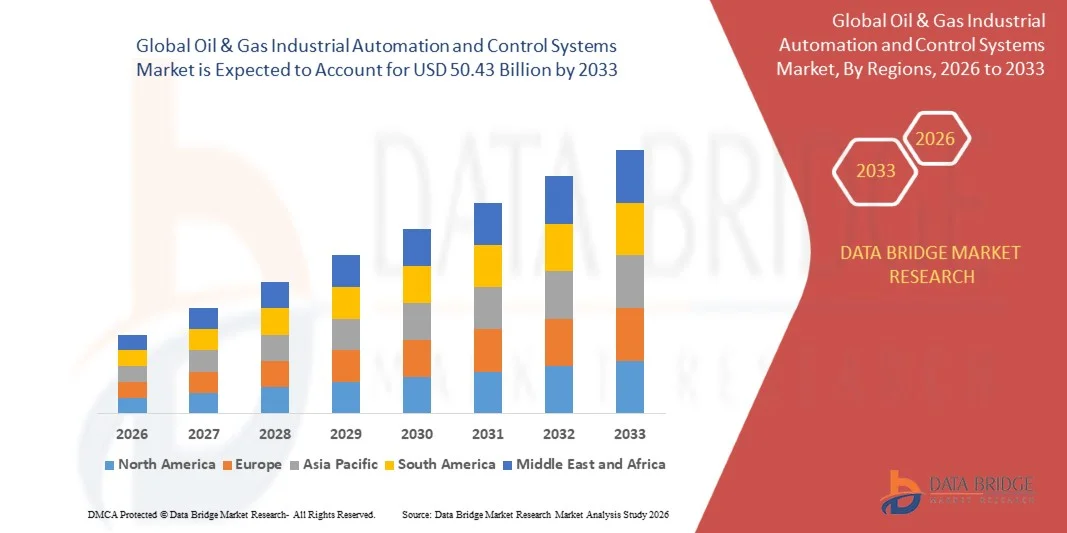
- As per Data Bridge Market Research analysis, the oil & gas industrial automation and control systems market was valued at USD 24.40 billion in 2025 and is projected to reach USD 50.43 billion by 2033, growing at a CAGR of 9.50% from 2026 to 2033.
- The market is experiencing consistent growth driven by increasing pressure to optimize production, reduce downtime, and minimize operational risks, with oil and gas companies integrating automation to streamline workflows and improve safety. Solutions such as SCADA systems, DCS, PLCs, and real-time analytics are becoming foundational for predictive maintenance, asset performance monitoring, and remote operations.
- The increasing need for operational efficiency, safety improvements, and cost optimization across oil and gas operations, combined with the adoption of advanced control systems, robotics, AI-driven technologies, and real-time analytics, is accelerating automation deployment for production optimization, predictive maintenance, asset performance monitoring, and remote operations. The shift toward cleaner fuels and growing global energy demand is further creating opportunities for industrial automation solution providers and digital transformation consultants.
Market Size & Forecast
- Global Market Value (2025): USD 24.40 Billion
- Expected Market Value (2033): USD 50.43 Billion
- Forecast CAGR (2026–2033): 9.50%
- Leading Region in 2025: North America
- Fastest Growing Region: Asia Pacific
What are the Major Takeaways of the Oil & Gas Industrial Automation and Control Systems Market?
- North America dominated the oil & gas automation market with the largest revenue share of 36.62% in 2025, supported by shale developers pioneering AI-steered drilling and pad optimization, along with mature cybersecurity infrastructure and modernization of remote monitoring and predictive maintenance systems.
- Asia-Pacific is expected to be the fastest-growing region at a CAGR of 7.12% from 2026 to 2033, fueled by refinery modernization, upstream digitization, LNG infrastructure expansion, and increasing adoption of AI-enabled cryogenic controls across the region.
- The distributed control system (DCS) segment led the market with a 29.82% share in 2025, driven by its extensive deployment in complex refining and LNG processes.
- Supervisory control and data acquisition (SCADA) are the fastest-growing automation technology type, projected to register a CAGR of 6.62%, reflecting the surge in demand for remote monitoring and real-time data acquisition across geographically dispersed assets.
- The control valves segment dominated the component category with a 43.6% revenue share in 2025, led by their extensive use in regulating fluid flow, pressure, and process conditions across upstream, midstream, and downstream oil and gas operations.
- Production and well optimization accounted for 37.74% of the market share in 2025, preferred by oil and gas operators seeking to maximize production efficiency, optimize well performance, and improve real-time control of production processes.
- The LNG terminals and storage segment is the fastest-growing application category, with a CAGR of 7.46%, driven by continued expansion of LNG infrastructure and demand for flexible gas supply.
Report Scope and Oil & Gas Industrial Automation and Control Systems Market Segmentation
|
Attributes |
Oil & Gas Industrial Automation and Control Systems Key Market Insights |
|
Segments Covered |
|
|
Countries Covered |
North America
Europe
Asia-Pacific
Middle East and Africa
South America
|
|
Key Market Players |
|
|
Market Opportunities |
|
|
Value Added Data Infosets |
In addition to the insights on market scenarios such as market value, growth rate, segmentation, geographical coverage, and major players, the market reports curated by the Data Bridge Market Research also include in-depth expert analysis, geographically represented company-wise production and capacity, network layouts of distributors and partners, detailed and updated price trend analysis and deficit analysis of supply chain and demand. |
What is the Key Trend in the Oil & Gas Industrial Automation and Control Systems Market?
- Oil and gas companies are increasingly adopting artificial intelligence, Internet of Things, digital twins, and robotics to automate operations, improve productivity, enhance safety, and enable more efficient upstream, midstream, and downstream processes.
- For instance, in September 2024, BP expanded its partnership with Palantir through a five-year agreement to deploy AI across its operations, building on digital-twin applications used for assets including the Khazzan gas fields and offshore platforms to support monitoring, optimization, and engineering decision-making.
- The growing integration of digital twins with automation and control systems is enabling real-time monitoring, predictive analysis, process optimization, failure prediction, and what-if scenario analysis across oil and gas production environments.
- Predictive maintenance and real-time asset monitoring are becoming important applications of automation, allowing operators to identify equipment abnormalities, anticipate failures, optimize maintenance decisions, and improve operational reliability.
- Oil and gas operators are increasingly deploying remote monitoring and exploration technologies, enabling automated supervision of geographically dispersed assets while reducing the need for continuous on-site intervention and improving operational efficiency.
- The increasing use of AI, machine learning, IoT, sensors, SCADA, PLCs, and DCSs is strengthening data-driven automation across upstream activities, particularly offshore operations, where companies seek improved production efficiency, workplace safety, and operational sustainability.
- For instance, in January 2025, Shell began production from its Whale deep-water platform using an onshore control room in New Orleans, enabling engineers to control oil and gas flow and monitor almost every aspect of the offshore facility remotely, demonstrating the growing adoption of remote operations and digital control technologies in oil and gas.
- As oil and gas companies continue shifting from conventional operational technologies toward AI, IoT, digital twins, robotics, predictive maintenance, and remote monitoring, the integration of intelligent automation and control systems is expected to accelerate across the industry.
What are the Key Drivers of the Oil & Gas Industrial Automation and Control Systems Market?
- The increasing need to improve worker productivity and safety is accelerating investment in automation technologies across oil and gas operations, with companies seeking automated processes that reduce operational risks and improve production efficiency.
- For instance, in November 2024, ADNOC awarded a USD 920 million contract to extend its AI-powered well digitalization program to more than 2,000 wells, enabling remote monitoring and control, reducing downtime, and optimizing well performance.
- The growing adoption of AI, IoT, digital twins, and robotics is enabling oil and gas companies to improve predictive maintenance, remote site monitoring, data and asset management, drilling automation, and energy management.
- The expansion of offshore oil and gas activities is increasing demand for sensors, transmitters, controllers, SCADA systems, PLCs, and DCSs, while automation technologies support safer and more efficient operation of complex offshore assets.
- For instance, in January 2024, SLB and Equinor achieved autonomous drilling of 99% of a 2.6-kilometer well section in Brazil, with the five-well program delivering a 60% increase in rate of penetration while reducing cost and carbon emissions.
- With oil and gas companies increasingly prioritizing operational efficiency, workplace safety, predictive maintenance, and digital transformation, industrial automation and control systems are becoming essential technologies for improving performance across the oil and gas value chain.
Which Factors are Challenging the Growth of the Oil & Gas Industrial Automation and Control Systems Market?
- The increasing connectivity between operational technology networks and enterprise networks is expanding the cyberattack surface of industrial control environments, creating additional cybersecurity requirements for oil and gas automation systems.
- For instance, in September 2024, a case study published in Applied Sciences examining a real oil and gas production plant control system and found that legacy Industrial Control Systems (ICS) are particularly vulnerable because of outdated technology, limited documentation, and proprietary components, making cybersecurity assessment and modernization more difficult.
- The integration of advanced automation technologies can create data integration, interoperability, scalability, and workforce-readiness challenges, particularly when companies attempt to integrate new digital systems with existing industrial infrastructure.
- Oil and gas facilities face significant security risks because failures or cyber threats involving interconnected automation and control systems can generate severe operational, safety, and asset-related consequences, increasing the complexity of automation deployment.
- For instance, in May 2025, an article published in the World Journal of Advanced Research and Reviews reported that legacy SCADA systems in the oil and gas industry face significant cybersecurity challenges because of aging infrastructure, outdated operating systems, proprietary hardware with limited update capabilities, and protocols lacking authentication or encryption.
- Consequently, the need to protect interconnected SCADA, sensors, controllers, and other industrial control systems, while addressing interoperability and workforce requirements, can increase implementation complexity and constrain the rapid deployment of advanced automation technologies.
How is the Oil & Gas Industrial Automation and Control Systems Market Segmented?
The oil & gas industrial automation and control systems market is segmented on the basis of automation technology, component, application, and end user.
- By Automation Technology
On the basis of automation technology, the market is segmented into distributed control system (DCS), programmable logic controller (PLC), supervisory control and data acquisition (SCADA), safety instrumented system (SIS), manufacturing execution system (MES), functional safety, plant asset management (PAM), and other technologies. The distributed control system (DCS) segment dominated the technology category with a 29.82% share in 2025, owing to its extensive deployment in complex refining and LNG processes. DCS provides centralized monitoring and control for continuous and complex industrial processes. Its established installed base across refineries and LNG facilities supports recurring modernization and replacement demand. Increasing integration of advanced process control, artificial intelligence, and decision-support technologies is further expanding DCS capabilities. DCS therefore remains the principal control architecture for large-scale and process-intensive oil and gas facilities.
The supervisory control and data acquisition (SCADA) segment is projected to register the fastest growth at a CAGR of 6.62% through 2033, driven by increasing demand for remote monitoring and real-time data acquisition across geographically dispersed assets. SCADA systems are particularly important for pipelines, production facilities, terminals, and other remote infrastructure. Their ability to collect operational data and provide supervisory control from centralized locations is supporting wider deployment. Satellite-enabled monitoring is further increasing the applicability of SCADA across remote oil and gas assets. Integration with industrial Internet of Things technologies and advanced analytics is improving real-time operational visibility. The increasing digitalization of midstream infrastructure is therefore expected to keep SCADA among the fastest-growing automation technologies.
- By Component
On the basis of component, the market is segmented into industrial robots, control valves, field instruments, human machine interface (HMI), industrial PC, process analyzers, intelligent pigging, and vibration monitoring. The control valves segment dominated the component category with 43.6% share in 2025. Control valves regulate fluid flow and pressure and are required across refining, transportation, distribution, and production operations. Their critical role in maintaining process efficiency and operational safety makes them an essential component of automated oil and gas facilities. Ball, butterfly, and gate valves are deployed according to specific process requirements. The extensive installation base across almost every stage of the oil and gas value chain continues to support demand for control valves.
The field instruments segment is projected to register the fastest growth at 6.71% CAGR through 2033. Field instruments include pressure transmitters, flow meters, and temperature sensors, which provide the measurement foundation for automated process-control loops. These devices are deployed extensively across upstream, midstream, and downstream facilities. Increasing adoption of smart sensors is improving measurement accuracy and enabling real-time connectivity with control platforms. Industrial Internet of Things integration is further increasing the value of connected field instrumentation. The modernization of aging oil and gas infrastructure and increasing requirements for real-time monitoring are expected to support continued demand for advanced field instruments.
- By Application
On the basis of application, the market is segmented into exploration and production, drilling and completion, production and well optimization, pipeline and transportation, refining and petrochemicals, and LNG terminals and storage. The production and well optimization segment dominated the application category with a 37.74% share in 2025. The segment is supported by AI-driven artificial-lift management, real-time analytics, and automation technologies that improve production efficiency. Automated monitoring allows operators to continuously evaluate well and production conditions. Advanced analytics can identify inefficiencies and support faster operational decisions. Digital oilfield platforms are also improving asset performance and production management. The increasing focus on maximizing output from existing wells continues to reinforce the importance of production and well optimization.
The LNG terminals and storage segment is projected to register the fastest growth at 7.46% CAGR through 2033, supported by continued expansion of LNG infrastructure and demand for flexible gas supply. LNG terminals require sophisticated automation to control liquefaction, storage, loading, unloading, and regasification processes. Cryogenic operating conditions increase the need for reliable measurement, monitoring, and automated control. Expanding LNG infrastructure across Asia-Pacific and Africa is creating additional procurement opportunities for advanced control systems. Digital monitoring and analytics are also improving safety, reliability, and process efficiency within LNG facilities. The combination of new LNG capacity and increasingly sophisticated control requirements is expected to make this the fastest-growing application category.
- By End User
On the basis of end user, the market is segmented into integrated oil and gas companies, national oil companies, and independent oil and gas companies. The integrated oil and gas companies segment is the leading end-user category dominated the market with revenue share of 66% in 2025. Integrated companies operate across exploration, production, transportation, refining, petrochemicals, and other activities, creating extensive requirements for automation and control systems. Their diversified operations allow DCS, SCADA, PLC, safety systems, field instrumentation, and analytics to be deployed across multiple facilities. Digital transformation programs are increasingly being implemented across their global asset portfolios. These companies also have substantial requirements for predictive maintenance and remote monitoring. Their broad operational footprint therefore makes them an important end-user group for industrial automation suppliers.
The national oil companies segment is projected to register the fastest growth at 8.00% CAGR through 2033, as major producers increase investments in upstream digitalization, refinery modernization, LNG infrastructure, and advanced control systems. National oil companies are implementing AI-enabled monitoring, predictive maintenance, remote operations, and digital-oilfield technologies to improve asset performance. Large-scale investments in production infrastructure are creating substantial automation requirements across their operations. The adoption of connected sensors and centralized control platforms is also improving real-time visibility into production assets. Increasing focus on operational efficiency, safety, and production optimization is encouraging further automation investment.
Which Region Holds the Largest Share of the Oil & Gas Industrial Automation and Control Systems Market?
- North America dominated the oil & gas automation market with the largest revenue share of 36.62% in 2025, supported by shale developers pioneering AI-steered drilling and pad optimization, along with mature cybersecurity infrastructure and modernization of remote monitoring and predictive maintenance systems.
- The region also benefits from AI-steered drilling, pad optimization, remote monitoring, and modernization of aging oil and gas infrastructure, while mature cybersecurity practices and increasing adoption of zero-trust operational-technology frameworks are supporting investment in advanced control systems. The United States' large-scale upstream activity, extensive pipeline network, and continued digital transformation further strengthen North America's leadership in the global market.
U.S. Oil & Gas Industrial Automation and Control Systems Market Insight
The U.S. oil & gas industrial automation and control systems market is witnessing strong growth due to extensive upstream and midstream infrastructure, continued shale oil and gas activity, and increasing investment in digital oilfield technologies. The country accounted for a major portion of North America's oil and gas automation market, supported by its large installed base of production, pipeline, refining, and LNG assets. In addition, the U.S. is increasingly adopting AI-driven drilling, remote monitoring, predictive maintenance, and advanced control technologies to improve operational efficiency. ExxonMobil has deployed AI-driven optimization across approximately 1,300 wells, resulting in a 2.2% increase in production, demonstrating the growing application of automation and AI in U.S. oil and gas operations
Asia-Pacific Oil & Gas Industrial Automation and Control Systems Market Insight
The Asia-Pacific oil & gas industrial automation and control systems market is expected to witness rapid growth, driven by expanding oil and gas infrastructure, increasing LNG investments, and accelerating digitalization across emerging economies. Rising energy demand and development of new production, refining, pipeline, and LNG facilities are creating opportunities for automation and control system providers. Growing adoption of AI, Internet of Things, digital twins, and remote monitoring is further supporting regional market expansion. China National Offshore Oil Corporation (CNOOC) has advanced intelligent oilfield development through digital technologies, including digital twins and intelligent production systems, supporting greater automation across offshore operations.
Japan Oil & Gas Industrial Automation and Control Systems Market Insight
The Japan oil & gas industrial automation and control systems market is witnessing consistent growth due to increasing investment in refinery modernization, energy-efficiency technologies, process automation, and digital transformation. Japanese oil and energy companies are increasingly integrating advanced control systems, data analytics, and predictive maintenance technologies to improve the efficiency and reliability of mature energy infrastructure. The country's sophisticated industrial automation ecosystem and strong presence of automation suppliers further support adoption across refining and petrochemical operations. ENEOS has been advancing digital transformation initiatives that use data and digital technologies to improve operational efficiency and maintenance across its energy businesses, supporting demand for advanced automation technologies.
China Oil & Gas Industrial Automation and Control Systems Market Insight
The China oil & gas industrial automation and control systems market is growing rapidly, driven by expanding refining and petrochemical capacity, increasing LNG infrastructure, and government-supported digital transformation across the energy sector. Growing adoption of intelligent oilfields, industrial Internet of Things technologies, AI, and automated production systems is strengthening demand for advanced control technologies. China's large-scale refining and petrochemical industry also provides significant opportunities for DCS, PLC, SCADA, safety systems, and process instrumentation. Sinopec has been developing intelligent oilfields and smart manufacturing initiatives using industrial Internet, artificial intelligence, big data, and digital technologies to improve production and operational efficiency
U.K. Oil & Gas Industrial Automation and Control Systems Market Insight
The U.K. oil & gas industrial automation and control systems market is experiencing steady growth, supported by continued North Sea operations, offshore asset modernization, and increasing adoption of digital technologies for remote monitoring and predictive maintenance. Mature offshore infrastructure is creating demand for automation upgrades that improve operational reliability, safety, and asset life. The U.K. is also increasingly deploying digital technologies to support remote operations and optimize offshore production. Equinor's UK North Sea operations have incorporated digital solutions and remote monitoring capabilities to improve offshore asset performance and operational efficiency, demonstrating the increasing role of digitalization in the country's mature offshore sector.
Germany Oil & Gas Industrial Automation and Control Systems Market Insight
The Germany oil & gas industrial automation and control systems market is expanding steadily due to the country's strong industrial automation capabilities, sophisticated chemical and refining industries, and increasing focus on energy efficiency and digitalization. Refining and petrochemical facilities are increasingly adopting advanced process-control, predictive-maintenance, and digital monitoring technologies to improve productivity and operational reliability. Germany's established industrial automation ecosystem also supports integration of advanced sensors, control platforms, and industrial software across energy-intensive facilities. BASF has implemented digital technologies, including advanced analytics and digital twins, across its production operations to optimize processes, improve maintenance, and enhance operational efficiency, supporting the broader adoption of industrial automation technologies in Germany.
Which are the Top Companies in Oil & Gas Industrial Automation and Control Systems Market?
The oil & gas industrial automation and control systems industry is primarily led by well-established companies, including:
- Siemens AG (Germany)
- Honeywell International Inc. (U.S.)
- ABB (Switzerland)
- Schneider Electric (France)
- Rockwell Automation, Inc. (U.S.)
- Yokogawa Electric Corporation (Japan)
- SLB Limited (U.S.)
- Halliburton (U.S.)
- TechnipFMC plc (U.K.)
- Weatherford (U.S.)
- Azbil Corporation (Japan)
- Fuji Electric Co., Ltd. (Japan)
- Mitsubishi Electric Corporation (Japan)
- Endress+Hauser Group Services AG (Switzerland)
- Valmet Oyj (Finland)
- Metso Corporation (Finland)
- KONGSBERG (Norway)
- Baker Hughes Company (U.S.)
- GE Vernova Inc. (U.S.)
What are Latest Developments in Oil & Gas Industrial Automation and Control Systems Market?
- In November 2025, Emerson and Interwell introduced the world’s first retrievable electric gas-lift system, the Adaptive Gas Lift System, designed to help oil and gas operators maximize production without costly and challenging well interventions. The system combines electric actuation with downhole gas-lift technology, enabling operators to adjust gas injection and optimize well performance. Emerson stated that the technology can help operators respond to changing reservoir conditions without conventional intervention requirements. The launch demonstrates the increasing integration of electrification, intelligent control, and automation into oil and gas production optimization.
- In November 2025, SLB launched Tela, an agentic AI assistant purpose-built for the upstream energy sector, designed to automate processes and transform workflows through conversational AI. Tela is embedded across SLB's applications and platforms and enables energy professionals to interact with digital workflows through a conversational interface. The technology is designed to support automation of operational processes and improve productivity across upstream activities. The launch represents a major development in the application of agentic AI and intelligent automation to oil and gas operations.
- In April 2025, Emerson launched a Global LNG Solutions Center in Qatar to provide localized automation and digital solutions for LNG and energy customers. The center brings together Emerson's automation, measurement, and digital technologies to support LNG and other energy projects in the region. Its launch was attended by representatives from QatarEnergy LNG, Qatar Chemicals, North Oil Company, ExxonMobil, Samsung, and other organizations. The facility strengthens access to automation technologies for LNG production and infrastructure
- In April 2022, Siemens highlighted the use of digital twins for oil and gas pipeline operations, enabling companies to integrate physical and digital assets into a comprehensive digital representation of their pipeline infrastructure. The digital-twin approach was presented as a way to improve operational efficiency and support data-driven decision-making across the pipeline lifecycle. Siemens emphasized that digitalization can support activities ranging from conceptual engineering and project development through operation and eventual decommissioning. The technology provides a digital foundation for integrating operational information and improving asset management.
- In November 2021, Rockwell Automation showcased automation and digitalization solutions for the oil and gas industry at ADIPEC 2021, highlighting data-driven technologies spanning drilling operations through refining. Rockwell Automation and Sensia presented solutions designed to integrate measurement, intelligence, and action across the oil and gas value chain. The company emphasized the use of digitalization and automation to improve process efficiency, safety, and operational performance while reducing costs and downtime. Sensia's portfolio included data-driven solutions, services, and products supporting operations from the reservoir through the refinery.

- Interactive Data Analysis Dashboard
- Company Analysis Dashboard for high growth potential opportunities
- Research Analyst Access for customization & queries
- Competitor Analysis with Interactive dashboard
- Latest News, Updates & Trend analysis
- Harness the Power of Benchmark Analysis for Comprehensive Competitor Tracking
Data collection and base year analysis are done using data collection modules with large sample sizes. The stage includes obtaining market information or related data through various sources and strategies. It includes examining and planning all the data acquired from the past in advance. It likewise envelops the examination of information inconsistencies seen across different information sources. The market data is analysed and estimated using market statistical and coherent models. Also, market share analysis and key trend analysis are the major success factors in the market report. To know more, please request an analyst call or drop down your inquiry.
The key research methodology used by DBMR research team is data triangulation which involves data mining, analysis of the impact of data variables on the market and primary (industry expert) validation. Data models include Vendor Positioning Grid, Market Time Line Analysis, Market Overview and Guide, Company Positioning Grid, Patent Analysis, Pricing Analysis, Company Market Share Analysis, Standards of Measurement, Global versus Regional and Vendor Share Analysis. To know more about the research methodology, drop in an inquiry to speak to our industry experts.
Data Bridge Market Research is a leader in advanced formative research. We take pride in servicing our existing and new customers with data and analysis that match and suits their goal. The report can be customized to include price trend analysis of target brands understanding the market for additional countries (ask for the list of countries), clinical trial results data, literature review, refurbished market and product base analysis. Market analysis of target competitors can be analyzed from technology-based analysis to market portfolio strategies. We can add as many competitors that you require data about in the format and data style you are looking for. Our team of analysts can also provide you data in crude raw excel files pivot tables (Fact book) or can assist you in creating presentations from the data sets available in the report.