Organic Fertilizers for Turfgrass Market Analysis
The organic fertilizers for turfgrass market is witnessing notable technological advancements, emphasizing sustainable and efficient solutions. Latest methods incorporate bio-based fertilizers enriched with microbial inoculants and slow-release formulations. These innovations optimize nutrient delivery, reduce leaching, and enhance soil health. Technologies such as nanotechnology are enabling precise nutrient delivery systems, ensuring prolonged efficacy and minimal environmental impact.
The usage of is growing as turfgrass managers seek eco-friendly alternatives to synthetic fertilizers. These fertilizers support sustainable landscaping practices, improve soil biodiversity, and reduce chemical dependency. Advanced composting techniques and the inclusion of biochar further enhance organic fertilizer quality.
Market growth is fueled by increasing awareness of environmental benefits and regulatory pressures to limit synthetic fertilizer use. The organic fertilizers demand for organic products in golf courses, sports fields, and residential lawns is rising. Furthermore, the integration of IoT and AI-driven tools for precise application supports market expansion, providing tailored nutrient solutions. These advancements are reshaping the turfgrass management industry towards a greener and sustainable future.
Organic Fertilizers for Turfgrass Market Size
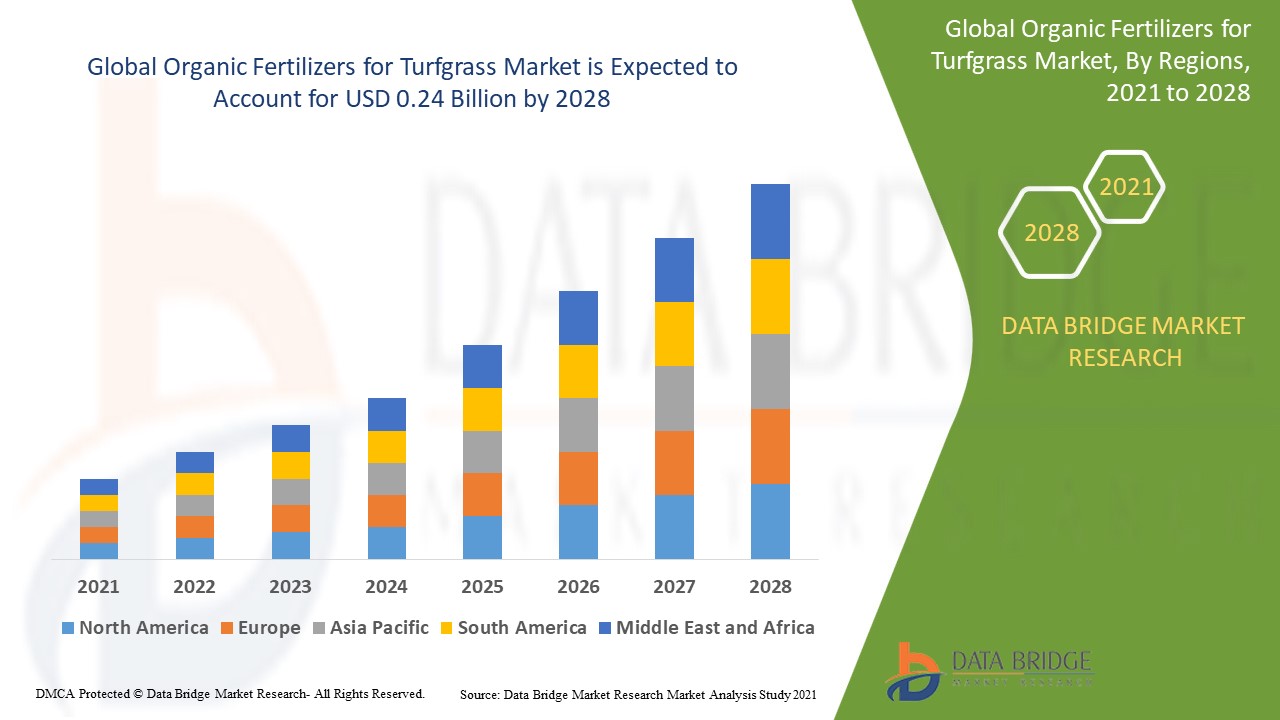
The global organic fertilizers for turfgrass market size was valued at USD 192.27 million in 2024 and is projected to reach USD 299.58 million by 2032, with a CAGR of 5.70% during the forecast period of 2025 to 2032. In addition to the insights on market scenarios such as market value, growth rate, segmentation, geographical coverage, and major players, the market reports curated by the Data Bridge Market Research also include import export analysis, production capacity overview, production consumption analysis, price trend analysis, climate change scenario, supply chain analysis, value chain analysis, raw material/consumables overview, vendor selection criteria, PESTLE Analysis, Porter Analysis, and regulatory framework.
Organic Fertilizers for Turfgrass Market Trends
“Increasing Demand for Eco-Friendly Turf Solutions”
A significant trend driving growth in the organic fertilizers for turfgrass market is the increasing preference for eco-friendly turf management solutions. With rising awareness of environmental sustainability, golf courses, sports fields, and residential lawns are transitioning to organic fertilizers to reduce chemical runoff and enhance soil health. For instance, municipalities in regions such as Europe are implementing strict regulations against synthetic fertilizers, further promoting organic options. Companies such as The Andersons Inc. have introduced innovative organic fertilizer blends tailored for turfgrass, offering balanced nutrition while minimizing environmental impact. This shift not only aligns with ecological goals but also addresses the growing demand for sustainable landscaping practices, boosting market adoption.
Report Scope and Organic Fertilizers for Turfgrass Market Segmentation
|
Attributes |
Organic Fertilizers for Turfgrass Key Market Insights |
|
Segments Covered |
|
|
Countries Covered |
U.S., Canada and Mexico in North America, Germany, France, U.K., Netherlands, Switzerland, Belgium, Russia, Italy, Spain, Turkey, Rest of Europe in Europe, China, Japan, India, South Korea, Singapore, Malaysia, Australia, Thailand, Indonesia, Philippines, Rest of Asia-Pacific (APAC) in the Asia-Pacific (APAC), Saudi Arabia, U.A.E, South Africa, Egypt, Israel, Rest of Middle East and Africa (MEA) as a part of Middle East and Africa (MEA), Brazil, Argentina and Rest of South America as part of South America |
|
Key Market Players |
Tata Chemicals Ltd. (India), The Scotts Company LLC (U.S.), Coromandel International Limited (India), NATIONAL FERTILIZERS LIMITED (India), KRIBHCO (India), Midwestern BioAg (U.S.), Italpollina S.p.A. (Italy), ILSA S.p.A. (Italy), Perfect Blend, LLC (U.S.), Suståne Natural Fertilizer, Inc. (U.S.), Biostar Renewables, LLC. (U.S.), AgroCare Canada, Inc. (Canada), Nature Safe (U.S.), Fertikal N.V. (Belgium), and MultiplexGroup (U.S.) |
|
Market Opportunities |
|
|
Value Added Data Infosets |
In addition to the insights on market scenarios such as market value, growth rate, segmentation, geographical coverage, and major players, the market reports curated by the Data Bridge Market Research also include import export analysis, production capacity overview, production consumption analysis, price trend analysis, climate change scenario, supply chain analysis, value chain analysis, raw material/consumables overview, vendor selection criteria, PESTLE Analysis, Porter Analysis, and regulatory framework. |
Organic Fertilizers for Turfgrass Market Definition
Organic fertilizers for turfgrass are natural, eco-friendly soil amendments derived from plant, animal, or mineral sources. They release nutrients slowly, promoting sustainable growth and improving soil health. Common ingredients include compost, manure, bone meal, and seaweed extracts, which supply essential nutrients such as nitrogen, phosphorus, and potassium. Organic fertilizers enhance microbial activity, improve soil structure, and increase water retention, fostering a healthy root system for turfgrass. Different from synthetic fertilizers, they reduce the risk of nutrient leaching and environmental harm. Widely used in lawns, golf courses, and sports fields, organic fertilizers support lush, green turf while maintaining ecological balance and soil fertility.
Organic Fertilizers for Turfgrass Market Dynamics
Drivers
- Growing Popularity of Organic Landscaping
The increasing preference for organic landscaping practices is significantly driving the demand for organic fertilizers in the turfgrass market. Consumers and landscapers are prioritizing eco-friendly methods that promote healthier soil and plant growth without synthetic chemicals. For instance, many residential communities and golf courses have transitioned to organic turf management to align with sustainability goals and address health concerns. High-profile venues, such as sports stadiums, are adopting organic fertilizers to ensure safe playing fields and minimize environmental impact. This shift reflects the broader trend of environmentally responsible landscaping, fostering a robust market for organic fertilizers tailored for diverse turfgrass applications.
- Rising Green Spaces
The expansion of urban green spaces, such as parks, recreational areas, and sports fields, significantly drives the demand for organic fertilizers in turfgrass management. As cities prioritize creating eco-friendly environments, there is a growing need for sustainable turf maintenance solutions. Organic fertilizers offer an environmentally friendly alternative that enhances soil health and reduces chemical runoff, aligning with green initiatives. Recreational areas, where public and pet safety are paramount, prefer organic options to minimize health risks. Furthermore, the increased focus on urban beautification and sustainability amplifies the adoption of organic fertilizers, bolstering their market growth in both public and private landscaping sectors.
Opportunities
- Improved Soil Health Benefits
Organic fertilizers significantly improve soil health by enhancing its structure, boosting microbial activity, and promoting efficient nutrient cycling. These benefits ensure sustainable and long-term turf management, making organic fertilizers highly attractive for residential lawns, sports fields, and recreational areas. By fostering healthier soil, these products reduce dependency on chemical inputs and mitigate environmental concerns such as soil degradation. The growing emphasis on soil conservation and sustainable practices creates substantial market opportunities. Urban green spaces, golf courses, and parks are increasingly adopting organic solutions to maintain turf quality while aligning with eco-friendly mandates. This trend positions organic fertilizers as a key solution in the expanding turfgrass management market.
- Increased Sports Turf Adoption
The growing adoption of organic fertilizers in sports turf management is creating significant market opportunities. Sports facilities increasingly prioritize player safety, as organic fertilizers reduce exposure to harmful chemicals compared to synthetic alternatives. In addition, compliance with sustainability goals has become a key focus for stadiums and sports complexes, further driving the demand for eco-friendly turf solutions. Organic fertilizers not only improve soil health and turf quality but also minimize nutrient runoff, aligning with environmental stewardship. The rise in green certifications for sports venues and expanding urban recreational projects further enhance this trend, positioning organic fertilizers as an essential component in modern sports turf management.
Restraints/Challenges
- Slow Nutrient Release
Slow nutrient release is a significant challenge for the organic fertilizers for turfgrass market. These fertilizers gradually release nutrients, which may not meet the immediate needs of turfgrass, particularly in high-performance areas such as sports fields. Turfgrass in these areas often requires quick nutrient uptake for optimal growth and appearance. The delayed nutrient release from organic fertilizers can result in inadequate nourishment during critical growth phases, leading to poor turfgrass quality and performance. This limitation makes organic options less appealing for high-demand applications, ultimately hindering their market growth.
- Storage and Handling Issues
Storage and handling issues significantly hinder the organic fertilizers for turfgrass market. Organic fertilizers are bulkier and require more space for storage, which increases logistical costs. In addition, they often have shorter shelf lives compared to synthetic fertilizers, leading to potential waste if not used within a specific period. This limited shelf life poses challenges for distributors and retailers, who may struggle with inventory management. The combination of these factors increases operational complexity, contributing to the overall reluctance of adopting organic fertilizers in the turfgrass sector.
This market report provides details of new recent developments, trade regulations, import-export analysis, production analysis, value chain optimization, market share, impact of domestic and localized market players, analyses opportunities in terms of emerging revenue pockets, changes in market regulations, strategic market growth analysis, market size, category market growths, application niches and dominance, product approvals, product launches, geographic expansions, technological innovations in the market. To gain more info on the market contact Data Bridge Market Research for an Analyst Brief, our team will help you take an informed market decision to achieve market growth.
Impact and Current Market Scenario of Raw Material Shortage and Shipping Delays
Data Bridge Market Research offers a high-level analysis of the market and delivers information by keeping in account the impact and current market environment of raw material shortage and shipping delays. This translates into assessing strategic possibilities, creating effective action plans, and assisting businesses in making important decisions.
Apart from the standard report, we also offer in-depth analysis of the procurement level from forecasted shipping delays, distributor mapping by region, commodity analysis, production analysis, price mapping trends, sourcing, category performance analysis, supply chain risk management solutions, advanced benchmarking, and other services for procurement and strategic support.
Expected Impact of Economic Slowdown on the Pricing and Availability of Products
When economic activity slows, industries begin to suffer. The forecasted effects of the economic downturn on the pricing and accessibility of the products are taken into account in the market insight reports and intelligence services provided by DBMR. With this, our clients can typically keep one step ahead of their competitors, project their sales and revenue, and estimate their profit and loss expenditures.
Organic Fertilizers for Turfgrass Market Scope
The market is segmented on the basis of form, crop type and source. The growth amongst these segments will help you analyze meagre growth segments in the industries and provide the users with a valuable market overview and market insights to help them make strategic decisions for identifying core market applications.
Form
- Dry
- Liquid
Crop Type
- Cereals and Grains
- Oilseeds and Pulses
- Fruits and Vegetables
Source
- Plant Origin
- Animal Origin
Organic Fertilizers for Turfgrass Market Regional Analysis/Insights
The market is analysed and market size insights and trends are provided by country, form, crop type and source as referenced above.
The countries covered in the market report are U.S., Canada and Mexico in North America, Germany, France, U.K., Netherlands, Switzerland, Belgium, Russia, Italy, Spain, Turkey, Rest of Europe in Europe, China, Japan, India, South Korea, Singapore, Malaysia, Australia, Thailand, Indonesia, Philippines, Rest of Asia-Pacific (APAC) in the Asia-Pacific (APAC), Saudi Arabia, U.A.E, South Africa, Egypt, Israel, Rest of Middle East and Africa (MEA) as a part of Middle East and Africa (MEA), Brazil, Argentina and Rest of South America as part of South America.
North America dominate the organic fertilizers for turf grass market due to rising consumer preference for chemical-free food products and rising research and development investments for sustainable farming practices in this region.
Europe is the expected region in terms of growth in plant based organic fertilizers for turfgrass market due to rising awareness pertaining to environmental effects of synthetic agricultural inputs, rising regulatory support coupled with government promotions and subsidies in this region.
The country section of the report also provides individual market impacting factors and changes in regulation in the market domestically that impacts the current and future trends of the market. Data points such as down-stream and upstream value chain analysis, technical trends and porter's five forces analysis, case studies are some of the pointers used to forecast the market scenario for individual countries. Also, the presence and availability of global brands and their challenges faced due to large or scarce competition from local and domestic brands, impact of domestic tariffs and trade routes are considered while providing forecast analysis of the country data.
Organic Fertilizers for Turfgrass Market Share
The market competitive landscape provides details by competitor. Details included are company overview, company financials, revenue generated, market potential, investment in research and development, new market initiatives, global presence, production sites and facilities, production capacities, company strengths and weaknesses, product launch, product width and breadth, application dominance. The above data points provided are only related to the companies' focus related to market.
Organic Fertilizers for Turfgrass Market Leaders Operating in the Market Are:
- Tata Chemicals Ltd. (India)
- The Scotts Company LLC (U.S.)
- Coromandel International Limited (India)
- NATIONAL FERTILIZERS LIMITED (India)
- KRIBHCO (India)
- Midwestern BioAg (U.S.)
- Italpollina S.p.A. (Italy)
- ILSA S.p.A. (Italy)
- Perfect Blend, LLC (U.S.)
- Suståne Natural Fertilizer, Inc. (U.S.)
- Biostar Renewables, LLC. (U.S.)
- AgroCare Canada, Inc. (Canada)
- Nature Safe (U.S.)
- Fertikal N.V. (Belgium)
- MultiplexGroup (U.S.)
Latest Developments in Organic Fertilizers for Turfgrass Market
- In March 2021, The Toro Company expanded its technological capabilities by acquiring Left Hand Robotics, Inc. This acquisition allows Toro to enhance its portfolio with advanced autonomous systems for lawn care and snow management. Left Hand Robotics is known for its innovative solutions, aligning with Toro's commitment to becoming a leader in next-gen technologies such as smart, autonomous systems and alternative energy
- In December 2020, ECHO Incorporated launched the HCA-2620S shafted hedge trimmer for North American markets, designed specifically for professional landscapers. Released just before the peak hedge-trimming season, it promises to be an essential tool for commercial landscapers. The HCA-2620S combines power and efficiency, meeting the growing demand for high-performance equipment during the crucial pre-blooming trimming period

- Interactive Data Analysis Dashboard
- Company Analysis Dashboard for high growth potential opportunities
- Research Analyst Access for customization & queries
- Competitor Analysis with Interactive dashboard
- Latest News, Updates & Trend analysis
- Harness the Power of Benchmark Analysis for Comprehensive Competitor Tracking
Data collection and base year analysis are done using data collection modules with large sample sizes. The stage includes obtaining market information or related data through various sources and strategies. It includes examining and planning all the data acquired from the past in advance. It likewise envelops the examination of information inconsistencies seen across different information sources. The market data is analysed and estimated using market statistical and coherent models. Also, market share analysis and key trend analysis are the major success factors in the market report. To know more, please request an analyst call or drop down your inquiry.
The key research methodology used by DBMR research team is data triangulation which involves data mining, analysis of the impact of data variables on the market and primary (industry expert) validation. Data models include Vendor Positioning Grid, Market Time Line Analysis, Market Overview and Guide, Company Positioning Grid, Patent Analysis, Pricing Analysis, Company Market Share Analysis, Standards of Measurement, Global versus Regional and Vendor Share Analysis. To know more about the research methodology, drop in an inquiry to speak to our industry experts.
Data Bridge Market Research is a leader in advanced formative research. We take pride in servicing our existing and new customers with data and analysis that match and suits their goal. The report can be customized to include price trend analysis of target brands understanding the market for additional countries (ask for the list of countries), clinical trial results data, literature review, refurbished market and product base analysis. Market analysis of target competitors can be analyzed from technology-based analysis to market portfolio strategies. We can add as many competitors that you require data about in the format and data style you are looking for. Our team of analysts can also provide you data in crude raw excel files pivot tables (Fact book) or can assist you in creating presentations from the data sets available in the report.