


What is the Paediatric Gliomas Drugs Market Size and Growth Rate?
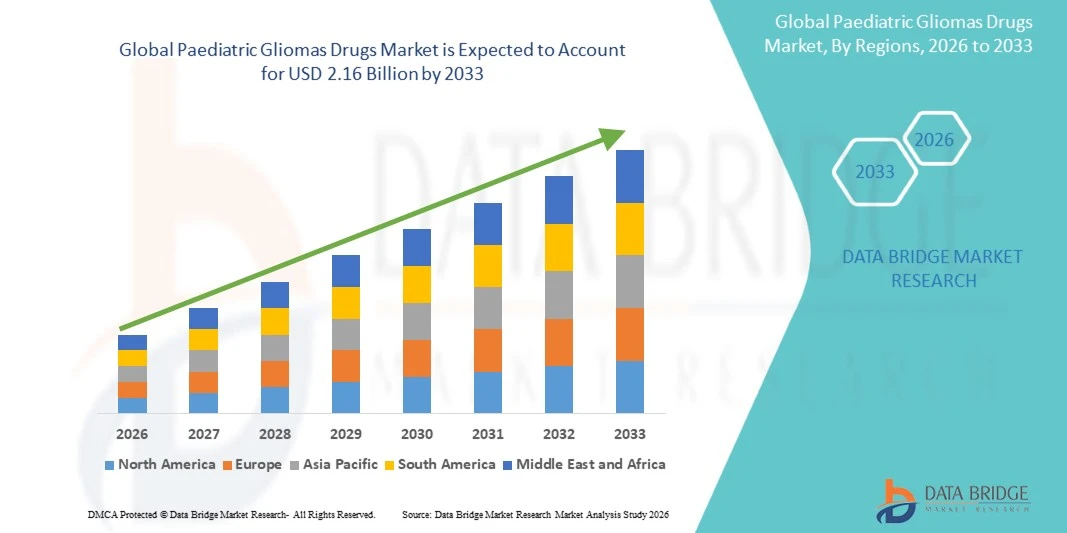
- As per Data Bridge Market Research analysis, the paediatric gliomas drugs market was valued at USD 1.31 billion in 2025 and is projected to reach USD 2.16 billion by 2033, growing at a CAGR of 6.50% from 2026 to 2033.
- The market is experiencing consistent growth driven by rising demand for effective and targeted treatment options, rapid advancements in paediatric oncology therapies, and expanding applications of chemotherapy, targeted therapies, and immunotherapy for the treatment of paediatric gliomas.
- The increasing incidence and diagnosis of paediatric brain tumors globally, combined with advancements in molecular diagnostics and precision medicine, are encouraging healthcare providers and pharmaceutical companies to adopt innovative treatment approaches. Targeted and personalized therapies are increasingly being explored alongside conventional chemotherapy and radiotherapy, offering improved treatment strategies for children with different molecular subtypes of gliomas.
Market Size & Forecast
- Global Market Value (2025): USD 1.31 Billion
- Expected Market Value (2033): USD 2.16 Billion
- Forecast CAGR (2026–2033): 6.50%
- Leading Region in 2025: North America
- Fastest Growing Region: Asia Pacific
What are the Major Takeaways of the Paediatric Gliomas Drugs Market?
- North America dominated the paediatric gliomas drugs market with the largest revenue share of 42% in 2025, supported by advanced healthcare infrastructure, high healthcare expenditure, and strong investment in paediatric oncology research.
- Asia-Pacific is expected to be the fastest-growing region at a CAGR of 7.2% from 2026 to 2033, fueled by improving healthcare infrastructure, rising healthcare expenditure, and increasing investment in paediatric cancer research and treatment.
- The high-grade segment led the market with a 45% share in 2025, driven by the substantial unmet medical need associated with aggressive paediatric gliomas and the requirement for intensive treatment approaches
- Low-grade are the fastest-growing type, projected to register a CAGR of 8.0%, reflecting the surge in adoption of molecularly targeted treatments and improved understanding of the biological characteristics of paediatric low-grade gliomas
- The imaging test segment dominated the diagnosis category with a 50% revenue share in 2025, led by the central role of neuroimaging in identifying and characterizing suspected paediatric brain tumours
- Drug treatments accounted for 45% of the market share in 2025, preferred by the continuing requirement for systemic medicines in progressive, recurrent, residual, or unresectable paediatric gliomas.
- The therapies segment is the fastest-growing treatment category, with a CAGR of 8.5%, driven by increasing development of targeted therapies, immunotherapies, and other precision-based treatment approaches.
Report Scope and Paediatric Gliomas Drugs Market Segmentation
|
Attributes |
Paediatric Gliomas Drugs Key Market Insights |
|
Segments Covered |
|
|
Countries Covered |
North America
Europe
Asia-Pacific
Middle East and Africa
South America
|
|
Key Market Players |
|
|
Market Opportunities |
|
|
Value Added Data Infosets |
In addition to the insights on market scenarios such as market value, growth rate, segmentation, geographical coverage, and major players, the market reports curated by the Data Bridge Market Research also include in-depth expert analysis, patient epidemiology, pipeline analysis, pricing analysis, and regulatory framework. |
What is the Key Trend in the Paediatric Gliomas Drugs Market?
- Molecularly targeted therapy is increasingly shaping the paediatric gliomas drugs market as genomic profiling identifies actionable alterations and enables treatments matched to specific tumor biology and individual patient characteristics.
- For instance, in April 2024, the U.S. FDA approved tovorafenib for patients aged 6 months and older with relapsed or refractory BRAF-altered paediatric low-grade glioma; the FIREFLY-1 efficacy population included 76 patients, with an overall response rate of 51%.
- Precision treatment increasingly uses genomic testing to identify BRAF, H3 K27M, IDH, and other alterations that can guide therapy selection and clinical-trial enrollment.
- Pharmaceutical developers and academic centers are increasingly evaluating targeted inhibitors, immunotherapies, and combination regimens to expand treatment options and address different molecular subtypes of paediatric gliomas.
- For instance, in August 2025, the U.S. FDA granted accelerated approval to dordaviprone for patients aged 1 year and older with progressive H3 K27M-mutant diffuse midline glioma, based on response data from 50 patients following prior therapy.
- As researchers continue identifying actionable molecular alterations and developing therapies for defined paediatric glioma subtypes, precision oncology is expected to strengthen drug development and expand treatment options across pediatric neuro-oncology
What are the Key Drivers of the Paediatric Gliomas Drugs Market?
- The growing use of molecular diagnostics in paediatric neuro-oncology is increasing demand for targeted medicines capable of addressing specific genetic alterations associated with glioma development, progression, and treatment resistance.
- For instance, in March 2023, the U.S. FDA approved dabrafenib in combination with trametinib for children aged 1 year and older with BRAF V600E-mutant low-grade glioma requiring systemic therapy. In the clinical trial, the combination achieved a 46.6% overall response rate compared with 10.8% for chemotherapy, supporting the growing role of molecularly targeted therapies in paediatric glioma treatment.
- Clinical research is increasingly evaluating targeted inhibitors, immunotherapies, and combination regimens to improve response rates, delay progression, and address treatment resistance in paediatric gliomas.
- For instance, in May 2024, the National Cancer Institute reported the FDA's accelerated approval of tovorafenib for children aged 6 months and older with BRAF-altered low-grade glioma following prior systemic therapy. In the 77-patient FIREFLY-1 study, tumors shrank or disappeared in almost 70% of treated children, highlighting increasing clinical development of targeted therapies for paediatric gliomas.
- With molecular profiling increasingly guiding diagnosis and treatment selection, paediatric glioma drug development will continue emphasizing biomarker-driven therapies, combination approaches, and medicines designed for distinct molecular tumor subtypes.
Which Factors are Challenging the Growth of the Paediatric Gliomas Drugs Market?
- Developing effective paediatric glioma drugs remains challenging because the blood-brain barrier restricts delivery of many therapeutic molecules into brain tumors, limiting drug exposure at the tumor site.
- For instance, in August 2026, British Journal of Cancer reported that rare paediatric CNS tumours present significant challenges for therapeutic development and clinical research because of their low incidence, limiting the availability of high-quality evidence.
- These biological barriers, combined with disease rarity, small patient populations, and limited clinical-trial recruitment, increase development complexity and restrict the generation of extensive clinical evidence.
- The NCI is evaluating focused ultrasound with oral etoposide in children with diffuse midline glioma to temporarily open the blood-brain barrier, illustrating the need for specialized drug-delivery strategies to improve therapeutic penetration into pediatric brain tumors.
- For instance, in June 2026, an article published in Acta Neuropathologica Communications noted that several targeted therapies for paediatric brain tumours are costly and that access and equity remain significant barriers to their global implementation.
- The biological complexity and limited patient populations associated with paediatric gliomas continue to increase clinical-development challenges, while inadequate drug penetration can restrict therapeutic effectiveness and require specialized delivery strategies, slowing broader adoption of emerging medicines.
How is the Paediatric Gliomas Drugs Market Segmented?
The paediatric gliomas drugs market is segmented on the basis of type, diagnosis, treatment, end-users, and distribution channel.
- By Type
On the basis of type, the paediatric gliomas drugs market is segmented into low grade and high grade. The high-grade segment dominated the market with 45% share in 2025, supported by the substantial unmet medical need associated with aggressive paediatric gliomas and the requirement for intensive treatment approaches. High-grade gliomas are associated with rapid progression and generally require multimodal management involving surgery, radiation, chemotherapy, targeted treatments, or clinical-trial therapies. The development of molecularly guided treatments is increasing the availability of therapeutic options for selected high-grade tumours. BRAF-altered high-grade gliomas, for example, are being investigated with targeted treatment combinations. Increasing research into molecular abnormalities is also supporting the development of more individualized treatment strategies.
The low-grade segment is projected to register the faster growth at a 8.0% CAGR during forecast period, driven by increasing adoption of molecularly targeted treatments and improved understanding of the biological characteristics of paediatric low-grade gliomas. Low-grade gliomas represent the most common subgroup of paediatric CNS tumours and are increasingly managed through molecularly informed treatment strategies. The identification of MAPK/ERK and mTOR pathway alterations has accelerated research into targeted inhibitors. BRAF and MEK-directed therapies are expanding treatment options for children with progressive or recurrent disease. Increasing clinical investigations are also supporting the development of targeted medicines for newly diagnosed and recurrent low-grade tumours.
- By Diagnosis
On the basis of diagnosis, the paediatric gliomas drugs market is segmented into imaging test, brain or spinal cord, tumour biopsy, and others. The imaging test segment dominated the market with an 50% share in 2025, owing to the central role of neuroimaging in identifying and characterizing suspected paediatric brain tumours. MRI is widely used to evaluate tumour location, size, anatomical characteristics, and potential involvement of surrounding structures. Imaging also plays an important role in surgical planning and treatment monitoring. In certain characteristic low-grade tumours, imaging findings can provide sufficient information to support clinical management without immediate tissue sampling. Repeated imaging is also important for detecting progression or evaluating treatment response.
The tumour biopsy segment is projected to register the faster growth at 7.5% CAGR during forecast period, driven by the increasing importance of histological and molecular characterization in paediatric glioma management. Tissue analysis enables clinicians to establish tumour pathology and identify molecular alterations relevant to prognosis and treatment selection. The growing use of precision medicine is increasing demand for molecular profiling alongside conventional histopathological assessment. Next-generation sequencing is increasingly incorporated into the evaluation of paediatric gliomas to identify actionable genomic alterations. Molecular classification is particularly relevant as targeted inhibitors become more important in paediatric neuro-oncology. Increasing clinical research based on biomarker-defined patient populations is further strengthening the role of tumour tissue analysis.
- By Treatment
On the basis of treatment, the paediatric gliomas drugs market is segmented into surgery, drug treatments, and therapies. The drug treatments segment dominated the market with an 45% share in 2025, supported by the continuing requirement for systemic medicines in progressive, recurrent, residual, or unresectable paediatric gliomas. Drug treatment includes conventional chemotherapy as well as increasingly important molecularly targeted medicines. Chemotherapy remains an established treatment option for children whose tumours cannot be completely removed or subsequently progress. Targeted treatments are expanding the therapeutic landscape as molecular alterations become better characterized. BRAF and MEK pathway inhibitors have created additional treatment options for selected paediatric glioma patients.
The therapies segment is projected to register the faster growth at 8.5% CAGR during forecast period, driven by increasing development of targeted therapies, immunotherapies, and other precision-based treatment approaches. Advances in molecular classification are enabling researchers to develop treatments against specific biological drivers of paediatric gliomas. Targeted inhibitors are increasingly being evaluated for tumours carrying actionable pathway alterations. Clinical investigations are also examining immunotherapy and other innovative approaches for difficult-to-treat high-grade tumours. The growing emphasis on reducing treatment-related toxicity while improving disease control is supporting research into more selective therapeutic strategies. Expansion of clinical-trial activity is further increasing the availability of investigational treatment approaches.
- By End-Users
On the basis of end-users, the paediatric gliomas drugs market is segmented into hospitals, homecare, speciality centres, and others. The hospitals segment dominated the market with 50% share in 2025, owing to the complex and multidisciplinary nature of paediatric glioma diagnosis and treatment. Hospitals provide access to paediatric oncologists, neurosurgeons, radiologists, pathologists, and other specialists involved in tumour management. Advanced imaging, biopsy procedures, surgery, chemotherapy, and treatment monitoring can be coordinated within hospital-based care pathways. Children receiving intensive or complex treatments also require close clinical supervision and management of treatment-related complications. Hospitals provide the infrastructure required for multidisciplinary evaluation and treatment planning.
The speciality centres segment is projected to register the faster growth at 8.0% CAGR during forecast period, driven by increasing demand for dedicated paediatric neuro-oncology expertise and specialized treatment pathways. Speciality centres can integrate neurosurgery, oncology, radiation therapy, pathology, molecular diagnostics, and supportive care within dedicated programs. The increasing importance of molecular profiling is creating greater demand for centres with expertise in interpreting complex genomic and pathological information. These centres can also facilitate access to clinical trials involving targeted medicines and emerging treatment approaches. Greater emphasis on individualized treatment is encouraging referrals to specialized facilities for children with complex or recurrent tumours. Advanced diagnostic capabilities and multidisciplinary care further strengthen the role of speciality centres.
- By Distribution Channel
On the basis of distribution channel, the paediatric gliomas drugs market is segmented into hospital pharmacy, online pharmacy, and retail pharmacy. The hospital pharmacy segment dominated the market with 55% share in 2025, primarily because paediatric glioma treatment is closely associated with specialized hospital-based oncology and neurological care. Many medicines require specialist prescribing, monitoring, dose adjustment, and clinical supervision. Hospital pharmacies are directly integrated with oncology and paediatric departments, facilitating coordinated dispensing and treatment administration. They also support the management of medicines associated with complex treatment regimens and adverse-effect monitoring. Hospital-based distribution enables physicians and pharmacists to coordinate medication use throughout the treatment pathway.
The online pharmacy segment is projected to register the faster growth at 9.0% CAGR during forecast period, supported by increasing digitalization of pharmaceutical distribution and the growing use of oral medicines in outpatient treatment. Digital pharmacy platforms can provide convenient prescription fulfilment and home delivery for families managing prolonged treatment courses. The availability of oral targeted medicines creates additional potential for prescription-based distribution outside conventional hospital settings. Online channels can also complement digitally supported follow-up and remote healthcare services. However, specialist prescribing and regulatory requirements remain important considerations for paediatric oncology medicines. As digital pharmaceutical services expand and outpatient treatment becomes more established, online distribution is expected to gain a larger role.
Which Region Holds the Largest Share of the Paediatric Gliomas Drugs Market?
- North America dominated the paediatric gliomas drugs market with the largest revenue share of 42% in 2025, supported by advanced healthcare infrastructure, high healthcare expenditure, and strong investment in paediatric oncology research.
- The region also benefits from high adoption of molecular diagnostics, targeted therapies, and innovative treatment approaches for paediatric gliomas, along with extensive clinical-trial activity and established healthcare systems. Increasing investment in paediatric cancer research and the availability of specialized treatment facilities continue to strengthen North America's position in the global market.
U.S. Paediatric Gliomas Drugs Market Insight
The U.S. paediatric gliomas drugs market is witnessing strong growth due to rising investments in paediatric oncology research, advanced diagnostic technologies, and development of targeted therapies. The country’s mature healthcare infrastructure, along with increasing adoption of molecular profiling and precision-medicine approaches, is driving demand for innovative treatments across specialized oncology centres. In addition, strong clinical-trial activity and increasing focus on improving outcomes for children with low- and high-grade gliomas are accelerating the development and adoption of novel drug therapies.
Asia-Pacific Paediatric Gliomas Drugs Market Insight
The Asia-Pacific paediatric gliomas drugs market is expected to witness rapid growth, driven by expanding healthcare infrastructure, increasing awareness of paediatric cancers, and rising investments in specialized oncology services across countries such as China, India, and Japan. Growing access to advanced diagnostic technologies, molecular testing, and targeted treatment approaches is supporting regional market expansion. In addition, increasing clinical research activity and improving availability of specialized paediatric oncology centres are accelerating the adoption of innovative glioma therapies across the region.
Japan Paediatric Gliomas Drugs Market Insight
The Japan paediatric gliomas drugs market is witnessing consistent growth due to rising investments in advanced paediatric cancer treatment, molecular diagnostics, and precision oncology. Hospitals and specialized cancer centres are increasingly adopting molecularly guided approaches for diagnosis and treatment of paediatric gliomas. Moreover, increasing research into targeted therapies and the country's advanced healthcare infrastructure are further contributing to market growth.
China Paediatric Gliomas Drugs Market Insight
The China paediatric gliomas drugs market is growing rapidly, driven by expanding healthcare infrastructure, increasing awareness of childhood cancers, and rising investments in paediatric oncology research. Growing adoption of advanced imaging, molecular diagnostics, and targeted treatment approaches across specialized hospitals is significantly boosting market demand. In addition, increasing clinical research, improving access to innovative medicines, and rising government focus on childhood cancer care are positioning China as an important market for paediatric glioma drugs.
U.K. Paediatric Gliomas Drugs Market Insight
The U.K. paediatric gliomas drugs market is experiencing steady growth, supported by rising adoption of precision-medicine approaches, advanced diagnostic technologies, and specialized paediatric oncology services. Increasing investments in clinical research and demand for targeted treatment options are contributing to market growth. Furthermore, integration of molecular profiling and innovative drug-development approaches is improving treatment strategies and supporting the U.K.'s position as an important market for paediatric glioma therapies.
Germany Paediatric Gliomas Drugs Market Insight
The Germany paediatric gliomas drugs market is expanding steadily due to the country's advanced healthcare infrastructure, strong clinical research capabilities, and increasing adoption of precision oncology. Paediatric oncology centres and specialized hospitals are increasingly utilizing molecular diagnostics and targeted treatment approaches for glioma management. Continuous advancements in cancer research, increasing clinical-trial activity, and strong focus on individualized treatment are further driving market growth in Germany.
Which are the Top Companies in Paediatric Gliomas Drugs Market?
The paediatric gliomas drugs industry is primarily led by well-established companies, including:
- Merck & Co., Inc. (U.S.)
- Pfizer Inc. (U.S.)
- Novartis AG (Switzerland)
- Bayer AG (Germany)
- Sanofi (France)
- Teva Pharmaceutical Industries Ltd. (Israel)
- AstraZeneca (U.K.)
- Abbott (U.S.)
- Bausch Health Companies Inc. (Canada)
- Sun Pharmaceutical Industries Ltd. (India)
- Aurobindo Pharma Limited (India)
- Lupin Limited (India)
- Amneal Pharmaceuticals LLC (U.S.)
- Thermo Fisher Scientific Inc. (U.S.)
- Baxter (U.S.)
- Hitachi, Ltd. (Japan)
- Koninklijke Philips N.V. (Netherlands)
- F. Hoffmann-La Roche Ltd (Switzerland)
- Day One Biopharmaceuticals, Inc. (U.S.)
- LES LABORATOIRES SERVIER (France)
What are Latest Developments in Paediatric Gliomas Drugs Market?
- In August 2025, the U.S. Food and Drug Administration (FDA) granted accelerated approval to dordaviprone (Modeyso) for adult and pediatric patients aged 1 year and older with H3 K27M-mutant diffuse midline glioma whose disease had progressed following prior therapy. The approval marked the first FDA approval of a systemic therapy for H3 K27M-mutant diffuse midline glioma, representing an important development in the treatment of this aggressive paediatric brain tumour.
- In August 2024, the FDA approved vorasidenib (Voranigo) for adult and paediatric patients aged 12 years and older with Grade 2 astrocytoma or oligodendroglioma carrying susceptible IDH1 or IDH2 mutations following surgery. The approval expanded the availability of molecularly targeted treatment for patients with IDH-mutant gliomas and represented the first FDA approval of a systemic therapy for this specific tumour population.
- In April 2024, the FDA granted accelerated approval to tovorafenib (Ojemda) for patients aged 6 months and older with relapsed or refractory paediatric low-grade glioma carrying a BRAF fusion, rearrangement, or BRAF V600 mutation. The approval represented the first FDA-approved systemic therapy for paediatric low-grade glioma with BRAF rearrangements, including BRAF fusions, strengthening the role of molecularly targeted treatment in paediatric gliomas.
- In January 2024, results from the FIREFLY-1 study of the oral pan-RAF inhibitor tovorafenib (DAY101) in children with recurrent or progressive BRAF-altered low-grade glioma were published in Nature Medicine. The study provided clinical evidence supporting the development of targeted RAF inhibition for paediatric low-grade glioma and contributed to the subsequent regulatory development of tovorafenib
- In March 2023, the FDA approved dabrafenib (Tafinlar) in combination with trametinib (Mekinist) for paediatric patients aged 1 year and older with low-grade glioma containing a BRAF V600E mutation who require systemic therapy. The FDA also approved new oral formulations of both medicines for children who cannot swallow pills, expanding the practical administration options for paediatric patients.

- Interactive Data Analysis Dashboard
- Company Analysis Dashboard for high growth potential opportunities
- Research Analyst Access for customization & queries
- Competitor Analysis with Interactive dashboard
- Latest News, Updates & Trend analysis
- Harness the Power of Benchmark Analysis for Comprehensive Competitor Tracking
Data collection and base year analysis are done using data collection modules with large sample sizes. The stage includes obtaining market information or related data through various sources and strategies. It includes examining and planning all the data acquired from the past in advance. It likewise envelops the examination of information inconsistencies seen across different information sources. The market data is analysed and estimated using market statistical and coherent models. Also, market share analysis and key trend analysis are the major success factors in the market report. To know more, please request an analyst call or drop down your inquiry.
The key research methodology used by DBMR research team is data triangulation which involves data mining, analysis of the impact of data variables on the market and primary (industry expert) validation. Data models include Vendor Positioning Grid, Market Time Line Analysis, Market Overview and Guide, Company Positioning Grid, Patent Analysis, Pricing Analysis, Company Market Share Analysis, Standards of Measurement, Global versus Regional and Vendor Share Analysis. To know more about the research methodology, drop in an inquiry to speak to our industry experts.
Data Bridge Market Research is a leader in advanced formative research. We take pride in servicing our existing and new customers with data and analysis that match and suits their goal. The report can be customized to include price trend analysis of target brands understanding the market for additional countries (ask for the list of countries), clinical trial results data, literature review, refurbished market and product base analysis. Market analysis of target competitors can be analyzed from technology-based analysis to market portfolio strategies. We can add as many competitors that you require data about in the format and data style you are looking for. Our team of analysts can also provide you data in crude raw excel files pivot tables (Fact book) or can assist you in creating presentations from the data sets available in the report.












