


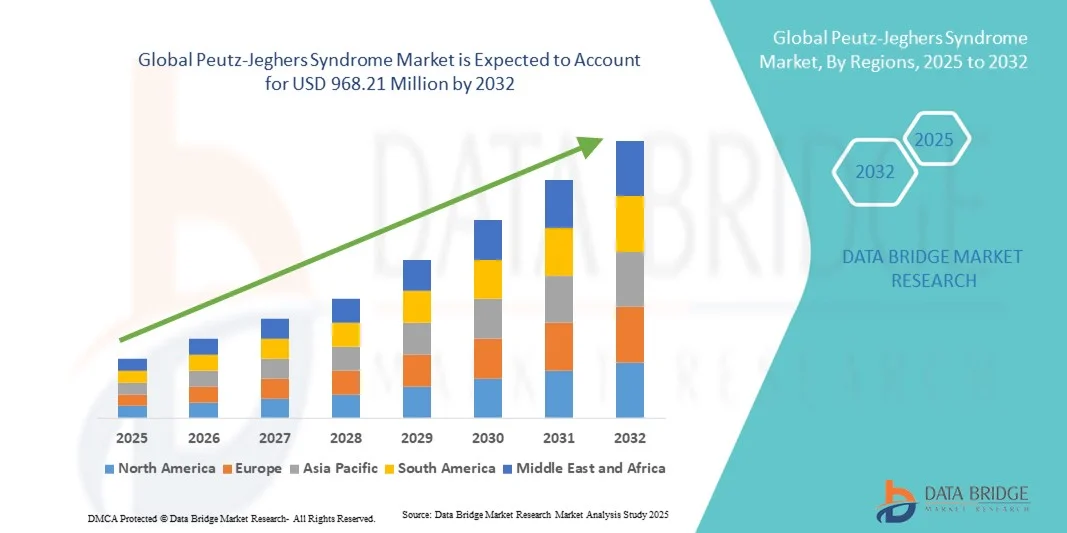
Peutz-Jeghers Syndrome Market Size
- The global Peutz-Jeghers Syndrome market size was valued at USD 670.50 million in 2024 and is expected to reach USD 968.21 million by 2032, at a CAGR of 4.70% during the forecast period
- The market growth is primarily driven by advancements in genetic testing, molecular diagnostics, and personalized medicine, which are improving early detection and treatment of rare hereditary disorders such as Peutz-Jeghers syndrome
- Furthermore, increasing awareness of gastrointestinal polyposis syndromes, growing research funding, and the availability of targeted therapies are supporting clinical management and patient outcomes. These converging factors are accelerating the adoption of innovative diagnostic and therapeutic solutions, thereby significantly boosting the industry’s growth
Peutz-Jeghers Syndrome Market Analysis
- Peutz-Jeghers syndrome (PJS), a rare genetic disorder marked by mucocutaneous pigmentation and gastrointestinal polyps, is gaining increased clinical and research focus owing to advancements in molecular diagnostics, improved endoscopic surveillance, and rising awareness of hereditary cancer syndromes
- The growing demand for early and accurate diagnosis is primarily driven by the expansion of genetic testing, increasing adoption of wireless capsule endoscopy, and a global emphasis on personalized medicine and preventive healthcare for individuals with hereditary gastrointestinal disorders
- North America dominated the Peutz-Jeghers syndrome market with the largest revenue share of 42.7% in 2024, supported by advanced healthcare infrastructure, widespread implementation of genetic screening programs, and the presence of leading diagnostic laboratories and research institutions
- Asia-Pacific is expected to be the fastest-growing region in the Peutz-Jeghers syndrome market during the forecast period due to increasing government initiatives for rare disease awareness, rapid healthcare modernization, and growing accessibility of diagnostic technologies
- The genetic testing segment dominated the Peutz-Jeghers syndrome market with a market share of 39.3% in 2024, driven by its high accuracy in identifying STK11 gene mutations, facilitating early detection, family screening, and effective disease management
Report Scope and Peutz-Jeghers Syndrome Market Segmentation
|
Attributes |
Peutz-Jeghers Syndrome Key Market Insights |
|
Segments Covered |
|
|
Countries Covered |
North America
Europe
Asia-Pacific
Middle East and Africa
South America
|
|
Key Market Players |
|
|
Market Opportunities |
|
|
Value Added Data Infosets |
In addition to the insights on market scenarios such as market value, growth rate, segmentation, geographical coverage, and major players, the market reports curated by the Data Bridge Market Research also include in-depth expert analysis, patient epidemiology, pipeline analysis, pricing analysis, and regulatory framework |
Peutz-Jeghers Syndrome Market Trends
Advancement in Genetic Diagnostics and Personalized Treatment Approaches
- A significant and accelerating trend in the global Peutz-Jeghers syndrome market is the increasing integration of advanced genetic testing technologies such as next-generation sequencing (NGS) and multiplex PCR, which are enabling more accurate detection of STK11 gene mutations and early diagnosis of hereditary gastrointestinal disorders
- For instance, Invitae and Blueprint Genetics have expanded their hereditary cancer panels to include STK11 mutation screening, helping clinicians identify at-risk individuals more efficiently and improve preventive care strategies
- AI integration in genetic analysis enables features such as automated variant interpretation, enhanced mutation detection accuracy, and risk prediction modeling, providing more precise and personalized diagnostic insights for patients and families. For instance, AI-based genomic platforms now support clinicians in differentiating PJS from other polyposis syndromes, optimizing treatment pathways and surveillance strategies
- The increasing collaboration between research institutions and biotechnology firms facilitates centralized access to genomic data, enabling large-scale genotype-phenotype correlation studies and promoting innovation in rare disease management. Through integrated databases, researchers can analyze mutation patterns, treatment responses, and long-term outcomes to refine clinical guidelines
- This trend toward personalized, data-driven, and interconnected diagnostic ecosystems is transforming how hereditary gastrointestinal disorders are managed. Consequently, companies such as Centogene and Fulgent Genetics are developing AI-supported testing services with enhanced analytical capabilities and multi-gene panel integration
- The demand for precise, accessible, and AI-enhanced diagnostic tools for Peutz-Jeghers syndrome is growing rapidly across developed and emerging markets, as healthcare systems increasingly emphasize early detection and preventive genomics
Peutz-Jeghers Syndrome Market Dynamics
Driver
Growing Awareness and Access to Genetic Testing for Early Diagnosis
- The increasing global emphasis on rare disease awareness and early genetic diagnosis, coupled with expanding access to hereditary cancer screening programs, is a significant driver for the Peutz-Jeghers syndrome market
- For instance, in March 2024, Ambry Genetics announced the enhancement of its rare disease testing portfolio with improved detection of STK11 variants, aiming to support earlier and more accurate diagnosis for PJS patients. Such advancements by diagnostic companies are expected to propel market growth in the forecast period
- As awareness of hereditary gastrointestinal disorders rises, patients and physicians are increasingly adopting comprehensive genetic testing and surveillance, offering improved prevention and management compared to traditional symptom-based approaches
- Furthermore, the rising availability of genetic counseling services and government-supported rare disease initiatives are reinforcing the demand for early diagnostic solutions in both developed and developing regions
- The convenience of advanced endoscopic imaging, wireless capsule endoscopy, and at-home genetic sample collection are key factors encouraging patient participation in early screening programs. The shift toward preventive medicine and precision-based healthcare further contributes to market expansion
Restraint/Challenge
High Diagnostic Costs and Limited Treatment Availability
- The high cost associated with genetic testing, endoscopic procedures, and long-term management of Peutz-Jeghers syndrome poses a major challenge to widespread adoption, especially in low- and middle-income countries with limited reimbursement support
- For instance, despite technological progress, comprehensive genetic testing for STK11 mutations remains expensive and is not universally covered by insurance, restricting access for many patients in underfunded healthcare systems
- Addressing these affordability issues through government subsidies, collaborative research funding, and expanded public healthcare coverage is crucial for improving diagnostic accessibility and equity. Companies such as Invitae and GeneDx are working to reduce test costs through scalable, automated workflows and partnerships with national health systems
- In addition, the absence of specific curative treatments and reliance on symptomatic management through repeated surgeries and surveillance can discourage early diagnosis and continuous patient monitoring. While research into targeted therapies is ongoing, limited therapeutic options currently hinder comprehensive disease management
- Overcoming these challenges through cost-effective genetic screening, expanded patient registries, and accelerated research into gene-targeted therapies will be vital for ensuring sustainable growth of the Peutz-Jeghers syndrome market
Peutz-Jeghers Syndrome Market Scope
The market is segmented on the basis of symptoms, diagnosis, gender, and end user.
- By Symptoms
On the basis of symptoms, the Peutz-Jeghers syndrome market is segmented into muco-cutaneous pigmentation, development of hamartomatous polyps, small bowel obstruction, gastrointestinal bleeding, anemia, stomach pain, and intussusception. The Development of Hamartomatous Polyps segment dominated the market with the largest revenue share in 2024, owing to the high prevalence of gastrointestinal polyps among diagnosed PJS patients. These polyps are the primary clinical manifestation leading to early detection through endoscopy and genetic testing. Their link to potential malignancies drives constant medical surveillance and intervention demand, resulting in higher diagnostic and therapeutic expenditures. Increased physician awareness and improvements in endoscopic imaging have further strengthened this segment’s dominance in clinical management and research focus.
The Gastrointestinal Bleeding segment is anticipated to witness the fastest growth rate during the forecast period due to the growing recognition of GI bleeding as an early indicator of PJS and advancements in capsule endoscopy that enable detection of small-bowel sources. Increasing hospital admissions for gastrointestinal complications, coupled with improving access to minimally invasive diagnostics, are propelling growth in this category. Furthermore, enhanced treatment protocols to manage recurrent bleeding episodes are expected to expand diagnostic demand and clinical interventions globally.
- By Diagnosis
On the basis of diagnosis, the Peutz-Jeghers syndrome market is segmented into endoscopy, X-ray examination, wireless capsule endoscopy, and genetic testing. The Genetic Testing segment dominated the market with the largest revenue share of 39.3% in 2024, driven by its ability to accurately identify mutations in the STK11 gene responsible for PJS. Advancements in next-generation sequencing (NGS) and affordability of multi-gene panels have enabled early detection and family screening, improving preventive care strategies. Healthcare providers increasingly rely on genetic analysis to guide patient monitoring and therapeutic decision-making, thereby strengthening this segment’s leadership. The growing integration of AI-assisted variant interpretation further enhances diagnostic precision and efficiency.
The Wireless Capsule Endoscopy segment is projected to be the fastest growing during the forecast period, fueled by its non-invasive nature and superior capability to visualize small intestinal lesions often missed by traditional endoscopy. Rising adoption of capsule-based diagnostics in both developed and emerging healthcare systems is expanding accessibility for patients. Continuous innovations in capsule imaging technology, real-time data transmission, and AI-based image analysis are further accelerating this segment’s growth trajectory.
- By Gender
On the basis of gender, the Peutz-Jeghers syndrome market is segmented into male and female. The Female segment dominated the market in 2024, attributed to a higher reported prevalence of PJS-related gynecologic and breast cancers among female carriers of the STK11 mutation. Increased awareness and proactive genetic counseling for women with hereditary cancer risks have supported stronger diagnostic uptake in this group. Furthermore, collaborations between oncologists and genetic counselors are improving early detection and preventive management for women at risk of malignancies associated with PJS. Ongoing inclusion of female-specific cancer screening protocols in genetic test packages also drives this segment’s revenue share.
The Male segment is expected to register the fastest growth during the forecast period, supported by improved awareness of hereditary gastrointestinal disorders and enhanced accessibility to genetic testing programs for men. Recent clinical studies have highlighted male-specific risks, such as pancreatic and testicular tumors linked to PJS, prompting more regular screening. In addition, expanding patient education and the availability of family-based genetic counseling are fostering early diagnosis and clinical surveillance among male patients.
- By End User
On the basis of end user, the Peutz-Jeghers syndrome market is segmented into hospitals, clinics, and others. The Hospitals segment dominated the market in 2024 with the largest revenue share, owing to the concentration of specialized diagnostic facilities, endoscopy units, and genetic laboratories in hospital settings. Hospitals serve as primary centers for multidisciplinary management, combining gastroenterology, oncology, and genetic counseling services under one roof. The presence of advanced diagnostic infrastructure and research-based collaborations with genetic testing firms strengthens hospitals’ position as the leading end users in this market. In addition, reimbursement support and patient referral networks contribute to sustained demand.
The Clinics segment is projected to witness the fastest growth during the forecast period due to the increasing decentralization of genetic testing and outpatient diagnostic services. The expansion of specialized gastroenterology and genetic clinics enables patients to access targeted testing and surveillance closer to home. Growing adoption of telemedicine for genetic counseling and follow-up care is further accelerating this segment’s expansion, especially in emerging markets where accessibility to tertiary hospitals remains limited.
Peutz-Jeghers Syndrome Market Regional Analysis
- North America dominated the Peutz-Jeghers syndrome market with the largest revenue share of 42.7% in 2024, supported by advanced healthcare infrastructure, widespread implementation of genetic screening programs, and the presence of leading diagnostic laboratories and research institutions
- Patients in the region increasingly rely on comprehensive genetic screening, endoscopic surveillance, and multidisciplinary care programs that offer early detection and personalized management of PJS-related complications
- This widespread adoption is further supported by favorable reimbursement frameworks, active research collaborations between hospitals and biotechnology firms, and a well-established network of genetic counselors, positioning North America as the leading hub for diagnosis and treatment of Peutz-Jeghers syndrome
U.S. Peutz-Jeghers Syndrome Market Insight
The U.S. Peutz-Jeghers syndrome market captured the largest revenue share of 80.5% in 2024 within North America, driven by the country’s advanced healthcare infrastructure and strong focus on precision medicine. The widespread availability of genetic testing services, coupled with active participation in hereditary cancer screening programs, is propelling market expansion. Growing collaborations between academic institutions and biotechnology firms for STK11 gene research are further fueling innovation. Moreover, increased awareness among healthcare professionals and patients about the risks associated with Peutz-Jeghers syndrome supports early diagnosis and long-term disease management.
Europe Peutz-Jeghers Syndrome Market Insight
The Europe Peutz-Jeghers syndrome market is projected to expand at a substantial CAGR throughout the forecast period, supported by government-backed initiatives for rare disease diagnosis and management. Rising prevalence of hereditary gastrointestinal syndromes and advancements in genetic testing infrastructure are major growth contributors. European healthcare systems are increasingly integrating genetic counseling and surveillance protocols into national screening programs. The growing collaboration between clinical research centers and diagnostic laboratories across Germany, France, and the U.K. is strengthening early detection capabilities and driving market growth across the continent.
U.K. Peutz-Jeghers Syndrome Market Insight
The U.K. Peutz-Jeghers syndrome market is anticipated to grow at a noteworthy CAGR during the forecast period, fueled by strong government support for rare disease research and expanded access to NHS-backed genomic testing. The integration of PJS screening within national genomic medicine programs has significantly improved early detection rates. Increasing public and professional awareness of hereditary gastrointestinal syndromes is driving diagnostic demand. Furthermore, collaborations between U.K. universities, biotech companies, and cancer research organizations are fostering innovation in genetic testing technologies and surveillance strategies.
Germany Peutz-Jeghers Syndrome Market Insight
The Germany Peutz-Jeghers syndrome market is expected to expand at a considerable CAGR during the forecast period, supported by the country’s advanced medical research ecosystem and investment in rare disease genomics. German healthcare providers emphasize preventive genetic testing and routine endoscopic monitoring to manage hereditary polyposis syndromes effectively. The presence of leading diagnostic firms and academic research partnerships accelerates the adoption of innovative molecular testing solutions. In addition, the strong focus on patient registries and data-driven healthcare enhances understanding of disease progression and supports long-term patient management.
Asia-Pacific Peutz-Jeghers Syndrome Market Insight
The Asia-Pacific Peutz-Jeghers syndrome market is poised to grow at the fastest CAGR of 23.7% during 2025–2032, driven by increasing healthcare modernization, government initiatives for rare disease awareness, and expanding access to genomic testing in countries such as China, Japan, and India. Improved healthcare spending, coupled with the growing availability of advanced diagnostic technologies, is boosting early detection rates. Moreover, regional collaborations between hospitals and biotech firms are enhancing access to genetic counseling and testing services, contributing to the region’s rapid growth.
Japan Peutz-Jeghers Syndrome Market Insight
The Japan Peutz-Jeghers syndrome market is gaining momentum due to the country’s high technological capabilities and early adoption of precision medicine. Japan’s focus on genomic-based healthcare, supported by national programs such as the Initiative on Rare and Undiagnosed Diseases (IRUD), is driving market growth. Increasing use of AI-assisted genetic testing platforms and integration of PJS surveillance within routine gastrointestinal care are key contributors. Moreover, the aging population and focus on preventive diagnostics are encouraging widespread adoption of early screening programs.
India Peutz-Jeghers Syndrome Market Insight
The India Peutz-Jeghers syndrome market accounted for the largest market revenue share in Asia-Pacific in 2024, attributed to rising healthcare investments, expanding access to genomic testing, and increased awareness of hereditary disorders. Government initiatives promoting genetic diagnostics and the inclusion of rare disease management in national health policies are key growth enablers. The country’s growing biotechnology sector and partnerships with international diagnostic firms are strengthening local testing capabilities. Moreover, affordability improvements and outreach programs in urban hospitals are helping expand early screening and diagnosis across broader patient populations.
Peutz-Jeghers Syndrome Market Share
The Peutz-Jeghers Syndrome industry is primarily led by well-established companies, including:
- Invitae Corporation (U.S.)
- Myriad Genetics, Inc. (U.S.)
- Natera, Inc. (U.S.)
- Fulgent Genetics, Inc. (U.S.)
- GeneDx, Inc. (U.S.)
- Ambry Genetics Corporation (U.S.)
- Blueprint Genetics Oy (Finland)
- CENTOGENE GmbH (Germany)
- Illumina, Inc. (U.S.)
- Thermo Fisher Scientific Inc. (U.S.)
- F. Hoffmann-La Roche Ltd (Switzerland)
- Quest Diagnostics Incorporated (U.S.)
- Labcorp (U.S.)
- BGI Genomics Co., Ltd. (China)
- Color Health, Inc. (U.S.)
- Baylor Genetics (U.S.)
- GeneDx, LLC. (U.S.)
- Eurofins Genomics (Luxembourg)
- PerkinElmer (U.S.)
- Guardant Health, Inc. (U.S.)
What are the Recent Developments in Global Peutz-Jeghers Syndrome Market?
- In April 2024, a study on the intestinal mucosal microbiome in PJS patients titled “Altered mucosal bacteria and metabolomics in patients with Peutz–Jeghers syndrome” was published. This research explored how the gut-microbiota and metabolite profiles of PJS patients differ from non-PJS controls. The findings point toward potential new biomarkers in the microbiome/metabolome space that might refine risk stratification, early detection, or even therapeutic targets in PJS a departure from purely genetic/endoscopic approaches
- In February 2024, a Turkish cohort study “Clinical and Molecular Analysis in Patients with Peutz–Jeghers syndrome” reported genotype-phenotype correlations in 20 patients from 14 families. The work deepened understanding of how specific gene variants in STK11 map to clinical outcomes (e.g., age at first polyp surgery, number of polyps, cancer risk). It helps clinicians tailor surveillance more precisely for instance, identifying higher-risk patients who may benefit from earlier and more frequent endoscopic monitoring
- In December 2023, updated management guidelines summarised in “The Management of Peutz–Jeghers Syndrome (2021)” were published by the European Hereditary Tumour Group (EHTG), expanding on older recommendations. These guidelines extended previous expert opinion papers and incorporated newer evidence on surveillance of GI tract, small bowel, polypectomy thresholds, and cancer screening
- In June 2023, a Chinese research group published a study titled “Peutz–Jeghers syndrome without STK11 mutation may correlate with less severe clinical-pathologic manifestations in Chinese patients.” This work found that PJS patients without detectable germline mutations in the STK11 gene exhibited later onset of disease, fewer and smaller gastrointestinal polyps, and a lower rate of serious complications such as bowel obstruction or bleeding
- In March 2023, the publication “Survival, surveillance, and genetics in patients with Peutz–Jeghers syndrome” from a Danish registry of 56 PJS patients provided a deeper long-term dataset on genetic detection rate (96%) and cancer outcomes. This long-term follow-up study gives robust evidence that comprehensive genetic diagnosis plus structured surveillance can improve survival and better define the spectrum of cancer risk in PJS. It underpins the value of systematic screening programs and helps refine cost-benefit discussions around surveillance timing and frequency

- Interactive Data Analysis Dashboard
- Company Analysis Dashboard for high growth potential opportunities
- Research Analyst Access for customization & queries
- Competitor Analysis with Interactive dashboard
- Latest News, Updates & Trend analysis
- Harness the Power of Benchmark Analysis for Comprehensive Competitor Tracking
Data collection and base year analysis are done using data collection modules with large sample sizes. The stage includes obtaining market information or related data through various sources and strategies. It includes examining and planning all the data acquired from the past in advance. It likewise envelops the examination of information inconsistencies seen across different information sources. The market data is analysed and estimated using market statistical and coherent models. Also, market share analysis and key trend analysis are the major success factors in the market report. To know more, please request an analyst call or drop down your inquiry.
The key research methodology used by DBMR research team is data triangulation which involves data mining, analysis of the impact of data variables on the market and primary (industry expert) validation. Data models include Vendor Positioning Grid, Market Time Line Analysis, Market Overview and Guide, Company Positioning Grid, Patent Analysis, Pricing Analysis, Company Market Share Analysis, Standards of Measurement, Global versus Regional and Vendor Share Analysis. To know more about the research methodology, drop in an inquiry to speak to our industry experts.
Data Bridge Market Research is a leader in advanced formative research. We take pride in servicing our existing and new customers with data and analysis that match and suits their goal. The report can be customized to include price trend analysis of target brands understanding the market for additional countries (ask for the list of countries), clinical trial results data, literature review, refurbished market and product base analysis. Market analysis of target competitors can be analyzed from technology-based analysis to market portfolio strategies. We can add as many competitors that you require data about in the format and data style you are looking for. Our team of analysts can also provide you data in crude raw excel files pivot tables (Fact book) or can assist you in creating presentations from the data sets available in the report.












